Why Choose Yeast Beta Glucan for Immune Products?
Yangge Biotech is a premium bioactive polysaccharide derived from the cell walls of Saccharomyces cerevisiae (baker’s yeast). It is supplied as a fine off-white to yellowish powder with specifications including 70% purity, making it suitable for dietary supplements, functional foods, health products, cosmetics, and other formulations. Yangge Biotech also offers OEM packaging and customized solutions to support different product-development and bulk purchasing requirements.
Looking for high-quality Yeast Beta-Glucan Powder for your next formulation? Contact Yangge Biotech for product specifications, COA, MSDS, samples, bulk pricing, and OEM/private-label inquiries, contact us or email us at info@yanggebiotech.com.
Yeast Beta-glucan derived from Saccharomyces cerevisiae represents a scientifically validated immune-modulating ingredient that procurement managers increasingly prioritize for supplement and pet nutrition formulations. Its unique β-1,3/1,6-glucan molecular structure activates innate immune responses by binding to Dectin-1 receptors on macrophages and dendritic cells, offering superior bioactivity compared to plant-derived alternatives. With proven clinical efficacy, regulatory compliance, and exceptional manufacturing stability, this bioactive polysaccharide addresses the core needs of mid-sized brands developing immune health products across North American and European markets.
Understanding Yeast Beta Glucan: Structure and Mechanism
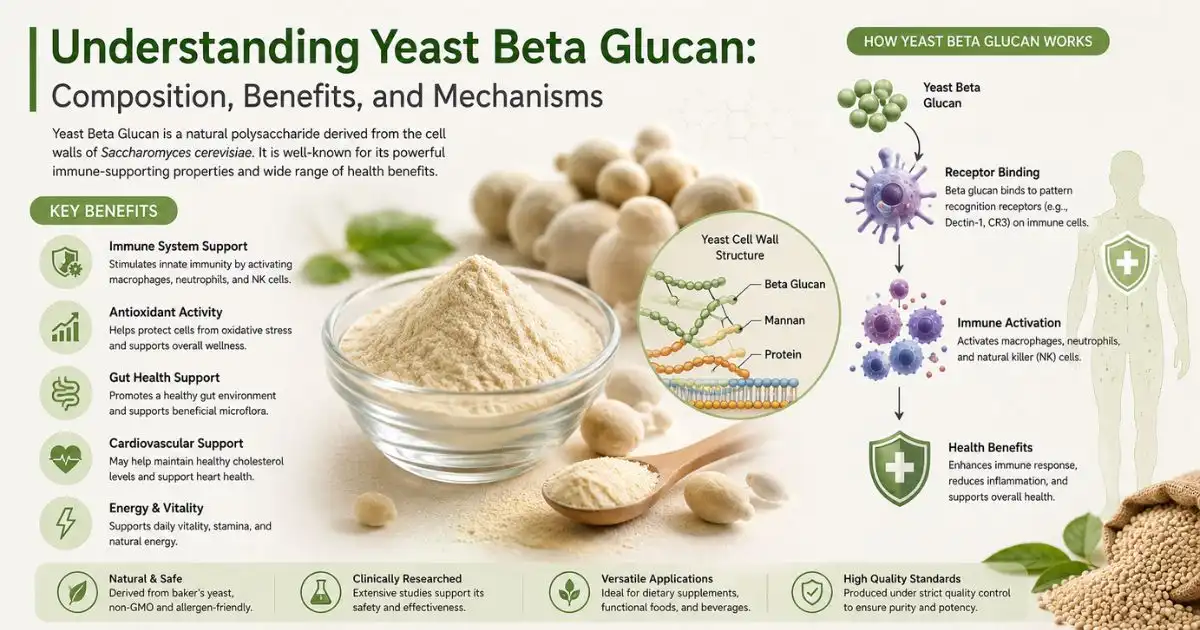
Beta glucans made from yeast are biologically active because of the way their molecules are structured. Looking at this ingredient's molecular structure makes the difference clear: Yeast Beta-glucan has a branched β-1,3/1,6-D-glucan structure, with 1,3-linked glucose units making up the backbone and 1,6-linked side chains extending out every three glucose residues. When put together in this way, they form a triple-helix shape that immune cells identify as a pattern of molecules related to a pathogen.
How Immune Recognition Works
The way our immune system works has changed over time so that it can now spot certain genetic patterns that are linked to microbe threats. This backbone structure can be recognized by macrophages, neutrophils, and dendritic cells; they all have Dectin-1 receptors. Yeast Beta-glucan connects to these receptors in the Peyer's patches of the small intestine. This sets off a series of immune signaling events that do not cause inflammation or cytokine storms. Immune stimulants that boost adaptive immunity work in a very different way. This means that you can take it every day without worrying about becoming less sensitive to it.
Structural Comparison with Other Beta Glucans
Buying teams can make better decisions when they know the differences between sources. Barley and oat beta glucans have β-1,3/1,4 links that help keep cholesterol in check more than they change the immune system. It is chemically similar to beta glucans found in yeast, but it is harder to get rid of them regularly and costs more. When yeast cell walls are extracted, the glucan content stays the same. Glucan content usually reaches 70–85% clarity through chemical and mechanical cleaning.
| Beta Glucan Source | Primary Structure | Main Bioactivity | Manufacturing Stability |
|---|---|---|---|
| Yeast (S. cerevisiae) | β-1,3/1,6-glucan | Immune modulation | Excellent (heat-stable to 121°C) |
| Oat/Barley | β-1,3/1,4-glucan | Cholesterol reduction | Moderate (sensitive to shear) |
| Mushroom (Shiitake) | β-1,3/1,6-glucan | Immune support | Variable (extraction dependent) |
To get the proteins and nucleic acids out of baker's yeast, controlled autolysis and an alkaline treatment are used. This makes sure that the powder doesn't have many proteins that can cause allergies. Making claims that supplements are allergen-free is hard for companies that make supplements, but this standard for cleaning solves a big problem.
Key Benefits of Yeast Beta Glucan in Immune Products
A lot of different kinds of people have had their immune systems boosted by glucans that come from yeast. People who trained for marathons and took 250 mg of Yeast Beta-glucan every day had 25% fewer upper respiratory tract infections, according to a study in the Journal of the American College of Nutrition. It works by stimulating the body's natural defenses instead of overstimulating them. This means that the benefits last without resistance building up.
A new study shows that it does more than just boost the immune system, which is good for the product's placement. When people are making high-quality immune products, Yeast Beta-glucan is very appealing because of the following pros:
Awakening of Immune Cells: Yeast Beta-glucan makes it easier for macrophages and natural killer cells to eat bacteria, which helps the body get rid of them. This effect on biological response can happen at doses as low as 250 mg per day. This saves money and makes it a good choice for capsules.
Support for metabolic health: small improvements in lipid profiles and better control of blood sugar are also side effects. It is very important to do this for functional food uses that want to boost metabolic health and immunity.
Skin Barrier Function: Beta glucan helps wounds heal faster by increasing the activity of Langerhans cells and the production of collagen when it is added to beauty items that are eaten or put on the skin. In other words, it can be used in many situations.
Safety Profile and Dosage Guidelines
Beta-glucan from yeast is okay with regulators in all big countries. In the EU, it is okay to eat as a Novel Food, and in the US, it is GRAS. Based on toxicological tests, there is a very large safety margin. Long-term tests on people showed that amounts up to 1,000 mg per day had no side effects. The daily dose range for people to boost their immune systems is between 250 mg and 500 mg. This makes it possible to make different kinds of formulations, like capsules, tablets, and functional drinks.
Safety ratings that are similar have been found for pet food recipes. It has been shown that adding 0.05-0.2% of these substances to feed makes animals less likely to get sick, both in aquaculture and as pets. Because of this, Yeast Beta-glucan is a good alternative to antibiotics that are used to speed up plant growth. This is in line with new laws that limit the use of antibiotics for preventative reasons in animal farms.
Market-Ready Yeast Beta Glucan Solutions: Forms and Sourcing
You have to weigh the needs of the formulation against the limits of the manufacturing process in order to pick the best commercial form. You can buy three main kinds of Yeast Beta-glucan. Each one is good for different kinds of products in its own way.
Available Product Forms
Powder (70% to 85% Pure): This is the most open way to buy a lot of it. It is a fine powder that is off-white to yellowish and doesn't taste or smell like anything. This form is simple to mix into dry mixes for drinks, pills, and tablets. Protein shakes and meal replacements have a good structure when they can hold water, and tablets can be pressed and pushed out normally when they can handle heat.
Particulate Suspensions: Some suppliers offer liquid supplement formulations that are already spread out, but medium-sized manufacturers who can mix them will usually save more money by using powder forms.
Higher quality parts (>80% beta glucan content) cost more but need less of a dose, which is good for things like gummies or small pills that need to save room.
When purchasing managers look at buyers, they shouldn't just look at specification sheets; they should also look at how the products were tested. The enzyme-based method (GOPOD format) that Megazyme made is now the standard way to measure β-1,3/1,6-glucan content. Other methods might get the amounts of inactive alpha-glucans or residual starches wrong, but this one can tell the difference between them.
| Sourcing Consideration | Specification to Verify | Industry Benchmark |
|---|---|---|
| Purity Analysis | β-1,3/1,6-glucan (enzymatic method) | ≥70% (USP compliant) |
| Protein Residue | Total protein content | <5% (hypoallergenic grade) |
| Heavy Metals | Lead, Arsenic, Mercury | <1ppm each (EU/FDA limits) |
| Microbiology | Total plate count, pathogens | <10,000 CFU/g, negative for E. coli/Salmonella |
| PAH4 Compliance | EU Regulation 835/2011 | Benzopyrene <10 ppb |
Supplier Evaluation Criteria
If you want to buy partnerships you can trust, the paperwork needs to be clear and well-written. To make sure their products are safe, major suppliers work with outside labs. With this, an issue that often comes up is that internal certificates of analysis might not fully show how different batches are, especially for ingredients like Yeast Beta-glucan, where batch-to-batch variability can significantly affect functionality and purity. In the sampling part of the buying process, it's good to have up-to-date test results from respected labs like Eurofins or SGS.
There are many different minimum order amounts. For instance, Yangge Biotech, a well-known company, offers starting amounts as low as 1 kg for initial formulation tests and going up to 25–50 kg for test production runs. When adding new ingredients, procurement teams usually have to make a decision every three to six weeks. This flexibility is very helpful during that time.
Why Yeast Beta Glucan Is the Preferred Choice for Immune Product Manufacturers
There are more and more ingredients that boost the immune system, but Yeast Beta-glucan is still chosen by R&D teams and buying leaders because it has clear benefits. It's possible that clinical support will make the biggest difference. Over 150 peer-reviewed studies have shown that certain foods can help your immune system. This is enough proof for some places to make structure-function claims on dietary supplements and for some to make qualified health claims.
When it comes to value for money, Yeast Beta-glucan is better than colostrum, transfer factors, or certain mushroom products. A 250 mg amount that works in the lab costs between $0.08 and $0.12 per serving at regular bulk prices. This lets stores set prices that are competitive while still making a lot of money. People who buy in bulk and are looking for deals need to know this economic profile very well if they want to compete in that market.
Sustainability and Supply Chain Reliability
Sustainability in manufacturing is becoming a bigger factor in what people buy, especially when it comes to European brands that are closely watched for how they treat people, the environment, and the government. The fermentation process of yeast is very efficient because growing Saccharomyces cerevisiae doesn't take up much room and doesn't make much carbon dioxide compared to growing plant-based materials. It takes 48 to 72 hours to go from fermentation to extraction. This means that supply lines can be adjusted to meet changing tastes.
If your product has FDA GRAS status, EU Novel Food recognition, or Health Canada Natural Product Number registration, it's easier to sell it in other countries. It's easier to bring in goods that are made with Yeast Beta-glucan than ingredients that come from places where phytosanitary or country-of-origin rules make it hard.
Versatility Across Product Categories
Because of how it works technically, the ingredient can be used for many things besides pill vitamins. Because it doesn't change when cooked, it can be used in baked goods, molded protein bars, and drinks that have been heated to high temperatures without losing any of their effectiveness. There are a lot of bitter or earthy tastes in plant immunity ingredients that the neutral taste profile doesn't pick up. This is important if you want people to like healthy foods and treats for pets.
More and more, OEM and ODM companies need Yeast Beta-glucan for custom recipes that boost the immune system and help people reach other health goals. Some typical pairs that work well together are probiotics to change the gut-immune axis, zinc to support the innate immune system, and vitamin D3 to make immune communication better. This tool makes formulating easier during the trial production phase because it can be used with a lot of different active ingredients and excipients.
How to Maximize the Benefits of Yeast Beta Glucan in Your Product Line
The first step in making the best product is to understand stable factors and how ingredients work together. Yeast Beta-glucan is very stable between pH 3.0 and 8.5. This means that it can be used in both acidic drinking systems and neutral tablet forms without having to worry about breaking down. Because water-soluble fibers need to be properly wet while being mixed, stiffening agents are often mixed in ahead of time, or high-shear mixers are used to make sure the fibers are spread out evenly.
Synergistic Formulation Strategies
It seems like more is being gained when Yeast Beta-glucan is mixed with other ingredients that work well with it. This helps with more health issues at the same time. Vitamin C makes the immune-boosting effects stronger by helping neutrophils do their job and collagen production. This creates a full profile of immune support. Along with yeast glucan, which has been backed by science, elderberry extract has chemicals that people already know and trust that help the immune system. This uses both traditional and evidence-based language.
When you make things for pets, adding prebiotics like fructooligosaccharides or mannan-oligosaccharides to Yeast Beta-glucan makes their immune systems and gut health better at the same time. Beta glucan and astaxanthin are often found together in aquaculture recipes because they help the immune system and speed up growth, which is good for both fish and shrimp farmers.
Storage and Packaging Recommendations
For bioactivity to stay the same, external factors must be thought about when the product is being stored and sent out. Beta glucan powders made from yeast will stay stable for 24 months if they are kept in cases that are tightly sealed and out of the light and water. It's best when it's below 25°C and the humidity is below 60%. Plain polyethylene packing doesn't keep wetness out as well as aluminum foil laminate packaging. This means that it is less likely to harden or break down while being shipped across foreign borders.
Putting big amounts of ingredients into smaller ones, like 1 kg aluminum foil bags inside bigger shipping containers, makes it easier to keep an eye on quality and plan your production schedule. This is because each sub-lot can be tested before the whole batch is made. When setting up the first supply connection, this method works really well.
Leveraging Clinical Data for Market Success
To get people to trust you, you need to make scientific proof easy to understand. There is a molecular process that brands use to explain why Yeast Beta-glucan-based products work when they do it well. They talk about how the ingredient "trains" immune cells instead of making them react in a way that causes inflammation. Health-conscious customers who look into how well ingredients work before buying will trust you more if you use published clinical studies in your marketing and product materials.
Third-party awards make you look better. The NSF International and Informed Choice programs, for instance, offer ways to test foods that check what they say on the label and look for contaminants. It's easier to follow the rules and takes less time to get new products on the market when sellers give you finished goods with these checks.
Conclusion
Yeast Beta-glucan from Saccharomyces cerevisiae is a cheap, scientifically proven, and open choice for making goods that help the immune system. In clinical studies, its unique β-1,3/1,6-glucan chemical structure was shown to change the immune system. In addition, it is very stable when it is made, and regulators agree with it, which makes it easier to make and sell.
This part can be found in makeup, useful foods, dietary supplements, and even food for pets. This makes it a good ingredient for brands in the health market that want to stand out. Manufacturers can safely add this bioactive polysaccharide to their product lines to meet customers' changing needs for immune health solutions based on evidence. To do this, they need to work with quality-focused suppliers who offer technical support, open testing, and flexible minimum orders.
FAQ
What distinguishes yeast beta glucan from oat beta glucan?
The molecules are different, and the way they work in living things is also different. Beta glucan from oats has β-1,3/1,4 linkages that help keep cholesterol in check, while beta glucan from yeast has β-1,3/1,6 linkages that make immune cell receptors work. Because of this difference in structure, sources from yeast work well in immune vitamins and sources from oats work well in recipes for heart health.
Does yeast beta glucan cause allergic reactions or yeast infections?
When the right methods are used to remove high-purity Yeast Beta-glucan, very few proteins are left over. This means that it is much less likely to cause allergies. Being made up of pure cell wall polysaccharides and not live yeast organisms means you don't have to worry about getting a yeast infection. By making sure that the protein level is less than 5%, the hypoallergenic qualities are good for people who are sensitive.
How should procurement teams verify beta glucan content accuracy?
Check the certificates of analysis to see what kind of enzymatic testing was done. The Megazyme GOPOD assay or USP-compliant protocols are best. Generic polysaccharide or total glucan tests might contain alpha-glucans that are not active by accident. By looking for active β-1,3/1,6-glucan content, you can be sure that the product you buy has been shown to boost the immune system and not something that isn't as strong or is mislabeled.
Partner with Yangge for Premium Yeast Beta Glucan Supply
Pharmaceutical-grade Yeast Beta-glucan powder is what Yangge Biotech does best. They send it to companies in North America and Europe that make immune supplements and pet food. Tests by a different lab showed that our β-1,3/1,6-glucan mixtures stay at least 70% pure. You can see their whole trip, from brewing to being packed up. This is Yeast Beta-glucan that we sell. It is certified by ISO, HACCP, Kosher, and Halal.
Our smallest order is 1 kg, which can be used for formulation tests. If you need a steady supply of bulk, we can do that too. As part of technical support, you can get help with formulation, help with regulatory paperwork, and custom packaging solutions that fit the needs of your OEM. If you want to get samples, more information, and good prices for your next immune health product launch,You may contact us or email our team at info@yanggebiotech.com.
References
1. Vetvicka, V., & Vannucci, L. (2020). "Biological Properties of Yeast β-1,3/1,6-D-Glucan in Immune Modulation." Journal of Immunology Research, 2020, Article ID 4297638.
2. Murphy, E.A., Davis, J.M., & Carmichael, M.D. (2010). "Immune Modulating Effects of β-Glucan." Current Opinion in Clinical Nutrition & Metabolic Care, 13(6), 656-661.
3. Kogan, G., Stasko, A., Bauerova, K., & Polovka, M. (2005). "Antioxidant Properties of Yeast (1→3)-β-D-Glucan Studied by Electron Paramagnetic Resonance Spectrometry." Carbohydrate Polymers, 61(1), 18-28.
4. Stier, H., Ebbeskotte, V., & Gruenwald, J. (2014). "Immune-Modulatory Effects of Dietary Yeast Beta-1,3/1,6-D-Glucan." Nutrition Journal, 13, Article 38.
5. Akramiene, D., Kondrotas, A., Didziapetriene, J., & Kevelaitis, E. (2007). "Effects of Beta-Glucans on the Immune System." Medicina (Kaunas), 43(8), 597-606.
6. Magnani, M., & Castro-Gomez, R.H. (2008). "β-Glucan from Saccharomyces cerevisiae: Constitution, Bioactivity and Obtaining." Semina: Ciências Agrárias, 29(3), 631-650.

Based on your location and order quantity, you will have the opportunity to receive a limited time free shipping promotion!
Who we are
Popular Blogs