Where to source Gardenia Yellow natural color powder?
Yangge Biotech supplies high-quality Gardenia Yellow Powder, a premium natural food colorant extracted from the fruit of Gardenia jasminoides. Rich in the natural pigment crocin, this water-soluble yellow color provides a bright, stable, and vibrant appearance for a wide range of food, beverage, nutraceutical, and cosmetic applications. Manufactured under strict quality control standards, our Gardenia Yellow Powder offers excellent heat stability, good pH tolerance, and consistent coloring performance, making it an ideal natural alternative to synthetic yellow colorants. Yangge Biotech provides OEM. Contact us today for product specifications, samples, certifications, bulk prices, and OEM solutions. Email: info@yanggebiotech.com.
Sourcing high-quality Gardenia Yellow natural color powder requires partnering with verified suppliers who maintain rigorous quality standards and regulatory compliance. The most reliable sources include established manufacturers in Asia particularly China, Japan, and Kore who extract this vibrant pigment from Gardenia jasminoides fruit using advanced spray-drying technology. For procurement managers in the U.S. food and beverage industry, connecting with ISO, HACCP, Kosher, and Halal certified suppliers ensures access to batch-consistent, clean-label colorants that meet FDA regulations and consumer demand for natural ingredients.


Understanding Gardenia Yellow Natural Color Powder
Botanical Origin and Extraction Process
The color Gardenia Yellow comes from the flowering plant Gardenia jasminoides Ellis, which is native to East Asia. To get the color elements crocin and crocetin, the process starts with collecting fully grown gardenia fruits. Then there are steps of aqueous extraction, filter, purification, and concentration. These carotenoid molecules give the color its bright yellow to orange-yellow look, which is valued in many fields. Modern companies use HPLC (High-Performance Liquid Chromatography) extraction methods to get the most color out of the material while removing as much unwanted geniposide as possible. Geniposides can change proteins to an unwanted blue color.
The quality of Gardenia Yellow powder depends a lot on how it is grown and where it is grown. Premium suppliers get their fruits from traditional growing areas in southern China and Japan. These areas have the right climate and soil conditions to grow fruits with the right amount of crocin. Yangge Biotech works directly with farming communities through long-term relationships that support local economies and make sure that products can be tracked from the farm to the production center.
Applications Across Food and Beverage Manufacturing
This natural colorant is now a must-have for companies making "clean label" goods. This chemical dissolves easily in water, so it can be added to clear juices, functional drinks, and alcoholic pre-mixes without making them cloudy or settling. This is a big benefit over beta-carotene, which needs to be emulsified. Gardenia Yellow is used by candy makers to color hard sweets, gummies, and sugar coats because it doesn't change color when heated or mixed with sugar.
This color is very useful for makers of noodles and pasta because it sticks to starch and protein structures. When added to wheat-based foods, it gives them a nice brown color that stays the same when they are boiled or steamed. Colored yogurt, flavored milk, and cheese are all used in dairy goods. The pigment's neutral pH stability (best at pH 7–10) keeps the color true throughout the shelf life. The clean label trend has also spread to plant-based protein snacks, ready-to-eat desserts, and health products that want to use natural colorings instead of artificial ones.
Advantages Over Synthetic Yellow Dyes
Synthetic colorants like Tartrazine (Yellow 5) are being replaced by natural ones because of pressure from regulators and consumer tastes. There are strong reasons for this change that go beyond market trends. There are more and more limits on synthetic dyes on international markets. In some places, they need to have labels that say they might make kids hyperactive. These worries go away when you use Gardenia Yellow powder, which also works better technically in some situations.
Regarding stability, this natural pigment is very good at withstanding heat it stays stable at 80°C for 120 minutes, which is longer than many other plant-based colorants, like turmeric. For baked goods, extruded snacks, and retort-processed foods, this ability to withstand heat is very important. Crocin chemicals naturally have antioxidant qualities that make them useful in other ways. For example, they may help products last longer by protecting them from oxidative decay. Natural pigments are also better for the environment because the methods used to get them create waste that breaks down naturally, unlike manufactured dyes, which are made from petrochemicals and are processed in ways that are harmful to the environment.

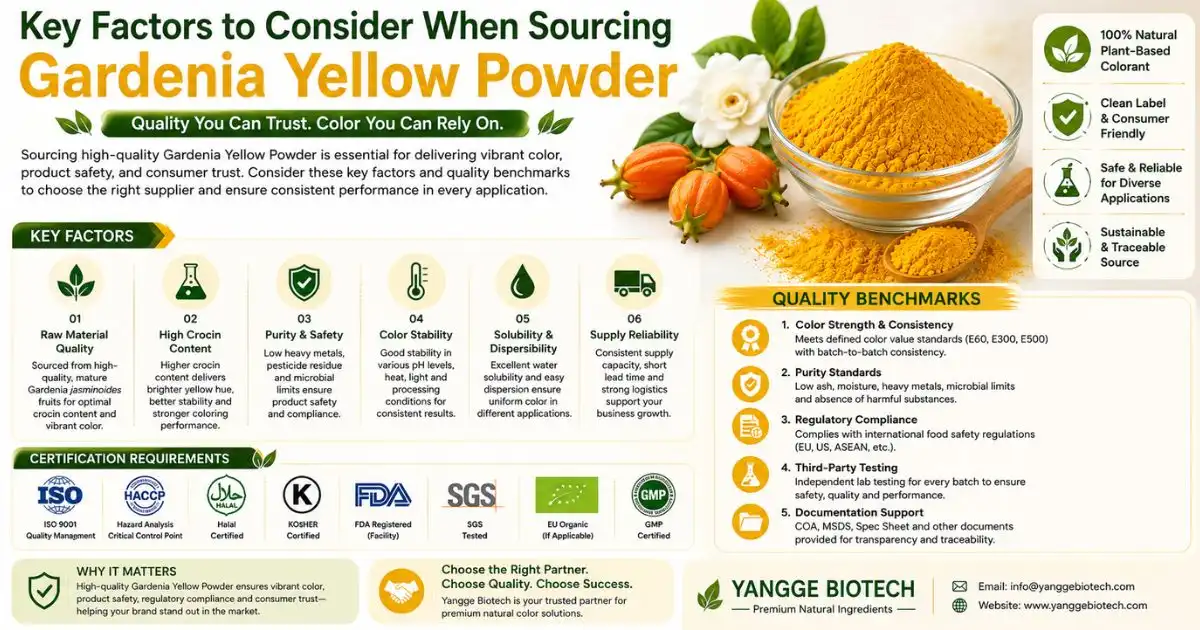
Key Factors to Consider When Sourcing Gardenia Yellow PowderQuality Benchmarks and Certification Requirements
Paying for things professionally means paying close attention to the technical details. Color Value, which is measured as E1% 1cm at 440nm using UV-Vis spectrophotometry, is the most important quality metric. The Gardenia Yellow Powder E60 label from Yangge Biotech shows a color value of 60, which is the optical density of a 1% solution over a 1 cm path length. Higher standards, like E300 and E500, offer stronger tinctures, which means that less of them are needed and the overall cost may be lower, even though they cost more.
Geniposide level is a very important sign of safety and quality. At high amounts, this substance reacts with amino acids and proteins to make blue pigments, which is not what you want to happen with yellow goods. Reliable suppliers give HPLC analysis reports that show the levels of geniposide are within the acceptable range for the industry. The transparency test is a useful way to check the quality of a solution: a 1% water solution should be clear, with no particles in it, which means that it has been fully extracted and filtered.
Certifications are an important way to make sure that quality control systems and legal compliance are working properly. Standardized production methods are shown by ISO certification, and hazard analysis and critical control points are shown by HACCP certification. Kosher and Halal certifications make it easier for products to get into a wider range of international markets. This is especially helpful for companies that want to sell to Middle Eastern, Southeast Asian, and niche Western consumers.
| Quality Parameter | Standard Specification | Testing Method | Importance |
|---|---|---|---|
| Color Value | E60, E300, E500 | UV-Vis Spectrophotometry at 440nm | Determines tinctorial strength and dosage rates |
| Geniposide Content | ≤3% (refined grade) | HPLC Analysis | Prevents blue discoloration in protein-rich formulations |
| Heavy Metals (Pb, As, Hg, Cd) | ≤10ppm total | ICP-MS | Regulatory compliance and consumer safety |
| Microbial Count | TPC ≤1000 cfu/g | Standard Plate Count | Food safety and shelf stability |
| Solubility | Clear 1% solution | Visual/Turbidity Test | Application performance in beverages |
Supplier Reliability and Supply Chain Considerations
The operational skills of the supplier are also looked at as part of the product specs. Your ability to grow is directly related to your production capacity. Manufacturers should be able to show consistent output volumes that match your expected annual needs, which for mid-sized food manufacturers are usually between $20,000 and $200,000. Consistent lead times are very important for managing inventory; dependable suppliers stick to delivery plans of two to four weeks from the time an order is confirmed until it arrives at the port.
It's important to be careful when negotiating minimum order numbers (MOQs). Buying in bulk lowers the cost per unit, but MOQs that are too high tie up operating capital and warehouse room. Established sellers usually have open MOQ arrangements for qualified buyers who show they are serious about buying through framework agreements. You should be able to find packaging choices that work with the way you make things, whether you need 25 kg drums for ongoing processing lines or smaller units for batch work and product development.
Communication skills are important and should not be ignored. When buying from Asian suppliers, the language barrier and different time zones are often seen as problems. However, these problems become much less of an issue when you work with export-focused manufacturers who have English-speaking customer service teams. Yangge Biotech has online help that is available 24 hours a day, 7 days a week for procurement managers in North America and Europe. This is to make sure that technical questions get quick, thorough answers during your work hours.
Pricing Structures and Total Cost Analysis
The unit price of Gardenia Yellow powder changes a lot depending on the color value, the order volume, and the state of the market. As a general rule, E60 grade costs less than E300 or E500 grades because they have different concentrations. Total cost analysis, on the other hand, shows that goods with a higher color value usually offer better value because they need smaller amounts to achieve the desired color strength.
In addition to FOB prices, a full cost estimate takes into account the costs of foreign shipping, which change depending on the price of fuel and the availability of containers. Harmonized system (HS) codes and current trade deals determine import duties and taxes. Gardenia Yellow usually comes into the U.S. as a natural food colorant, which has moderate duty rates. Extra costs like customs trading fees, warehouse storage, and domestic delivery must be included in budgeting models by procurement pros.
Quality problems that require re-designing or source reliability issues that cause production delays can sometimes lead to hidden costs. Investing in slightly more expensive sources with a history of reliability can often lower the total cost of ownership by getting rid of trash, downtime, and emergency air freight costs. Payment terms also affect effective costs. For example, suppliers who offer net-30 or net-60 terms make cash flow better than those who require prepayment, which is common with newer vendors.
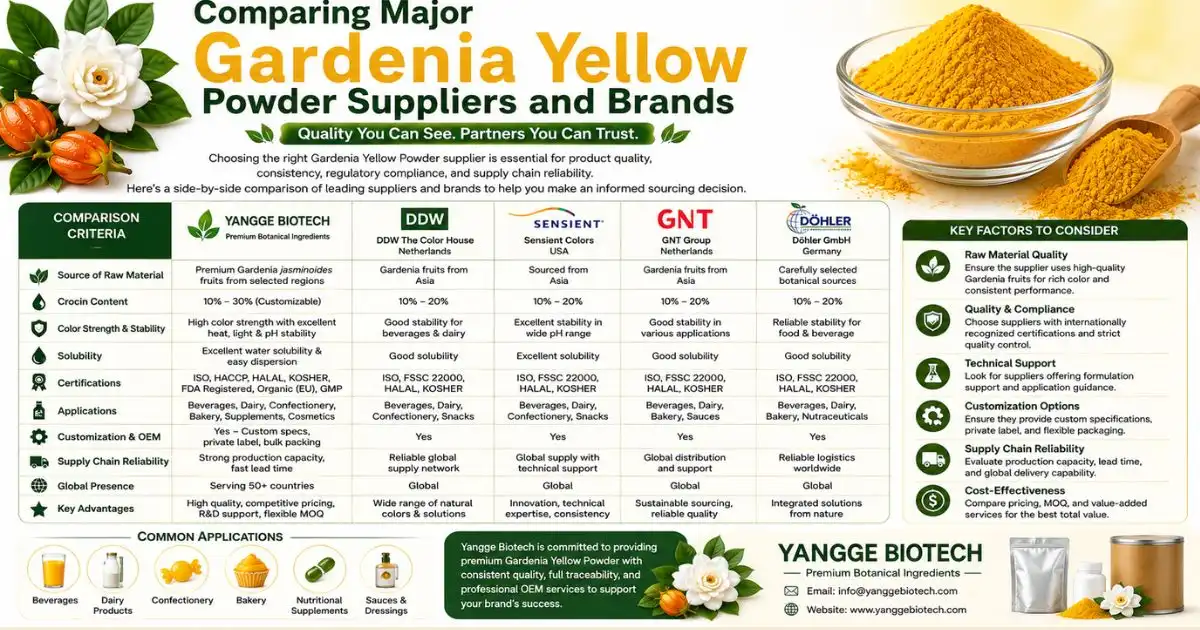
Comparing Major Gardenia Yellow Powder Suppliers and Brands
Global Market Landscape
The Gardenia Yellow powder market is mostly in East Asia, with China producing the most because it has the most land for growing plants and the most well-established facilities for extracting the powder. Japanese suppliers can charge high prices because they strictly monitor quality and use specialized low-geniposide processing methods. This makes them the best choice for high-end candy and drinks. Korean manufacturers are in the middle because they offer reasonable prices and strict adherence to rules that make their products fit for foreign markets.
There aren't many suppliers in the Western region yet, and most North American and European distributors are more like importers than major makers. This structure of the supply chain makes it possible for customers to directly connect with manufacturers, cutting out the middleman and the markups that come with them. Quality is maintained by carefully choosing suppliers. Some European companies have set up processing plants, but they usually get the raw gardenia fruit from Asian growers, which means that the prices are the same or higher without necessarily being better quality.
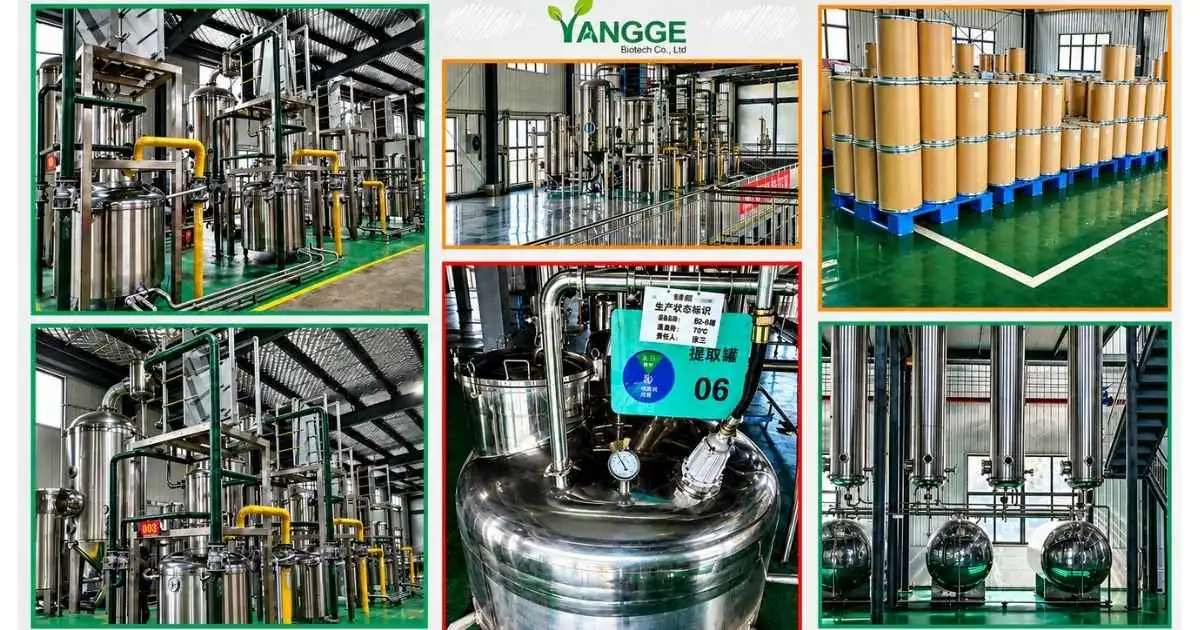
Yangge Biotech stands out because it has vertical integration, which means that it works directly with gardenia fruit growers and also runs modern facilities for extraction and spray drying. This farm-to-powder method makes sure that the quality of the raw materials stays the same, that they can be tracked clearly, and that the prices are competitive and reflect the real costs of production instead of the various distribution margins. We've been recognized for being good environmental stewards in China's natural products sector for our dedication to sustainable sourcing practices.
Evaluating Product Variants and Specifications
Knowing the differences between specifications helps you make smart buying choices that meet the needs of your application. The E-value system (E60, E300, E500) shows how strong the color is, with higher numbers indicating more pigment content. Manufacturers of brightly colored goods like orange-flavored drinks or golden-yellow hard candies can benefit from E300 or E500 grades because they deliver target colors at lower dosage rates, which could make the products more cost-effective even though they cost more per kilogram.
The way particles are distributed affects how fast they dissolve and how well they work in an application. Spray-dried powders with small particles (usually 80–120 mesh) dissolve quickly in cold water. This is important for beverage applications that need the powder to dissolve completely without being heated. For tasks that need hot water or long mixing times, like making noodle dough, coarser grades may be enough. The particle size ranges and dissolution time standards should be listed in the technical data sheets under normal circumstances.
Water activity (Aw) and moisture content affect how stable something is in storage and how long it will last. Premium Gardenia Yellow powder keeps its moisture content below 5% and its water activity below 0.6, which stops microbes from growing and keeps the powder from caking while it's being stored. Companies that work in humid areas should give more weight to suppliers that can show strong control over moisture, since too much moisture can cause clumping and make automatic dose systems less effective.
Customer Experience and Supplier Performance
Looking at a supplier's track record through customer testimonials and case studies can help with purchasing decisions. Long-term ties between established providers and major food makers show that they can deliver high-quality goods and provide quick technical support. When looking at potential partners, ask for references from clients who make similar products. For example, if you're making colored drinks, the experience of a beverage manufacturer will give you more useful information than pharmaceutical experience.
Risk reduction through sample testing programs is very helpful. Reliable sellers offer free samples or small trial amounts so that you can test your formulations before placing an order for mass production. During this phase, you should test the stability of the product under the specific conditions that you will be using for processing, such as the temps, pH ranges, light, and air. This will help you make sure that it works well in your real production environment, not just in a lab setting.
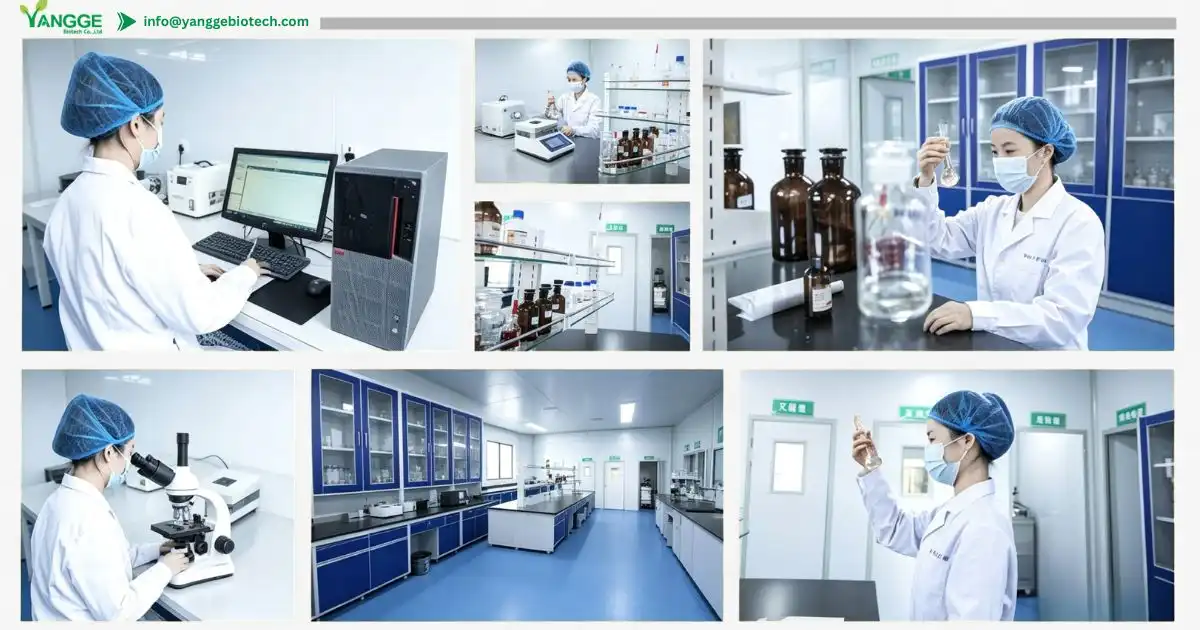
Professional sellers can be told apart from opportunistic traders by their ability to settle disputes and quality promises. Specification changes, shipping delays, and problems with product performance should all be covered by clear contractual terms. Yangge Biotech has thorough quality control programs that include certificates of analysis for each batch, product liability insurance, and written corrective action procedures. This gives procurement teams confidence that quality problems will be solved in a planned way instead of being dodged.
How to Source Gardenia Yellow Powder A Step-by-Step B2B Buying Guide
Defining Your Technical and Commercial Requirements
Successful buying begins with crystallizing your specific needs across technical, economic, and logistical aspects. Technical requirements include the color strength you want the end product to have, the processing conditions (temperature, pH, mixing intensity), and the regulatory state in the places where the product will be sold. Writing down these parameters makes it easier to have useful technical conversations with possible sellers and creates objective criteria for evaluating suppliers of Gardenia Yellow.
Predictions of volume have a direct effect on choosing a provider and negotiating prices. Find out how much will be used each year by using the formulation ratios and the expected production numbers, and then add the right amount of backup stock. When a new product comes out, there is a lot of unpredictability. To avoid overcommitting, you could set up framework agreements that specify volume ranges instead of firm promises. This would show that you are serious about making a purchase, which would encourage the seller to invest in your relationship.
Specifications for packaging and delivery need to be carefully thought through. Large orders in 25 kg fiber drums work well for continuous high-volume production, while smaller packaging units work well for batch production or facilities that make more than one product. Shipping times should include ocean freight transit (usually 4 to 6 weeks from Chinese ports to the U.S. East Coast and 6 to 8 weeks to the West Coast), customs clearance, and domestic transportation. Making sure there are enough inventory buffers will keep production from stopping.
Supplier Evaluation and Selection Process
Making a systematic checklist for evaluating suppliers gives procurement decisions more structure. Some important factors are regulatory certifications (ISO, HACCP, and related food safety standards), proof of production capacity, the ability of a quality control laboratory, and signs of financial stability. Site audits, whether they are actual visits or services hired by a third party, give unique information about how things are made, stored, and how professionally they are run that paperwork alone can't show.
Evaluation of samples should follow standard procedures that allow fair comparisons between different providers. Prepare similar test recipes using samples from each possible source. Compare colors, test for stability, and evaluate the taste. Write down the results in a planned way, making sure to note the color strength, clarity, heat stability, and any off-flavors or smells. Accelerated shelf-life testing at high temperatures can predict how something will work in the long run and show any problems that might arise before making big purchases.
Checking references goes along with technical evaluation because it shows how the supplier acts when things go wrong. Contact gave references and asked specific questions about how reliable shipping was when supplies were low, how quickly issues about quality were addressed, how good the technical support was, and how satisfied the customer was with the overall relationship. Industry networks and trade groups can give you general information about the names of suppliers, helping you spot possible red flags or confirm good views you've had from dealing with them directly.
| Evaluation Criteria | Assessment Method | Weight (%) | Yangge Biotech Performance |
|---|---|---|---|
| Product Quality & Consistency | Lab analysis + stability testing | 30% | E60/E300/E500 specs, CoA with each batch |
| Regulatory Compliance | Certification verification | 25% | ISO, HACCP, Kosher, Halal certified |
| Pricing Competitiveness | Quote comparison | 20% | Direct manufacturer pricing, no intermediaries |
| Supply Chain Reliability | Reference checks + capacity audit | 15% | 24/7 support, 2-4 week lead times |
| Technical Support | Sample interaction + communication | 10% | Dedicated technical team, application guidance |
Negotiation, Contracting, and Order Execution
Negotiating prices is more than just talking about per-kilogram rates; it also involves delivering total value. When you make a yearly framework deal that specifies quarterly volumes, you usually get 5–15% price cuts compared to spot purchases. These discounts are called volume commitment discounts. Negotiating payment terms is a mix between managing cash flow and how risky the supplier thinks the business is. Long-term buyers with good credit can usually get net-30 or net-60 terms, but new relationships may need letters of credit or partial prepayment.
Specifications for quality with measurable acceptance criteria, delivery schedules with penalties for late deliveries, and clear steps for specification deviations or quality disputes should all be included in the contract terms. Include plans for regular quality checks and sample keeping rules that will make it possible to find problems after delivery. When sharing secret formulas during technical talks, intellectual property rights are important. Confidentiality agreements protect competitive information while allowing suppliers to work together effectively.
When coordinating logistics, it's important to know which Incoterms to use. For example, FOB (Free on Board) means that customers are responsible for foreign shipping, while CIF (Cost, Insurance, and Freight) makes logistics easier but may make costs less clear. Customs paperwork has to correctly label goods with the right HS codes, list all the ingredients in detail, and include all the necessary certifications. Working with experienced customs brokers or freight forwarders who know how to bring in food ingredients makes the process go more quickly and reduces the chance of delays.
Post-Purchase Quality Assurance and Relationship Management
Checking the quality of the delivery guards against variations from the specifications and damage during transport. Upon arrival, inspection should check the integrity of the package, make sure that the batch numbers match the paperwork, and do quick quality tests like measuring the color value, checking for dissolution, and judging the product's taste. Keep typical samples from each shipment for future use. Keeping a sample library will allow you to compare batches and provide proof if there are quality issues.
Tracking performance across multiple deliveries shows how consistent a supplier is and finds new quality trends. Keep records of the color value measurements, processing performance notes, and any customer feedback about finished products that used the ingredient. Reviewing suppliers every three months and putting all of this information together helps people have productive conversations about how to improve quality. It also strengthens relationships by showing that both parties are paying attention to details and are committed to doing their best.
Building relationships turns one-time purchases into long-term agreements. You will be treated as a valuable customer during allocation shortages if you regularly communicate with us about things other than placing orders. For example, you can share market views, give feedback on new applications, and talk about upcoming regulatory changes. When possible, visiting a supplier's facilities improves knowledge and shows dedication to the relationship in a way that can't be done through only phone calls or emails.
Value-Added Services and Future Trends in Gardenia Yellow Sourcing
Technological Innovations in Extraction and Processing
As extraction technology keeps getting better, Gardenia Yellow powder keeps getting better and can be used in more ways. Molecular weight separation is more accurate with membrane filtration systems, which create ultra-low geniposide grades that don't turn foods blue, even when they contain a lot of protein, like in protein bars and nutritional shakes. Microencapsulation technologies that are still being developed could lead to oil-dispersible versions that could be used in more fat-based systems, like chocolate, and in oil-in-water emulsions that are mostly made up of manmade colors right now.
Gardenia Yellow is mixed with natural antioxidants like ascorbic acid, tocopherols, and rosemary extract in formulas that make them more stable in light and resistant to oxidation. These formulas work around the pigment's moderate photostability problem, so clear bottle drinks can last longer in store lighting conditions. Better standardization through improved spray-drying controls leads to tighter color value limits, which lowers variation from batch to batch that makes quality control harder for finished goods.
Analytical skills have come a long way, and fast testing methods have cut down on the time it takes to check the quality of work. Portable spectrophotometers let you measure color values on-site while goods are being delivered, which confirms specifications right away. Advanced chromatography methods find adulterants and confirm validity. This keeps cheaper, less desirable pigments from being used instead for economic reasons, which is a worry because natural colorants are expensive.
Customization Options and Flexible Supply Solutions
More and more, top suppliers offer customization services that are made to fit the needs of each customer. When Gardenia Yellow is mixed with other natural pigments like spirulina blue, beetroot red, and turmeric, it creates custom color profiles that are exactly what the goal shade needs to be. This extra service makes it easier to come up with new formulas and makes sure that all batches have the same color by managing the mixing processes.
Customizing the packaging meets a wide range of business needs. Along with standard bulk drums, there are also smaller retail-sized pouches for food artisans, intermediate bulk containers (IBCs) for automated liquid dosing systems, and special moisture-barrier packaging for places with tropical climates. With private labeling services, distributors and ingredient trading companies can sell products under their own brands while still taking advantage of the expertise and production scale of the manufacturer.
Just-in-time delivery programs and vendor-managed inventory plans cut down on the amount of working capital needed and the room needed in warehouses. Customers who are qualified can set up consignment inventory deals with suppliers. This way, suppliers can keep stock in carefully placed warehouses, and ownership only changes hands when the stock is taken out for production. These agreements change the costs of keeping inventory while ensuring the availability of materials. This is especially helpful for seasonal goods whose production plans change.
Strategic Partnership Benefits with Yangge Biotech
Our integrated approach to Gardenia Yellow production gives procurement professionals looking for a reliable, high-quality supply a lot of advantages over their competitors. Direct farming ties make sure that the raw materials are consistent and that they can be tracked back to specific growing areas. This is necessary for many clean-label certification programs and is becoming more and more important for companies that report on their sustainability. We support our customers' ESG (Environmental, Social, and Governance) goals by investing in green energy and best practices for the environment. This shows that we are responsible manufacturers.
Technical support includes more than just product specifications; it also includes help with application development. Our research and development team works with customers to improve formulations by running tests to find the best dosage rates, handling conditions, and ways to make the products more stable. This consultative approach shortens the time it takes to make a product and lowers the risks that come with reformulating it. This is especially helpful when switching from synthetic to natural colorants and may need to make changes to the way the product is processed.
Regulatory knowledge is another important part of a relationship. To understand the rules for food additives around the world, you need special skills that many procurement teams don't have. Yangge Biotech keeps up with the latest regulatory news in the world's biggest markets and gives advice on what applications are allowed, how labels should be made, and what paperwork is needed for regulatory entries. Support like this is very helpful when bringing goods to new areas with different natural colorant rules.
Conclusion
When looking for Gardenia Yellow natural color powder, you need to pay close attention to quality standards, the dependability of the seller, and the total cost. Technical needs and business facts must be balanced in order for procurement to be successful. Suppliers must be chosen based on their steady product quality, compliance with regulations, and responsive customer support. The move toward natural colorants is in line with a larger trend in the industry toward clean-label ingredients. This gives manufacturers a chance to set their products apart by focusing on natural ingredients while still meeting customers' expectations for safety and transparency.
Strategic connections with suppliers offer more than just deals for goods. They help businesses succeed in the long term by allowing them to work together on technical issues, get advice on regulations, and be flexible with their supply chains. As extraction technologies improve and the market for natural colorants keeps growing, your company can take advantage of these trends by working with new, customer-focused providers. This will also help you manage the supply chain risks that come with getting ingredients from other countries.
FAQ
What is the typical shelf life of Gardenia Yellow Powder, and how should it be stored?
Properly stored Gardenia Yellow powder maintains quality for 24 months from manufacturing date. Storage conditions critically influence longevity—maintain temperatures below 25°C in sealed, moisture-proof containers protected from direct light exposure. Warehouse environments should control humidity below 60% relative humidity to prevent moisture absorption causing caking and color degradation. Once opened, containers should be resealed immediately after use and consumed within six months for optimal performance.
Can Gardenia Yellow Powder be customized for specific application requirements?
Customization options include adjusting color value specifications, particle size distribution, and creating blended colorant systems matched to target shades. Suppliers can also modify packaging configurations, provide kosher or halal production runs with dedicated equipment, and develop stability-enhanced formulations incorporating antioxidants. Talking about specific needs while evaluating suppliers shows what customization options are available and what minimum order numbers or wait times mean for custom productions.
How do import regulations affect international bulk ordering of natural colorants?
The U.S. FDA rules say that Gardenia Yellow is a color additive that can be used in certain food situations, as long as it follows 21 CFR Part 73. Certificates of analysis, country of origin statements, and other related certifications must be included in import paperwork. Working with experienced customs brokers who know how to classify food additives will make sure that the right paperwork is sent and that the tariff code is applied correctly. Some places have restrictions. For example, the European Union does not allow Gardenia Yellow to be used for food, which limits exports to that market and means that orders must be carefully checked for delivery before they are sent.
Partner with a Trusted Gardenia Yellow Supplier
Yangge Biotech stands ready to support your natural colorant procurement needs with premium Gardenia Yellow Powder E60, E300, and E500 specifications backed by comprehensive quality certifications and responsive technical support. Our farm-to-production traceability, competitive manufacturer-direct pricing, and proven track record serving food and beverage manufacturers across North America, Europe, and Asia position us as your strategic partner in clean-label ingredient sourcing.
Contact our dedicated procurement support team at info@yanggebiotech.com to request technical data sheets, arrange complimentary samples, or discuss your specific application requirements. Experience the difference that comes from working directly with a certified natural color manufacturer committed to quality, sustainability, and customer success.
References
1. Chen, Y., & Zhang, H. (2021). Natural Food Colorants: Chemistry, Applications and Regulatory Aspects in the Global Market. Journal of Food Science and Technology, 58(4), 1235-1249.
2. International Food Additives Council. (2022). Comprehensive Guide to Natural Colorants in Food Manufacturing: Technical Specifications and Regulatory Framework. Geneva: IFAC Publications.
3. Liu, S., Wang, J., & Tanaka, M. (2020). Gardenia jasminoides Ellis: Cultivation, Extraction Methods and Industrial Applications of Crocin-Based Natural Pigments. Industrial Crops and Products, 147, 112-126.
4. Nguyen, T. H., & Rodriguez, M. A. (2023). Clean Label Trends in Food and Beverage Manufacturing: Consumer Preferences and Reformulation Strategies. Food Technology Magazine, 77(2), 34-42.
5. United States Food and Drug Administration. (2023). Color Additives: Requirements and Regulatory Status for Natural Plant-Based Colorants in Food Manufacturing. FDA Guidance Documents.
6. Wong, K. P., & Ishikawa, T. (2022). Stability and Performance Characteristics of Gardenia Yellow in Beverage Systems: Comparative Analysis with Synthetic and Natural Alternatives. Asian Journal of Food Science, 15(3), 88-101.

Based on your location and order quantity, you will have the opportunity to receive a limited time free shipping promotion!
Who we are
Popular Blogs