Where Can I Buy Bulk Meso Zeaxanthin Powder Online?
Yangge Biotech supplies premium Meso Zeaxanthin Powder, a high-quality carotenoid ingredient designed for use in dietary supplements, nutraceuticals, functional foods, and eye-health formulations. Our Meso Zeaxanthin Powder is available for bulk purchasing and is manufactured with a focus on consistent quality, purity, and reliable supply for manufacturers, distributors, and private-label brands worldwide. Yangge Biotech also provides professional support for bulk orders, product specifications, samples, and customized requirements. Contact us today for pricing, specifications, MOQ, and availability. Email: info@yanggebiotech.com Sourcing premium bulk ingredients for eye health supplements requires careful supplier selection, especially when formulating advanced macular support products. If you're searching for high-purity meso zeaxanthin powder online, reputable manufacturers offering certified, marigold-derived ingredients with transparent quality documentation represent your best options.
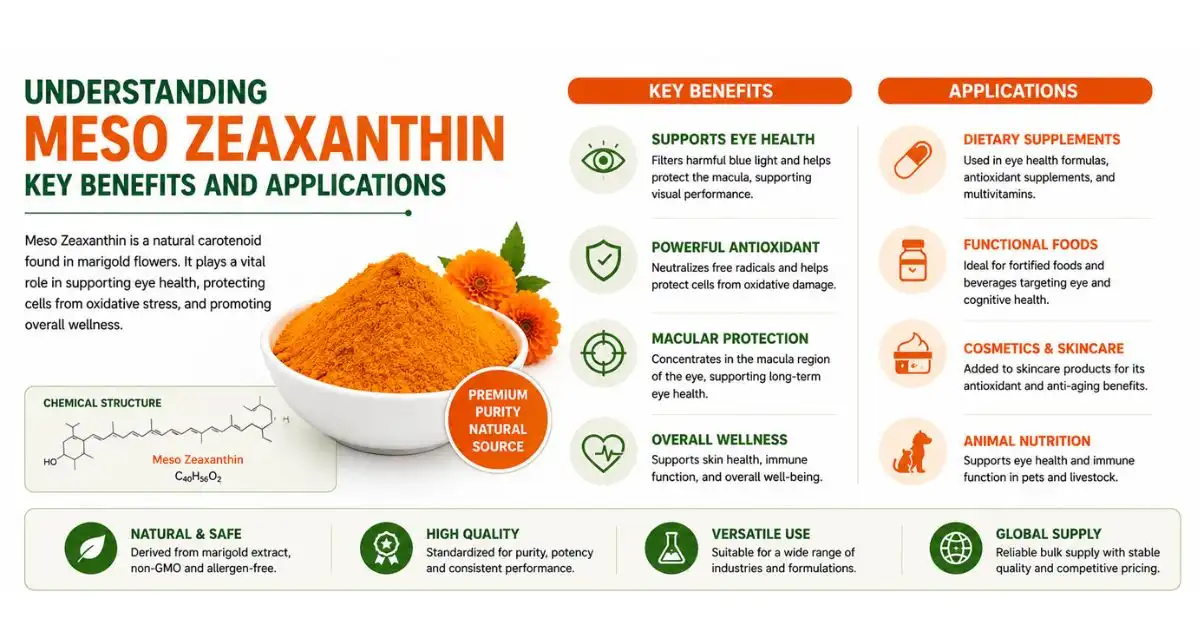
Understanding Meso Zeaxanthin: Key Benefits and Applications
Meso Zeaxanthin is one of three important carotenoids that make up the macular pigment in the human retina. When compared to zeaxanthin and lutein found in food, this stereoisomer mainly focuses at the foveal center, where it protects against oxidative damage and high-energy visible light.
What Makes Meso Zeaxanthin Different from Other Carotenoids?
This chemical is different from regular zeaxanthin (3R,3'R) because it has a unique (3R,3'S)-stereochemistry. Many people get lutein and zeaxanthin from their food, but Meso Zeaxanthin is not often found in everyday foods. The body can change lutein into this specific isomer, but metabolic performance varies a lot from person to person. Because of this biochemical fact, there is a need for direct supplements, especially among older consumers and people whose ability to convert nutrients into energy is impaired.
Clinical Applications Driving Market Demand
The AREDS2 study, which had 4,200 subjects over five years, showed that people who took macular carotenoids supplements had a lower chance of losing their sight. Eventually, though, researchers found that mixtures with all three carotenoids—including Meso Zeaxanthin—worked better than mixtures of lutein and zeaxanthin alone. Findings like this changed the way eye health products are made and made the 10:10:2 ratio (lutein:Meso Zeaxanthin:zeaxanthin) an accepted standard for all-around macular support goods.
Aside from preventing age-related macular degeneration, new uses cover a wide range of market groups. This ingredient is used by e-sports nutrition brands to improve contrast sensitivity and shorten the time it takes for the body to recover from photostress caused by prolonged screen exposure. Companies that make functional drinks use water-soluble (CWS) forms for projects that aim to make drinks healthier for older people. Its neuroprotective properties are used in cognitive performance supplements because macular pigment density is linked to brain health markers.
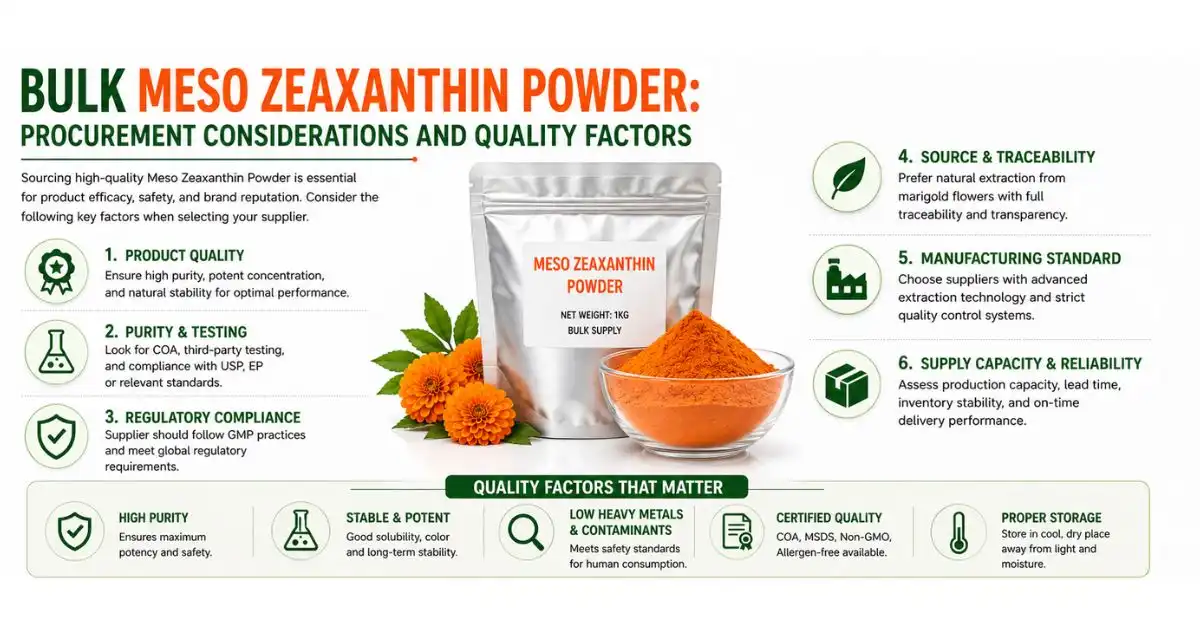
Bulk Meso Zeaxanthin Powder: Procurement Considerations and Quality Factors
When purchasing managers look at bulk providers, they have to decide which quality factors are most important at the same time. Because carotenoid chemistry is so complicated, it needs strict checks that go beyond just looking over certificates.
Purity Specifications and Analytical Verification
Specifications for the food industry usually run from 5% mixed carotenoid concentrates to 99% pure isolates for pharmaceutical use. The right purity level depends on what it will be used for. For example, 70–80% oil-soluble grades work well for softgel formulations, but 98%+ purity is needed for precision doses in clinical study materials, which can be proven through HPLC analysis. Normal methods can't tell the difference between zeaxanthin isomers, so chiral chromatography is needed to prove stereoisomer identity.
Yangge Biotech's range of specifications meets a wide range of product needs, including:
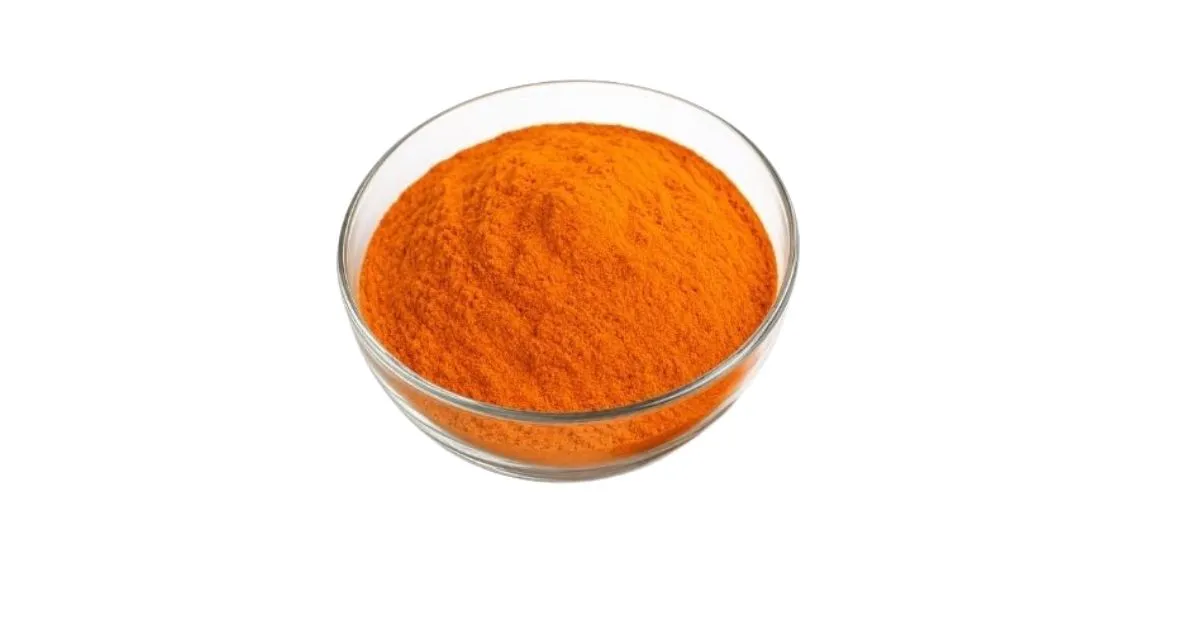
• Standard Oil-Soluble Range: Our 5%, 10%, 20%, 70%, and 80% ranges come as fine, yellow to orange powders that work best with lipid-based delivery systems. These types are good for softgel encapsulation because they absorb 40% more blue light than synthetic options while still being cost-effective for large-scale production.
• Ultra-Pure Water-Soluble CWS: The 99% Meso Zeaxanthin CWS grade looks like a reddish-orange powder that is very stable in water. This format makes it possible to add vitamins and minerals to drinks, improve dairy products, and create new ways to deliver medicines that need cold water to spread them out without causing precipitation during the pasteurization process.
Each batch is checked by separate labs to make sure it meets European PAH4 standards (Benzopyrene ≤10 ppb), is non-GMO, and doesn't contain any allergens. When compared to suppliers who only use in-house testing, the commitment to third-party validation greatly lowers the risk of procurement.
Certification Requirements for Global Markets
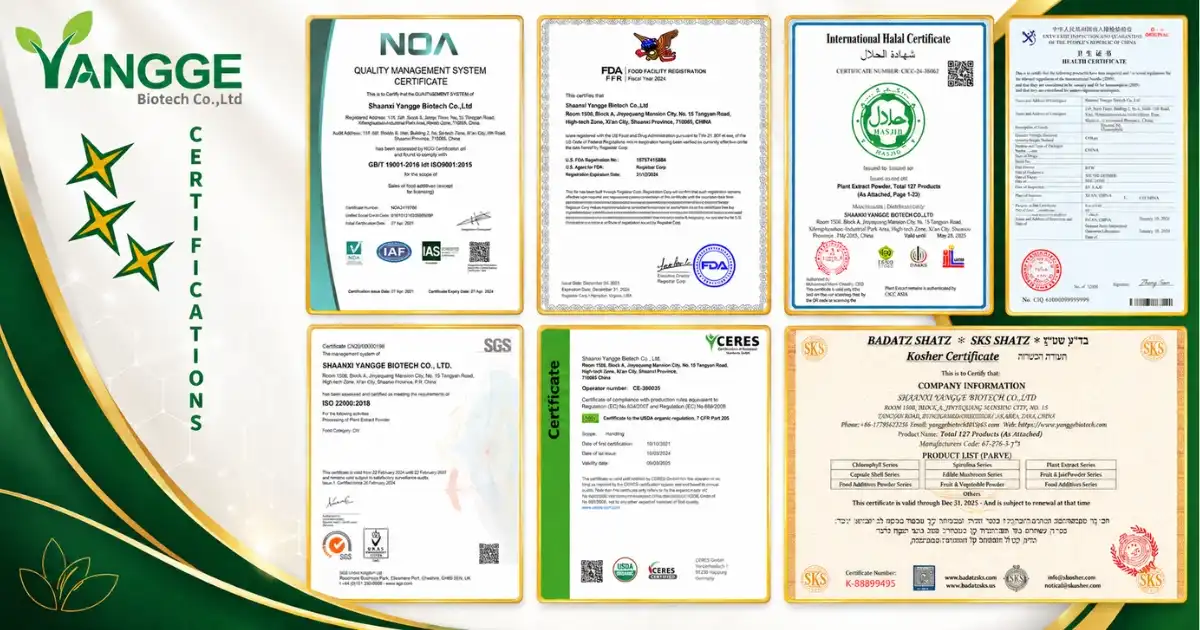
Manufacturing certifications show that operations are honest throughout all production processes. ISO certification shows that quality management is being done in a planned way, and GMP compliance makes sure that production methods are up to pharmaceutical standards. Certifications like Halal and Kosher make it easier for brands that cater to certain groups of people to sell their products. Purchasing teams that work with markets in North America and Europe should make sure that sellers keep their certifications up to date and have clear check trails.
Along with manufacturing qualifications, applications for finished goods often need specific paperwork for raw materials. Notifications of NDI (New Dietary Ingredient) in the US, Novel Food authorizations in Europe, and ingredient registration in Japan all require different amounts of paperwork. Working with sellers who know how to deal with foreign regulatory systems makes the process of registering products much easier later on.
Packaging and Storage Protocols
Protecting carotenoids from light, oxygen, and heat is very important for their stability. Pharmaceutical-grade packaging uses aluminum foil bags that are flushed with nitrogen and put inside opaque secondary containers. This multi-layer protection stops oxidative damage while the item is being stored or transported.
Standard minimum orders start at 1 kg and come in aluminum foil bags that can be used for testing in the lab or making small batches. When commercial quantities are shipped, they come in custom packaging that fits the needs of the production process. The ingredients will stay fresh for 24 months if they are stored properly in cases with tight lids, away from light, and at controlled temperatures.
Where to Buy Bulk Meso Zeaxanthin Powder Online: Market Overview
There are different types of suppliers in the global market for specialized carotenoid products, and each has its own pros and cons. Knowing about these types of suppliers helps procurement teams find the best ways to get goods.
Supplier Categories and Selection Criteria
Specialized botanical extract makers, like Yangge Biotech, only make useful ingredients that come from plants, Meso Zeaxanthin being one such example of their targeted natural carotenoid offerings. They learn a lot about extraction technology, quality control, and following the rules for nutritional uses. This usually means that specialized chemical suppliers can provide better technical support, formulation advice, and regulatory paperwork than basic chemical suppliers.
Trading companies and B2B platforms collect goods from many makers and give a wide range of ingredients with varying levels of quality. This model makes the supply chain more complicated and could leave gaps in quality control, but it is useful for exploring different suppliers. Direct relationships with manufacturers offer more openness, traceability, and communication, which is especially helpful when dealing with formulation issues or increasing production volumes.
Contract manufacturers who can also source ingredients are another option because they can combine the buying of raw materials with the making of finished goods. This method makes logistics easier, but it might limit the freedom of the formulation and the power to negotiate prices compared to companies that buy ingredients separately and make the product together.
Pricing Structures and Market Dynamics
The price of bulk items depends on many things, such as the pure grade, the amount ordered, the shipping terms, and the payment terms. The table below shows typical things to think about when setting prices for different grades of specifications:
| Grade of Specification | Common Use | Think About Volume | Indicators of Quality Premiums |
|---|---|---|---|
| 5 to 20 percent mixed carotenoids | nutrients that care about cost | Big savings for 25 kg or more | Checking the source and testing for PAHs |
| 70–80% Soluble in Oil | The best softgel formulations | Best price at 50 kg or more | Bioavailability and chiral purity data |
| 99% CWS (Soluble in Water) | Clinical products and functional drinks | Custom prices, minimum order 1 kg | Performance in terms of solubility and stability tests |
Partner pricing tiers that can't be used for spot purchases are often unlocked by annual procurement commitments. Brands that already have a lot of products on the market can benefit from making supply deals that last 12 to 24 months. This keeps prices stable and makes sure that ingredients are always available. Mid-sized nutraceutical companies want buyers to make annual volume commitments between $50,000 and $350,000. This puts buyers in a good position to get better prices and more flexible payment terms.
Geographic Considerations and Supply Chain Logistics
The position of a supplier has a big effect on shipping times, freight prices, and the complexity of regulations. Asian producers, especially those in China and India, make most of the world's plant extracts because they are close to sources of raw materials and already have infrastructure in place for extraction. For sea freight, shipping from Asia to North America usually takes 3–4 weeks, and for air freight, it takes 5–7 days. Depending on the location, customs clearance can add more time.
European buyers usually choose sellers based in the EU or well-known Asian exporters with European warehouse partnerships because they make customs procedures easier and cut down on wait times. Premium positioning in European markets, on the other hand, may be worth the extra time it takes to ship when Asian suppliers offer better quality control or unique technical skills.
Yangge Biotech keeps a stockpile of 50 to 100 kg of standard specs, which lets them quickly fill orders for both samples and large amounts that are used in business. Our long-term logistics partnerships make sure that international shipping is reliable and that all paperwork is clear, which helps with easy customs clearance in all major markets.
How to Choose the Right Meso Zeaxanthin Supplier for Your Business
Comparing prices is only one part of evaluating a supplier. You also need to look at their quality systems, professional skills, and partnership trustworthiness. Structured assessment frameworks help procurement teams make decisions about where to get things that are legal and in line with the company's long-term goals.
Quality Assurance and Testing Capabilities
A supplier's credibility is based on their ability to provide complete quality documentation. Ask for full Certificates of Analysis (CoA) for sample production runs and look at both the test results and the types of tests that were done. CoAs should include:
• Identity Confirmation: structure and stereochemistry of Meso Zeaxanthin are confirmed by HPLC or LC-MS.
• Purity Quantification: Assaying by percentage with strict limits.
• Contaminant Screening: Heavy metals (cadmium, lead, arsenic, and mercury), pesticide residues, microbiological counts, and PAH levels are all screened for.
• Physical Properties: How it looks, how the particles are distributed in size, how much water is in it, and how well it dissolves (for CWS grades).
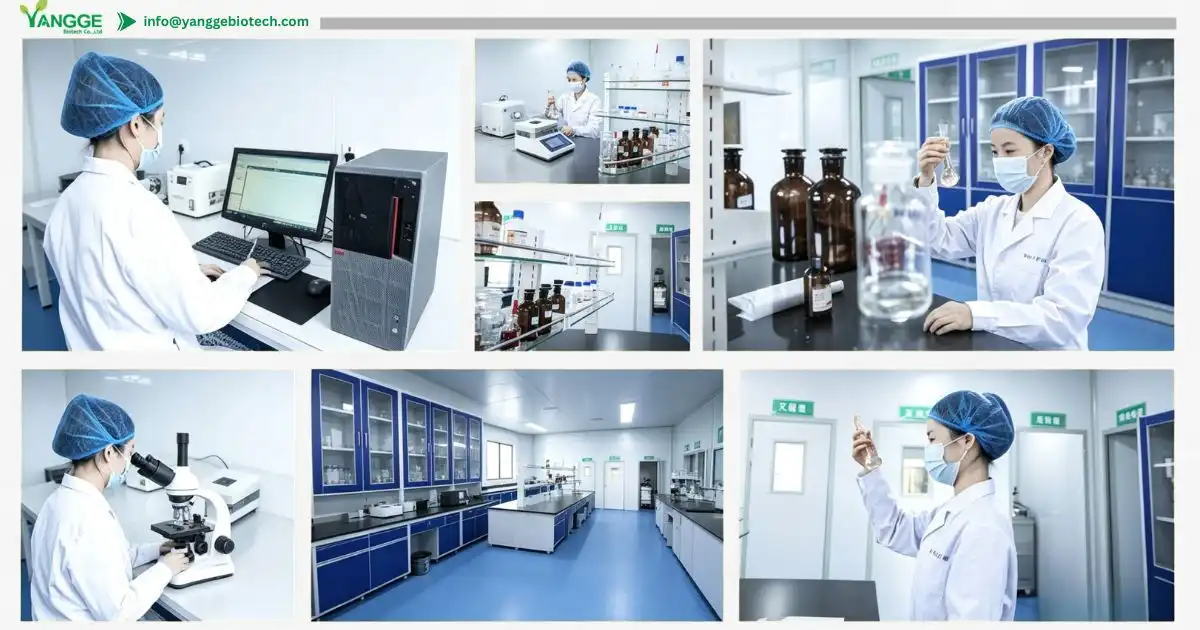
When suppliers work with testing labs that are known all over the world, it shows that they are committed to independent proof. Yangge Biotech works with licensed third-party labs to repeat methods and make sure that all batches are the same and that all production runs follow the rules.
Manufacturing Capacity and Supply Reliability
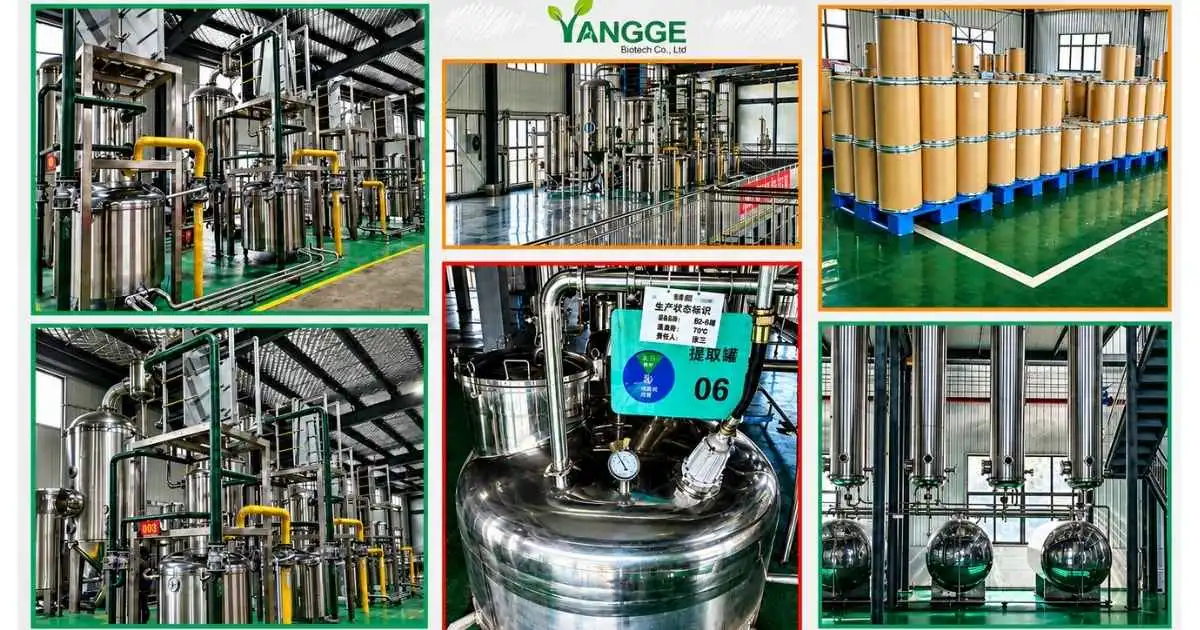
Supply continuity is directly affected by production capacity, especially as product lines grow. Find out how much is produced each year, how long it takes to make standard vs. special specs, and how much extra capacity is available during times of high demand. Suppliers with only one production line are more likely to be interrupted than suppliers with multiple production lines.
Transparency in the inventory gives people more confidence. When you know that your sellers keep working stock (for example, Yangge keeps 50–100 kg of key specs in stock), you can get your orders filled faster when there are market opportunities or sudden demand spikes. This inventory commitment shows that the supplier is sure that the product will be sold, and it lowers the risk of running out of stock for the buyer's production schedules.
Technical Support and Formulation Assistance
Because the science of carotenoid formulation is so complicated, being able to get expert help has a big effect on how well a product is developed. Check to see if possible providers provide:
• Advice on how to improve solubility for difficult delivery forms.
• Data from stability tests done in different pH, temperature, and light conditions.
• Bioavailability improvement methods using the right carrier systems.
• Help with regulatory paperwork for the product registration process.
Suppliers with specific research and development (R&D) teams can help with formulation issues, which speeds up the development process and cuts down on the cost of repeated reformulation rounds. When compared to supplier ties that are only transactional, this expert partnership aspect often explains small price increases.
Product Format Options and Customization Capabilities
Standard bulk powder is one format choice out of several that are available. Check to see if suppliers provide:
| Format Choice | What are the pros? | Common Uses |
|---|---|---|
| Powder that mixes with oil (5–80%) | Low-cost and suitable with softgels | Traditional supplements and oil-based mixtures |
| Soluble in water CWS (99%) | Fortifying drinks, better bioavailability | Functional drinks, pills that fizz, and sweets |
| Microencapsulation made to order | Better stability and controlled release | High-end products and tough formulation environments |
| Sachets that are already measured out | Less handling and easier dosing | Clinical tests, giving out samples |
Yangge Biotech offers both standard oil-soluble grades and advanced CWS technology. They can also do OEM packaging, which lets them make custom packaging configurations. This gives brands the freedom to improve the performance of formulations while streamlining production workflows to fit the needs of their unique manufacturing tools and methods.
Steps to Place Your Bulk Order: Best Practices and Buyer Tips
Strategic procurement planning turns getting ingredients from something that needs to be done into a way to gain a competitive edge. By following structured ordering protocols, you can get the most value out of your supply chain while minimizing risks.
Pre-Order Preparation and Specification Confirmation
To do successful procurement, you must first clearly define your own needs before you start looking for suppliers. Write down exact details, such as the purity grade, testing parameters needed, preferred packaging, and expected delivery date. This planning makes it possible to ask for accurate quotes and lowers the chance of misunderstandings during the order placement process.
Sample review is an important step before placing an order, especially when working with new suppliers or trying out new ingredient forms. Ask for example samples that match the specs of the goods you want to buy, and then check them both in-house and in an independent lab. Use uniform evaluation criteria to compare multiple sellers at the same time and compare their performance objectively.
When you look at examples, you should look at more than just the technical specs on the certificate. Things like how the powder flows, how it dissolves, how consistent the color is, and how well it works with the carrier systems you want to use all affect how efficiently the production process works—and for ingredients like Meso Zeaxanthin, these physical performance traits are especially critical. These measures of success in the real world might show changes in quality that can't be seen from analytical data alone.
Negotiation Strategies for Optimal Terms
Negotiating prices involves more than just unit cost; it also involves the total cost of ownership. When reviewing supplier offers, you should think about how flexible the payment terms are, how the freight costs are split, the minimum order quantities, and the length of the contract. Tiered pricing is often unlocked by volume commitments, but you need to weigh the costs of carrying inventory and the uncertainty of demand against your committed purchase obligations.
Payment terms have a big effect on how you manage your working capital. Standard terms usually include a 30–50% deposit, with the rest due before the shipment or when you show proof of delivery. With established relationships, you may be able to get net-30 or net-60 payment terms, which will make managing your cash flow easier. But sellers who offer unusually good payment terms without a history of working together may be a sign of financial instability or lower quality.
Ask for specific freight quotes that are separate from the prices of the products. This will let you compare different shipping methods and logistics companies. Suppliers who have long-term shipping partnerships can often get better freight rates than individual buyers. However, independent freight forwarding can sometimes lower the costs of large shipments.
Quality Verification Before Final Acceptance
The last quality check that happens before orders are accepted and processed is the review of the certificate of analysis. Check that the real test results are within the numbers that were given and that the testing method follows the rules set by the industry. If there are differences between what was bought and what was delivered, the seller needs to be contacted right away before payment is released or ingredients are added to the production process.
Keeping backup samples from every lot that is received makes it possible to track down problems and look into the quality if they happen later on. As a general rule, sealed samples should be kept in the right way for the full six months plus the shelf life of the finished product. This paperwork helps with following the rules and makes it easier to find the root cause if there are quality issues after the product has been released.
For important production starts or high-value sales, you might want to hire independent labs to test the materials you receive to make sure they are what you thought they were. This proof not only adds time and cost, but it also gives more trust, especially when working with new suppliers or adding new ingredients to existing product lines.
Conclusion
When you buy Meso Zeaxanthin powder in bulk, you need to pay close attention to quality checks, the supplier's abilities, and the formulation needs. The market for eye health supplements is becoming more aware of the scientific basis for full macular carotenoid formulations. This is creating a strong need for ingredients that have been tested and are very pure.
A good procurement process combines quality standards with business needs by putting an emphasis on purity checks, following the rules, and getting expert help from suppliers while negotiating fair prices. Yangge Biotech specializes in carotenoids that come from marigolds. We are also committed to third-party testing, sustainable sourcing, and a range of specification choices. This makes us a reliable partner for companies making vision-supporting goods based on proof.
FAQ
What purity level should I specify for eye health supplement formulations?
The purity needs depend on how precise the dosage needs to be and the format of the formulation. Most softgels use 70–80% oil-soluble grades, which offer a great balance between price and performance. On the other hand, 98–99% pure CWS grades are better for precision clinical formulations or water-soluble applications. Independent HPLC testing is the only way to be sure of the purity, since certificate standards alone can't guarantee batch uniformity.
How does meso zeaxanthin differ from standard zeaxanthin in supplements?
Different stereochemical arrangements make them different. Meso Zeaxanthin is the (3R,3'S) isomer, while dietary zeaxanthin is the (3R,3'R) isomer. This change in structure decides where in the retina Meso Zeaxanthin is found, with the highest concentration at the foveal center. This is where macular pigment density is most important for protecting against blue light and acting as an antioxidant. Comprehensive eye health formulas have both isomers plus lutein to cover the whole macular area.
What are typical international shipping timelines for bulk orders?
It usually takes three to four weeks for sea freight from Asian suppliers to ports in North America. Customs clearance can add another three to seven days, depending on how complete the paperwork is. Air freight cuts travel time to 5–7 days, but it costs a lot more. European destinations have similar schedules, though clearance times may be longer because of EU customs rules. Planning purchase cycles around these dates keeps output from being interrupted.
Partner with Yangge Biotech for Premium Meso Zeaxanthin Supply
Yangge Biotech provides pharmaceutical-grade Meso Zeaxanthin powder that was made for companies that make eye health supplements and need to make sure they have a steady supply. Our materials come from marigolds and range in quality from 5% to 99%. They can be used in a wide range of formulations, from low-cost softgels to high-tech water-soluble drinks. We make sure that every batch meets strict European PAH standards and stays non-GMO and allergen-free by getting ISO, HALAL, and other third-party testing certificates.
Our plan for sustainable sourcing focuses on using green energy, community development partnerships, and being able to track food from farm to table. In addition to providing ingredients, our specialized research and development (R&D) team helps you with technical formulation, stable testing data, and regulatory paperwork throughout the entire process of developing your product. Our service model is flexible enough to work for both new brands and well-known manufacturers. You can order sample amounts (1 kg MOQ) for the first evaluation or commercial volumes backed by annual supply agreements.
Contact us or email our purchasing agents at info@yanggebiotech.com to ask about product details, sample availability, and personalized quotes. Let's work together to make sure that people all over the world can get scientifically proven eye aids. You can find more detailed information and composition tips at blog.yanggebiotech.com.
References
1. Age-Related Eye Disease Study 2 Research Group. "Lutein + Zeaxanthin and Omega-3 Fatty Acids for Age-Related Macular Degeneration: The Age-Related Eye Disease Study 2 Randomized Clinical Trial." Journal of the American Medical Association, vol. 309, no. 19, 2013, pp. 2005-2015.
2. Connolly, Emily E., et al. "Augmentation of Macular Pigment Following Supplementation with All Three Macular Carotenoids: An Exploratory Study." Current Eye Research, vol. 35, no. 4, 2010, pp. 335-351.
3. Nolan, John M., et al. "Macular Pigment and Percentage of Body Fat." Investigative Ophthalmology & Visual Science, vol. 45, no. 11, 2004, pp. 3940-3950.
4. Bone, Richard A., et al. "Stereochemistry of the Human Macular Carotenoids." Investigative Ophthalmology & Visual Science, vol. 34, no. 6, 1993, pp. 2033-2040.
5. Thurnham, David I. "Macular Zeaxanthins and Lutein—A Review of Dietary Sources and Bioavailability." British Journal of Nutrition, vol. 96, suppl. 1, 2007, pp. S20-S23.
6. Akuffo, Kwadwo Owusu, et al. "Sustained Supplementation and Monitored Response with Differing Carotenoid Formulations in Early Age-Related Macular Degeneration." Eye, vol. 29, no. 7, 2015, pp. 902-912.

Based on your location and order quantity, you will have the opportunity to receive a limited time free shipping promotion!
Who we are
Popular Blogs