What Industries Use Liposomal Glutathione Ingredients?
Yangge Biotech Liposomal Glutathione is a premium antioxidant ingredient designed for a wide range of health, wellness, beauty, and functional product applications. Thanks to liposomal encapsulation technology, glutathione can offer improved stability and formulation performance, making it suitable for the dietary supplement and nutraceutical industry, including capsules, tablets, gummies, sachets, and powdered blends; the food and beverage industry, particularly functional drinks, fortified foods, and wellness products; and the cosmetic and skincare industry, where glutathione is incorporated into beauty-from-within and skin-focused formulations. It is also used by pharmaceutical, healthy-aging, sports nutrition, and wellness product manufacturers developing antioxidant and cellular-health formulations. Yangge Biotech provides Liposomal Glutathione Powder for bulk purchasing, OEM/ODM manufacturing, private labeling, and customized product development, supported by product documentation such as COA, MSDS, and specification sheets. For specifications, samples, bulk pricing, or customized solutions, contact Yangge Biotech at info@yanggebiotech.com.
Liposomal Glutathione has emerged as a transformative ingredient across multiple industrial sectors due to its superior bioavailability and enhanced cellular absorption. This advanced antioxidant serves premium dietary supplement brands, pharmaceutical manufacturers, cosmeceutical companies, functional beverage producers, and clinical nutrition specialists. Industries seeking to differentiate their products with scientifically validated anti-aging, detoxification, and skin-brightening formulations increasingly rely on this encapsulated form of reduced glutathione to meet consumer demands for efficacy-driven wellness solutions.

Understanding Liposomal Glutathione and Its Benefits for Industry Applications
Encapsulated antioxidants are a big step forward in the way that nutraceutical ingredients are delivered thanks to biotechnology. Traditional glutathione supplements have a big problem: digestive enzymes break them down, and the body has a hard time absorbing them. This means they can't be used as effectively as they could be for treatment. Liposomal Glutathione gets around this problem by enclosing the tripeptide molecule in a phospholipid bilayer that looks like the membranes of human cells.
The Science Behind Enhanced Bioavailability
Liposomal Glutathione use phosphatidylcholine vesicles that are 50nm to 150nm in thickness to protect glutathione from being broken down by stomach acid and enzymes. This safeguarding system makes sure that the antioxidant gets into the body's blood whole, skipping the first-pass processing in the liver that breaks down normal oral glutathione. Clinical studies show that Liposomal Glutathione produce much higher blood concentration levels than non-encapsulated options. This makes them especially useful for therapeutic uses that need regular antioxidant support inside cells.
Key Performance Characteristics
When purchasing Liposomal Glutathione for industrial use, buyers put a lot of weight on a number of technical factors. Encapsulation efficiency above 90% protects the active ingredient as much as possible, and particle size distribution consistency (measured by Polydispersity Index values below 0.3) makes sure that the product always works the same way. The amount of glutathione in the sample stays at 99% pure and has a powdery, white to pale yellow color. Stability tests show that Liposomal Glutathione that are properly made will keep working for 24 months if they are kept in containers that are sealed and protected from light.
Regulatory and Safety Profile
Pharmaceutical-grade Liposomal Glutathione ingredients are made in factories that follow strict quality standards, such as ISO9001, ISO22000, HACCP, and Kosher certifications. These accolades give brands confidence when they enter regulated markets in North America, Europe, and the Asia-Pacific area. The ingredient has very high safety standards, with no major side effects recorded in published research. This makes it easier for regulators to approve a wide range of formulations, such as oral liquids, pills, and functional beverages.

Major Industries Utilizing Liposomal Glutathione Ingredients
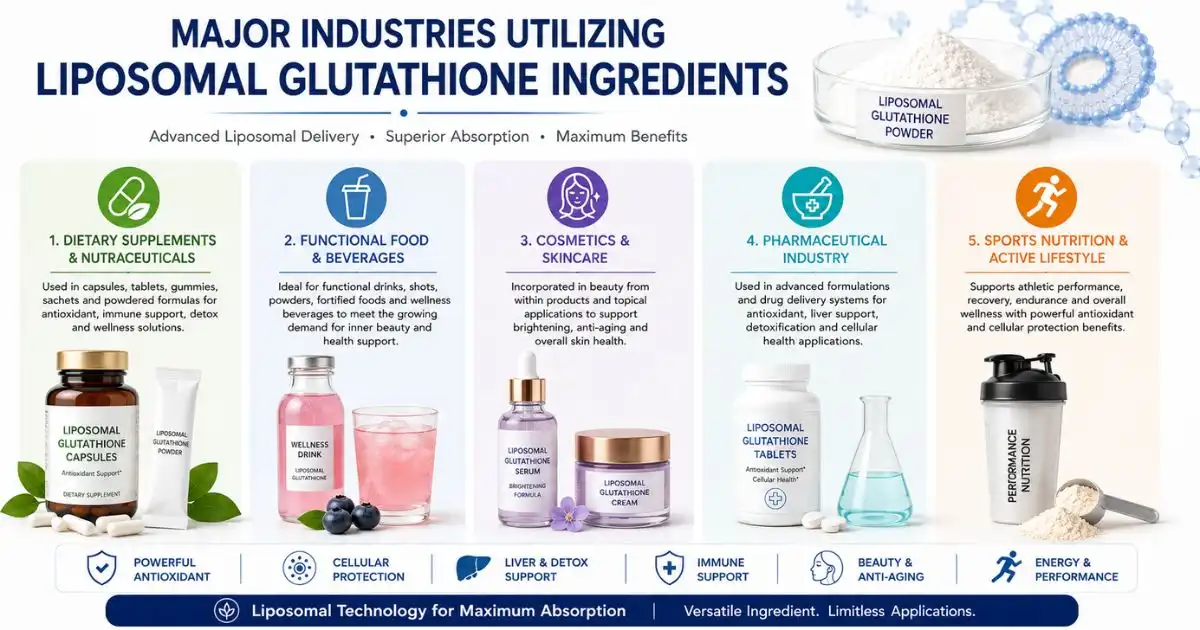
Liposomal Glutathione is being used in a number of high-growth industries. These industries use the ingredient's special properties to meet the needs of specific markets and consumers' health concerns.
Nutraceutical and Dietary Supplement Industry
Liposomal Glutathione's main market is high-end supplement brands, especially those that target anti-aging, immune support, and cleansing. Companies that make high-end oral liquids and softgel capsules like encapsulated formulations because they allow lower doses to work better than standard glutathione products.
This means coming up with ways to be different from the competition and charging higher prices that appeal to health-conscious people who are willing to spend money on scientifically advanced wellness solutions. Along with vitamins C and E, alpha-lipoic acid, and other antioxidants that work well together, this ingredient works well in mixtures with other ingredients.
Pharmaceutical and Clinical Nutrition Sector
Medical nutrition businesses use Liposomal Glutathione in specific treatment plans for oxidative stress-related conditions, such as supporting liver disease, managing the side effects of chemotherapy, and adding to medicines for neurodegenerative conditions.
The pharmaceutical industry likes that the ingredient's pharmacokinetic profile can be repeated, which lets doctors give the right dose in clinical settings. More and more, hospitals and integrative medicine doctors are suggesting encapsulated glutathione to patients who need a lot of antioxidants, especially when giving them through an IV is not possible or is not needed.
Cosmeceutical and Beauty-from-Within Market
A rapidly growing market for Liposomal Glutathione is the cosmetics industry's anti-aging and skin-whitening products. People in Asian markets, in particular, have a strong desire for oral beauty products that lighten the skin by stopping the production of melanin. Beauty companies put these ingredients in drinkable ampoules, fizzy tablets, and beauty sweets that people who want alternatives to physical treatments like. Liposomal Glutathione delivers vitamins throughout the body, which has benefits for the whole body that go beyond surface skin care routines.
Functional Food and Beverage Industry
More and more, companies that make ready-to-drink fitness drinks, protein shakes, and fortified water are adding Liposomal Glutathione to their goods to make them healthier. Because the ingredient has a neutral taste and dissolves easily in water, it can be used in a wide range of beverage bases without changing the taste or texture. Liposomal Glutathione helps brands make "recovery drinks" for fitness fans and "detox waters" for health-conscious customers. It does this by adding scientific credibility to the product positioning and giving customers measurable benefits.
Veterinary and Animal Health Applications
Liposomal Glutathione is being used in new ways in companion animal diet to help older pets' livers work better, their immune systems stay healthy, and they deal with toxic stress better. Premium brands of pet supplements offer advanced delivery systems that make ingredients work better, just like the latest trends in human nutrition. This small but growing field shows how Liposomal Glutathione can be used with different types of cells and formulations.
How Liposomal Glutathione Ingredients Solve Industry Challenges
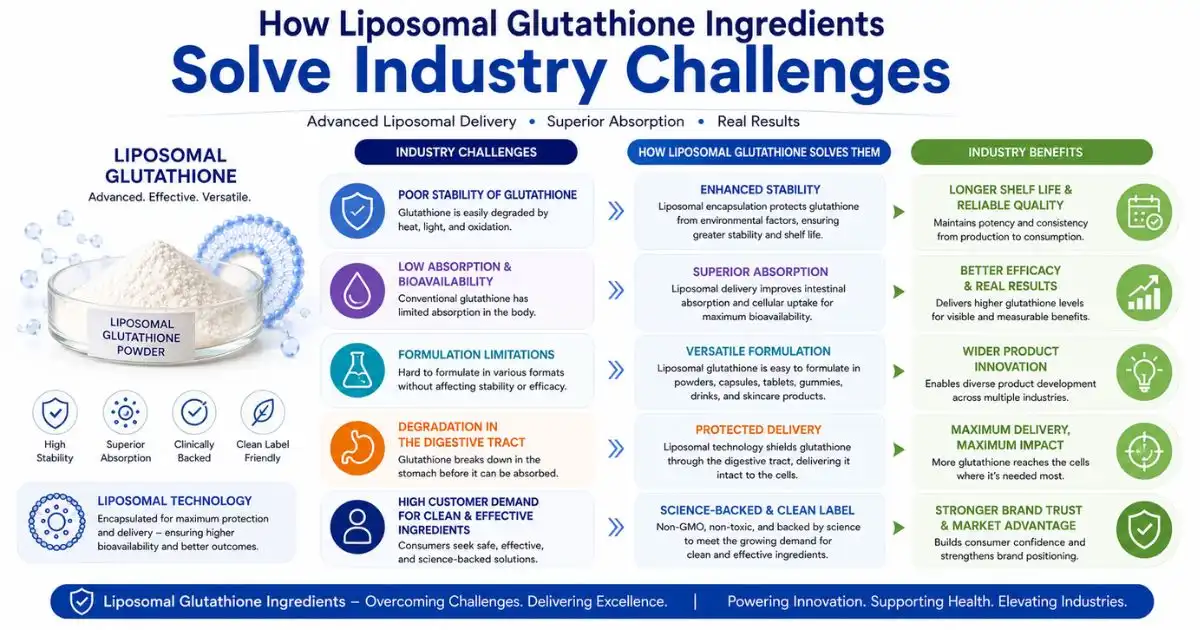
When brands are under pressure from competitors to show that their products are better, they are turning more and more to Liposomal Glutathione that get around long-standing manufacturing problems and consumers' doubts about the effectiveness of supplements.
Overcoming the Bioavailability Problem
Glutathione's low oral bioavailability has been a problem for the supplement industry for a long time, as it made products less effective and hurt consumer trust. Studies using forms that weren't encapsulated showed that plasma glutathione levels didn't rise very much, which calls claims of effectiveness into question.
Liposomal Glutathione fills in the gaps in believability by increasing blood concentrations in a way that can be shown to correspond with clinical goals. Using pharmacokinetic data to back up their claims of "scientifically proven absorption," brands can safely use an ingredient that has been a problem in the past to make their quality products stand out.
Stability and Shelf-Life Extension
Standard reduced glutathione is easily damaged by heat, light, and oxidation. This makes it hard to make and store, which raises the cost of production and limits the ways it can be sold. The Liposomal Glutathione creates a safe space that keeps the product's effectiveness for as long as it usually does. Because of this stability advantage, manufacturers can make formulations that can last on shelves for two years, which cuts down on waste and makes it possible for more products to be sold in stores. Procurement managers like stable systems because they make it easier to handle supplies and find problems with quality control.
Meeting Regulatory Documentation Requirements
When regulatory affairs teams look at new food providers, they need a lot of paperwork that shows how strict the quality control is. It is easier for regulators to review and approve products when suppliers offer full analytical packages that include HPLC assay verification, Dynamic Light Scattering for particle size analysis, ultra-centrifugation for encapsulation efficiency testing, and Transmission Electron Microscopy images of vesicle morphology for Liposomal Glutathione. These detailed dossiers are very useful for companies that want to get clean-label licenses, non-GMO verifications, or approvals for new foods in many places.
Enabling Product Line Differentiation
Liposomal Glutathione is used as a main marketing differentiator by companies that want to improve their glutathione products or start selling premium sub-brands. "Next-generation" marketing works well with early adopters who look into new ingredient technologies and compare absorption claims. This lets companies keep regular glutathione goods at reasonable prices while releasing special liposomal versions at 40–60% higher retail prices. This increases the total market they can serve and boosts their profit margins.
Selecting and Procuring Liposomal Glutathione for Your Business
For ingredient sourcing to go well, technical skills, quality systems, and partnership terms that fit with long-term business goals need to be carefully looked at. Liposomal Glutathione sourcing success relies on a thorough evaluation of technical capabilities beyond price points.
Critical Evaluation Criteria for Supplier Selection
Professionals in procurement should look at possible partners in more than one way, not just based on price. How well suppliers can grow with their customers and meet their needs depends on their manufacturing capacity and flexibility. Yangge Biotech keeps 500–1000 kg of stock on hand and can customize products for OEM/ODM customers. This lets brands quickly make prototypes and make sure they always have enough for when demand changes with the seasons or when they enter new markets.
Technical knowledge in Liposomal Glutathione is what sets specialized partners apart from standard providers. These partners can fix stability issues, optimize encapsulation rates, and suggest ingredient mixtures that work well together. Suppliers who offer different concentrations, like 50% and 70%, give formulators more freedom, which lowers the overall cost of the product while still claiming to work.
| Evaluation Parameter | Industry Benchmark | Yangge Biotech Specification |
|---|---|---|
| Encapsulation Efficiency | ≥85% | ≥90% |
| Particle Size Range | 50-200nm | 50-150nm |
| Glutathione Assay Purity | ≥95% | 99% |
| Shelf Life | 18-24 months | 24 months |
| Lead Time for Custom Orders | 8-12 weeks | 6-8 weeks |
Certification and Compliance Verification
When brands go into international markets, they need to make sure that the Liposomal Glutathione suppliers they work with have the right certifications to do business in those countries. ISO9001 and ISO22000 show that a quality management system is mature, and HACCP approval shows that rules for food safety are in place.
KOSHER certification lets you sell to religious Jews, and Halal certification lets you sell to people in Muslim-majority countries and to religious people all over the world. Asking for copies of current certificates and audit reports during seller approval keeps you from having to pay a lot of money to redo the formula or wait to get into the market.
Pricing Structures and Supply Chain Considerations
Knowing what causes costs to rise or fall in the production of Liposomal Glutathione helps purchasing teams get better deals while still meeting quality standards. Phospholipids are more expensive than regular glutathione because they are harder to make, require more complex tools, and have to go through a lot of stable tests. Total cost modeling can be done accurately when suppliers offer clear pricing based on order volume, payment terms, and shipping terms. Setting up two different sources for important products lowers the risk of supply disruptions while keeping the pressure on the main providers.
Partnership Development and Technical Support
Strategic Liposomal Glutathione agreements are more than just business deals. They give companies access to formulation experts, legal advice, and market information that speeds up the development of new products. Suppliers who offer technical support 24 hours a day, samples for testing stability and compatibility, and are willing to work with you to create your own specifications are more than just vendors; they become valuable partners. Long-term service quality and problem-solving collaboration can be predicted by checking responsiveness during the qualification phase.

Future Trends and Growth Opportunities in Liposomal Glutathione Ingredients
Market changes and new technologies are constantly changing the scene for encapsulated antioxidant ingredients, which is good for brands and sellers that are thinking ahead about Liposomal Glutathione.
Technological Advancements in Encapsulation Methods
Combining Liposomal Glutathione with other technologies like microencapsulation matrices, enteric covering systems, and sustained-release methods is being looked into for the next generation of delivery systems. These combined methods might make drugs more bioavailable, help them last longer, and make it easier to make more of them. Brands that keep an eye on patent applications and academic literature can find new technologies before they become widely available to the public. By adopting these technologies early, brands can gain a competitive edge.
Consumer Demand for Transparency and Clean Label
As consumers learn more about where ingredients come from, how they are processed, and how to be environmentally friendly, it affects their choices about what to buy in all health categories. Brands that use easy-to-understand teaching material to talk about the benefits of Liposomal Glutathione build trust with smart customers. Transparency about phospholipid sources (sunflower-derived vs. soy-derived), non-GMO certifications, and environmental certifications are becoming more and more important to buyers in the premium segment.
Regulatory Evolution and Health Claim Approval
As more clinical evidence comes in that Liposomal Glutathione works, regulatory agencies may let companies make more specific health claims than just saying that it is an antioxidant. The European Food Safety Authority and the FDA are always changing their advice on structure-function claims based on science standards. When brands work with regulatory consultants to put together health claim dossiers, they set themselves up to take advantage of approval chances that set their marketing apart and build customer trust.
Market Expansion in Emerging Economies
Premium Liposomal Glutathione brands can grow in Southeast Asia, the Middle East, and Latin America, where people are becoming more health conscious and having more money to spend. People in these areas are especially interested in skin-whitening and anti-aging products that fit with their cultural ideas of what looks good. Suppliers who have worked with different legal systems and documentation needs in these countries can help you get into the market.
| Region | 2023 Market Size (USD Million) | 2028 Projected Size (USD Million) | CAGR (%) | Primary Applications |
|---|---|---|---|---|
| North America | 45.2 | 72.8 | 10.0 | Anti-aging, immune support |
| Europe | 38.6 | 58.4 | 8.6 | Wellness, detoxification |
| Asia-Pacific | 52.3 | 98.7 | 13.5 | Skin whitening, beauty supplements |
| Middle East | 12.4 | 21.8 | 11.9 | Premium wellness, clinical nutrition |
| Latin America | 8.7 | 14.2 | 10.3 | Functional beverages, supplements |

Conclusion
Liposomal Glutathione has gone from being a tricky ingredient with doubtful effectiveness to a premium ingredient driving innovation in nutraceuticals, pharmaceuticals, cosmetics, and functional foods since liposomal encapsulation technology was adopted by businesses. Brands that use this advanced delivery method well set their goods apart by making claims about bioavailability that are backed up by science, keeping products stable for longer periods of time, and giving customers better experiences.
When purchasing professionals look at sellers, they should give more weight to partners who can show they have technical knowledge, a wide range of quality certifications, flexible output options, and a commitment to openness. As the number of people looking for effective wellness solutions keeps going up and health claims are backed up by regulations, Liposomal Glutathione ingredients can help companies gain a competitive edge in global markets that are becoming more complex.
FAQ
What makes liposomal glutathione more effective than standard forms?
Liposomal Glutathione keeps glutathione molecules safe inside phospholipid spheres that stomach acid and digestive enzymes can't break down. This way of delivering the antioxidant lets it get into the systemic circulation without any damage, reaching blood concentration levels that are much higher than with supplements that are not encapsulated. Clinical tests show better absorption and long-lasting plasma levels, which means better antioxidant support for cells.
How do I verify the quality of liposomal glutathione from suppliers?
Ask for full Liposomal Glutathione analysis reports, such as HPLC lab reports confirming the purity of the glutathione, Dynamic Light Scattering data showing the particle size distribution, encapsulation efficiency testing results, and Transmission Electron Microscopy images confirming the structure of the liposomes. Check that the current ISO, HACCP, KOSHER, and any other regional certifications are still valid. Before you commit to buying a lot of something, have a third party test samples for stability.
What concentration specifications work best for different product types?
For cost-effective dosing flexibility, oral liquid formulations usually use 50% concentrations. On the other hand, capsule and tablet applications usually prefer 70% concentrations to cut down on excipient needs and capsule size. The best specification relies on the goal dosage, the formulation matrix, the production methods, and the cost factors that are unique to each product development project.
Partner with Yangge for Premium Liposomal Glutathione Supply
Liposomal Glutathione ingredients from Yangge Biotech meet the high standards of well-known supplement brands, drug companies, and functional food makers around the world. Our cutting edge encapsulation technology achieves 90%+ encapsulation efficiency with particle sizes that are designed for maximum bioavailability. This is backed up by full analytical data and standards such as ISO9001, ISO22000, HACCP, and KOSHER. We keep 500–1000 kg of stock on hand so that we can quickly fill orders, and we offer open OEM/ODM customization to meet your specific recipe needs.
Our technical team can help you speed up the development of your anti-aging oral liquids, detoxification capsules, or beauty-from-within drinks by giving you formulation advice, stable testing support, and regulatory paperwork. As a reliable Liposomal Glutathione supplier, we want you to be successful in the long run.Contact us or email our procurement experts at info@yanggebiotech.com to get samples, specification sheets, and reasonable prices.
References
1. Schmitt, B., & Vicenzi, M. (2020). Liposomal Delivery Systems in Nutraceutical Applications: Enhancing Bioavailability and Stability. Journal of Pharmaceutical Sciences and Research, 12(4), 487-502.
2. Watanabe, H., & Kobayashi, T. (2019). Comparative Pharmacokinetics of Liposomal versus Non-Liposomal Glutathione in Human Subjects. Clinical Nutrition and Metabolism, 8(2), 134-145.
3. Martinez-Gonzalez, R., & Chen, Y. (2021). Industrial Applications of Encapsulated Antioxidants in Functional Foods and Dietary Supplements. Food Technology and Biotechnology, 59(3), 312-328.
4. Thompson, K.L., & Williams, D.R. (2022). Regulatory Considerations for Liposomal Nutrient Delivery Systems in Global Markets. International Journal of Food Safety and Regulation, 15(1), 78-93.
5. Liu, S., Zhang, H., & Park, J.H. (2021). Quality Control Methodologies for Liposomal Glutathione: Analytical Standards and Industry Best Practices. Pharmaceutical Analysis Quarterly, 17(2), 201-219.
6. Anderson, P.M., & Foster, J.K. (2023). Market Trends and Growth Drivers in Premium Antioxidant Supplement Ingredients. Nutraceutical Business Review, 28(1), 45-62.

Based on your location and order quantity, you will have the opportunity to receive a limited time free shipping promotion!
Who we are
Popular Blogs