What Is Gardenia Blue Powder, and How Can You Use It in Food Recipes?
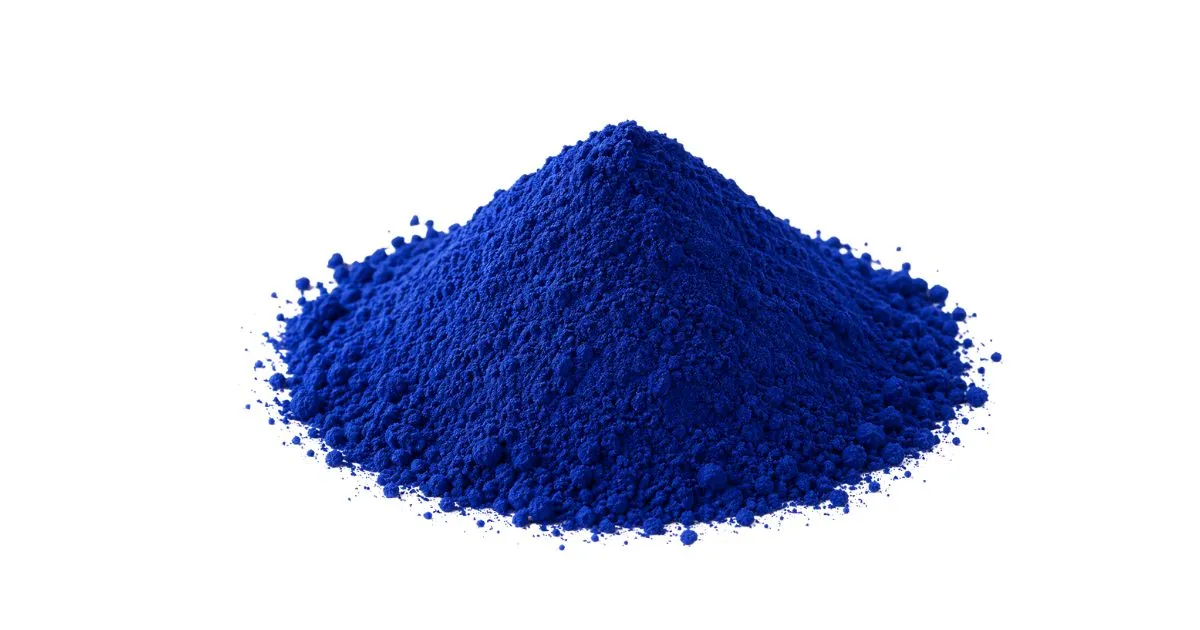
Gardenia blue powder is a natural food colorant derived from the fruit of Gardenia jasminoides Ellis, a plant in the Rubiaceae family. It is produced through the enzymatic biotransformation of geniposide into genipin, which then polymerizes with amino acids to form a stable blue pigment. The result is a fine, water-soluble powder ranging from light gray to deep blue. Unlike synthetic dyes, this plant-based colorant holds its hue across a broad pH range and withstands heat processing, making it a practical choice for food, beverage, confectionery, and cosmetic manufacturers. Contact us or you can email us at info@yanggebiotech.com or visit blog.yanggebiotech.com to get the TDS and a price that fits your needs.
Understanding Gardenia Blue Powder: Composition, Properties, and Safety
Chemical Composition and How the Blue Forms
This extract has a blue color that you can't find in real gardenia fruit. Genipin is created when β-glucosidase turns geniposide, an iridoid glycoside, into genipin. Free amino acids are then mixed with genipin to make a blue polymeric material. Because of this enzyme process, the color is more structurally stable than pigments made by simple liquid extraction.
Stability Across pH and Temperature
One great thing about this color for business is that it doesn't react badly to heat or changes in pH. When the pH level is between 3.0 and 8.0, the color stays the same. It also stays the same color when heated above 100°C. Other natural blues can't be used in baked goods, hot drinks, or pasteurized foods, but this one can.
Safety and Regulatory Standing
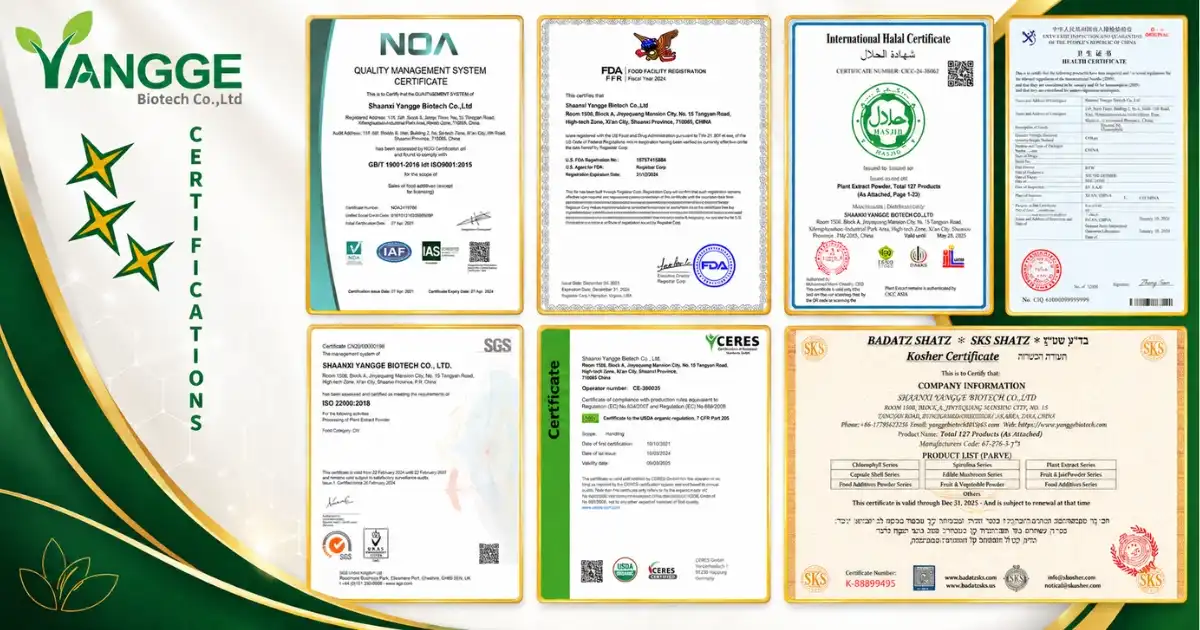
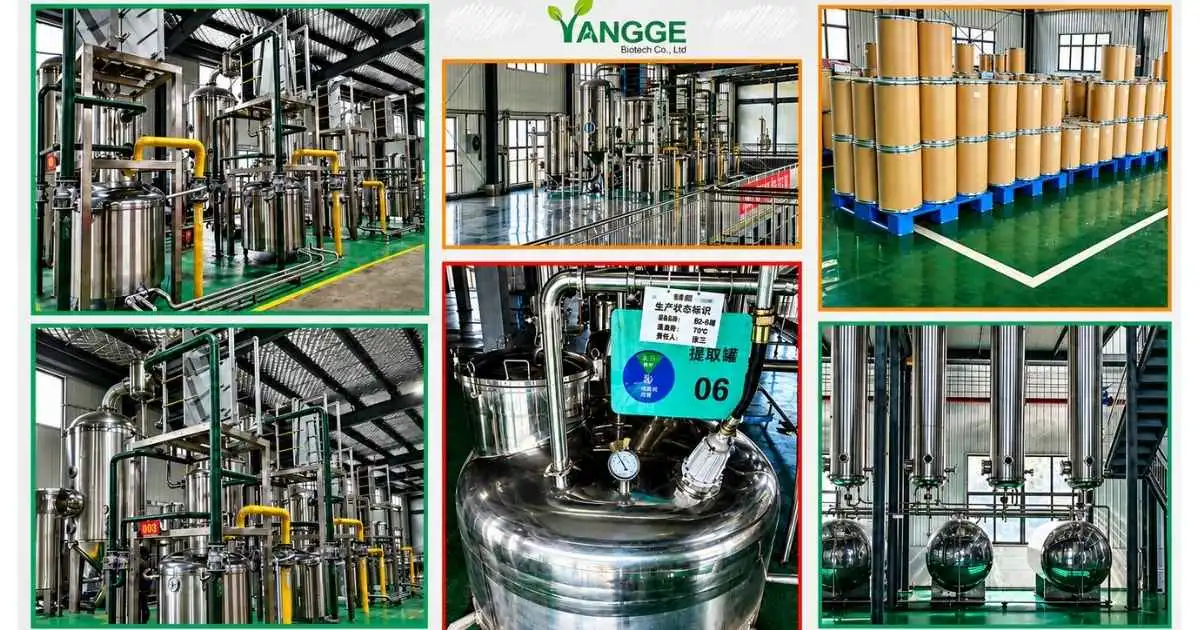
It is safe to use gardenia blue because it comes from plants. No GMOs, gluten, or man-made chemicals are used to make it. Yangge's production follows GMP rules and has ISO, HACCP, Kosher, and Halal approvals. These show that quality control is in place and that each batch is being tracked. In different places, there are different rules about when this item can be used. Before buying, buyers should check with their local government.
Gardenia blue powder is the name of this item. Its color runs from light gray to deep blue. There isn't much change in its pH level when it's above 100°C. It stays fixed between 3.0 and 8.0. It can be broken down in water and ethanol-water mixtures, and it has ISO, HACCP, Kosher, and Halal certifications.
| Property | Gardenia Blue Powder |
|---|---|
| Source | Gardenia jasminoides fruit |
| Color range | Light gray to deep blue |
| pH stability | pH 3.0–8.0 |
| Heat stability | Stable above 100°C |
| Solubility | Water, ethanol aqueous solution |
| Certifications | ISO, HACCP, Kosher, Halal |
Applications of Gardenia Blue Powder in Food Recipes
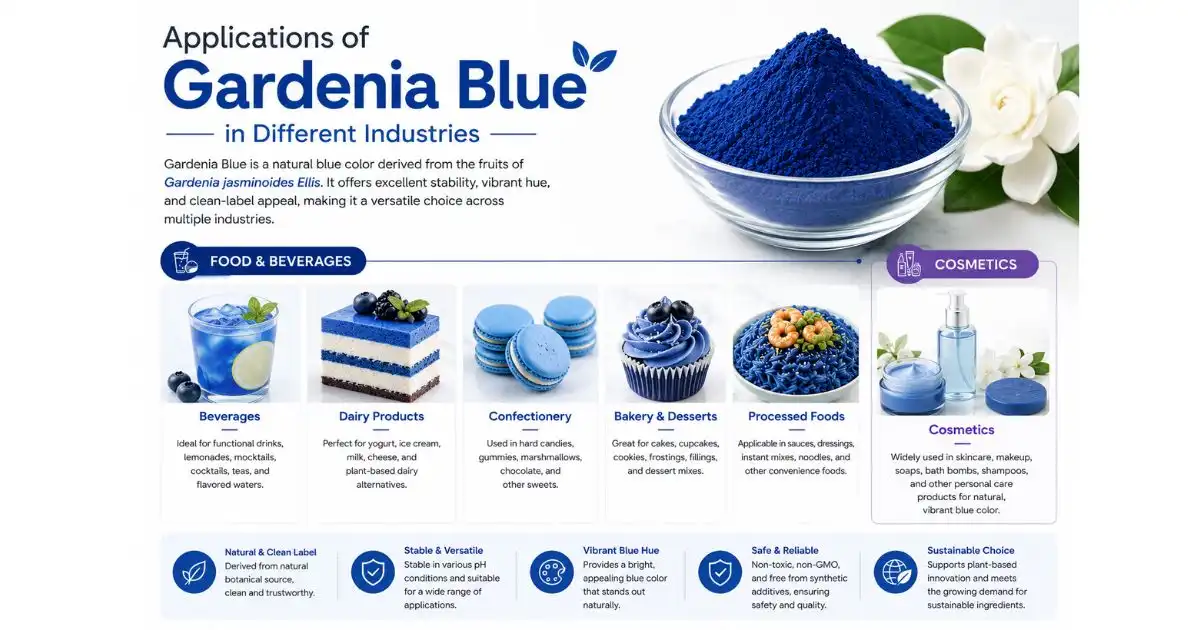
Confectionery and Candy Coatings
When making candy, it's important that the color doesn't change much. This natural blue colorant mixes easily with sugar syrups and panning coats that are made with water. This means that the effects are always the same. Most of the time, formulators can use grades E60 or E80 when making coverings for hard candies, gummies, or pills. They can move up to grades E100 or E200 for stronger colors.
Beverages and Cocktail Applications
It's a good choice for ready-to-drink drinks, flavored spirits, and cocktail syrups because the powder mixes well with both still and fizzy drinks. It makes a natural green that goes well with lime-flavored or matcha-style foods when mixed with gardenia yellow in a certain way. It's not unstable like chlorophyll-based greens are.
Baked Goods, Desserts, and Jams
People who bake at home or for a living can add this color straight to cake mixes, buttercreams, or jam bases. In normal amounts, it stays organoleptically neutral, which means it doesn't smell or taste bad. Hot ovens would fade or change the colors of spirulina-based foods, but this one can handle it.
As an E60 or E80 candy coating, dissolve in warm sugar syrup before coating. As an E30 or E60 beverage coating, dissolve in water first; avoid direct pH below 3.0. As an E80 or E100 baked good coating, add to wet ingredients before mixing. As an E60 or E80 jam or preserve, it stays stable through pasteurization cycles. As an E100 or E200 cosmetics coating, check your local cosmetics laws.
| Application | Recommended Grade | Notes |
|---|---|---|
| Candy coating | E60 / E80 | Dissolve in warm sugar syrup before coating |
| Beverages | E30 / E60 | Pre-dissolve in water; avoid direct pH < 3.0 |
| Baked goods | E80 / E100 | Add to wet ingredients before mixing |
| Jams & preserves | E60 / E80 | Stable through pasteurization cycles |
| Cosmetics | E100 / E200 | Confirm regional cosmetic regulations |
Comparing Gardenia Blue Powder with Other Natural and Synthetic Blue Colorants
Gardenia Blue vs. Spirulina Blue (Phycocyanin)
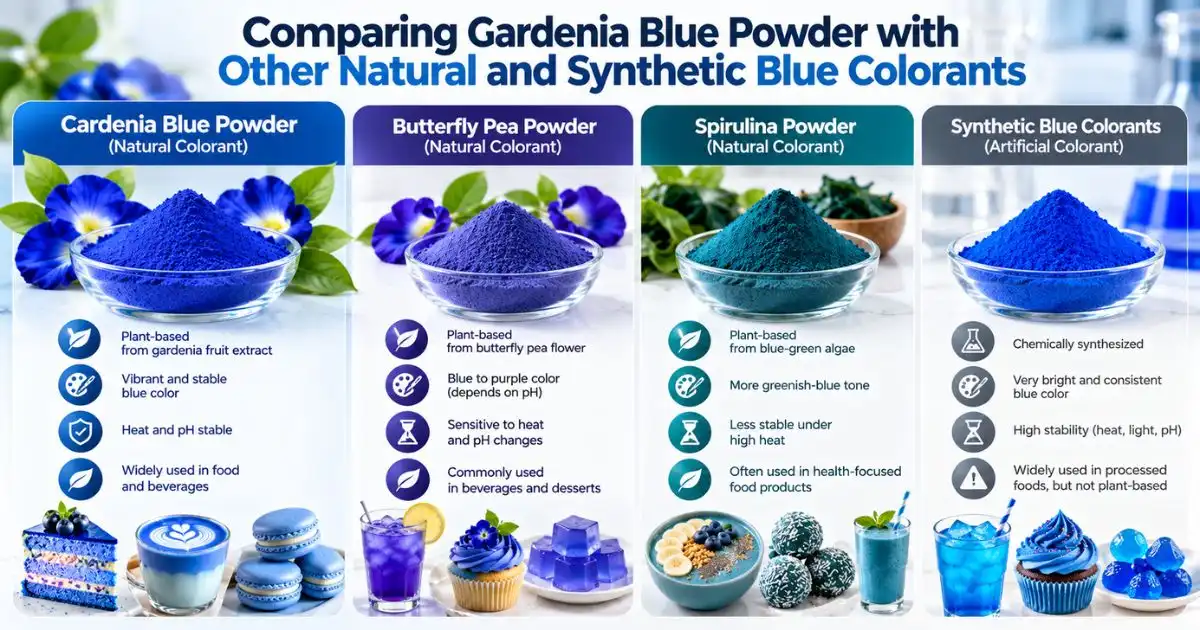
Phycocyanin is a bright blue color that looks good, but it fades when it gets above 60°C. Because of this, it can only be used for cold tasks, like making ice cream, sweets that don't need to be baked, and cold drinks. Gardenia blue powder offers more formulation possibilities. It is better to use gardenia-derived pigment for things that need to be heated because it keeps the color better.
Gardenia Blue vs. Butterfly Pea Flower Extract
As soon as acid hits butterfly pea extract, the color changes from blue to purple or pink. It's cool to see this in drinks, but it can be bad if the pH level of the product isn't close to perfect. Gardenia blue stays more true to its color in the pH range that most foods are in, so you might not have to change the recipe as much.
Gardenia Blue vs. Synthetic FD&C Blue No. 1
People who want clean labels have made many brands stop using FD&C dyes, even though synthetic brilliant blue is a cheap and reliable color. Another option is gardenia blue, which comes from plants and supports claims of natural placement. It costs a little more per unit, but for brands that want to sell high-end, natural, or organic products, the label benefit is greater than the price difference.
Sourcing and Procuring Gardenia Blue Powder for B2B Clients
Evaluating a Gardenia Blue Powder Supplier
When looking for a provider, the most important things to look for are certifications, documents from third-party tests, and an E-value (color strength) that stays the same across batches. You can get full specification sheets from Yangge, which include TDS-Gardenia Blue E80. Yangge also helps buyers from the sample stage all the way through production. All five types (E30, E60, E80, E100, and E200) can be sent out fast.
Procurement Flow and Lead Times
There are six steps a business must go through in order to buy this color: check the grade; request a sample; test the recipe and stability; place a trial order; and then increase production. Yangge offers samples for testing on a bench, fair prices for all standard levels, and flexible MOQ arrangements so that you can try out different formulations before committing fully.
International Supply and Certification Support
Yangge's gardenia blue powder goods are bought and sold in the EU, North America, Southeast Asia, and East Asia. The company meets the paperwork needs of most foreign governments thanks to its ISO and HACCP certifications and its "farm-to-table" approach to food safety. People who want to buy in the EU or US should ask for the necessary safety dossiers and batch analysis certificates when they take samples.
Advantages and Challenges of Using Gardenia Blue Powder in Industrial Food Production
Core Advantages for Large-Scale Manufacturing
Production teams using high-volume lines benefit from this hue for three reasons. First, it doesn't change color when heated or cooled, therefore less work is performed due to color shift. Second, gardenia yellow is co-produced, so formulators may blend it with other hues for natural greens. Buying blue and yellow colorants individually saves a lot. Third, QC rejects fewer when a certified maker's E-value is consistent across batches.
The biggest issues with natural colorants are that the colors don't always match from one batch to the next and the mixtures don't stay fixed while they're being processed. There is a straight solution to these issues with these perks.
Practical Challenges to Manage
There is a lot of water in the powder, so it takes water from the air. It can cake if you don't store it right. People who want to buy things should ask for sealed boxes that keep wetness out and keep the goods in cool, dry places. If the pH level is less than 3.0, there may be a slight shift toward green. Before making a lot of something, formulators should test it at the right pH. Also, each country has its own rules, so it's important to make sure everything is in order before going to market.
Conclusion
Gardenia blue powder is a great natural dye that goes well with a lot of things. It doesn't change when it gets hot or when the pH level changes a lot. It mixes easily in water-based systems and supports the clean label placement. It always works when other natural blues don't, which is good for formulators who work with drinks, jams, baked goods, or sweets.
When there are five different E-value grades and current stock, procurement teams are less likely to be late with their orders. As long as it is kept correctly and its pH range is checked, this is one of the most useful natural blue colors for making food for industry.
FAQ
Does gardenia blue affect the taste of food?
At recommended dosage levels, this natural pigment is organoleptically neutral. It does not alter flavor, aroma, or texture in finished food or beverage products.
Is it suitable for clean-label and organic products?
It supports clean-label claims as a plant-derived, non-synthetic colorant. For organic certification, buyers should verify that the specific production batch meets the certifying body's input standards.
How should it be stored to prevent caking?
Store in airtight, moisture-barrier packaging in a cool, dry, dark environment. Its hygroscopic nature makes humidity control the most important storage variable.
Can it be blended with gardenia yellow to make green?
Yes. Blending gardenia blue with gardenia yellow in controlled ratios produces stable natural green tones a cost-efficient approach compared to sourcing separate colorants.
What specifications does Yangge offer?
Yangge supplies five E-value grades: E30, E60, E80, E100, and E200. All grades are currently in stock and available for sampling.
Request Samples or Bulk Pricing From Yangge Trusted Gardenia Blue Powder Manufacturer
The gardenia blue powder that Yangge Biotech Co., Ltd. sells comes in five different E-value grades. There are ISO, HACCP, Kosher, and Halal papers that come with the powder. Our team gets back to you in 24 hours, whether you need bulk prices for big orders or bench samples to try out different formulas.Contact us or you can email us at info@yanggebiotech.com or visit blog.yanggebiotech.com to get the TDS and a price that fits your needs.
References
1. Buchweitz, M. (2016). Natural Solutions for Blue Colors in Food. Handbook on Natural Pigments in Food and Beverages. Woodhead Publishing.
2. Clydesdale, F. M. (1993). Color as a factor in food choice. Critical Reviews in Food Science and Nutrition, 33(1), 83–101.
3. Hayashi, T., & Yamaguchi, K. (2002). Stability of gardenia pigments in food systems. Food Chemistry, 79(4), 435–441.
4. Hendry, G. A. F., & Houghton, J. D. (Eds.). (1996). Natural Food Colorants (2nd ed.). Blackie Academic & Professional.
5. Mortensen, A. (2006). Carotenoids and other pigments as natural colorants. Pure and Applied Chemistry, 78(8), 1477–1491.
6. Scotter, M. J. (2011). Methods for the determination of European Union-permitted added natural colours in foods. Food Additives & Contaminants: Part A, 28(5), 527–596.
Based on your location and order quantity, you will have the opportunity to receive a limited time free shipping promotion!
Who we are
Popular Blogs