A Complete Buyer's Guide to Vegetable Carbon E153 for Food Brands
If you're a food brand looking to achieve a deep, consistent black color without synthetic dyes, vegetable carbon E153 is likely already on your radar. Made from the controlled carbonization of coconut shells or bamboo, this natural black pigment carries the INS designation E153 and is used across bakery, confectionery, ice cream, and plant-based food categories. This guide covers everything from what it is and how it performs, to how you source it responsibly and what certifications to require before placing an order.Contact us or send us an email at info@yanggebiotech.com or visit blog.yanggebiotech.com right away to get your sample and COA.

What Is Vegetable Carbon E153? Essential Knowledge for Food Industry Professionals
How It's Produced
Vegetable carbon black E153 is made by carbonizing plant-based raw materials, primarily coconut shells or bamboo, at controlled high temperatures. The powder that is left over is very fine and black. It doesn't smell or taste good and doesn't mix with other chemicals. You can get Yangge's E153 in both Kosher and USP grades. The extraction methods used to make it have been checked by HPLC. This carbon black is better for your product's label than carbon black made from oil because it comes from plants.
Key Physical Properties
| Property | Detail |
|---|---|
| Appearance | Black powder |
| Odor / Taste | Odorless, tasteless |
| Solubility | Insoluble in water and organic solvents |
| INS Number | E153 |
| Raw Material Source | Coconut shell / Bamboo |
No matter what you smell or taste vegetable carbon doesn't break down in water or organic solvents. It looks like black powder. Its INS number is E153, and bamboo or coconut shells are used to make it. It is important to know right away that E153 does not dissolve. Instead, it spreads out. This means that the people who are making the product need to think about how the bits will be spread out, especially in things like soups and ice cream that are mostly water.
Regulatory Standing
Directive 94/36/EC says that E153 can be used in food in the EU, and the EFSA has said that it can be used in some types of food. The FDA does not officially list it as a color agent that can be used in most foods in the US market. This means that American brands need to get clearance at the category level before putting out a product. The FDA has looked over Yangge's products, they are certified as Halal and Kosher, and each shipment is checked by a separate lab from outside of China.

Uses and Benefits of Vegetable Carbon for Food Brands
Where It Performs Best
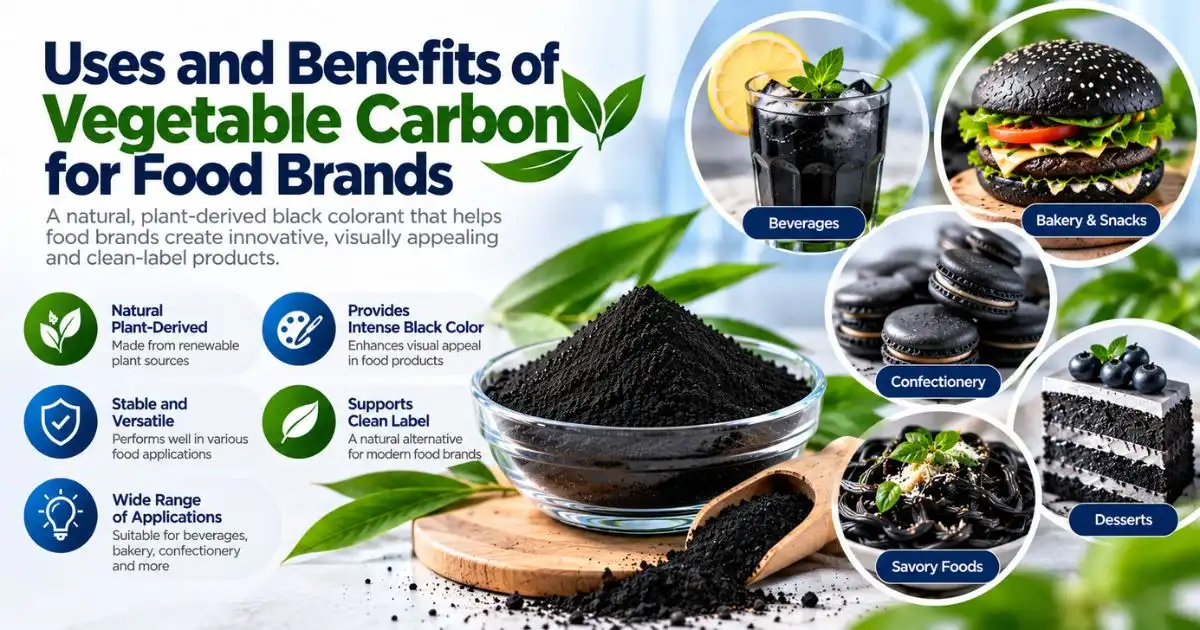
When used in food, vegetable carbon makes the darkest black that is possible. Lots of different things use it, like activated charcoal ice cream, dark candy coatings, foods that taste like black sesame, and high-end drinks. It gives a truly jet-black finish instead of the gray cast that cheaper options often leave behind when the right amount is used.
Advantages Over Synthetic Alternatives
Clean label rules are the main reason brands have switched away from Brilliant Black BN (E151). These are the main ways that E153 is different from other choices:
- Vs. E151 (Brilliant Black BN): Clean label claims can be made with E153, which comes from plants. E151, on the other hand, is an azo dye that was made in a lab and needs to have the "Southampton warning" mark on it.
- Vs. Activated Charcoal: Activated charcoal can look gray instead of black when taken in normal amounts. E153 is more consistent in how dark it is black, and it was made for food coloring uses instead of adsorption uses.
- Vs. Squid Ink: Some people don't like squid ink because it takes on the tastes of other things. It's safe for vegans to use E153 in foods because it doesn't have a smell or taste.
These distinctions matter beyond aesthetics. You chose an ingredient whose plant source is easy to find and which has a clear approval trail. Your quality assurance and regulatory team will be thankful.
Label and Market Positioning
The EU labels products colored with E153 as having vegetable carbon on the list of ingredients, which is good for people who care about clean labels. It's not enough for brands to say this to follow the "dark food" or "premium black" trend; it's also their duty. Activated charcoal lattes, candy with a gothic look, and homemade black bread are some examples.
Making an Informed Procurement Decision: Comparing Vegetable Carbon Options
Product Form and Grade Comparison
| Grade / Form | Typical Use | Key Consideration |
|---|---|---|
| Food-grade powder (E153) | Bakery, ice cream, sauces | Batch consistency; PAH testing required |
| USP/Kosher grade powder | Premium confectionery, export to EU/ME | Stricter purity standards |
| Liquid dispersion | Beverages, coatings | Easier to dose; higher per-unit cost |
Vegetable carbon E153 powder is used in baking, ice cream, and sauces. It has stricter purity standards and needs to be tested for PAHs. Higher purity standards mean that USP/Kosher grade powder is used in high-end sweets and sent to the EU and ME. Liquid dispersion is used in drinks and coatings. It is easy to dose, but it costs more per unit.
Yangge's Vegetable Carbon Black E153 is available in food-grade powder form at Kosher and USP grade, with 5 tons currently in stock. MOQ starts at 1 ton, with FOB and CIF delivery options. For brands still in the trial phase, 10–30g free samples are available for R&D testing before committing to a bulk order.
Price and Lead Time Factors
If you want to buy food-grade E153, the price will depend on the purity grade, the amount you order, and proof of origin. Buy from well-known companies with full certification stacks to save money. Brands that buy from uncertified suppliers will pay a little more, but they won't have to pay for failed audits or making new products. Yangge's stock materials usually have shorter lead times than materials that are made to order. This makes things a lot easier when a new product needs to come out.

How to Choose the Right Vegetable Carbon Supplier for Your Food Brand
Certification Checklist
This is what your purchasing and quality assurance teams should check before they choose a vegetable carbon black source:
- Halal and Kosher certification (The item can only be sold to Jews and people from the Middle East if it is certified as Halal and Kosher)
- FDA review documentation (EN 15587 or a similar standard) is needed for US food applications.
- Heavy metal and PAH test reports per EU limits.
- COA (Certificate of Analysis) from an independent international laboratory, issued per batch.
Yangge provides all of the above and offers downloadable COA documentation (COA-Vegetable carbon black E153-YANGGEBIOTECH.pdf) directly through their product page.
Evaluating Batch Consistency
In food companies, color must stay the same from one run of production to the next. You should be able to get spectrophotometric data for more than one batch from a seller. Find out how much Lab* color is used and make sure the production process uses HPLC-verified extraction, which Yangge does. The end result and how people see it are directly affected by changes in how black or gray something is from one batch to the next.
Logistics and Flexibility
| Supplier Criterion | Yangge Offering |
|---|---|
| MOQ | 1 ton |
| Free Sample | 10–30g for R&D |
| Delivery Terms | FOB / CIF |
| Stock Availability | 5 tons in stock |
| Packaging | Various packaging solutions |
Yangge Offering meets our needs and is a good source. Of 10–30g, they will give you one for free for research and development purposes. The delivery terms are FOB or CIF. Plus, they have 5 tons of stock on hand.

Practical Tips for Using Vegetable Carbon in Food Manufacturing
Dispersion Best Practices
The right pre-dispersion is very important since vegetable carbon E153 doesn't mix with water. Emulsified systems, like ice cream or chocolate sauces, need the powder to be mixed with the fat or oil first. For systems that use water, mix the dispersant with a carrier that works with high shear. Most of the time, you start with 0.1 to 0.5% w/w and work your way up for the color you want. Every time you mix a base, check the pH level because low pH levels can change how bright a color looks.
Storage and Handling
As long as the E153 powder is sealed, keep it away from water and direct light. Being around moisture can make it clump, which changes how it spreads even though it is biologically solid. Keep things in a cool, dry place and close the boxes back up right away after you use them. Do not put vegetable carbon near raw ingredients. This will help keep germs from spreading. This is very important in places that deal with allergens.
Application Timing in Baked Goods
You should add E153 to bread or buns while they are still being made and before the water is added. If you add the color too late, it might not be spread out properly in the crust or cake when it's done. If you mix cocoa butter ahead of time at a low temperature, the layers on your sweets will be smooth and even. A lot of bakeries that make black burger buns use 0.3% to 0.8% of the flour's weight of E153. The exact amount used depends on how the oven keeps the color.

Conclusion
Vegetable carbon E153 provides food manufacturers with a risk-free, plant-based alternative to using synthetic dyes to achieve a deep black color. You can always trust a supplier to give you certified, batch-tested goods, no matter if you're a high-end candy shop or a clean-label bakery. When you buy something, the most important things to do are find out where the plant came from, make sure it meets PAH and heavy metal standards, look at the certifications, and test it with a real sample before making a lot of it. This is all taken care of by Yangge's Vegetable Carbon Black E153 right out of the box. It has paperwork from Halal, Kosher, and the FDA, and each package is checked by a different lab.
FAQ
Is E153 the same as activated charcoal?
No, they are not the same. Both are made from carbonized plant matter, but activated charcoal has a lot more surface area and can soak up a lot more. E153 is used to color food, and the PAH levels, quality, and particle size are all closely watched. When taken in the right amounts, activated charcoal can look gray, but E153 always looks black.
Can I use E153 in products sold in the US?
The FDA does not yet list E153 as a safe colorant that can be used in many US foods. There may be some uses that are fine, though. Before you go live, you should always talk to a representative from the government. There are rules about what kinds of food can be sold in the EU, so E153 is fine there.
What documents should I request from a supplier?
Ask for a Certificate of Analysis (COA) from a third-party lab, as well as Halal and Kosher certificates, test results for heavy metals and PAH, and proof of origin that shows where the vegetable ingredients came from.
How much sample is available before committing to a bulk order?
People can get 10–30g of Vegetable Carbon Black E153 from Yangge to test and learn about it before they place a large order.
What is the minimum order quantity?
You can choose between FOB and CIF shipping, and the MOQ is 1 ton. Yangge has 5 tons ready to ship right now.
Request a Sample of Yangge's Vegetable Carbon Black E153
When you make your next black food, you need a colorant that always works. Yangge is a business that makes 100% vegetable carbon that is ISO, HACCP, Kosher, and Halal certified. They have 5 tons of E153 in stock, free trials, and can give you all the proof papers you need if you ask. Send us an email at info@yanggebiotech.com or visit blog.yanggebiotech.com right away to get your sample and COA.
References
1. European Food Safety Authority (EFSA). Re-evaluation of vegetable carbon (E 153) as a food additive. EFSA Journal, 2012.
2. Food and Agriculture Organization / World Health Organization (FAO/WHO). Combined Compendium of Food Additive Specifications: Vegetable Carbon. JECFA Monographs, 2006.
3. European Parliament and Council. Directive 94/36/EC on colours for use in foodstuffs. Official Journal of the European Communities, 1994.
4. Downham, A., & Collins, P. Colouring our foods in the last and next millennium. International Journal of Food Science & Technology, 2000.
5. Mortensen, A. Carotenoids and other pigments as natural colorants. Pure and Applied Chemistry, 2006.
6. Institute of Food Technologists (IFT). Clean Label Trends in the Food Industry. Food Technology Magazine, 2019.

Based on your location and order quantity, you will have the opportunity to receive a limited time free shipping promotion!
Who we are
Popular Blogs