What Foods Can Use Red Beet Betanin Natural Coloring?
Red Beet Betanin (E162) from Yangge Biotech is a premium natural red food coloring derived from carefully selected beetroot. Rich in naturally occurring betanin pigments, it provides attractive red to purple shades and is suitable for a wide range of applications, including beverages, confectionery, gummies, dairy products, bakery products, snacks, sauces, functional foods, dietary supplements, and cosmetic formulations. Yangge Biotech supplies Beetroot Red E162 in deep red powder form with bulk supply, free samples, OEM packaging, and product documentation available for manufacturers and distributors. For product specifications, COA, samples, bulk pricing, or OEM/ODM inquiries, contact Yangge Biotech at info@yanggebiotech.com,
Red Beet Betanin (E162) has emerged as a powerful natural coloring solution for food manufacturers seeking clean-label alternatives to synthetic dyes. This water-soluble pigment, extracted from Beta vulgaris roots, delivers vibrant red-to-purple hues across dairy products like yogurts and ice creams, beverages including juices and smoothies, confectionery items such as candies and chocolates, processed meats, plant-based alternatives, bakery goods, and sauces. Its betalain composition offers both coloring functionality and antioxidant benefits, making it ideal for health-conscious formulations that meet European E-number compliance and Halal/Kosher certifications.


Understanding Red Beet Betanin and Its Properties
As a supplier of natural colorants, we've seen a huge shift in the food industry toward pigments that are based on betalain. Beetroot red E162 is a betalain, which is a different type of anthocyanin or carotenid. It has a unique chemical structure that gives it color and health benefits. The characteristic reddish-violet color comes from the pigment's 75–95% betacyanins, mostly betanin.
Chemical Composition and Safety Profile
The chemical formula C24H27N2O13 shows that betanin is glycosidic, which means that a glucose molecule binds to the betanidin aglycone. This shape helps it dissolve in water and work with food systems that use water. Regulatory bodies all over the world agree that E162 is safe to eat and drink, with no major side effects reported when used in the amounts that are suggested. Its antioxidant power comes from its ability to get rid of free radicals, which gives it useful properties beyond its good looks.
Stability Characteristics Critical for Procurement
Knowing the parameters of stability helps procurement managers make smart choices. When the pH is between 4 and 6, betanin keeps its color best and looks bright blue-red. Temperature sensitivity is clear above 80°C, where thermal degradation speeds up and colors fade more quickly. In the same way, light exposure causes pigments to break down through photodegradation routes. Oxygen makes things even less stable, especially when the goods have a long shelf life or are packaged in clear plastic.
It has been our experience that companies that work with frozen foods or products that don't last long on the shelf do better than companies that use high heat. Because the color changes depending on the pH level, going from red in acidic conditions to blue-violet as the pH level rises, the formula needs to be carefully changed to keep the desired colors during production and storage.

Foods Suitable for Red Beet Betanin Natural Coloring
Beetroot red E162 can be used in a lot of different food types, and each type has its own set of difficulties and possibilities. From working with mid-sized manufacturers in Europe and North America, we've seen certain trends in how to make projects go smoothly.
Dairy and Frozen Desserts
Betanin works really well in cultured dairy settings with pH levels between 4.0 and 4.6, which is great for the pigment's stability window. This is why yogurt makers love it. Formulations for ice cream work better when they are frozen, because the low temperature and oxygen levels help keep the color's structure. Flavored milk drinks look better without breaking the promise of clean labels that customers are increasingly demanding.
This natural dye has been successfully added to cottage cheese, cream cheese spreads, and dairy-based dips. Because heat treatment isn't done in the last stages of production, betanin can be added late in the process, keeping the color's full intensity. When working with suppliers who follow strict quality control standards, batch stability is still possible.
Beverage Applications
When betanin is added strategically, it makes juice blends look better, especially berry-flavored ones. Fruit drinks naturally have a low pH, which makes them great for keeping colors stable. Manufacturers of smoothies like the health halo effect, which is when they add a natural colorant that makes their goods look even healthier.
Fruit wines, flavored spirits, and cocktail mixes are all examples of alcoholic drinks that use E162 to make their products stand out. Sparkling fruit drinks and sports drinks that don't contain booze work just as well. Because it dissolves in water, it is easy to add during the mixing process and has little effect on the taste profiles when used in the right amounts.
Confectionery and Bakery Products
Red Beet Betanin is a natural pigment widely used in food coloring. Hard candies, gummies, and marshmallows often use betanin to make color ranges from pink to red. The hard part is controlling the heat that comes from making candy. To deal with this issue, manufacturers either add the colorant after the food has been cooked or use packaging technologies that keep the pigment molecules safe during short periods of high temperature.
| Product Category | Optimal pH Range | Processing Temperature | Expected Shelf Life |
|---|---|---|---|
| Yogurt & Cultured Dairy | 4.0–4.6 | Processing in cold | 21 to 45 days |
| Fruit Juices | 3.0 to 4.5 | Pasteurized (≤80°C) or cold | 60 to 180 days |
| Ice Cream | 6.0 to 7.0 | State of being frozen | 12 to 24 months |
| Hard Candies | 4.5 to 5.5 | Add after cooking | 6 to 12 months |
More work needs to be done for bakery uses like colored doughs, cake batters, icings, and fillings. During baking, betanin is exposed to temperatures that are higher than what it can handle. Glazes, frostings, and toppings that are put on top of baked goods or products that don't get too hot, like no-bake cheesecakes and sweets that are kept in the fridge, have been the most successful uses.
Processed Meats and Plant-Based Alternatives
E162 is used in the meat business to make goods like summer sausage, cured meats, and deli cuts look better. Getting pink-red tones that look natural helps goods meet customer standards for quality and freshness. The color works well in the slightly acidic pH environment that is common in cured meats.
Plant-based meat substitutes are an application area that is growing very quickly. Betanin is used by companies that make veggie sausages, burgers, and deli slices to make them look like regular meat goods. This use fits nicely with clean-label standards, since people who choose plant-based choices usually care most about natural ingredients. The challenge is to find the right balance between color intensity and the earthy notes that can come from beetroot extract. Using purified betanin makes this less of a problem, though.
Sauces, Dressings, and Ready-Meals
Betanin's ability to make red colors stronger is good for tomato-based foods like pasta sauces, different kinds of ketchup, and pizza sauces. Because these products are acidic, they help keep the color stable. Bright colors in salad sauces, especially raspberry vinaigrettes and other berry-flavored dressings, let customers know what flavors they contain.
Betanin is used to make ready-to-eat meals with colored rice, pasta, or sauce components stand out visually. Manufacturers need to think about reheating directions because heating in the microwave or oven can make it hard for colors to stay true. Long-term color stability is better for foods that are meant to be eaten cold or with little warming.

Comparing Red Beet Betanin with Other Natural and Synthetic Colorants
When making purchasing choices, it's important to know how beetroot red E162 compares to other coloring options. We've helped a lot of manufacturers through this evaluation process, which has shown us clear pros and cons.
Betanin versus Synthetic Red Dyes
Synthetic options, such as Erythrosine or Red 40 (Allura Red), offer better resistance to heat and color intensity at lower usage rates. However, regulations are becoming stricter on synthetic dyes, especially in European markets where people strongly prefer natural alternatives. Betanin's clean label benefit is greater than its technical drawbacks for brands aiming at health-conscious people.
In some places, synthetic colorants have to come with allergen-like warnings, which makes the labeling process more complicated than with natural options. As production methods get better and more people want natural pigments, the price difference between synthetic and natural options keeps getting smaller. Brands that market themselves as high-end or health-conscious find that using natural colorants pays off because customers trust them more.
Purified Betanin versus Beetroot Powder
Beetroot powder has all the nutrients that a veggie needs, like sugars, fibers, minerals, and colors. Even though this is good for you nutritionally, it changes the taste and needs higher usage rates to get the same color strength. At the concentrations needed for bright coloration, the earthy, vegetable taste stands out.
By using advanced extraction methods like HPLC on purified betanin extracts, the coloring compounds are concentrated while off-flavors and other materials are kept to a minimum. Our Yangge beetroot red E162 is an example of a product that meets these standards and is 100% pure. The deep red powder form makes dosing more accurate, improves batch consistency, and has no effect on flavor at the right coloring concentrations.
| Colorant Type | Tinctorial Strength | Heat Stability | Clean Label Appeal | Typical Cost Index |
|---|---|---|---|---|
| Synthetic Red 40 | Very High | Very good | Low | 1.0x |
| Carmine (Cochineal) | High | good | Large (not vegan) | 2.5 times |
| Beetroot Powder | Low | Moderate | High | 1.5x |
| Purified Betanin (E162) | High | Moderate | Very High | 2.0x |
| Anthocyanins | A Medium | Moderate | Very High | 2.2x |
Certification and Compliance Advantages
The availability of non-GMO, non-irradiated Red Beet Betanin meeting European PAH4 standards (Benzopyrene ≤10 ppb) meets important sourcing criteria for producers serving controlled markets. Kosher and Halal certifications expand market access, particularly valuable for companies targeting Middle Eastern regions or religiously observant consumer segments.
Organic certification choices exist for beetroot red, though supply varies based on farming yields. Suppliers maintaining relationships with certified organic farms can offer this premium option, commanding price premiums that conscientious brands willingly absorb. The traceability from farm to final product increasingly matters for major retailers implementing stringent supplier verification programs.

Procurement Considerations for z: What B2B Clients Should Know
Successful procurement goes beyond finding suitable colorants to building reliable supply chains that support consistent production quality. Our experience handling food and beverage manufacturers shows several key decision factors.
Quality Indicators and Specifications
Betanin content serves as the main quality metric, usually expressed as color value or tinctorial strength. Higher betanin concentrations offer more intense coloring at lower usage rates, improving cost-efficiency despite possibly higher per-kilogram price. The deep red powder look shows proper processing and minimum degradation.
Specifications should address moisture content, microbial limits, heavy metals, and residual solvents when applicable. European guidelines for PAH4 compliance guard against polycyclic aromatic hydrocarbon contamination, a worry with some natural extracts. Our Yangge beetroot red E162 keeps Benzopyrene levels at ≤10 ppb, well within safety limits.
Water solubility testing shows the pigment dissolves completely without sediment, important for beverage applications. pH stability ranges recorded through accelerated shelf-life studies help predict performance in specific formulation settings. Suppliers providing comprehensive technical data sheets enable informed formulation decisions.
Minimum Order Quantities and Pricing Dynamics
Mid-sized makers generally require 30-250 kg annually per product line, matching with the 1 kg minimum order number and 50-100 kg inventory levels kept by prompt suppliers. This flexibility supports initial trials and small-batch output without excessive capital investment. The 2-year shelf life when stored properly in tightly closed, light-protected containers reduces pressure for immediate consumption.
Pricing varies based on beetroot crop rates, extraction efficiency improvements, and market demand trends. Establishing relationships with suppliers keeping regular inventory buffers guards against spot market volatility. Volume commitments often unlock tiered pricing structures that improve margins for established product lines.
The standard for aluminum foil bags for 1 kg pieces keeps light and wetness out while they are being stored and shipped. For co-packing arrangements, custom package choices can be used to meet specific handling needs or brand tastes. To do a good cost-benefit analysis, you need to know the total landed costs, which include freight, duties, and handling.
Supplier Selection Criteria
Suppliers with a good reputation show clear certification paperwork, proof from a third-party lab, and strong quality control systems. Certifications like ISO, HACCP, Kosher, and Halal show that quality and safety are handled in a planned way. Working with well-known labs to do retesting gives you an independent check that the specs meet the standards that were set.
The ability to provide technical help sets special sellers apart from commodity vendors. Having access to application specialists who know how to change the pH, find the best dosage, and make sure the product works with other processes speeds up the development process. Free samples make it possible to try something without taking any risks before committing to large amounts of production.
Lead times and transportation prices are affected by where things are located. Supply chain disruptions are kept to a minimum by suppliers who keep stock in destination markets or who work together to make international shipping work well. Some service providers give online services 24 hours a day, 7 days a week. This model works across time zones and makes it easier to communicate quickly in emergency circumstances.
How to Use Red Beet Betanin in Food Manufacturing
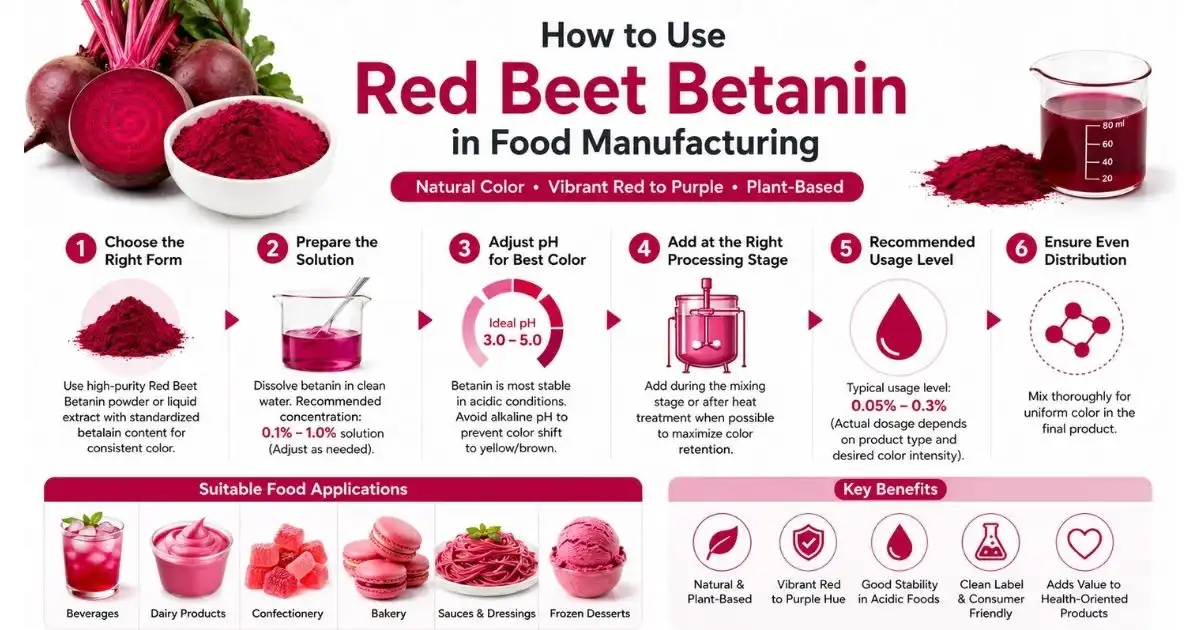
Knowing how to use raw materials in real life turns the specs of a product into a success. It's helpful for manufacturing teams to know the best ways to incorporate things and the most typical mistakes that people make, and Red Beet Betanin is a prime example of a natural pigment where proper handling—from pH control to heat exposure directly determines final product quality.
Dosage Recommendations by Product Category
Usage rates usually fall between 0.01% and 0.5%, based on how strong of an effect you want and the properties of the food matrix. Lower amounts (0.01-0.05%) are used for drinks to get light to medium tones, while higher amounts (0.01–0.3%) may be needed for candy to get bright colors. Most dairy products are between 0.05 and 0.15%, which is a good balance between color effect and cost.
Starting with low doses when making a new product keeps it from turning too color and lets you make small changes over time. The fact that it dissolves in water makes it easy to mix with liquids, but mixing it with small amounts of water first makes sure that it's spread out evenly. Because betanin is hydrophilic, it can't dissolve properly in oils or fats, so don't add it directly to those.
Processing Stage Considerations
Timing is very important for applications that are sensitive to temperature. Adding betanin after pasteurization or during the last steps of cooling helps keep the color of goods that have been heated. When heat contact can't be avoided, keeping temperatures below 80°C and limiting the amount of time the pigment is exposed helps it stay active.
If at all possible, pH should be changed before adding the colorant, since the end pH of the system decides the color shade. Testing small amounts at different pH levels helps figure out what will happen when the product is made in large quantities. Color changes that are hard for customers to understand are avoided by buffering systems that keep the pH fixed throughout the shelf life.
Light-protective wrapping keeps colors stable for longer for goods sold in stores. Protect betanin from photodegradation with opaque containers or materials that don't break down in UV light. On consumer packages, putting storage instructions like "store in cool, dark place" promotes the best way to handle things.
Compatibility with Other Ingredients
Betanin works well with most food items when the pH level is normal to slightly acidic. Ascorbic acid, or vitamin C, may speed up breakdown in some forms, so stability tests are needed before putting these parts together. Ions of metal, especially iron and copper, can speed up oxidative breakdown. This is why chelating drugs like citric acid can be useful in some situations.
Protein-rich foods, like dairy products, can sometimes keep their color longer because betanin and protein molecules protect each other. On the other hand, large amounts of sugar in sweets can change how water works and how stable colors are by dehydrating them.
Conclusion
For producers dedicated to clean-label products in the dairy, beverage, confectionery, meat, and baking industries, Red Beet Betanin establishes itself as an important natural colorant. The E162 label, along with Kosher and Halal labels, creates a lot of new market opportunities and meets consumer needs for easily recognizable plant-based ingredients. To do it right, you need to know how colors change depending on pH, how sensitive they are to temperature, and how to plan your working time.
When purchasing betanin, purchasing managers should give more weight to sellers that offer high-purity standards, full certifications, and expert help that connects the properties of the raw material to the performance of the finished product. The moderate stability issues can be dealt with by making smart formulation choices. This bright natural pigment gives you an edge in health-conscious market segments.
FAQ
Does betanin cause any side effects in food products?
Betanin has a great safety profile, with no major side effects reported when used at the amounts suggested in food uses. The European Food Safety Authority and other regulatory bodies agree that E162 is safe to eat. People like the color because it comes from beetroot vegetables, which are commonly eaten. Manufacturers should be aware that betanin may temporarily turn urine or stools red in people who are sensitive to it. This is a normal physiological response and is not a safety concern.
Can red beet betanin maintain stability in baked goods?
Because they are cooked at high temperatures, baked goods can be tricky. Red Beet Betanin can be used successfully in no-bake desserts, cakes that are kept in the fridge, and low-temperature baking processes (below 150°C for short periods of time). The color will stay stable.
What certifications should B2B buyers prioritize when sourcing betanin?
Food safety standards (ISO, HACCP), religious compliance (Kosher, Halal), and quality guarantees (non-GMO, non-irradiated) are some of the most important approvals. Suppliers to the European market should show proof that they have received governmental permission for E162 and are in compliance with PAH4. Organic certification makes high-end products more valuable. Third-party laboratory verification through well-known testing facilities gives specifications independent proof, which lowers quality risks in purchasing choices.
Partner with Yangge for Premium Beetroot Red E162 Solutions
Yangge Biotech Co., Ltd. has factory-direct beetroot red E162 betanin extract that meets the highest standards in the industry and is ready to help you with your natural coloring needs. Through HPLC extraction, our deep red powder meets all of the standards for the world market. It is backed by ISO, HACCP, Kosher, and Halal certifications. As an established Red Beet Betanin supplier, we maintain 50–100 kg of stock on hand to make sure that orders starting at 1 kg are filled quickly. You can also get free samples to try.
Our formula is non-GMO and has not been irradiated. It meets European PAH4 standards (Benzopyrene ≤10 ppb) and can be kept for two years if stored properly. We've built our name on sustainable traceability from farm to table, working closely with farming communities and getting awards for our green practices. Whether you're making clean-label drinks, natural-colored dairy products, or plant-based meat options, our expert team is available online 24 hours a day to help you with pH optimization, dosage suggestions, and stability issues.
Contact us right away at info@yanggebiotech.com to get your free sample and full technical specs. Find out how working with a specialized natural plant extract expert can help you make better products that meet the changing needs of customers. Go to blog.yanggebiotech.com to learn more about how natural colorants can be used and what the latest trends are in the industry.
References
1. Delgado-Vargas, F., Jiménez, A.R., and Paredes-López, O. (2000). "Natural Pigments: Carotenoids, Anthocyanins, and Betalains – Characteristics, Biosynthesis, Processing, and Stability." Critical Reviews in Food Science and Nutrition, 40(3), 173-289.
2. Stintzing, F.C. and Carle, R. (2004). "Functional Properties of Anthocyanins and Betalains in Plants, Food, and in Human Nutrition." Trends in Food Science & Technology, 15(1), 19-38.
3. European Food Safety Authority (2015). "Scientific Opinion on the Re-evaluation of Beetroot Red (E 162) as a Food Additive." EFSA Journal, 13(12), 4318.
4. Azeredo, H.M.C. (2009). "Betalains: Properties, Sources, Applications, and Stability – A Review." International Journal of Food Science and Technology, 44(12), 2365-2376.
5. Herbach, K.M., Stintzing, F.C., and Carle, R. (2006). "Betalain Stability and Degradation – Structural and Chromatic Aspects." Journal of Food Science, 71(4), R41-R50.
6. Mortensen, A. (2006). "Carotenoids and Other Pigments as Natural Colorants." Pure and Applied Chemistry, 78(8), 1477-1491.

Based on your location and order quantity, you will have the opportunity to receive a limited time free shipping promotion!
Who we are
Popular Blogs