Should You Really Buy Gardenia Blue or Spirulina Blue for Drinks?
If you are a beverage formulator or procurement manager weighing a switch from synthetic dyes to natural alternatives, the short answer is: it depends on your processing conditions. Gardenia blue color derived from Gardenia jasminoides fruit outperforms most plant-based options under heat and moderate pH fluctuations. Spirulina blue (phycocyanin) suits cold-process applications but degrades above 70 °C. Understanding where each pigment excels will save your team weeks of failed trials and unnecessary rework. To get a sample or price, email us at info@yanggebiotech.com or go to blog.yanggebiotech.com.
Understanding Gardenia Blue and Spirulina Blue: Color, Origin, and Significance
What Is Gardenia Blue and Where Does It Come From?
Gardenia blue is made when geniposide, which comes from the fruit of the Gardenia jasminoides plant, reacts with amino acids. This creates an iridoid pigment that is stable and dissolves in water. HPLC tests show that Yangge's gardenia blue powder comes in grades E30, E60, E80, E100, and E200. The powder that is made is light gray to deep blue and dissolves easily in water and watery ethanol, so it can be used in a lot of different drinks.
What Is Spirulina Blue and How Is It Different?
Arthrospira platensis is a type of freshwater microalgae that is where spirulina blue comes from. Its active pigment, phycocyanin, absorbs light at around 620 nm and is used in functional drinks for color and to make people think they are healthier. But because phycocyanin is a protein-bound pigment, heat breaks it down and makes it lose its blue color. This is a big problem for drinks that have been heated or processed.
How Their Color Profiles Compare in Real Drink Applications
| Property | Gardenia Blue | Spirulina Blue (Phycocyanin) |
|---|---|---|
| Peak absorption | ~590 nm | ~620 nm |
| Heat stability | Stable at 120 °C / 60 min | Degrades above 70 °C |
| pH stability | Stable pH 4.0–8.0 | Sensitive below pH 4.5 |
| Water solubility | High | High |
| Color shift risk | Minimal | Moderate to high |
Gardenia Blue and Spirulina Blue (Phycocyanin) are the properties of this substance. Its peak absorption is around 590 nm and 620 nm. It is stable at 120 °C for 60 minutes but breaks down above 70 °C. It is stable at pH 4.0–8.0 but sensitive below pH 4.5. It dissolves easily in water and has a moderate to high color shift risk.
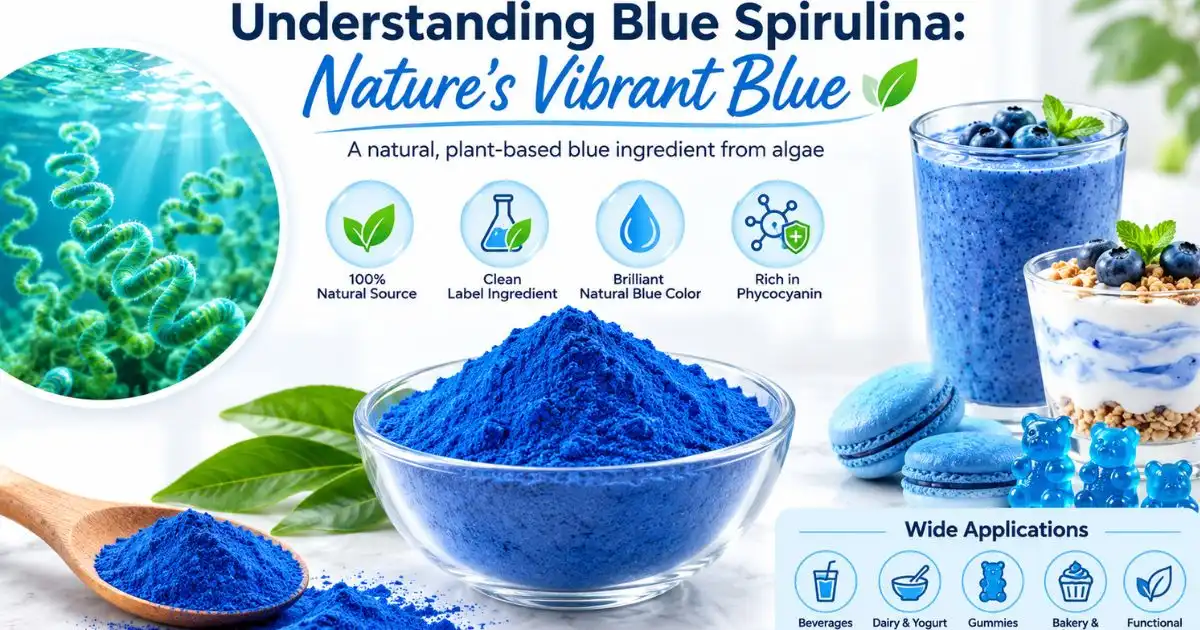
Core Factors Affecting Your Decision to Buy Gardenia Blue or Spirulina Blue for Drinks
Thermal Processing Requirements
Heat resistance is a must for ready-to-drink coffee, prepared soft drinks, and hot juices. At 120 °C for more than 60 minutes, gardenia blue color keeps its color. Spirulina blue, on the other hand, usually loses its color after a short time in temperatures above 75 °C. If any kind of thermal treatment is used in your production line, gardenia blue is the practical choice.
pH Compatibility Across Beverage Types
The pH level of most fruit- and fizzy drinks is between 3.0 and 5.0. Below pH 4.5, spirulina's phycocyanin becomes unstable, which makes tones look muddy or faded. Gardenia blue color stays blue between pH 4.0 and 8.0, so it can be used in almost all standard drinks, from sparkling water blends to iced teas, without having to make any changes to the formula.
Clean-Label and Regulatory Standing
Both colors back "clean label" claims, but the laws that cover them vary from market to market. Gardenia blue is okay to use according to rules in China (GB), Japan, and South Korea. In the EU and the US, formulators should check certain usage categories before putting the product on the market. The FDA knows that spirulina can be used to add color. For quick reference on compliance, here it is:
| Market | Gardenia Blue Status | Spirulina Blue Status |
|---|---|---|
| China (GB) | Approved | Approved |
| Japan / Korea | Approved | Approved |
| USA | Check usage category | FDA-recognized |
| EU | Check novel food status | Approved (E3) |
How to Source High-Quality Gardenia Blue and Spirulina Blue Colorants for B2B Procurement
What Specifications Should You Request?
When looking for gardenia blue color powder, you should always ask for the color value (E1% 1cm), geniposide residue data (HPLC-verified), and smell profile. Yangge has five specification grades, from E30 to E200, so formulators can pick the concentration that works best for their dosage goals. Low geniposide residue is very important for candy making because off-notes can change how people taste things.
Certifications That Matter for B2B Buyers
As basic quality indicators, ISO, HACCP, Kosher, and Halal certifications are held by trustworthy suppliers. Yangge Biotech has all four, and its production is in line with GMP standards. For gardenia food, it is possible to track its origins from the farm to the table. For foreign markets, you should ask suppliers directly for a COA (Certificate of Analysis) for each batch and make sure that their center does third-party audits.
Matching Product Form to Your Production Setup
When matching your stock with your production needs, here are the main types of products to think about:
- Powder (E80 standard grade): The most common choice for beverage powders, dry mixes, and confectionery coatings. It dissolves cleanly in water and aqueous ethanol without leaving residue, making it easy to scale from trial to production.
- Concentrated grades (E100, E200): Suited for high-intensity applications where low dosage is preferred to control cost per ton of finished product. These grades reduce transport weight and storage volume.
- Lower grades (E30, E60): Appropriate for blended colorant systems or applications where a softer blue tone is the target outcome.
Picking the right grade at the start cuts down on the number of times you have to change the amount during trials and keeps your 4–8 week buying cycle on track.
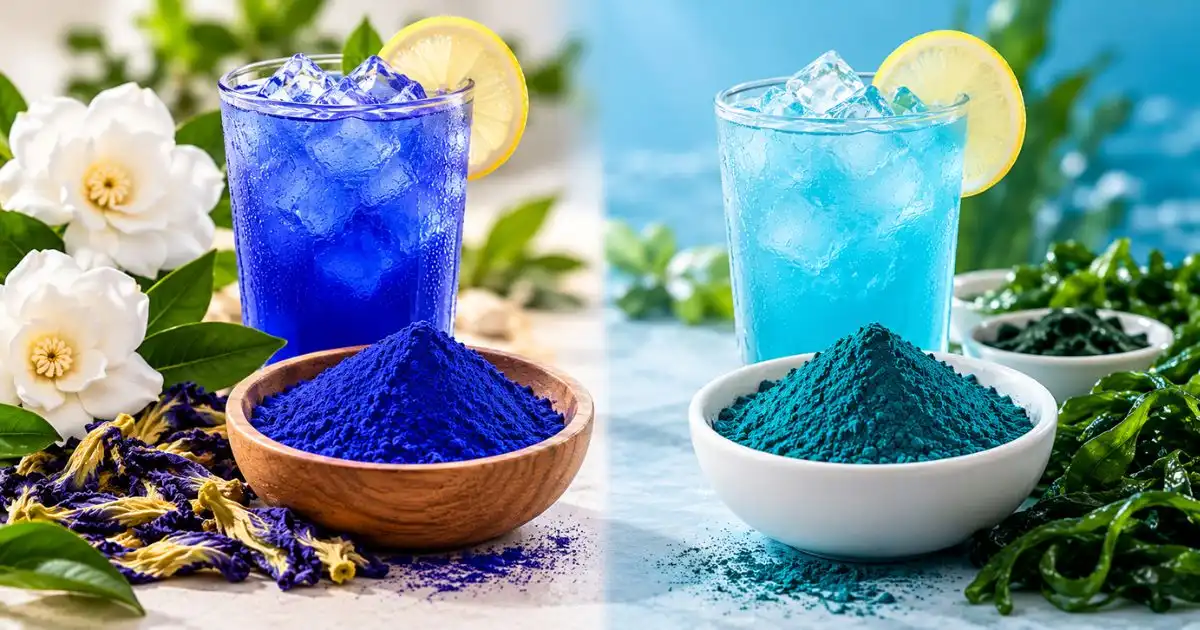
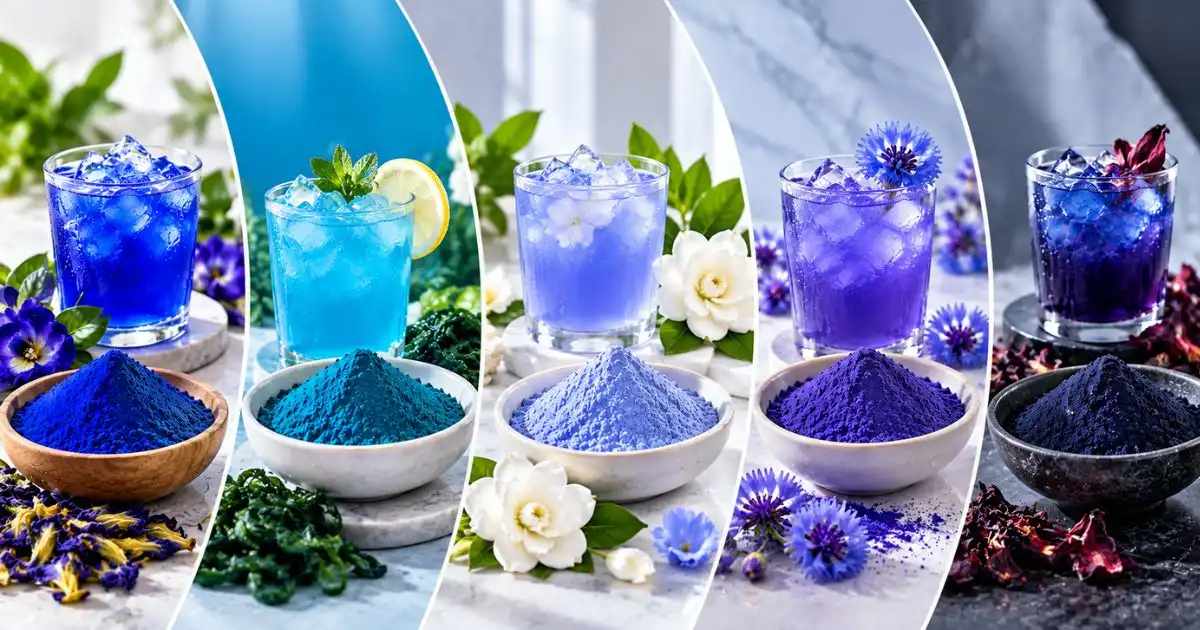
Comparison of Gardenia Blue to Other Blue Floral and Natural Colorants in Drinks
How Does Butterfly Pea Flower Compare?
Butterfly pea flower (Clitoria ternatea) is designed to be sensitive to pH. As acidity rises, its anthocyanins change color from blue to purple to pink. This makes it appealing for interactive cocktails but not reliable for making standard drinks. Gardenia blue, on the other hand, stays the same from pH 4.0 to 8.0, so formulators can be sure that every batch will have the same result.
What About Blue Hydrangea and Blue Orchid Extracts?
Blue hydrangea and blue orchid products are sold in stores, but they are hard to get and only work in certain areas because of regulations. At the same concentrations, they usually have less color intensity per gram than gardenia blue color. If B2B buyers want to make sure they have a steady supply of color and can check the value of the color (E1% 1cm), these other options add sourcing risk without improving performance.
Where Spirulina Still Makes Sense
Spirulina blue is still the best choice for uses that don't involve heat, like coatings for ice cream, raw energy bars, cold-brew drinks, and powdered drink mixes that are mixed with cold water and left out to sit. People who are looking for useful nutrition claims also like its protein-based color. If your product line has both hot and cold uses, you might want to look into a dual-sourcing approach that includes both colors.
Best Practices for Handling and Incorporating Gardenia Blue and Spirulina Blue in Drink Formulations
Storage Conditions to Protect Color Value
Gardenia blue powder should be kept in containers that can't be opened or exposed to light at temperatures below 25 °C and relative humidity below 60%. If you store it right, the standard shelf life is 24 months. The powder is hygroscopic, which means it can absorb water. This changes how easily it flows, but the color stays the same. For best color performance, spirulina should be kept in the fridge and used within 12 to 18 months.
Dosage Reference and Blending Guidance
Gardenia blue powder (E80) usually works best at 0.01 to 0.05% (w/w) for drinking uses, but this depends on the target color depth and matrix transparency. In order to get green tones, it works well to mix gardenia yellow with blue at a ratio of 1:3 to 1:5. This benefit of co-production lowers the cost per ton of finished product when compared to buying a green color on its own.
Quality Checks Before Scale-Up
Before going from testing to production, use a spectrophotometer to make sure that the color values are the same from batch to batch. Ask your supplier for HPLC data for each lot to make sure the amount of geniposide residue is within the acceptable range. Keep track of the pH of your water source, as differences in city supplies can affect how quickly the drug dissolves and how it looks at low dose levels.
Conclusion
For thermally processed, pH-variable beverage applications, the gardenia blue color performs better. It stays stable between pH 4.0 and 8.0 and can withstand 120 °C for 60 minutes, which are the two most common places where formulations fail in beverage color replacement projects. It's still a good idea to use spirulina blue in cold-processed foods and functional drinks. It's not a matter of which one you like better; it's a matter of matching the pigment chemistry to the way you make the paint. Before committing to a large order, ask for application data and sample batches.
FAQ
Can Gardenia Blue and Spirulina Blue Be Combined in One Drink Formula?
If your process stays below 70 °C, you can mix them. When used in cold processes, the two pigments can make each other's colors look better. But in pasteurized drinks, the spirulina part will break down during heat treatment, which will make the color uneven. Formulators usually pick one color for each SKU instead of blending them so that the results aren't unpredictable.
What Certifications Should I Verify Before Purchasing?
Any supplier should be able to give you ISO, HACCP, Kosher, or Halal certificates. Check the HPLC-confirmed color value (E1% 1cm) and geniposide residue levels for gardenia blue in particular. Batch-level COA paperwork is something that all reputable manufacturers do. These papers keep your QA team safe during checks and prove that ingredients can be tracked.
Are There Seasonal Supply Risks for Gardenia Blue?
In East Asia, gardenia fruit is mostly picked in the fall. Reliable sellers handle this by planning their supplies and working with other suppliers in different regions. For its E30–E200 grades, Yangge Biotech keeps stock on hand all year. Before setting a launch date, check with your supplier about lead times and safety stock policies.
Is Gardenia Blue Suitable for Alcoholic Beverages?
Yes. Gardenia blue can be mixed with water and aqueous ethanol solutions, so it can be used in RTDs with spirits, wine drinks, and liquor where the ethanol level is usually between 4% and 40%.
Request Samples from Yangge A Trusted Gardenia Blue Color Supplier
Yangge Biotech sells gardenia blue color powder that is certified by ISO, HACCP, Kosher, and Halal. They have grades E30 through E200, and each batch comes with full HPLC batch documentation and information on how to use the powder in drinks, sweets, and jams. Whether you are a person who makes drinks or a team that buys things in bulk, our expert team can help you with dosage and mixing based on your grid. To get a sample or price, email us at info@yanggebiotech.com or go to blog.yanggebiotech.com.
References
1. Buchweitz, M. (2016). Natural Solutions for Blue Colors in Food. Handbook on Natural Pigments in Food and Beverages. Woodhead Publishing.
2. Mortensen, A. (2006). Carotenoids and other pigments as natural colorants. Pure and Applied Chemistry, 78(8), 1477–1491.
3. Shi, Y., & Shi, J. (2019). Stability of natural blue pigments from Gardenia jasminoides Ellis in food systems. LWT – Food Science and Technology, 112, 108254.
4. Jespersen, L., & Strømdahl, L. D. (2005). Heat and light stability of phycocyanin in soft drink systems. European Food Research and Technology, 220(3–4), 261–266.
5. Stintzing, F. C., & Carle, R. (2004). Functional properties of anthocyanins and betalains in plants, food, and in human nutrition. Trends in Food Science & Technology, 15(1), 19–38.
6. Delgado-Vargas, F., Jiménez, A. R., & Paredes-López, O. (2000). Natural pigments: Carotenoids, anthocyanins, and betalains—Characteristics, biosynthesis, processing, and stability. Critical Reviews in Food Science and Nutrition, 40(3), 173–289.

Based on your location and order quantity, you will have the opportunity to receive a limited time free shipping promotion!
Who we are
Popular Blogs