Is Vegetable Carbon E153 Fully Vegan, Halal and Kosher Certified?
Vegetable carbon E153 is fully vegan, Halal, and Kosher certified when produced under verified plant-based conditions. Yangge's Vegetable Carbon Black E153 is derived from coconut shell and bamboo through controlled carbonization no animal-derived materials are involved at any stage. The product holds active Halal and Kosher certificates, alongside FDA approval. Each batch is tested by independent international laboratories before shipment. For food manufacturers targeting clean-label markets, this triple-certified black colorant offers a credible, compliant alternative to synthetic dyes, giving procurement teams the documentation they need to satisfy regulatory and retail requirements.Contact us an email at info@yanggebiotech.com to get a free sample of 10–30g or to talk about your bulk needs. Visit blog.yanggebiotech.com for more information about the product and the full COA.

Understanding Vegetable Carbon E153 and Its Certifications
What Is Vegetable Carbon E153?
Vegetable carbon Black E153 is a fine black powder that is made by carbonizing plant matter, mostly bamboo or coconut shell, under controlled heat. Its INS number is E153, and it has no smell or taste and doesn't dissolve in water or organic solvents. It is made to be a food-grade colorant, which makes it different from activated charcoal, which is used to absorb or detoxify substances and cannot be used in place of E153 on food labels.
How Does It Differ From Activated Charcoal?
Carbon is the same chemical base that both activated charcoal and E153 are made of, but their production methods and legal classifications are very different. Toxins can stick to activated charcoal because it has a lot of surfaces that can be activated by steam or chemicals. On the other hand, E153 is made by pyrolysis without any other action, and then it is milled to a constant particle size so that the colors are spread out evenly. If you use activated charcoal instead of E153, the color might be gray instead of black, and in most controlled markets, you won't be able to name it correctly.
Defining Vegan, Halal, and Kosher Standards
These three certifications say that food ingredients are safe for different groups of people and under different rules. When something is certified vegan, it means that it did not use any animal-derived materials in any way. For a product to be certified as halal by a recognized Islamic body, the raw materials, tools used for processing, and facilities must not contain any haram substances. Rabbinical agencies manage kosher certification, which has strict rules about where to get ingredients like vegetable carbon, how to make tools, and how to keep an eye on things. For each standard, audits must be recorded, and a single valid certificate is not enough serious B2B buyers expect ongoing compliance tracking.

Is Vegetable Carbon E153 Fully Vegan, Halal, and Kosher?
Vegan Status: Plant Origin and Cross-Contamination
Yangge's E153 comes from nothing but coconut shell and bamboo, which are both plants and not animal goods. There are no animal-based binders, carriers, or manufacturing tools used. The fact that it is vegan is built into the raw material. Facility division is what buyers are really worried about: in plants that make more than one thing, using the same tools can lead to non-vegan cross-contact. Yangge follows ISO and HACCP rules and has special production controls that lower the risk of cross-contamination. This means that the product can be labeled in lines of products that are marketed as vegan.
Halal Compliance: Segregation and Certification
To be halal, plants must come from a certain place, but every link in the supply chain must be free of haram contamination. As of right now, Yangge's Vegetable carbon Black E153 has a valid Halal license. For Halal-sensitive lines, production methods follow the rules for segregation, and documentation is provided upon request. Having a supplier-issued Halal certificate backed by a recognized certifying body makes auditing a lot easier for food companies that sell to customers in the Middle East or in North America and Europe that sell Halal-certified goods.
| Certification | Certifying Basis | Yangge Status |
|---|---|---|
| Vegan | Plant-only raw materials, no animal inputs | Confirmed (coconut shell / bamboo) |
| Halal | Haram-free production, certified by Islamic body | Certificate held |
| Kosher | Rabbinical supervision, kosher-compliant processing | Certificate held |
Kosher Certification: Supervised Sourcing and Production
Kosher compliance puts a lot of weight on keeping an eye on production and being able to track down ingredients. Yangge's E153 is Kosher approved, which means that a known religious agency has looked over both the paperwork about where the materials came from and the rules for making them.
This gets rid of a common qualification bottleneck for food producers who serve approved kosher retail lines or food service providers using vegetable carbon. You can download the Certificate of Analysis (COA) for each batch here: COA-Vegetable carbon blackE153-YANGGEBIOTECH.pdf. Certification documents are sent with the normal shipping paperwork.

Applications and Benefits of Certified Vegetable Carbon E153 for B2B Clients
Food Coloring in Bakery, Confectionery, and Beverages
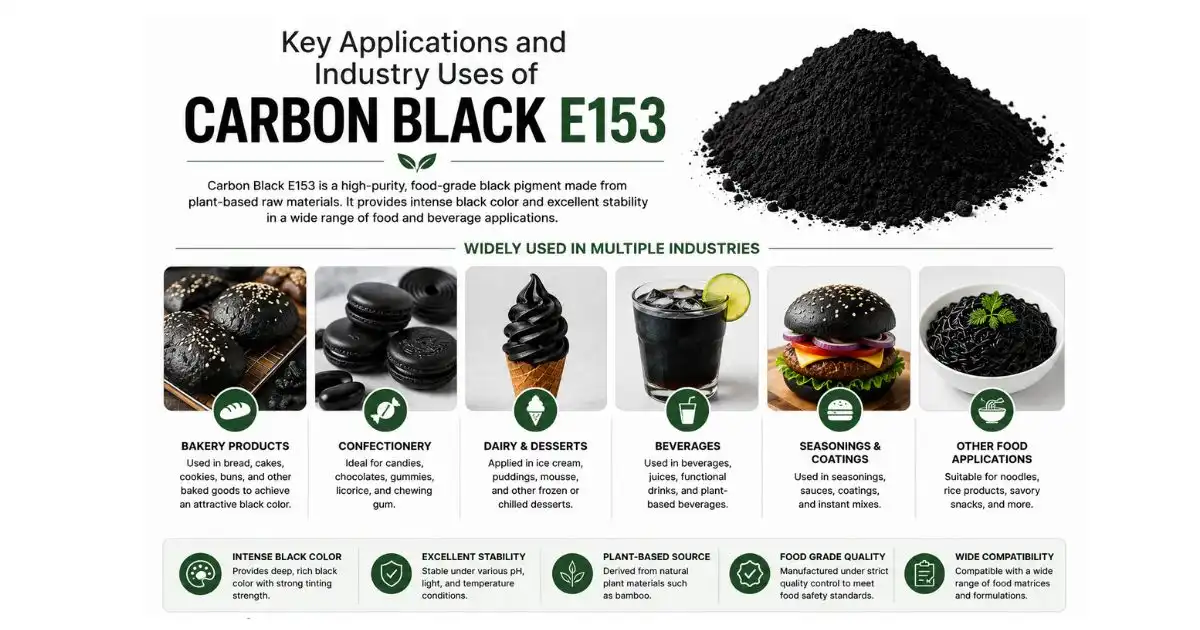
E153 makes a deep, stable black that can be used to color baked goods, ice cream, candy coatings, sauces, and drinks that need to be black. Because it doesn't dissolve in water, it works as a pigment instead of a dye. The depth of color depends on how evenly the particles are spread out, not how well they dissolve.
When properly mixed, the colorant gives uniform results from batch to batch for people who are making black burger buns, charcoal-colored ice cream, or black sesame-colored candies. Yangge's material is checked with HPLC to make sure that every package meets the requirements for purity and color strength.
| Application | Typical Use Level | Key Benefit |
|---|---|---|
| Black burger buns / bread | 0.1–0.5% | Deep, uniform black crust color |
| Ice cream / frozen desserts | 0.05–0.3% | Stable black without graying |
| Confectionery coatings | 0.1–0.4% | Opaque black finish |
| Sauces and dressings | 0.05–0.2% | Color depth in liquid systems |
Cosmetic and Pharmaceutical Applications
Beyond food, Yangge's Vegetable carbon Black E153 satisfies pure standards for beauty pigment use in mascara, eyeliner, and black-tinted skin care products that call for a natural black pigment. Because it is non-toxic and doesn't have a bad smell, formulators who want to switch from manmade carbon colors can use it.
Pharmaceutical-grade uses also exist, but buyers in this market segment should ask for specific grade documentation and PAH (polycyclic aromatic hydrocarbon) test results. Before each shipment, Yangge provides these through third-party laboratory testing.
Clean-Label Positioning and Market Demand
Consumer study in North America and Europe constantly shows that claims like "plant-based" and "naturally derived" affect people's decisions to buy. Manufacturers can get rid of artificial color statements from ingredient lists by switching out synthetic colorants like Brilliant Black BN (E151) for an E153 that comes from plants. This switch lets mid-sized food brands compete in high-end stores make claims on the front of the package and take part in wider clean-label reformulation programs without having to make big changes to their current recipes.
Comparing Vegetable Carbon E153 With Alternatives for Procurement Decisions
Vegetable Carbon vs. Activated Charcoal vs. Animal Charcoal
The differences between these three materials are important for labeling, certification, and performance, but procurement teams often see them listed as the same thing. Bone char, which is made from animal parts, is not allowed in any vegan, halal, or kosher products.
In the EU and the US, activated charcoal is in a regulatory gray area when it comes to food coloring. It is not approved as a food additive under E153 rules in most places. In regulated markets, the only certified food coloring that is legal is E153, which is made from plant matter in conditions that are safe for food. Buyers should always ask for a COA that confirms the item came from a plant.
Powder Grade vs. Granule: Choosing the Right Form
Yangge's E153 comes in the form of a black powder, which is the usual way to use food coloring. Compared to grain grades that are usually used in industrial settings, powder forms allow for more even mixing in doughs, coats, and liquids. The right specification for food R&D teams that want to test black coloring in baked goods or frozen desserts is powder-grade E153. Yangge offers free samples ranging from 10 to 30 grams, which can be used right away to test the product before placing an order for at least 1 ton.
Regulatory Scope: U.S., EU, and Beyond
E153 is approved in the EU under Regulation (EC) No 1333/2008 for certain types of food. In the US, the regulatory process is different, and buyers should check with the FDA to see what the current state is for their particular application before going to market.
Yangge's product has FDA approval paperwork, and the team helps buyers in North America, the EU, and the Middle East make sure they are following the rules. By making sure of the right legal framework early on in the buying process, it is possible to avoid having to do expensive changes later on.

How to Source Certified Vegetable Carbon E153 for B2B Procurement
Evaluating Suppliers: Certifications and Lab Testing
A reliable vegetable carbon provider should at least have a current COA with batch-specific heavy metal and PAH results, Halal and Kosher certificates from reputable organizations, and proof that the raw materials came from plants. Yangge meets all three requirements and has every package tested by a separate foreign lab. Buyers who get their goods from unknown sellers who can't provide batch-level PAH data are really at risk of not following the rules.
Ordering Logistics: MOQ, Pricing, and Delivery
Yangge has 5 tons of Vegetable carbon Black E153 in stock right now, and a single ton is needed to place an order. FOB or CIF terms can be used for delivery, giving buyers in North America, Europe, and Asia more options. Yangge gives 10–30g free samples to R&D teams that are still working on formulas so that they can try them out without having to pay for them. This sample program is very useful for product developers who need to make sure that the color depth and spread are correct in their own matrix before scaling it.
Verifying Traceability From Plant to Final Product
Traceability paperwork should prove the plant source (coconut shell or bamboo), processing conditions, and quality checks that were done on the raw material and the final powder. Yangge uses production methods that are ISO and HACCP-certified, and its supply chain includes practices that allow food to be tracked from farm to table.
A sustainable sourcing approach lets the company work directly with providers of raw materials, and it also meets the ESG reporting needs of buyers. Full traceability records can be sent to buyers upon request and added to their files for qualifying suppliers.

Conclusion
Yangge's Vegetable carbon Black E153 is certified Halal, Kosher, and FDA. It is made from coconut shell and bamboo, and independent labs test it before every shipment. It gives food companies that make clean-label black products, like premium ice cream and black burger buns, a verified, plant-based alternative to synthetic colorants. It's easy to buy because they have 5 tons in stock, a minimum order quantity of 1 ton, and free samples for research and development. This product directly meets the needs of buyers who care about batch stability, recorded purity, and well-known certifications.
FAQ
Is Vegetable Carbon E153 the same as activated charcoal?
No. Activated charcoal and E153 are processed differently and classified separately by food regulators. E153 is carbonized plant material refined for food-grade coloring. Activated charcoal undergoes additional activation for adsorption use and is not approved as a food colorant in most regulated markets.
Can E153 be used in the United States?
Yangge's product carries FDA approval documentation. Buyers should confirm the specific application and current FDA status for their product category, as the regulatory pathway in the U.S. differs from EU approval under E153.
What plant materials does Yangge's E153 come from?
Yangge's Vegetable Carbon Black E153 is produced from coconut shell and bamboo through carbonization. Both sources are plant-only, supporting vegan and Halal declarations.
How do I request a free sample?
Yangge offers 10–30g free samples for R&D trials. Contact the team at info@yanggebiotech.com to request a sample along with the product COA.
What is the minimum order quantity?
The MOQ is 1 ton. Yangge currently holds 5 tons in stock and ships on FOB or CIF terms.
Request Certified Vegetable Carbon From Yangge Today
Yangge is a reliable company that makes vegetable carbon. They have ISO, HACCP, Halal, and Kosher certifications and sell to food and cosmetic companies all over the world. Before each shipment, our E153 black powder is checked by independent labs, and full traceability paperwork is provided. Send us an email at info@yanggebiotech.com to get a free sample of 10–30g or to talk about your bulk needs. Visit blog.yanggebiotech.com for more information about the product and the full COA.
References
1. European Food Safety Authority (EFSA). Re-evaluation of Vegetable Carbon (E 153) as a Food Additive. EFSA Journal, 2012.
2. Food and Agriculture Organization of the United Nations / World Health Organization (FAO/WHO). Combined Compendium of Food Additive Specifications: Vegetable Carbon. JECFA Monographs, 2006.
3. European Parliament. Regulation (EC) No 1333/2008 on Food Additives. Official Journal of the European Union, 2008.
4. Islamic Food and Nutrition Council of America (IFANCA). Halal Certification Standards for Food Additives and Colorants. IFANCA Technical Bulletin, 2019.
5. Orthodox Union (OU). Kosher Certification Guidelines for Natural Colorants and Food-Grade Pigments. OU Kosher Standards Manual, 2020.
6. Codex Alimentarius Commission. General Standard for Food Additives (GSFA): INS 153 Vegetable Carbon. Codex Stan 192-1995, Rev. 2019.

Based on your location and order quantity, you will have the opportunity to receive a limited time free shipping promotion!
Who we are
Popular Blogs