Is Carbon Black E153 a safe natural food coloring?
Yangge Biotech supplies food-grade Vegetable Carbon Black E153 with options for bulk purchasing, OEM packaging, customized specifications, and supporting documentation such as COA, MSDS, specification sheets, and testing reports. The product is available as a fine black powder and is offered for manufacturers, distributors, supplement companies, food brands, and other B2B customers worldwide.
For manufacturers looking for a reliable Carbon Black E153 powder supplier, Yangge Biotech provides consistent ingredient quality, batch testing, flexible packaging solutions, and bulk supply support. Contact Yangge Biotech today to request samples, product specifications, COA, pricing, or OEM/ODM solutions.
Email: info@yanggebiotech.com
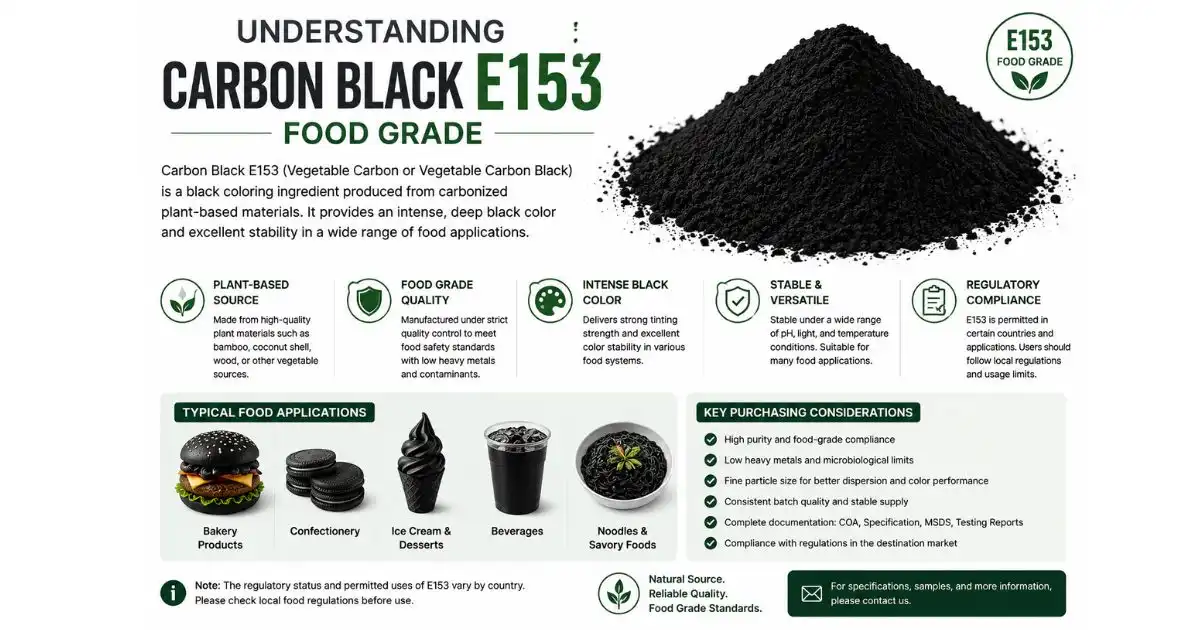
Carbon Black E153, particularly when derived from vegetable sources like coconut shells or bamboo through controlled carbonization, represents a safe and effective natural food coloring option approved across multiple regulatory jurisdictions. This food-grade pigment offers intense black coloration without flavor interference, meeting clean-label demands while maintaining regulatory compliance in regions including the EU and Canada. Safety depends primarily on source material quality and rigorous testing for contaminants such as polycyclic aromatic hydrocarbons (PAHs) and heavy metals.
Understanding Carbon Black E153 and Its Properties
What Is Vegetable Carbon Black E153?
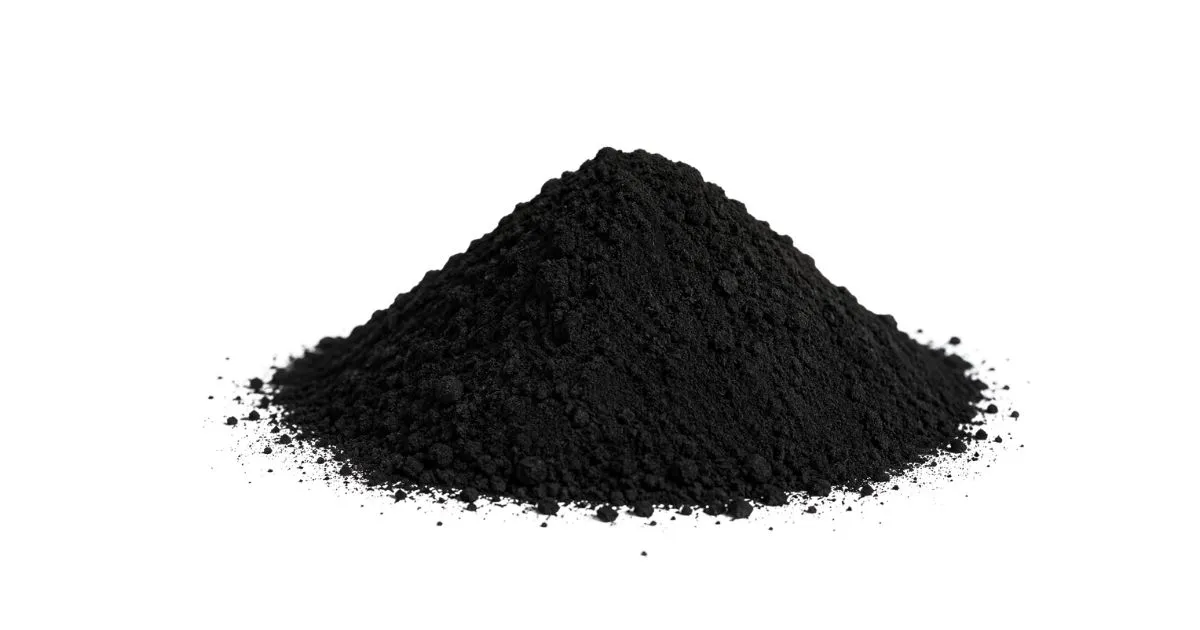
Carbonising plant-based materials like coconut shells, bamboo, or wood that comes from sustainable sources makes Vegetable Carbon Black E153, a natural black pigment. In contrast to manufactured colorants, which are made through chemical synthesis, this additive is made through thermal breakdown in controlled settings with little air. The process makes almost pure elemental carbon with a microcrystalline structure. It comes out as a fine black powder that has no smell or taste and can be used in any manufacturing process.
This colorant is called E153 in the International Numbering System, which makes it different from other carbon-based additives. Yangge Biotech makes high-quality Vegetable Carbon Black E153 from coconut and bamboo shells. They make sure the quality is always the same by using HPLC extraction methods that give the product higher purity levels than 95% carbon content on a dry base.
Chemical and Physical Characteristics
This color is very useful in the food industry because of the way it is made. It has great covering power and color depth because the particles are usually smaller than 5 micrometres. Because it doesn't dissolve in water, ethanol, or oils, it works as a dispersed pigment instead of a soluble dye, keeping its shape during processing.
One of the best things about this colorant is that it doesn't break down at temperatures above 200°C, unlike organic dyes that do when they are heated for processing at high temperatures like baking or extrusion. This stability also includes pH resistance, since the inert carbon structure doesn't change when mixed with acidic or basic substances that are common in food. Light contact doesn't change the color, so the product looks the same throughout its shelf life.
Typical Applications in Food Manufacturing
Products with black themes are becoming more and more popular in the baking, candy, and drink industries. Carbon Black E153 gives activated charcoal ice cream, black burger buns, and Halloween-themed sweets their unique look without adding any flavour. When used to make liquorice, it gives it a deep black color and hides differences in natural ingredients that could cause batch differences.
Companies that make expensive dog and cat food are adding this color more and more. The way food looks affects people's decisions to buy it. Cross-contamination between kibble colors is avoided in multicoloured products because the colorant stays stable during extrusion processes and doesn't move around. Speciality soft drinks and alcoholic drinks aimed at trend-conscious customers are examples of beverage uses. However, formulators must deal with settling issues because the pigment is not soluble.
Analyzing the Safety and Toxicity of Carbon Black E153
Regulatory Status Across Major Markets
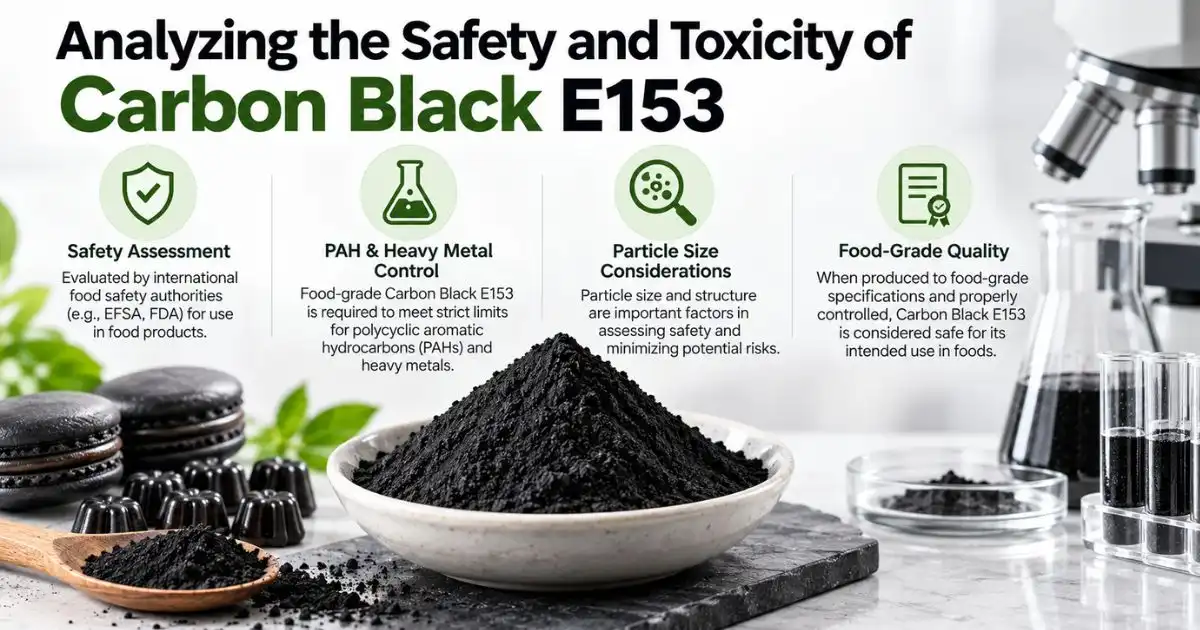
Understanding legal systems helps with choices about what to buy and how to get into new markets. The European Union approved E153 for use in food under Commission Regulation (EU) No 231/2012. This means that it can be used in certain types of food and manufacturers can use as much as they need to get the effects they want without having to worry about specific maximum amounts. With this permission, the European Food Safety Authority says that using Carbon Black E153 in the right way doesn't pose any safety risks.
The Food and Drug Regulations in Canada also allow vegetable carbon to be used as a food coloring. The drug is GRAS (Generally Recognised As Safe) in certain situations in countries that follow international food guidelines. Halal and Kosher approvals make markets even easier to get into, and they meet religious dietary needs that are becoming more important in global supply lines.
But procurement managers who want to sell in the U.S. have to deal with some problems. The FDA does not currently approve E153 as a food color additive, so companies that want to sell their goods in the U.S. have to change the recipes of their goods and use approved alternatives. This difference in regulations shows how important it is to know what the target market needs while a product is being developed.
Scientific Research on Safety Parameters
New toxicological study gives us more confidence that Carbon Black E153 is safe when it is made under the right conditions. Studies that looked at both short-term and long-term exposure situations found no negative effects at levels of consumption common in food applications. Bioavailability is limited because the color is inert and can't cross biological walls. This means that particles that are eaten go through the digestive system without being absorbed.
Polycyclic aromatic hydrocarbons (PAHs), which can cause cancer, may get into the water through poor carbonisation processes. This is the biggest safety concern. To make sure that benzo(a)pyrene levels stay below 50 µg/kg, which is well below the levels that are linked to health risks, good manufacturers use strict processing controls and verification testing. Heavy metal pollution is another point of check, with arsenic limits of 3 mg/kg, lead limits of 2 mg/kg, and mercury limits of 1 mg/kg.
These parameters are regularly checked by a third-party laboratory, and reliable suppliers give Certificates of Analysis that show they meet international standards. Before sending out a lot of products, Yangge Biotech has them tested thoroughly by foreign labs. This makes sure that the quality is always the same and that the company follows all the rules.
Clarifying the Natural Versus Synthetic Debate
What makes E153 "natural" depends on where it comes from and how it was processed. Most regulations consider versions that come from plants and are made only by heating plant materials to carbonation without adding any chemicals to them to be natural colorants. This difference is very important for clean-label positioning because people are becoming more and more interested in naturally derived products over manufactured ones.
On the other hand, some carbon black products come from incomplete combustion processes that use gasoline to make substances that are effectively similar but not the same. To make sure the supply chain is clear and to back up marketing claims, procurement specifications should clearly require vegetable-source documentation. Plant origin certificates, like those for coconut shells, bamboo, or other plants, are needed to prove that a natural product is what it says it is.
Comparing Carbon Black E153 with Alternatives
E153 Versus E150 (Caramel Colors)
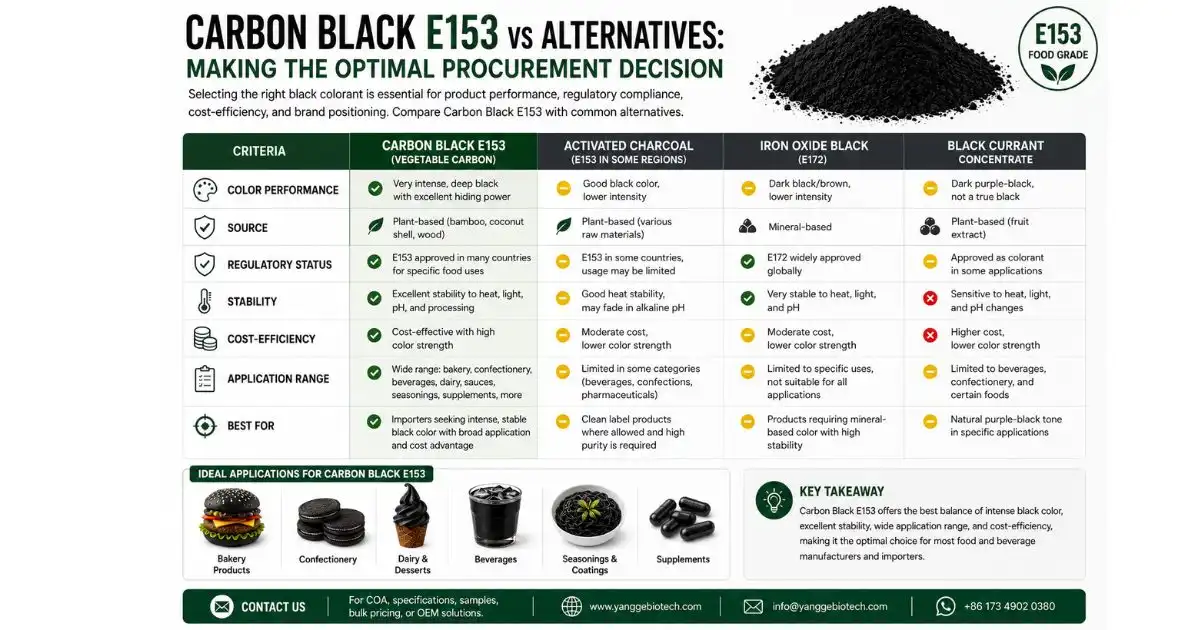
Both give off a dark color, but there are important differences that make one better for some uses than the other. The caramel colors in E150 come from carefully burning carbohydrates, which can make them brown or black, based on how they are processed and what other ingredients are added. There are four subclasses of E150, named E150a through E150d. Each has its own features and legal issues to think about.
When compared to caramel colors, which tend toward brown tones even at high concentrations, vegetable carbon is more black. Because the pigment is inert, there are no worries about the formation of ammonium compounds, which can happen with some E150 variants. When working with high temperatures, Carbon Black E153 is better because it is more stable, but caramel colors are better because they dissolve in water, which is useful in beverage recipes where it's hard for solid pigments to stay suspended.
| Parameter | Vegetable Carbon E153 | Caramel Color E150 |
|---|---|---|
| Color Intensity | Pure black, high opacity | Brown to dark brown |
| Solubility | Insoluble (dispersed pigment) | Water-soluble (E150c, E150d) |
| Heat Stability | Excellent (>200°C) | Moderate (degrades >150°C) |
| pH Sensitivity | None (chemically inert) | Moderate (color shift in extremes) |
| Natural Status | Natural (plant-derived) | Processed natural (sugar-derived) |
Comparison with Activated Charcoal
People often get Carbon Black E153 and activated charcoal mixed up, but the two are made in very different ways and have very different functions. Activated charcoal goes through more activation steps, usually chemical or steam contact, that make a lot of pores inside it. This makes the surface area ideal for adsorption. Because it is porous, activated charcoal is good for filtering and detoxing, but it raises concerns when used in food.
Because activated charcoal can absorb things, it may bind nutrients, flavours, or even medicines, causing unwanted effects in food or after consumption. Regulatory bodies have different rules for each of these materials. For example, activated charcoal is not allowed to be added to food in many places, even though it is okay to use in supplements. When Carbon Black E153 is made, the particle size is optimised for color dispersion instead of surface area. This gets rid of problems with adsorption and improves the performance of the pigments.
Alternative Natural Black Pigments
Squid ink, black carrot concentrate, and grape skin extract are some other natural black colorants. Each has its own pros and cons. Squid ink has real color and a unique flavour profile that is good for speciality uses, but it can cause allergies and is hard to get consistently. Anthocyanin-based colorants from black carrot and grapes are sensitive to light and pH, which makes them less stable than carbon-based pigments.
Synthetic options, such as Brilliant Black PN (E151), give strong colors and are very easy to dissolve, but they go against the trend toward clean labels and are getting more and more attention from regulators. The decision matrix finds the best balance between color performance, stability needs, regulatory acceptance, cost, and brand positioning goals that are unique to each product line.
Procurement Considerations for Carbon Black E153
Identifying Reliable Suppliers and Verifying Quality
Partnering with reputable makers protects the quality of the product and the supply chain, especially when using ingredients like Carbon Black E153 that require strict quality control. The first step in verification is to look at the certificates. ISO, HACCP, Kosher, and Halal certifications show that the food is managed well and follows national food rules. Following Good Manufacturing Practice (GMP) and getting an FDA site registered show that you are committed to foreign standards, even when you're serving people from other countries' stores.
Ask for proof that the ingredients come from vegetables to back up claims that the product is pure, and stay away from versions that come from petroleum. Each package should come with a Certificate of Analysis (CoA) that lists:
- Carbon content purity
- Levels of PAHs, mainly benzo(a)pyrene
- Results of heavy metal screening
- Testing for microbial contamination
- Moisture content and ash percentages
For every batch, Yangge Biotech gives full paperwork, including verification from a third-party lab. This makes sure that there is transparency throughout the supply chain. As part of our commitment to sustainable sourcing, we work directly with farming communities to make sure that we can track all of our products from the time they are harvested for raw materials to the time they are delivered to customers.
Pricing Structures and Order Considerations
Understanding the different parts of costs helps buying budgets work better while still meeting quality standards. The price of Vegetable Carbon Black E153 is based on the cost of the raw materials, the difficulty of preparing them, the need for approval, and the cost of checking their quality. Unit economics are usually better when you buy in bulk, and most established suppliers have minimum order quantities of around one metric tonne.
Prices on the market right now range from $8 to $15 per kilogram, based on the grade, the need for certification, and the size of the sale. Premium grades with strict PAH limits and full certification portfolios command higher prices, which are justified by lower regulatory risk and better marketability. The type of delivery (FOB vs. CIF) has a big effect on the total landed costs, especially when shipping goods across international borders.
| Order Quantity | Typical Unit Price Range | Lead Time | Delivery Terms |
|---|---|---|---|
| 1-5 tons | $12-15/kg | 3-4 weeks | FOB/CIF available |
| 5-10 tons | $10-13/kg | 2-3 weeks | CIF recommended |
| 10+ tons | $8-11/kg | Negotiable | CIF with optimized logistics |
Sample Testing and Quality Verification
Responsible procurement includes checking before the purchase by evaluating samples. For research and development trials, most providers offer 10–30 gram samples. This lets you check the dispersion properties, color intensity, and compatibility with certain formulations before committing to large orders.
Protocols for testing should look at how the particles are spread out, how regular the colors are in the target uses, how the materials behave during production, and how the finished product looks. Dispersion testing shows possible agglomeration problems that could lead to visible spots or streaks in finished products. This is a common worry raised by companies that use carbon-based pigments. Testing an ingredient's compatibility with other ingredients stops them from reacting in ways that could change its stability or look.
Yangge Biotech gives away free samples and provides expert support during the review phase to help customers find the best formulation parameters and processing conditions. This way of working together cuts down on implementation risks and speeds up the time it takes to get new products on the market.

Best Practices for Using Carbon Black E153 in Food Products
Storage and Handling Guidelines
When pigments are stored correctly, they keep their quality and don't get contaminated. Keep Vegetable Carbon Black E153 in a cool, dry place that is out of direct sunlight and where the temperature stays below 25°C and the relative humidity stays below 60%. Sealed containers keep out airborne contaminants and keep moisture from absorbing, which could cause clumping.
The fine powder shape makes dust when it is handled, which makes it hard to keep work areas clean. Airborne particles can be kept to a minimum by using closed transfer systems or working with formulas that have already been spread out. Workers who handle the pigment by hand are protected by PPE like dust masks, but the pigment itself is not toxic when breathed in and only causes mechanical irritation.
Achieving Optimal Dispersion and Color Uniformity
The quality of the dispersion has a direct effect on how the final product looks. Because the pigment is not soluble, it needs to be mixed mechanically (high-shear mixing, homogenisation, or wet milling) in order to make stable suspensions. Before adding to bulk formulas, spreading in glycerin, vegetable oils, or water-based systems makes distribution better and stops clumping.
Dosage usually ranges from 0.1% to 0.5%, depending on how dark you want the matrix to be and how it is made. For pigments like Carbon Black E153, starting with lower concentrations and slowly increasing them while watching the color develop stops you from using too much. When coating something, using several thin layers gives better uniformity than using a single heavy layer. This is because multiple thin layers prevent streaks and improve glossiness, which is especially important when applying Carbon Black E153 to achieve a smooth, even finish.
Cleaning the equipment is important because the color may stain working surfaces for a short time. Alkaline cleaners and mechanical scrubbing get rid of leftovers, but because the color is inert, it doesn't stick to food-contact surfaces forever like some synthetic dyes do.
Regulatory Compliance and Labeling Requirements
Labels that are correct help businesses stay in line with the law and build trust with customers. According to European rules, these ingredients must be listed as "vegetable carbon" or "E153" on the label. Clean-label goods may stress that the ingredients are natural vegetables by saying things like "colored with vegetable carbon from coconut shells" to support the natural stance.
Keep proof that natural claims are true, like supplier certifications that confirm plant-based materials and processing methods. This ability to be tracked is very important during reports or when there are questions from regulators. Understanding the needs of the market you want to sell to saves you money on formula changes or problems getting into the market. For example, products going to the U.S. market can't have E153 in them, so they need different colorants or are taken out of the market.
Conclusion
Vegetable Carbon Black E153 gives companies that make food and pet food a safe, stable, and naturally derived way to get strong black colouration in a wide range of situations. Because it is legal in many countries outside of the US and doesn't change much in temperature or pH, this color is a good choice for clean-label items that aim to please people who care about quality. To be safe, you must only buy from reputable companies that have strict quality controls in place, especially when it comes to PAH and heavy metal contamination.
Procurement pros can safely add this colorant to product lines while meeting performance standards and regulatory obligations by choosing the right suppliers, making sure the formulations are optimised, and following the right handling practices. As the need for natural alternatives to synthetic colorants grows, it becomes even more important to build trusting supply chains with certified manufacturers who are dedicated to quality and openness.
FAQ
Is Vegetable Carbon E153 approved globally?
Following international food standards, Vegetable Carbon E153 is approved by regulators in the European Union, Canada, and many other places. Under quantum satis rules, the EU lets it be used in certain types of food. But the U.S. FDA has not yet approved E153 as a food color additive. This means that goods made for American customers have limited access to the market. For safety reasons, companies that ship goods around the world should check the rules in the markets where their products will be sold while the products are still being developed.
How do I verify supplier authenticity and product quality?
The first step in the verification process is to look at the supplier's credentials, such as ISO, HACCP, Kosher, and Halal credentials that show systematic quality management. Ask for Certificates of Analysis that show the carbon purity, PAH levels (especially benzo(a)pyrene levels below 50 µg/kg), heavy metal screening results, and microbial testing outcomes. Verification by a third-party agency adds to the confidence. Asking for samples before buying in bulk lets you check the color's performance and how it spreads in different situations, which lowers the risks of buying in bulk.
What are primary safety concerns with this colorant?
The main safety concerns are the possibility of pollution with heavy metals and polycyclic aromatic hydrocarbons (PAHs) that can happen when production processes are not done correctly. Reliable suppliers use strict controls during processing and thorough testing to make sure that the levels of contaminants stay well below the safety thresholds. Since the pigment is inactive and can't be taken through the digestive system, it is not harmful in and of itself. These risks can be successfully reduced by choosing certified sources with clear quality paperwork.
Partner with Yangge for Premium Vegetable Carbon Black E153 Supplier Solutions
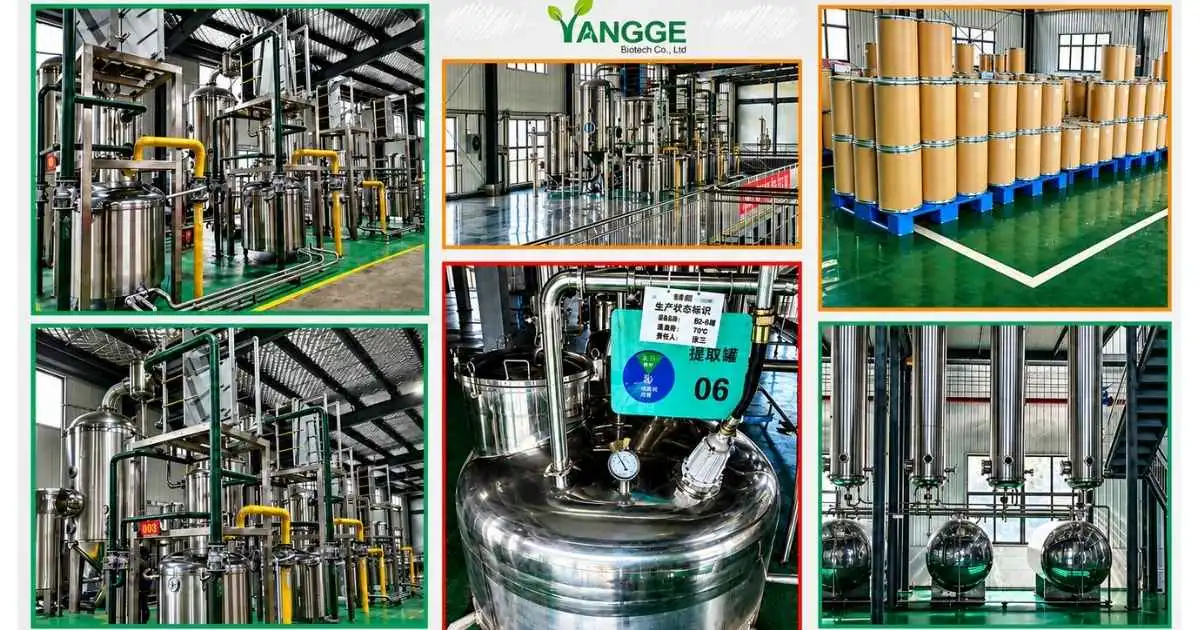
Yangge Biotech is an expert in providing high-quality Vegetable Carbon Black E153 that is made from eco-friendly plant materials like coconut shells and bamboo. Our kosher and halal-certified goods are made to the highest international quality standards. Before they are shipped, each batch is tested by a third-party lab for PAH levels, heavy metals, and purity factors. With five tonnes in stock and flexible FOB/CIF shipping choices, we can meet the needs of food and pet food makers around the world for both one-time orders and regular bulk supply needs.
Our technical team offers free 10–30g samples for R&D evaluation and provides full application help throughout the entire product creation process. We know how important it is for your buying choices that the dispersion is uniform, that regulations are followed, and that the supply is reliable.Contact us or email our team at info@yanggebiotech.com to talk about your specific needs, get technical specs, or set up shipping of samples. Yangge Biotech is a reliable Carbon Black E153 producer that is dedicated to quality and sustainability. They provide the raw materials that help your goods do well in markets that are very competitive.
References
1. European Food Safety Authority (EFSA). (2012). Scientific Opinion on the re-evaluation of vegetable carbon (E 153) as a food additive. EFSA Journal, 10(4), 2592.
2. Food and Agriculture Organization/World Health Organization (FAO/WHO). (2021). Compendium of Food Additive Specifications: Joint FAO/WHO Expert Committee on Food Additives. FAO JECFA Monographs, 23.
3. European Commission. (2012). Commission Regulation (EU) No 231/2012 laying down specifications for food additives listed in Annexes II and III to Regulation (EC) No 1333/2008. Official Journal of the European Union, L83/1.
4. U.S. Food and Drug Administration (FDA). (2022). Color Additives Permitted for Use in Foods. CFR - Code of Federal Regulations Title 21.
5. Downham, A., & Collins, P. (2000). Colouring our foods in the last and next millennium. International Journal of Food Science & Technology, 35(1), 5-22.
6. Martins, N., Roriz, C.L., Morales, P., Barros, L., & Ferreira, I.C. (2016). Food colorants: Challenges, opportunities and current desires of agro-industries to ensure consumer expectations and regulatory practices. Trends in Food Science & Technology, 52, 1-15.

Based on your location and order quantity, you will have the opportunity to receive a limited time free shipping promotion!
Who we are
Popular Blogs