How to prevent fading in phycocyanin formulations
Preventing fading in phycocyanin formulations starts with understanding that blue phycocyanin is a protein-bound pigment, not a simple dye. Its chromophore is covalently linked to a protein chain, making it reactive to heat, light, pH shifts, and oxidative stress. To protect its color value and biological activity, formulators must control processing temperatures below 45°C, maintain pH between 5.0 and 7.0, limit UV exposure, and select high-purity grades such as E18, E25, or E25 with ≥25% phycocyanin content. Sourcing from a supplier with verified HPLC batch reports is the single most effective upstream decision.Contact us at info@yanggebiotech.com or visit blog.yanggebiotech.com right now to get a sample or technical data sheet today.

Understanding the Problem of Fading in Phycocyanin Formulations
It's not just a matter of looks when phycocyanin breaks down. If the color fades, it means that the structure of the active protein has been broken. The antioxidant power, the color value, and any claims on the label about the amount of phycocyanin present are all lost.
Why the Molecular Structure Makes It Fragile
Phycobiliproteins are the group that C-phycocyanin is a part of. There is a blue color called phycocyanobilin that is strongly linked to a structure made of apoproteins. When heat or changes in pH make the protein unfold, the chromophore can't find its place anymore. The blue color fades a lot when it absorbs less light at 618 nm. This is the reason why you need to keep track of both the phycocyanin percentage and the color number (E1% at 618 nm).
Industries Most Affected by Color Loss
The foods that fade the most quickly are sweets, functional drinks, and supplements. This is because they use water-based mixtures, are pasteurized, or have fruit acids with a low pH. If you put cosmetics in UV light, they can break down. Every sector needs a different plan to be stable. There is no one way to do it.
What "Fading" Actually Costs B2B Clients
If claims about phycocyanin content can't be checked, faded finished goods may have to go through re-formulation cycles, batch rejects, customer complaints, and the close attention of regulators. A 2019 study in the journal Food Chemistry found that after only 24 hours at 60°C, liquid phycocyanin lost up to 60% of its color. What this shows is how quickly things can become unstable if you don't have the right controls.
Key Factors Contributing to Fading in Phycocyanin Formulations
There are three main types of things that cause color loss for blue phycocyanin: triggers in the surroundings, formulation chemistry, and the quality of the raw materials. All three must be kept under control for the product to have a stable shelf life.
| Degradation Factor | Threshold for Risk | Recommended Control |
|---|---|---|
| Temperature | >45°C accelerates unfolding | Cold-processing; avoid pasteurization as much as possible |
| pH | <4.0 or >8.0 can mess up the chromophore | Make sure the final matrix has a pH of 5.0–7.0 |
| UV/Visible Light | 400–700 nm wavelength range | UV-blocking packaging; use amber glass or opaque pouches |
| Oxidation | Free radical exposure | Add ascorbic acid or rosemary extract as co-antioxidants |
pH Sensitivity and Its Impact on Color Value
Proteins break down quickly when the pH is below 4.0, and the color value drops in a way that can be tested. There are a lot of fruit-flavored drinks and candy recipes with a pH between 3.0 and 3.5. This means that exposed phycocyanin can't be added directly without being encapsulated or taking its pH down.
Heat Stress During Processing
Three main ways that heat can hurt something are through spray drying, extrusion, and pasteurization. A study in LWT – Food Science and Technology found that phycocyanin content dropped by more than 30% when temperatures above 140°C were used during spray drying, even in short runs. When you dry something at a low temperature, the color and structure of the proteins stay the same.
Raw Material Purity and Grade Selection
It's not possible to change the color value grades E10, E18, and E25. High color value grades have more phycocyanin per gram. In other words, the color has more time to fade before it can be seen. Pharmaceutical- or USP-grade material also has stricter batch-to-batch requirements. This makes stability testing less variable in the long run.

Proven Methods to Prevent Fading in Phycocyanin Formulations
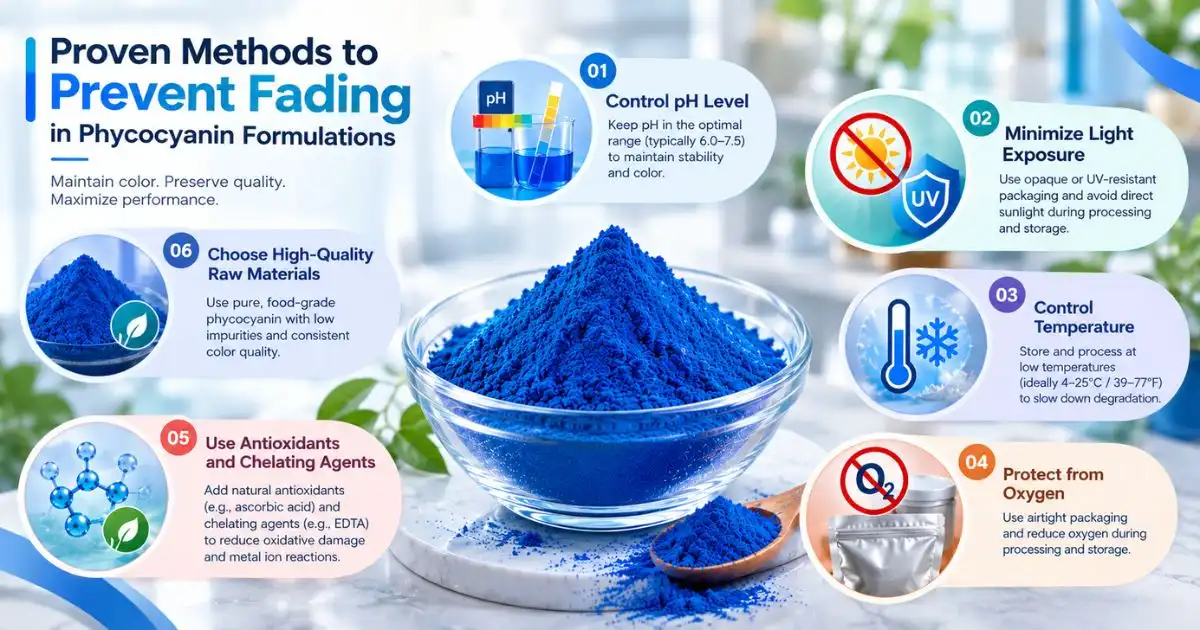
Blue phycocyanin needs more than one level of security to stay stable in different product forms. There is no one additive or way to package that works by itself. Formulation chemistry, conditions for processing, and physical barriers are all important parts of the best programs.
Here are the core stabilization strategies that formulators rely on across supplement and food manufacturing:
- pH buffering: With citrate or phosphate buffers, the formulation matrix should stay between pH 5.5 and 6.5. These proteins stay together and can be used in a lot of different food and drink recipes. High-acid fruit extracts should not be mixed with colors that have not been sealed first.
- Antioxidant co-addition: At a quantity of 0.05 to 0.2% (w/v), ascorbic acid, which is added as an antioxidant, gets rid of free radicals that hurt the chromophore. Olive oil and rosemary extract are both good for you and can be used without any problems. When both are present, they work together to protect more.
- Encapsulation: Color is kept safe from heat, oxygen, and acid when maltodextrin or cyclodextrin walls are used for microencapsulation. This way is best for sour drinks, sweets, and chewables because direct absorption doesn't work well with them.
- Cold-chain processing: To keep the color value and the 25%+ phycocyanin requirement when cold-chain processing is used, the inlet temperatures must stay below 45°C while mixing and below 130°C while spray drying. If a company wants to make high-end supplements, they may use freeze-drying.
| Product Format | Primary Risk | Recommended Stabilization Method |
|---|---|---|
| Capsules/Tablets | Moisture ingress, oxidation | Desiccant packaging; antioxidant co-blending |
| Gummies | Low pH, heat during molding | Encapsulation; pH buffering of the gummy matrix |
| Powders (instant mix) | Humidity, light | Nitrogen flush; opaque, moisture-barrier pouches |
| Functional Beverages | UV exposure, pH | UV-blocking bottles; cold-fill processing |
Once formulators have used the right mix of methods, they should quickly test how stable their work is (at 40°C/75% RH for at least 4 weeks) before choosing a final recipe that can be used for mass production.
Comparing Blue Phycocyanin with Other Natural Pigments in Terms of Stability
In terms of natural dyes, blue phycocyanin is one of a kind. It is the only natural blue color that the FDA lists under 21 CFR 73.530 and the EFSA says can be used as a food color. This gives it a legal base that other blue colors, like gardenia blue or butterfly pea flower blue, don't have in big stores.
Phycocyanin vs. Butterfly Pea Flower
Because butterfly pea flower turns purple when the pH falls below 4.0, it shouldn't be used where it's acidic. If the pH level is neutral, phycocyanin stays a steady cyan-blue color, but it needs to be surrounded by low-pH materials. When added to drinks and vitamin pills with a neutral pH, phycocyanin makes the color more uniform.
Powder vs. Liquid Form
If you want to store phycocyanin (E18, E25), powder is always better than liquid concentrates. Powder forms support water action below 0.3, which makes it much slower for bacteria and oxygen to break down. It's more dangerous to handle liquids in long supply chains because they need to be kept cold and have shorter stable windows when the container is open.
Why Purity Grade Matters for Stability Benchmarking
E25 grade (a value of 250 or more) has about 2.5 times more phycocyanin than E10 grade, based on the same color value test. If you use E25, you need less overall ingredient weight in your recipe if you want the end label to say that it contains 25% phycocyanin. This lowers the interactions between the matrices and boosts the safety margin overall.

Practical Procurement and Application Recommendations for B2B Clients
What happens with efforts to keep blue phycocyanin stable further down the line depends on the choices made earlier about procurement. The first thing that needs to be done is to find a supplier that can provide verified HPLC batch reports, standardized color value data, and documentation of stability.
What to Request Before Placing a Bulk Order
Ask for an Analysis Certificate that lists the phycocyanin percentage (HPLC-verified), the color value (E1% at 618 nm), the protein content (60–70%), the heavy metals panel, and the number of microbes. There is no way that color-grade material could be sold as nutritional-grade without proof from a well-known lab.
Grade Selection Guide for Common Formats
There are three shades of phycocyanin made by Yangge Biotech. They are E10, E18, and E25. E18 is most often used in food and drinks, while E25 is best for making high-potency supplements. There is a 25 kg minimum order size for all types, and they are all 100% water-soluble. They also meet Kosher and USP requirements. We always have one ton in stock and ready to ship.
OEM and Private Label Considerations
Yangge can pack OEM items in three different sizes: 60 g, 100 g, and 8 oz. For the right price, you can have capsules, tablets, powders, and gummies made just the way you want them. The supplier's technical team should be involved early in the formulation stage, before pilot tests. This cuts down on the time it takes to get the product to market and the number of times it needs to be adjusted.

Conclusion
Blue phycocyanin goods retain their color due to proper ingredient, processing, and packaging. High-purity grades like E18 and E25 offer superior shelf stability than lower-grade choices that weren't maintained at the optimum temperature when pH is regulated, antioxidants are added, and proper packaging is employed. Businesses who purchase from others should receive high-content phycocyanin from a provider with good batch records and plenty of stock. This is the safest technique to achieve steady, label-compliant goods.
FAQ
Is phycocyanin safe for use in dietary supplements?
Yes. Phycocyanin derived from Arthrospira platensis (spirulina) has a long history of safe use. Under 21 CFR 73.530, the FDA says it doesn't need to be approved because it's just a color agent. Also, a lot of food groups consider it generally safe (GRAS). Full microbe and heavy metal tests are done on every batch of Yangge's phycocyanin to make sure it meets USP and Kosher standards.
What dosage of phycocyanin is effective for color retention in formulations?
For most food and drink uses, 0.1 to 0.5% (w/w) is enough. Supplement pills or capsules that say they have 25% phycocyanin vary in how much you should take based on the grade and total fill weight. To get the same color value with E25 as with E10, you need less mass. This saves money in high-dose forms.
How do I test phycocyanin stability in my formulation?
Do quick tests every four weeks at 40°C and 75% relative humidity to see how stable it is. Use HPLC to find the color value (E1% at 618 nm) and phycocyanin percentage at weeks 0, 2, and 4. It's stable enough for most business uses if the color value drops by less than 10% over four weeks.
Partner with Yangge for Stable, High-Purity Phycocyanin
Yangge is a trusted blue phycocyanin supplier with 1 ton of E10, E18, and E25 grades in stock, backed by HPLC batch reports and Kosher/USP certification. We help you with your recipe for capsules, tablets, powders, and gummies from the sample stage all the way up to the large-scale production stage. Contact us at info@yanggebiotech.com or visit blog.yanggebiotech.com right now to get a sample or technical data sheet today.
References
1. Chaiklahan, R., et al. "Stability of Phycocyanin Extracted from Spirulina sp." Process Biochemistry, 2012.
2. Fernández-Rojas, B., et al. "Nutraceutical Properties of Phycocyanin." Journal of Functional Foods, 2014.
3. Martínez-Meza, G., et al. "Thermal and pH Stability of C-Phycocyanin." LWT – Food Science and Technology, 2020.
4. Mishra, S. K., et al. "Phycocyanin: A Potential Drug for Cancer Treatment." Journal of Scientific & Industrial Research, 2011.
5. Pagels, F., et al. "Phycobiliproteins from Cyanobacteria: Chemistry and Biotechnological Applications." Biotechnology Advances, 2019.
6. Yan, S. G., et al. "Effect of Encapsulation on the Stability of C-Phycocyanin." Food Chemistry, 2019.

Based on your location and order quantity, you will have the opportunity to receive a limited time free shipping promotion!
Who we are
Popular Blogs