How Sweet Potato Red Color Is Made: From Root to Powder Form
Sweet potato red color is caused by naturally occurring plant pigments, primarily anthocyanins in purple-fleshed roots. They choose one with lots of colors and then clean, dry, cut, and work with the roots. The pigments are taken out, sped up, dried, ground, and sieved until they are a very fine powder that is violet-red. It turns red when that powder is mixed with acidic drinks. It turns purple when the pH level rises. Yangge gives Powder Sweet Potato to groups that make jam, baked goods, drinks, and candy. You can follow this guide from the root to the powder. It will also tell you what to check before you place your order.
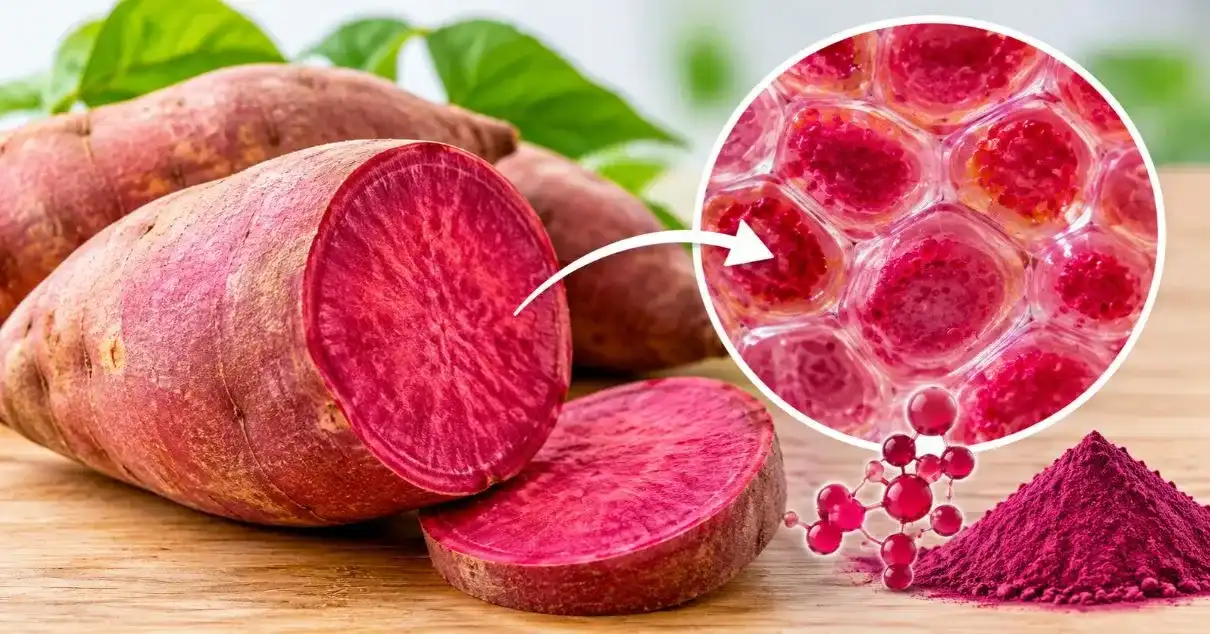
What Creates Sweet Potato Red Color Inside the Root?
Why Is My Sweet Potato Red Inside?
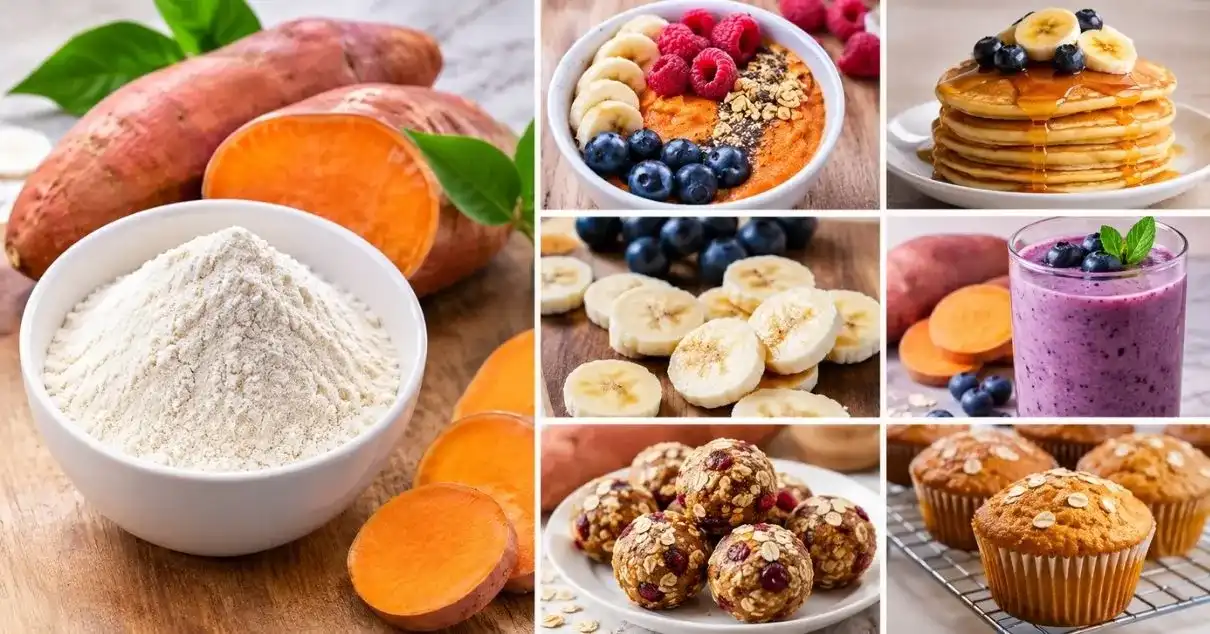
The flesh can be purple or red. The genes in each type decide whether the root stores color in the flesh, the skin, or both. Many times, a type with a deep purple-red cut surface is one that has a lot of anthocyanins. Because of carotenoids, skin can be pink, orange-red, or a mix of the two. Roots with red skin often have pale or orange flesh, showing that skin color doesn't always show flesh color. People who want to buy plants should not just judge them by their color. Instead, they should ask about the cultivar and lab data.
Anthocyanins and Carotenoids: Two Pigment Families
Most of the work is done by two groups of pigments. Anthocyanins change plants from green to red, purple, and blue when they mix with water. In their 2010 paper in the Journal of Agricultural and Food Chemistry, Truong et al. used HPLC-MS to find that purple-fleshed sweet potatoes mostly have acylated cyanidin and peonidin glycosides. Beta-carotene is a type of carotene that breaks down in fat and gives orange flesh its color. To color, this difference is important. Because they are mostly water, anthocyanins work well in drinks, jam, and syrups. Roots that are high in anthocyanins are the best place to start when you want to make a reddish-purple dye.
Natural Color or Spoilage? Quick Checks
It smells good and doesn't change color when you cut it. Now the spoilage looks different. Keep an eye out for smells like sour or fermented food, areas that are slimy or sinking, mold that you can see, and dark spots that spread. The wood isn't going bad if it gets a little darker after being cut. For business lots, it's best to have a simple intake process. Compare a piece of meat from each group to a picture. Do not use any lots that have mold on them or smell bad. Don't just look at something to tell if it's safe or good for you. Don't forget to use test reports and specs.
How Sweet Potato Red Color Develops from Field to Storage?
Growing Conditions and Harvest Timing
The field tells the crop how close it can get to the color that its genes say it can have. The soil, temperature, sunlight, and water all affect what color the roots are. What's more, you need to know when to harvest. If you pull the roots too early, they might have less solids and lighter flesh. This means that lots from different fields or times of the year might have different levels of sweet potato red color. People who want to buy it should know what kind of plant it is, where it grows, and when it was picked. In a way that lasts, Yangge works with farming communities to keep track of food from the farm to the table. This makes sure that these records are easy for your QA team to understand.
Red Skin, Red Flesh, and Purple Varieties
The names of this group make it hard to understand what they're saying. The things that each type can bring are shown in the table below.
| Type | Main pigment | Typical flesh | Powder color |
|---|---|---|---|
| Purple-fleshed | Acylated anthocyanins | Purple to deep violet | Violet-red to violet; shifts with pH |
| Orange-fleshed | Beta-carotene | Orange | Yellow-orange |
| Red-skinned, light or orange flesh | Skin pigments; flesh varies | Cream to orange | Depends on whether skin is included |
Dusts that are red and purple can look the same after being dried and ground. Images and plant names don't make sense to me. Instead, I believe color values and pH tests.
Curing and Storage Before Processing
After you pick sweet potatoes, you need to leave them out in warm, damp air for a few days so they can grow. Most of the time, the temperature is around 85 °F (29 °C) and the air is very humid. When you heal a wound, it gets better and things last longer. After that, the roots are kept at a temperature between 13 and 15 °C (55 to 60 °F), because too low of a temperature can hurt plants by making them too cold. Be careful not to hurt the color or yield of the plant. If there is damage, it will rot and get dark spots. The raw materials are either kept in a controlled environment or quickly washed so that they can be turned into powder. The color of the powder will stay the same if you can always get good raw materials.
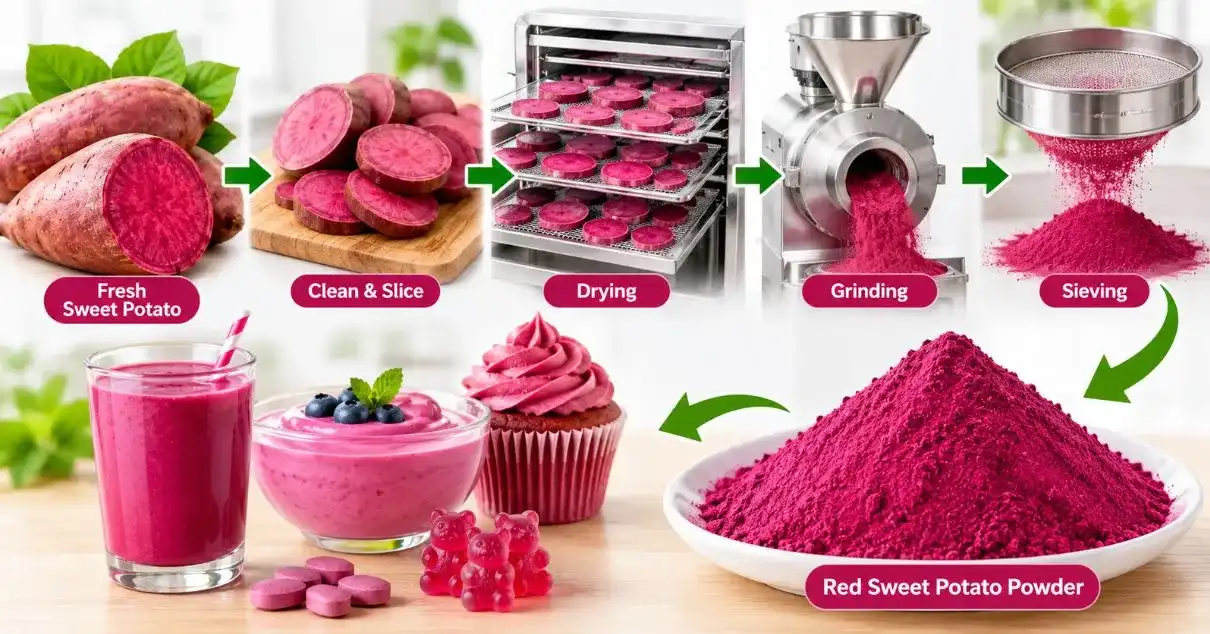
From Fresh Root to Red Sweet Potato Powder: The Processing Route
Step-by-Step Processing Route
The way most plant-color powders work is like that. First, the team sorts and looks at the roots. After that, they are washed, trimmed, and cut. The pieces are washed with water or a food-safe solvent to get rid of the solids and stains. After being boiled, it is dried, ground, and strained. Before each lot is packed, quality teams check it. When someone wants to buy a certain grade, I tell them to ask about the process flow for that grade. This is because different producers and grades use various solvents, ratios, and conditions. A pure extract gives you more color but not as much taste. On the other hand, whole-root powder keeps more of the flavor and fiber.
Drying Methods and Color Retention
Time and heat make the color fade as it dries. The table shows four common ways next to each other.
| Method | Heat exposure | Color retention | Cost and speed |
|---|---|---|---|
| Hot-air drying | Longer, higher temperature | Fair; browning possible | Low cost, high throughput |
| Vacuum drying | Lower temperature | Better | Moderate |
| Freeze-drying | Lowest | Highest | High cost, lower throughput |
| Spray drying (extract liquid) | Brief contact | Good for soluble powder | Suits large lots |
Most water-soluble extract powders are easy to spray dry since they are made from liquid concentrates. How you want the color to fade, how much color you want to keep, and how much money you have will all affect the best way for you.
Packaging, Storage, and Traceability
These powders lose their color when they get hot or light, and they can also pick up water from damp air. Yangge puts Powder Sweet Potato into 25 kg or 10 kg paper drums with two plastic bags inside, or into 1–5 kg aluminum foil bags with a cardboard box on the outside. Keep it out of the sun and heat, somewhere cool and dry. When ocean freight has too much water in it, it can clump together, so moisture barriers are important for export. Ask any supplier for batch records and packaging with lot codes so that your team can figure out what's wrong with the sweet potato red color.
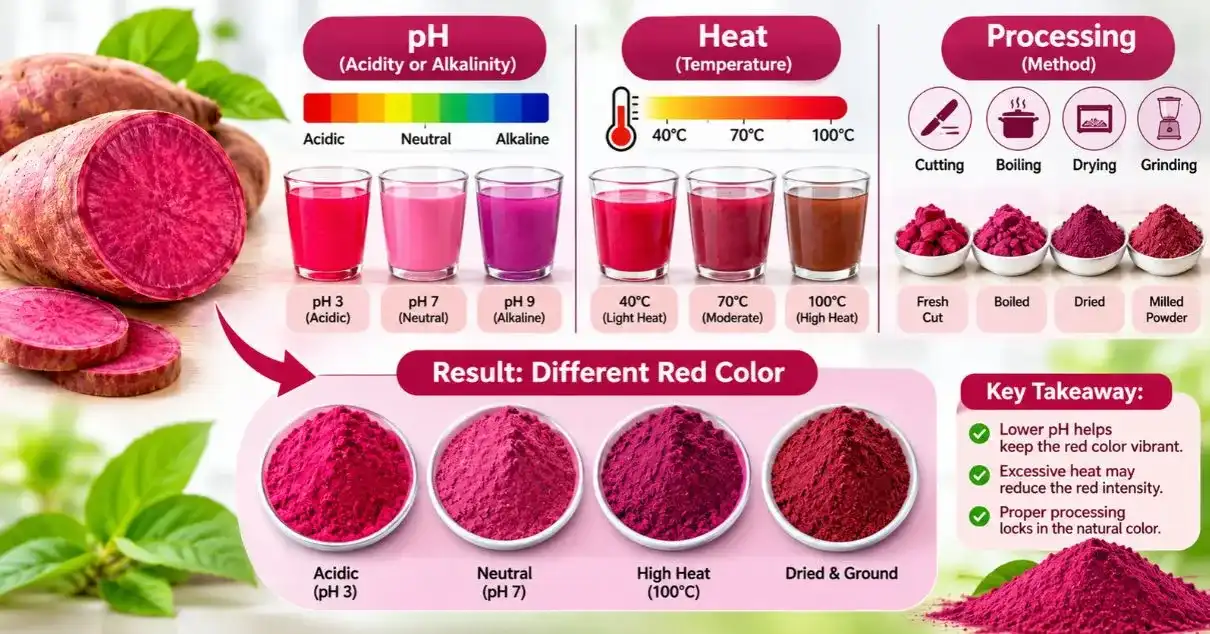
How pH, Heat, and Processing Change Sweet Potato Red Color?
pH: The Color Switch
If you change the pH of anthocyanin, it changes color. The red flavylium form is usually found in things with a pH of 3 or less. The color changes to purple or violet between pH 4 and 6. For example, Giusti and Wrolstad say that when it goes above neutral, it turns blue or green and is less stable. That is why a sports drink with a pH of 3 looks red and a milk drink with a pH of 3 looks violet. The first thing that application engineers should do is set the target pH. Gums with acid, fruit, and soft drinks inside are the best thing to eat.
Heat, Light, and Oxygen
Acylate is a good idea. Giusti and Wrolstad looked into acylated anthocyanins and found that they were more resistant to changes in heat, light, and pH than forms that were not acylated. There are acylated forms of most of the purple anthocyanins in sweet potatoes. This is why they are sold next to sources from grapes or strawberries. But not even natural reds are safe. Strong light, oxygen, metal ions, ascorbic acid, or heat for a long time can make it fade faster. You can test it with your own recipe, at your own process temperature, in the final package, and for as long as you think it will last. Before you place your order, our team can talk about your project.
Nutrition and What Color Does Not Tell You
You can find carbs, fiber, and potassium in sweet potatoes. Beta-carotene is in the orange ones, and anthocyanins are in the purple ones. Scientists are interested in anthocyanins because they protect cells from damage. The type, the area, and the processing all change the value. As water leaves a whole-root powder, the solids get stronger. Don't think that a pure color extract has all the nutrients of the whole root just because it has color. If something says it's healthy or colored naturally, you should ask for an analysis certificate. It's not true that something darker means it has more nutrients.
Applications and Buying Guide for Natural Red-Purple Coloring
Where the Powder Works Best
It works best with foods that are acidic or almost acidic. As good choices, you can pick soft drinks, sports drinks, jams, fruit fillings, and sour gummies or hard candies made with malic or citric acid. Sweet potato red color changes the color of systems that use water because it doesn't dissolve in oil but does in water. Milk and other things that aren't really red show up as violet. It will look a little different if you change a man-made red. Teams can see what the color looks like when mixed with other natural colors that are okay to use to make it redder. Start with slow dose tests to get a feel for how each matrix works.
Yangge Powder Sweet Potato Specifications
This is the question most people have about our goods.
| Item | Detail |
|---|---|
| Product name | Powder Sweet Potato (sweet potato extract) |
| Active ingredient | Anthocyanins |
| Appearance | Violet red to violet fine powder |
| Specification | 4:1–50:1, 1%–25%, straight powder; 100% water soluble |
| Test method | UV/TLC |
| Free sample | 10–20 g |
| Packaging | 25 kg or 10 kg paper drum; 1–5 kg aluminum foil bag |
| Storage | Cool, dry place; away from strong light and heat |
Your application engineer will be able to match a grade to the right shade and dose with this information.
Supplier Checks and Common Mistakes
Begin with the paper work. You should ask for these things along with a specification sheet, an analysis certificate, reports on heavy metals and microbiology, and certificates from the supplier. Yangge is approved by ISO, HACCP, Kosher, and Halal, and they follow GMP rules when they make their goods. Check the lead time, the minimum order size, and the shipping time. 21 CFR 73.260 says what color vegetable juice can be. Check with someone who deals with rules to see if an extract is on that list. What it says on the package and how it was made matter. Four mistakes that people often make: judging quality only by color, mixing up red skin and red flesh, not paying attention to moisture and packaging, and not trying the product out in real life.
Conclusion
Orange flesh is colored by carotenoids, and purple roots are colored by anthocyanins. How much color it has before it is processed depends on the type, how it was grown, when it was picked, how it was cured, and how it was stored. The root is then steamed, dried, ground, and sieved to make a powder that shows sweet potato red color in violet-red shades. The color will last longer or shorter depending on how it is dried. If the acidity is high, the color will be red. If it's low, the color will be purple. Heat, light, and oxygen can still make things fade. Look at certificates of analysis, specifications, and tests that were done with the real recipe to find out where your food comes from. Color doesn't show what's healthy.
FAQ
Q1: Why is my sweet potato red inside?
A: Most of the time, this type makes carotenoids or anthocyanins. Instead, mold, slime, or a bad smell mean the food is going bad.
Q2: Does pH change sweet potato red color?
A: Yes. Red has a pH level of 3 or less, purple has a pH level of 4 to 6, and bluish tones have a pH level close to 6. Try making up your own recipe.
Q3: What is in Yangge Powder Sweet Potato?
A: Anthocyanins are what make it work. The powder is fine and violet-red to violet. It is water-soluble and comes off completely. It comes in strengths between 1% and 25%, or 4:1 to 50:1.
Q4: Does Yangge hold certifications?
A: Yes. We have been given the green light by ISO, HACCP, Kosher, and Halal. You can get the papers by calling us.
Q5: Can I request a sample?
A: Yes. We'll send 10–20 g to food and drink companies for free. Tell us what kind of product it is, what pH level you want to reach, and what temperature you want to use.
Request Sweet Potato Red Color Samples from Yangge
Yangge is happy to hear from people or businesses that need a natural sweet potato red color for jam, candy, cookies, or drinks. The company that makes this sweet potato red color is ISO, HACCP, Kosher, and Halal certified. Please let us know if you need free 10–20 g samples, technical information, or 1 ton business prices. Send us an email at info@yanggebiotech.com telling us what kind of product you need, what pH level you want, and how much you need each year.
References
1. Journal of Agricultural and Food Chemistry, 2010 – Truong, V.D., et al. "Characterisation of Anthocyanins and Anthocyanidins in Purple-Fleshed Sweetpotatoes by HPLC-DAD/ESI-MS/MS."
2. Biochemical Engineering Journal, 2003 – Giusti, M.M., and Wrolstad, R.E. "Acylated Anthocyanins from Edible Sources and Their Applications in Food Systems."
3. Journal of Food Science, 1999 – Rodriguez-Saona, L.E., Giusti, M.M., and Wrolstad, R.E. "Color and Pigment Stability of Red Radish and Red-Fleshed Potato Anthocyanins in Juice Model Systems."
4. Journal of Food Science, 2008 – Steed, L.E., and Truong, V.D. "Anthocyanin Content, Antioxidant Activity, and Selected Physical Properties of Flowable Purple-Fleshed Sweetpotato Purees."
5. Food Chemistry, 1997 – Bridle, P., and Timberlake, C.F. "Anthocyanins as Natural Food Colours: Selected Aspects."
6. Code of Federal Regulations, Title 21, Part 73, 2024 – U.S. Food and Drug Administration. "Listing of Color Additives Exempt from Certification."

Based on your location and order quantity, you will have the opportunity to receive a limited time free shipping promotion!
Who we are
Popular Blogs