After Red No.3: Reformulating With Natural Red Colors Safely
You should think of switching from Red No. 3 to natural reds as a whole project, not just a swap. If the pH, heat, and light levels are right, red beet color betanin powder (E162) works well in foods and drinks that are made with water. Add it late in the process if you want to test it in the final mix. Talk to your regulatory team about how to label it too. This article talks about the rules of the change, how betanin powder works, what other reds are like it, and how to get it the easiest.
Why Reformulators Are Moving Beyond Red No. 3?
What the FDA Decision Means for US Brands?
The FDA said on January 15, 2025, that FD&C Red No. 3, which is also known as erythrosine, could no longer be used in medicines and food that people eat. January 15, 2027, is the last day for food companies to change how they make their goods. There is until January 18, 2028 for drug companies that make drugs that can be eaten. It was used with the Delaney Clause. This part of the law says that color additives that have been shown to make people or animals get cancer cannot be used. The FDA said the way they checked to see if the drug was safe for rats doesn't work for people. So, the action is based on the law, not on something new that was learned about person health. If you sell in more than one state or country, you need to check the rules for each one. Rules like these change based on the item and how it will be used.
Why Consumer Demand Points the Same Way?
The AB 418 law from 2023 in California said that Red No. 3 could not be in foods sold in the state after January 1, 2027. There are brands that want to move faster than the government says they have to. A lot of buyers also tell us that people read ingredient lists more carefully and look for colors that come from plants. That makes sense since beet red comes from the roots of Beta vulgaris. Still, a label claim is only real if it can be shown to be true. Before you put a "natural" or "clean" label on a package, make sure you have the supplier's specs, certificates, and statements on file.
Why Replacing Red No. 3 Is Not a One-to-One Swap?
When you mix red No. 3 with a natural color, more than just the color changes. Changes the price, the dose, the taste, the color, and the amount of light and heat it can handle. If the color looks good in a fresh drink, it might not look as good in a clear bottle. If the pH changes, it might also turn a different color. That's why I tell teams that before they finalize a recipe, they should set a target color standard, write down all the processing conditions, and test the recipe on a small scale. People who skip these steps say they don't like the batch and have to do more work.
What Betanin Powder Is and How It Performs?
What Betanin Powder Is and How It Differs From Beetroot Powder?
Betein is what gives red beets their red color. It comes from the betalain family. It is a natural color made up of several betacyanin pigments, with betanin being the most important. Things that are colored are all the same, like betanin powder. Beet powder is made from dried whole beets, so it's hard to say how strong it will be. The earthy flavor, sugars, and fiber make the color less bright. Water and bethanin mix well, so it can be used in systems that use water. You might need an emulsion, an encapsulation, or a different natural color to make things out of oil. Because of the pH, when you mix it with water, the color changes from red to purple-red.
Yangge Beetroot Red E162 Product Specifications
Right now, this is how much Beet Red E162, Betanin costs.
| Item | Detail |
|---|---|
| Specification | 100% |
| Extraction method | HPLC |
| Appearance | Deep red powder |
| Shelf life | 2 years |
| Quality notes | No irradiation, non-GMO, non-allergen; meets the European PAH4 standard, benzo[a]pyrene ≤10 ppb |
| Retesting | Cooperation with a well-known laboratory |
| MOQ / Inventory | 1 Kg / 50–100 Kg in stock |
| Package | 1 Kg aluminum foil bag, or custom |
| Samples / OEM | Free sample and OEM packaging available |
| Storage | Tightly closed original container, away from light |
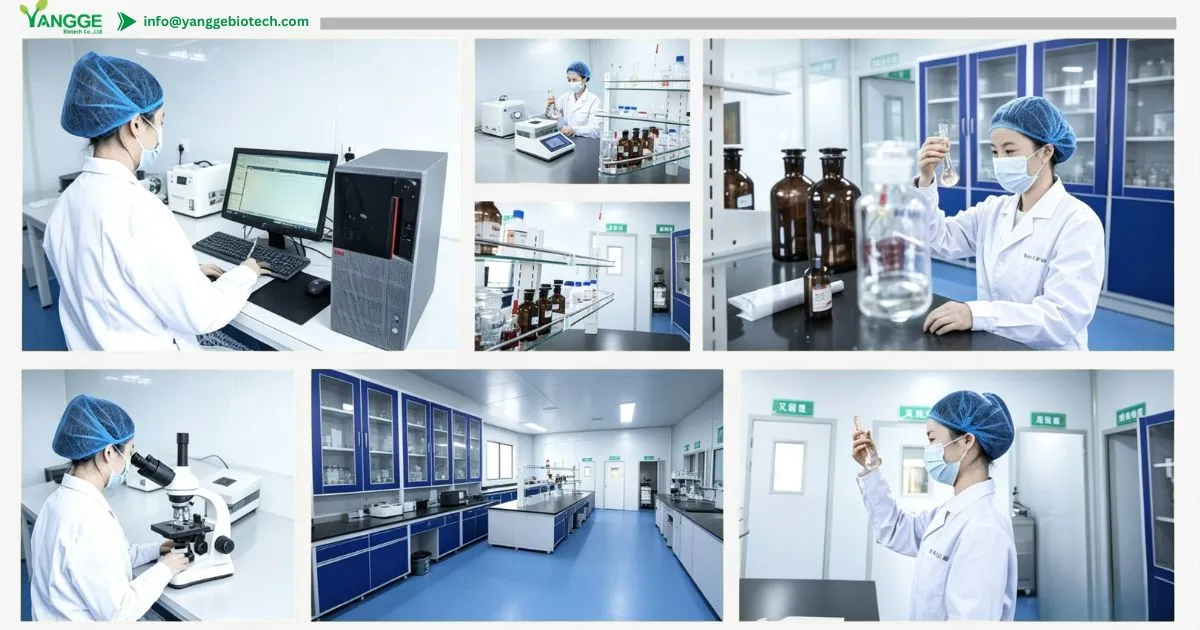
That way, your QA team knows where to begin reading the specs. ISO, HACCP, Kosher, and Halal have all given Yangge Biotech their seal of approval. We follow GMP rules when we make our goods. For each lot you look at, please ask for the most recent Certificate of Analysis.
Stability: pH, Heat, Light, and Oxygen
The biggest risk with this switch is that it might not work right. Based on what our product says, the color will stay the same in acidic and basic environments and below 80℃. Light and heat don't hurt it as much, and the color fades faster when it gets hot. Herbach et al.'s study from 2006 says that betanin is most stable when the pH level is between 4 and 5. It breaks down faster in air, light, and water. Once the mixture is hot, add the powder. Make sure the packs are clear or block UV light. Also, try ascorbic acid as an antioxidant in your own recipe. Keep an eye on things like color loss, hue shift, sediment, and shelf life when you store things quickly or in real time.
Betanin Powder Compared With Other Red Color Options
Beet Powder, Synthetic Reds, and Other Natural Pigments
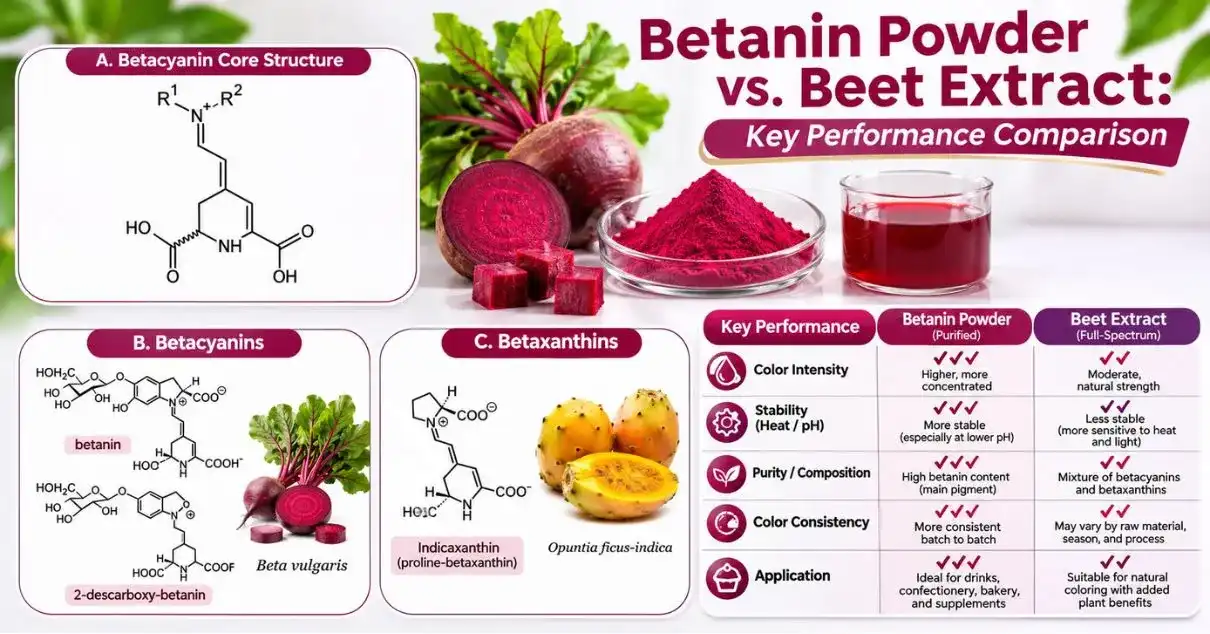
When you compare them, look at how strong, in what shade, and stable they are in your product they are. The price per kg doesn't always tell you everything you need to know. The table shows what's going on right away.
| Option | Strength | Watch-out |
|---|---|---|
| Betanin powder | Red to purple-red shade, water soluble | Sensitive to heat, light, oxygen; faint beet note at high dosage |
| Beetroot powder | Whole-food positioning | Lower, less controlled pigment strength; adds sugar and fiber |
| Synthetic reds (such as Allura Red) | Typically stronger stability | Clean-label concerns; rules vary by market |
| Anthocyanins | Bright red in acidic products | Hue shifts as pH rises |
| Carotenoids | Suit oil phases and fat-containing foods | Shade leans orange |
To find out how much something costs, you need to look at more than just the quote. You also need to see how much it makes, how much it wastes, and how long it lasts.
Applications: Beverages, Dairy, Confectionery, and Plant-Based Foods
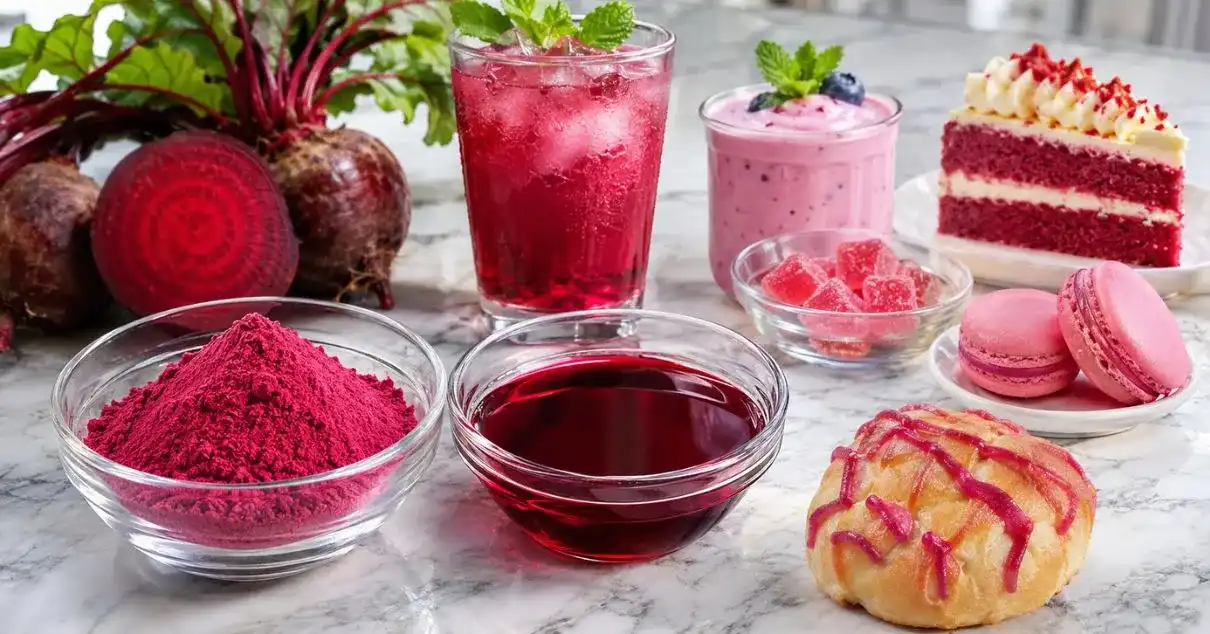
Being able to use betanin powder in many things means that they need different tests. A lot of yogurt has a pH level between 4.0 and 4.6, which is pretty close to what betanin likes. It doesn't get too hot because ice cream is made in a cool place. The color beet red makes plant-based burgers look like they have raw meat on them. A lot of people who shop know that the patty is done when it stops being white and turns brown. If you want to make gummies or other sweets that need to be heated up, add the color after the cook step. Clear water bottles should not be near light. Don't just think one result will work every time; check them all out.
Choosing the Right Betanin Powder for Beverages and Supplements
Make sure you check how clear it is, how much sediment it has, how well it reacts to different pH levels, and how it tastes at the end. Supplement makers need to make sure that their products can be taken as powder, capsules, tablets, or sachets. Other than that, they should check for allergens, heavy metals, the carrier, and the limits of microbes. Some of the things you can compare between suppliers are the lead time, particle size, moisture, color value, shelf life, and ability to be tracked. For a 100% specification like the one in our listing, you still need an analysis certificate and information on how the specification was made. Before you commit, run the same test on at least two different sets of files. This will help you see how the groups' colors change.
How to Reformulate and Buy Betanin Powder Safely?
A Step-by-Step Reformulation Process
To begin, pick the goal, the audience, the pH level, the process temperatures, the type of package, the shelf life, and the color standard. To find a dosage range, mix betanin powder with the same kind of water, in the same way, and in the same order as when it was first made. The color can change if there are herbs, proteins, vitamins, minerals, sweeteners, or preservatives in it. Make sure it works with all of these. Study the shelf life both quickly and in real time after making a test batch. Also, taste it to see if it tastes like beets. Finish the review for the government before the launch. Don't skip the pilot because each step checks for a different way to fail.
Procurement Checklist and Supplier Scorecard
It is possible for QA, R&D, and procurement to all use the same weighted scorecard data to judge suppliers. You should change these weights to fit your item. They are all based on the same order of importance and are only the beginning.
| Criterion | What to request | Suggested weight |
|---|---|---|
| Color value and shade | Assay method, sample match | 25% |
| Heat and light stability | Test data in your matrix | 20% |
| Solubility and system fit | Dissolution trial | 15% |
| pH performance | Results at your pH | 15% |
| Documents and compliance | CoA, export papers, certificates | 15% |
| Price in use and supply | Quote, MOQ, lead time | 10% |
As long as they are not dehydrated, beets do not need to be certified in the US (21 CFR 73.40). Find out from your regulatory team if your ingredient is on that list or a different one. What is claimed to be organic must be certified for the part used, the place where it was made, and the people who will buy it.
Common Pitfalls and How to Avoid Them
To begin, it's not accurate to believe that all natural reds are the same. They're not. When they work with oil or water, heat, light, and pH all affect them in different ways. You don't think about color strength, dosage, freight, or how much it costs to make a batch that doesn't work if you only look at price per kilogram. The third is not testing a lab sample first before letting it go. Keep powder out of the way of air, light, and moisture by putting it in a jar with a tight lid. This is the fourth way to keep powder safe. Saying something is "natural," "clean label," or "safe" without proof or legal review for each market is the last one.
Conclusion
You need to change where it comes from, how it's made, and how it meets standards to get rid of Red No. 3. It's not a simple swap that only takes one step. The FDA said in 2025 that food had to be ready by January 15, 2027. Cal. AB 418 says the due date is January 1, 2027. Betanin powder (E162) turns red to purple-red when combined with water. For it to work best, you should keep an eye on the pH, heat, light, and oxygen levels. Being able to control the color better than whole beet, anthocyanins, carotenoids, and beet powder, but not as well against heat and light as man-made reds. It's less likely that flaring, color changes, and claims that can't be backed up will happen if the final formula is tested, late additions are made, pilot validation studies are done, and suppliers are looked at in a weighted way.
FAQ
Q1: Is betanin powder the same as beetroot powder?
A: Since betanin powder is often found in paints, the answer is no. Whole beets that have been dried out are used to make beet powder. They have less color strength, but that can be changed.
Q2: Can betanin powder handle heat?
A: It seems to stay stable below 80℃, but it doesn't do well in heat or light. If your process needs it, put the part where you heat things at the end.
Q3: Does it work in oil-based products?
A: But because betanin breaks down in water, products made with oil might need an emulsion, an encapsulation, or a different natural color.
Q4: What are the MOQ and sample terms?
A: We have 50–100 kg in stock, and 1 kg is the least you can order. Tests and OEM packaging are free.
Request Yangge Betanin Powder Samples for Your Reformulation
Are you ready for a new Red No. 3? Yangge Biotech has betanin powder in stock, and you can order as little as 1 kg to get it. They also offer free samples, OEM packaging, and are ISO, HACCP, Kosher, and Halal certified. If you email info@yanggebiotech.com with the type of product, pH, process temperature, target shade, and amount you need each year, they can help you find a supplier of betanin powder. Anyone on our team can help you at any time.
References
1. U.S. Food and Drug Administration, "FDA to Revoke Authorization for the Use of Red No. 3 in Food and Ingested Drugs," 2025.
2. Herbach, K. M., Stintzing, F. C., and Carle, R., "Betalain Stability and Degradation—Structural and Chromatic Aspects," Journal of Food Science, 2006.
3. Esatbeyoglu, T., et al., "Betanin—A Food Colorant with Biological Activity," Molecular Nutrition & Food Research, 2015.
4. Sigurdson, G. T., Tang, P., and Giusti, M. M., "Natural Colorants: Food Colorants from Natural Sources," Annual Review of Food Science and Technology, 2017.
5. EFSA Panel on Food Additives and Nutrient Sources added to Food, "Scientific Opinion on the re-evaluation of beetroot red (E 162) as a food additive," EFSA Journal, 2015.
6. Code of Federal Regulations, Title 21, Section 73.40, "Dehydrated beets (beet powder)," 2024.

Based on your location and order quantity, you will have the opportunity to receive a limited time free shipping promotion!
Who we are
Popular Blogs