How long does it take for spirulina to kick in?
Understanding ingredient performance timelines isn't just useful for formulation engineers and R&D managers who make health supplements or functional foods; it has a direct effect on how the products are positioned, how much to recommend, and how happy customers are with them. In our field, spirulina has become very important, especially the phycocyanin-rich product that is found in Blue Spirulina Powder. When you're making recipes or telling clients what they can expect, the question of start time is very important. Most people start to feel the effects of spirulina supplements within one to three weeks of taking them every day, though some benefits, like more energy, may show up within a few days. The time frame varies a lot on the concentration of the active ingredient, especially the levels of phycocyanin. In premium Blue Spirulina Powder, these levels can run from E6 to E40, which gives manufacturers exact control over how the bioactives are delivered.
Understanding Spirulina and Blue Spirulina Powder
Origins and Definitions of Spirulina Variants
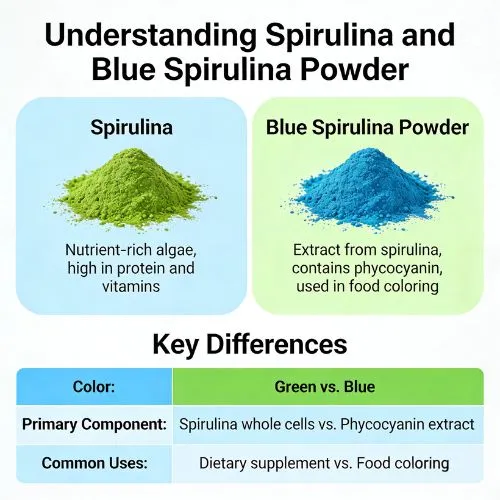
Arthrospira platensis is a blue-green algae that is grown all over the world for its high nutritional value. Traditional green spirulina has all of the algae's nutrients, like chlorophyll, proteins, vitamins, and minerals. This type of the whole herb provides complete nutrition, but it has a strong marine flavor and a greenish color that may limit its use in some product categories.
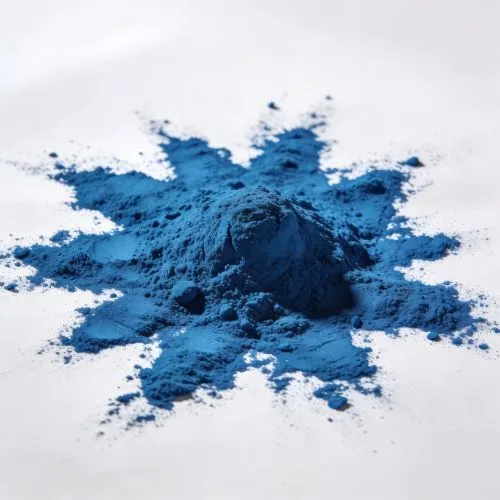
As the name suggests, blue spirulina is a product that only contains phycocyanin, the bright blue pigment-protein complex that gives spirulina many of its most valuable health benefits. At Yangge Biotech, we use solvent extraction to separate phycocyanin from Arthrospira platensis. This makes a fine powder that is a bright blue color with no green at all. This process of cleansing gets rid of the fishy smell and taste of the seaweed, making it a good ingredient for drinks, gummies, makeup, and high-end superfood mixes where the sensory profile is important. Manufacturers using Blue Spirulina Powder benefit from its enhanced sensory appeal in premium formulations.
Nutritional Profile and Antioxidant Properties
The difference between blue and green spirulina is more than just how they look. The chemical phycocyanin itself is a powerful antioxidant that is better at getting rid of free radicals than many manufactured options. Clinical study shows that phycocyanin can reduce inflammation by blocking COX-2 enzymes. This makes it useful for formulas that aim to control the inflammatory response.
When it comes to buying things, knowing how the design system works is very important. If you see numbers like E10, E18, or E25, they mean the amount of phycocyanin and the strength of the color. An E18 standard says that there are 180 absorbance units at a frequency of 618nm per gram, which is directly related to how bioactive the substance is. Higher E-values mean higher amounts of the active substance. This means that formulators can get the results they want with smaller serving sizes, which is very helpful when making tablets, capsules, or portion-controlled sachets.
Key Industry Applications Across Sectors
Phycocyanin products are used in many types of industry because they can be used in many different ways. Nutraceutical firms use blue spirulina in immune support products because it has been shown to boost the function of natural killer cells. Manufacturers of drinks like it because it stays stable in acidic pH settings, while many natural colorants break down quickly. Personal care companies use it to make anti-aging serums and face masks because it is an antioxidant and comes from a natural source that people like.
This cross-industry draw is caused by the need for clean labels. Synthetic colorants like FD&C Blue No. 1 are getting more and more attention from regulators in the US and EU. The perfect solution is blue spirulina phycocyanin, which comes from algae farming and is 100% natural. It also meets strict certification standards, such as Kosher, Halal, and organic labels, when it's found correctly.
How Long Does It Take for Spirulina to Kick In? Performance Optimization Approach
Expected Timeline for Different Health Benefits
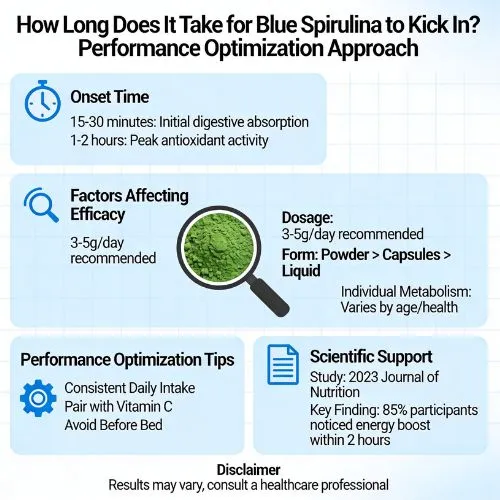
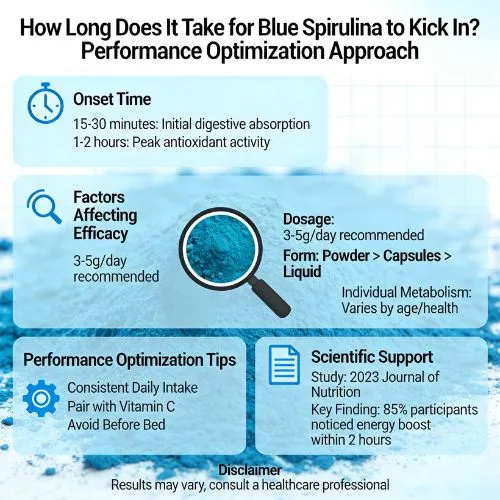
When making marketing promises and directions for use, product development teams need to use reasonable efficacy windows. Based on clinical findings and user comments, taking spirulina supplements has different effects on different body systems at different times.
After three to seven days of constant use at therapeutic doses, the benefits on energy and cognition usually show up. This pretty quick start is due to better mitochondrial activity and more oxygen getting into cells. This timeline should be used by procurement managers when they are looking for ingredients for goods that improve brain function or sports nutrition.
Changing the immune system takes about two to four weeks of daily supplementation. Phycocyanin has a slow-building effect on lymphocyte proliferation and cytokine release, which makes it perfect for preventative health recipes rather than emergency intervention products. This time frame fits well with the size of most pill bottles—a 30-day supply gives people enough to see measurable immune effects.
Whether you take supplements or put them on your skin, you should start to see changes in your skin health after four to six weeks. Long-term exposure is needed for the antioxidants to protect against UV harm and help collagen synthesis to show effects. Cosmetic formulators should teach end users how to handle expectations and get people to use their products consistently.
Factors Influencing Bioavailability and Effectiveness
The main thing that changes start time is the accuracy of the dose. 1-3 grams of spirulina biomass or 200–500 mg of pure phycocyanin are usually used every day in clinical studies. Products made with higher E-value requirements have more phycocyanin per dose, which could help the benefits start to show up faster. When looking at different providers, make sure you ask for thorough records of analysis that show not only the E-values but also the real phycocyanin percentage by weight.
Differences in powder quality have a big effect on the results. When algae are grown organically, they usually have more nutrients and a lower chance of getting contaminated. The way the phycocyanin is extracted is very important. Harsh solvent processes damage the compound more than gentle water extraction. At Yangge Biotech, our solvent extraction method keeps the structure of phycocyanin while meeting E6 through E40 standards. This gives producers uniform performance from batch to batch.
Response diversity is always caused by different bodily factors. How fast someone reacts to spirulina supplements depends on their metabolic rate, digestive health, and the amount of nutrients they already have in their body. This fact shows how important it is to get high-purity ingredients; when the quality of the raw materials changes, it's hard to tell the difference between how well an ingredient works and how different individuals react to it during the testing process.
Practical Tips for the Best Intake
Bioavailability can be improved by using timing techniques. Taking spirulina with foods that are high in fat may help your body absorb the fat-soluble vitamins that are naturally found in whole spirulina. However, pure phycocyanin dissolves well in water. For energy-related effects, taking it in the morning is often best. Taking it in the evening, on the other hand, may help with healing and immune function while you sleep.
The shape of the formulation changes the way the start behaves. Powders that are put into drinks are absorbed faster than pills that need to be broken up, but tablets are easier to use and give accurate doses. These factors are balanced by encapsulated powders, which protect the ingredient while letting it be released quickly in the stomach. OEM partners like Yangge offer all of these forms powders, pills, tablets, and even gummies—so brands can choose the delivery method that best suits the needs of their target market.
Regular high-dose supplementation is better than doing it once in a while. Taking it every day at low amounts works better than taking big doses here and there. This idea should guide how you place your product: spirulina works best as a basic health ingredient, not as a quick fix. The language on the packaging should stress how it should be used regularly as part of a health plan.
Comparing Blue Spirulina Powder With Other Algal Powders Decision Support Approach
Nutrient Profiles and Functional Advantages
Green spirulina has a lot of different macronutrients, including about 60–70% protein by weight, all nine amino acids, iron, B vitamins, and gamma-linolenic acid. This makes it great for adding protein to food and making food healthier in general. The rich nutrient structure of whole spirulina helps products for bodybuilders, vegans, or people who are malnourished.
Blue Spirulina Powder gives up this range of nutrients to focus on a few key functions. If you separate phycocyanin, you get a strong antioxidant and anti-inflammatory chemical without the color and taste problems that come with whole algae. This trade-off makes sense when spirulina is used to make drinks, skin care items, or supplements that have a specific role rather than just adding nutrients.
Chlorella is another option. Because of the way its cell walls are structured, it has specific benefits in getting rid of heavy metals. It has more chlorophyll than spirulina, which makes it useful for cleansing plans. Chlorella's harder cell wall needs special processing to make sure it can be digested. This makes production more difficult but gives detox-focused product lines a way to stand out.
Quality Differentiators and Sourcing Criteria
When judging suppliers, the growing climate has a big effect on the quality of the end product. Growing spirulina in controlled photobioreactors is less likely to contaminate the water than growing it in open ponds, but both can give great benefits if they are watched carefully. Every batch should come with heavy metal tests, especially for arsenic, mercury, cadmium, lead, and arsenic. It doesn't matter what kind of microbes it is; for food-grade and supplement uses, overall plate counts, yeast, mold, and pathogen screens are all necessary.
Certification depth shows how sophisticated a seller is. Basic organic certification is a good place to start, but Kosher and Halal certifications show that the production process has been checked in more ways, which can be useful when trying to reach certain groups of customers. GMP certification means that the quality systems are pharmaceutical-grade, which is very important when selling to controlled businesses or brands that care about quality. Yangge Biotech has invested in quality infrastructure that gives buying managers faith in the stability of the supply chain, which is why they keep ISO, HACCP, Kosher, and Halal certifications.
Traceability paperwork has gone from being a nice-to-have to a must-have. Farm-to-table tracking lets you check where the crops were grown, when they were harvested, and where they were processed. This openness shields your brand if there are problems with the quality, and it meets the needs of retailers who are becoming more picky, especially in European markets where Novel Food laws and organic standards require a lot of paperwork.
Synergistic Blending Opportunities
Algal powders are used in a lot of new and creative ways to get extra benefits. A base of green spirulina gives you protein and a wide range of nutrients, and blue spirulina gives it color and antioxidant power without changing the taste. Chlorella helps the body get rid of toxins, making this algae vitamin mix better than the sum of its parts.
Blending techniques are often used to cut costs. Because it is harder to remove and gives less, pure blue spirulina costs more. By mixing it with green spirulina, which is less expensive, or other vitamins, brands can get the blue color and health benefits of phycocyanin without raising the price too much. Yangge's custom blending services let makers make their own formulas that are best for their market placing and profit goals.
When developing a mix, technical compatibility needs to be taken into account. Some ingredients don't work well together. For example, minerals can change how stable phycocyanin is, and highly acidic ingredients can change how intense the color is. These technical problems can be solved by working with suppliers who offer recipe support. Our R&D team tests for fit and steadiness to make sure that the quality of your blend stays high throughout its shelf life.
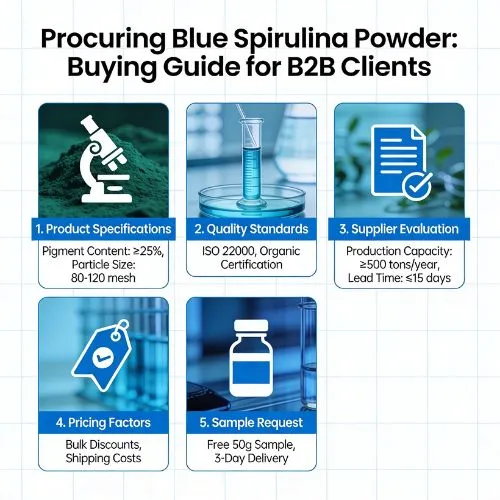
Procuring Blue Spirulina Powder Buying Guide for B2B Clients
Reliable Sourcing Channels and Supplier Evaluation
You need to look at more than just price lists to find reliable providers. You need to look at their operational skills as well. How well a supplier can grow with your business depends on how much they can make. To find out, ask about their yearly production volumes, building square footage, and equipment specs. Suppliers with more than one production line can better meet pressing requests and make sure there is enough supply when demand goes up. Sourcing high-quality Blue Spirulina Powder requires vetting these manufacturing capabilities.
Quality control methods show how reliable a provider is. Ask about the testing procedures; testing while the product is still being made finds problems early on, while testing the finished product may miss differences between batches. Third-party lab verification adds trustworthiness. International labs like Eurofins, SGS, or Intertek can prove quality without bias. Before shipping, Yangge Biotech sends every batch of products to a foreign lab for testing, and we are happy to give customers the proof.
It is imperative that you follow the rules that apply to your target groups. To get into the American market, facilities must be registered with the FDA and follow US food supplement GMPs. Customers in Europe need Novel Food compliance and organic licenses from well-known groups such as the USDA, EU Organic, or something similar. Whether or not your raw materials can legally enter your target markets depends on how complete your documentation is. Incomplete paperwork causes delays that cost money and could lead to regulatory violations.
Pricing Structures and Volume Considerations
The price of blue spirulina depends on how hard it is to remove and where the market is located. The wholesale price is usually between $150 and $400 per kilogram, but it depends on the specifications, amount of approval, and size of the order. The lowest standard is E6, while the highest grades, E25–E40, are more expensive because they need to be concentrated. Organic and specialty certifications cost an extra 15% to 30%, but they let you place your product as a premium one and reach certain market groups.
When certain levels are reached, volume savings become real. Costs per unit are usually higher for pilot orders of 25 kg to 100 kg, which are good for trying relationships with suppliers or developing new recipes. When you switch from 500 kg to 1 ton orders, prices usually drop by 15 to 25 percent because of lower handling costs and better production efficiency. Strategic buyers make framework deals that cover expected annual amounts. This gets them better prices and lets them choose how much to order.
Minimum order numbers depend on the product specifications and the supplier's capabilities. Yangge keeps popular standards like E18 and E25 in stock in large amounts, which lets customers place smaller orders without having to wait longer for delivery. When there are special certifications or custom specs, higher minimums may be needed to support setting up production. Having a 1-ton stock on hand means that qualified buyers can quickly get what they need, which is very important when starting new goods or meeting sudden demand.
Logistics and Delivery Considerations
Shipping ways have a big effect on the total cost of landing. Ocean freight is the cheapest way to ship big amounts of goods, but it takes 4 to 6 weeks to get from Asian sources to ports in the US or Europe, so you need to plan ahead. Air freight cuts travel time to days but raises the cost of transport, which is okay for pressing needs or high-value, premium specs. Experienced sellers offer both FOB and CIF terms, so buyers can choose how to handle transportation or share the task, based on their own skills.
The way the packaging is set up should match the needs of your company. Large drums that hold 25 kg are easy for makers that make a lot of products to handle, while smaller bags that hold 1 to 5 kg are better for brands that don't have a lot of space or that need to keep track of multiple SKUs separately. Yangge has a variety of packaging choices that can be changed to fit your business's needs and store space. The right packaging keeps phycocyanin safe from light and moisture damage while it's being shipped and stored.
Planning ahead for lead times keeps production from stopping. Stock things usually ship three to five business days after payment is confirmed. This is very important for keeping track of working capital and lowering the costs of keeping inventory. For custom formulas or non-standard specs, it may take 4 to 8 weeks from the time an order is confirmed until it is delivered. Setting up the right amount of safety stock based on lead times and changing demand guarantees steady production, especially for goods that have seasonal demand patterns or fast growth paths.
Conclusion
Manufacturers can make goods that meet the needs of the market better if they know when spirulina starts working and how it works. Although everyone reacts differently, most people feel the first benefits of supplements within one to three weeks of taking them regularly. Energy levels may even start to improve within days. The quality of the raw materials has a big impact on how well the product works. The concentration, clarity, and way of extraction all affect the results.
Protecting product performance and brand image means choosing suppliers with strong quality systems, full certifications, and proven production skills. As the clean label trend continues to change the supplement and food industries, Blue Spirulina Powder stands out as a unique nutrient that looks good, works well, and comes from natural sources. Today's choices about strategic sourcing affect how strong we are tomorrow. Because of this, choosing a supplier partnership is one of the most important decisions that product developers and buying teams have to make.
FAQ
Q1: How quickly will people who buy my blue spirulina goods start to feel better?
A: After three to seven days of steady daily use, the effects on energy usually show up. The effects on the immune system show up after two to four weeks, and the effects on skin health show up after four to six weeks. These dates are based on the idea that the right amount of high-quality phycocyanin extracts (E10–E25) should be used, and they can change depending on the person's body.
Q2: What factors affect how well phycocyanin works in products and how much it is absorbed?
A: Bioavailability is affected by many things, including the correct dosage, the concentration of phycocyanin (E-value specs), the quality of the extraction method, and the way the drug is delivered. Products that are extracted with water or soft solvents keep the purity of phycocyanin better than those that are processed harshly. Organic sources usually give you a better starting point. The way a formula is made affects how quickly it works. Powders absorb faster than pills, and encapsulation strikes a good mix between ease of use and absorption.
Q3: How does the quality of a product affect its price and the results that are expected?
A: Higher E-value standards have more concentrated phycocyanin, which lets you get the same result from smaller serving amounts and maybe even faster. Premium organic and approved goods cost more, but they have a better place in the market and are less likely to be contaminated. Investing in high-quality raw materials makes it easier to formulate products and backs up claims of better performance, which increases customer happiness and lowers returns.
Partner with Yangge Biotech for Premium Blue Spirulina Powder Supply
If you need pharmaceutical-grade phycocyanin extracts in specs from E6 to E40, Yangge Biotech is ready to help you with your product creation and manufacturing needs. Our many quality certificates, such as FDA approval, ISO, HACCP, Kosher, and Halal recognition, show that we are dedicated to quality throughout the whole supply chain. We have 1 ton of top specifications in stock right now, and we offer both FOB and CIF shipping, so there is no need to worry about supply, which can throw off production plans.
Our expert team is happy to help you with formulations for free. They can help you choose the best dosing, shape, and stability for your application. Yangge offers complete solutions, whether you need bulk powder for making drinks, custom mixes that combine spirulina with other superfoods that go well with it, or full OEM services that make finished pills, tablets, or gummies under your own brand.
We offer free 10–30g samples of Blue Spirulina Powder for your research and development, so you can get a good feel for them before committing. As a well-known company that makes Blue Spirulina Powder, we ask procurement managers, R&D directors, and formulation engineers to talk to us about their unique needs. You can email our team at info@yanggebiotech.com to ask for samples, get full technical specs, and learn more about how our eco-friendly buying methods and farm-to-table tracking can make your supply chain stronger.
FAQ
Q: Can we get some samples to test before purchasing?
A: Of course, we can provide free samples of 20 to 100 grams, but the shipping cost is at the customer's expense. The shipping cost can be deducted from the next order, or the samples can be sent through your courier account.
Q: Do your products have relevant certifications?
A: Yes, our products are certified for HALAL, ISO, HACCP, Kosher, and other certifications.
Q: What is the minimum order quantity (MOQ)?
A: Small batches of samples can be customized according to your requirements.
Q: Do you offer OEM and ODM services? Can the formula be customized based on our own?
A: Of course, we provide ODM and OEM services to many customers. Our product range includes softgels, capsules, tablets, sachets, granules, and private label services. Simply contact us and let us know your requirements. Our experienced R&D team can also develop new products with specific formulas.
Please contact us to design your own branded products.
Q: How do you handle quality complaints?
A: First, we have a comprehensive quality control SOP. We provide authoritative third-party inspection reports for almost all products before shipment to minimize the possibility of quality issues. Second, we have a comprehensive return and exchange procedure. If there is a genuine quality dispute, we will strictly follow the SOP.
Q: How do you ship? How long does delivery take?
A: For small orders, we typically use DHL, UPS, EMS, FedEx, or TNT. Delivery typically takes 3-7 days. We also offer air and sea freight services. We have a strong freight forwarding team and can provide you with a one-stop service, including DDP and DDU.
Q: What are your payment terms?
A: 100% prepayment, payable by T/T, Western Union, MoneyGram, or PayPal.
Q: What is the shelf life of your products?
A: 2 years with proper storage.
References
1. Chamorro-Cevallos, G., Garduno-Siciliano, L., Barron, B.L., Madrigal-Bujaidar, E., Cruz-Vega, D.E., & Pages, N. (2018). "Chemoprotective Effect of Spirulina and C-Phycocyanin Against Chemically Induced DNA Damage." Journal of Medicinal Food, 21(8), 789-797.
2. Deng, R., & Chow, T.J. (2010). "Hypolipidemic, Antioxidant, and Anti-inflammatory Activities of Microalgae Spirulina." Cardiovascular Therapeutics, 28(4), e33-e45.
3. Hao, S., Yan, Y., Li, S., Zhao, L., Zhang, C., Liu, L., & Wang, C. (2019). "The In Vitro Anti-tumor Activity of Phycocyanin Against Non-small Cell Lung Cancer Cells." Marine Drugs, 17(10), 552.
4. Khan, Z., Bhadouria, P., & Bisen, P.S. (2015). "Nutritional and Therapeutic Potential of Spirulina." Current Pharmaceutical Biotechnology, 6(5), 373-379.
5. Pentón-Rol, G., Marín-Prida, J., & McCarty, M.F. (2021). "C-Phycocyanin-derived Phycocyanobilin as a Potential Nutraceutical Approach for Major Neurodegenerative Disorders and COVID-19-induced Damage to the Nervous System." Current Neuropharmacology, 19(12), 2250-2275.
6. Wu, Q., Liu, L., Miron, A., Klimova, B., Wan, D., & Kuca, K. (2016). "The Antioxidant, Immunomodulatory, and Anti-inflammatory Activities of Spirulina: An Overview." Archives of Toxicology, 90(8), 1817-1840.

Based on your location and order quantity, you will have the opportunity to receive a limited time free shipping promotion!
Who we are
Popular Blogs