How is Gardenia Blue extracted from gardenia fruit?
Yangge Biotech supplies high-quality Gardenia Blue Powder, a premium natural blue food color extracted from carefully selected Gardenia jasminoides fruits using advanced extraction and purification technology. This plant-based blue pigment offers vibrant color, excellent water solubility, and reliable stability, making it an ideal clean-label alternative to synthetic blue colorants. It is widely used by food, beverage, dietary supplement, nutraceutical, and cosmetic manufacturers seeking natural coloring solutions with consistent quality and performance. Yangge Biotech provides bulk supply, OEM/private label services, customized specifications, and strict quality control to meet global manufacturing requirements.Every production batch undergoes comprehensive laboratory analysis and third-party testing to ensure safety, purity, consistency, and compliance with customer specifications you mau contact us or email at info@yanggebiotech.com.
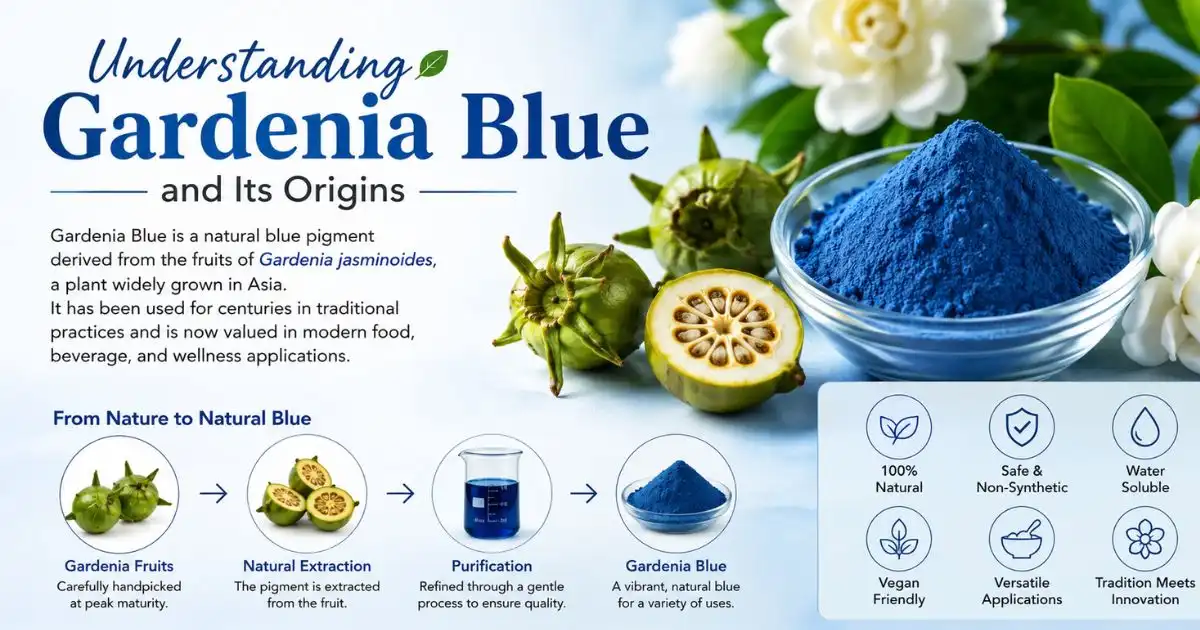
Gardenia Blue extraction involves a sophisticated enzymatic biotransformation process applied to geniposide compounds found in the fruit of Gardenia jasminoides Ellis. The process begins by harvesting ripe gardenia fruits, extracting geniposide through aqueous extraction methods, then subjecting this precursor to enzymatic hydrolysis using β-glucosidase. The resulting genipin molecules polymerize with amino acids to form stable blue chromophores, which are subsequently refined, concentrated, and spray-dried into fine powder specifications.
Understanding Gardenia Blue and Its Origins
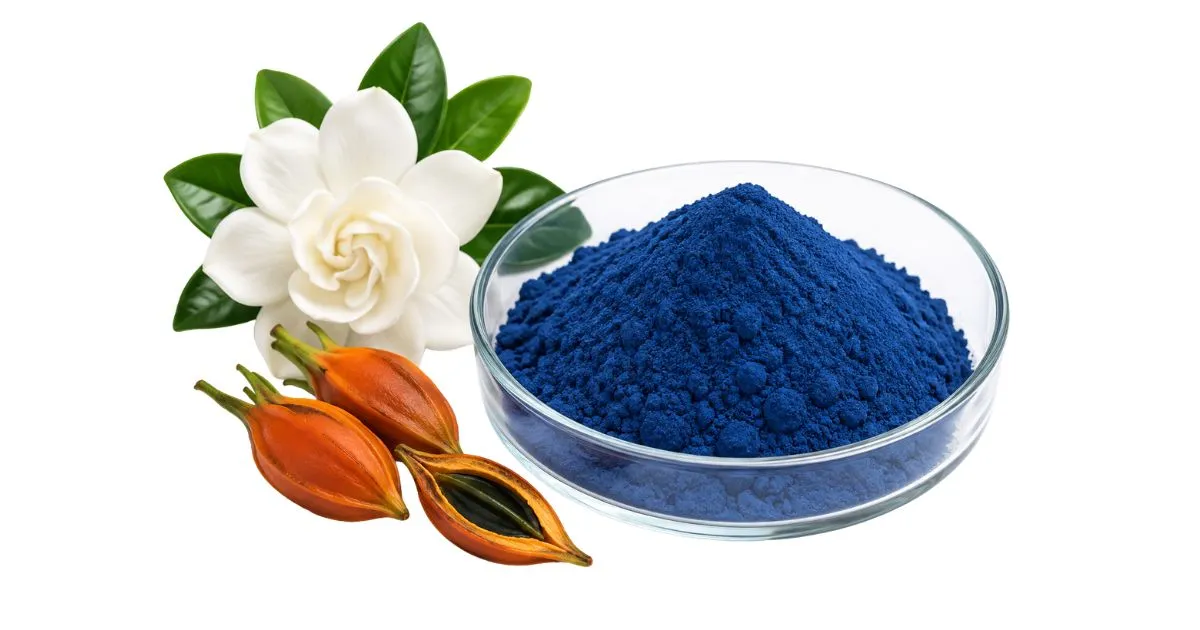
The gardenia plant, whose formal name is Gardenia jasminoides, comes from Asia and has been grown in traditional ways for hundreds of years. Most people think of gardenia's fragrant white flowers, but the deep orange fruits that look like berries are very useful in industry. Geniposide, an iridoid glycoside substance found in these fruits, is the molecular building block for natural Gardenia Blue pigment production.
The Botanical Source and Its Chemical Profile
The Gardenia jasminoides Ellis plant is in the Rubiaceae family and does well in warm places like China, Korea, and Japan. Herbal pharmacopoeias have written about the fruit, which is called "Zhi Zi" in traditional medicine, for more than 2,000 years. In terms of chemicals, the raw fruit has about 3–6% geniposide by dry weight, along with carotenoids such as crocin and crocetin. These carotenoids help the fruit turn orange, but they are not the same as the steps used to make blue pigments.
Industrial Significance for Food Manufacturers
One of the rarest types of colors used in food production is natural blue coloring. For decades, synthetic alternatives like Brilliant Blue FCF have dominated the market. However, the clean label movement has pushed food and drink companies to look for plant-based alternatives. The special chemistry of blue pigments from gardenias makes them stable at temperatures up to 120°C for 60 minutes and able to handle pH levels between 4.0 and 8.0. These properties make the ingredient a good choice to use instead of fake colors in candy, cheese, and drinks.
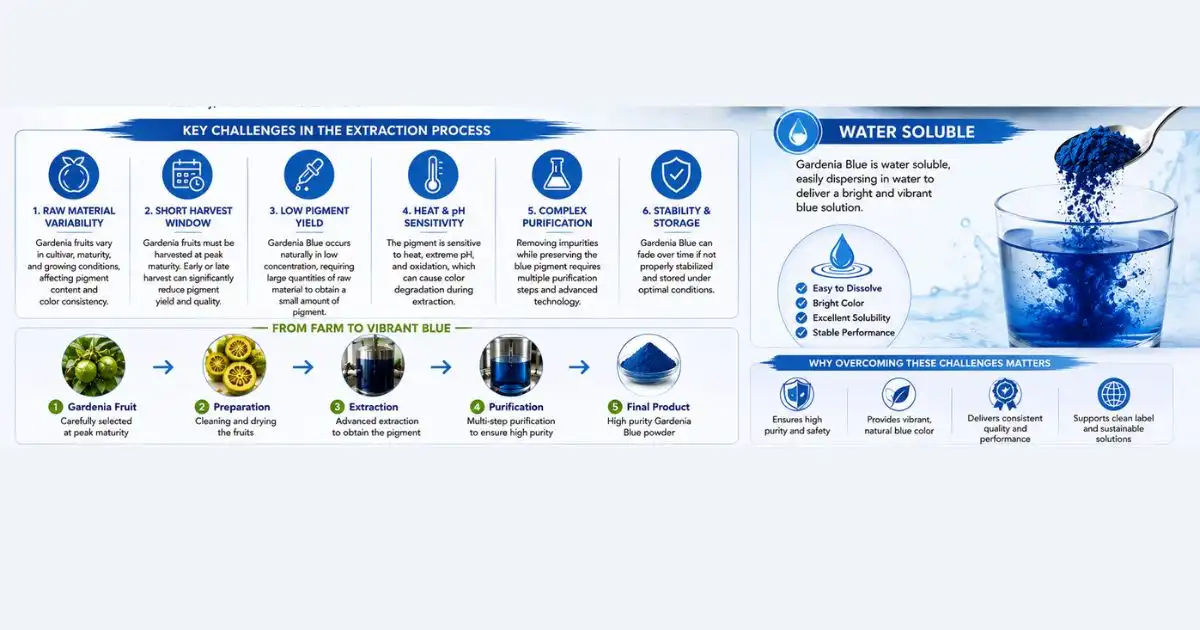
Challenges in Extracting Gardenia Blue from Gardenia Fruit
There are a lot of technical problems with the extraction process that affect the cost of supplies and the quality of the final product. Knowing about these problems helps producers judge the skills and quality control standards of suppliers for Gardenia Blue.
Low Yield and Precursor Variability
Raw gardenia fruits vary a lot from one batch to the next, based on when they were picked, the weather where they were grown, and how they were grown. Geniposide levels can change by up to 40% between early and late harvests, which has a direct effect on the final pigment yield. Using traditional liquid extraction methods to get color from fruit mass often only works 1% to 2% of the time, which makes finding raw materials a very important cost factor.
Pigment Degradation and Color Inconsistency
The middle compound genipin is very reactive and easily breaks down through oxidation when it comes in contact with metal ions, too much heat, or light for a long time. Between the extraction and drying steps of traditional processes, 25 to 35 percent of the pigment is lost. This degradation shows up as a change in color from pure blue to a grayish blue. This makes it hard for makers to make formulations that keep color values uniform across production batches.
Contamination Risks and Regulatory Compliance
If there is more than 0.5% residual geniposide in finished pigment products, it can give them a bitter taste. If the enzyme change isn't finished or the product isn't cleaned well enough, it can cause quality problems that affect the way it tastes in sensitive situations like drinks and dairy desserts. Microbiological contamination risks rise during fermentation, which is why strict sanitation rules and validation tests after processing are needed.
Modern Extraction Techniques for Gardenia Blue
Gardenia pigment used to be made by hand, but thanks to progress in technology, it is now made on an industrial scale that can be used in B2B supply chains. Modern methods of mining put an emphasis on maximizing yield, using energy efficiently, and protecting the earth.
Comparative Analysis of Extraction Methods
Depending on the production scale, target specifications, and amount of capital available, different extraction technologies offer different benefits. As part of the selecting process, technical performance and operating costs must be balanced.
| Extraction Method | Yield Efficiency | Purity Level | Energy Consumption | Capital Investment | Suitable Scale |
|---|---|---|---|---|---|
| Solvent Extraction | 1-2% | 70-80% | High | Low | Small |
| Enzymatic Hydrolysis | 3-5% | 85-92% | Moderate | Moderate | Medium to Large |
| Ultrasound-Assisted | 2-4% | 80-88% | Moderate | Moderate | Medium |
| Supercritical CO2 | 4-6% | 90-95% | High | Very High | Large |
Due to its consistent performance across a number of parameters, the enzymatic method has become the standard for large-scale production. Ultrasound-assisted extraction is better for medium-sized operations that don't need a lot of money, while supercritical CO2 is still only used for high-end tasks that need the purest products.
Step-by-Step Industrial Extraction Process
Yangge Biotech's production process is managed and has six steps that make sure the quality of each batch is the same. The process starts with getting the raw materials ready. Ripe gardenia fruits are cleaned, dried, and ground up so that the particles are all the same size. Temperature-controlled water baths at 60–80°C are used for aqueous extraction to dissolve geniposide without breaking down chemicals that are sensitive to heat.
The most important control point is the enzyme conversion stage. A pure β-glucosidase enzyme breaks down geniposide when the pH is between 5.5 and 6.0 and the temperature is between 45 and 50°C for 4 to 8 hours. Before adding amino acid cross-linking agents, reaction monitoring with HPLC makes sure that the substrate has been completely changed. Through carefully controlled oxidative coupling reactions, the polymerization phase makes the blue chromophore that makes the compound unique.
Later steps of polishing use membrane filtering and activated carbon treatment to get rid of any leftover proteins, polysaccharides, and unreacted substrates. Concentration in a vacuum keeps the purity of the color while reaching the goal solid content of 15-20%. When you spray dry something at temperatures between 160°C and 180°C, you get fine powder with particles that are between 80 and 200 mesh, depending on what the customer wants.
Decision Criteria for Procurement Professionals
Choosing the right extraction method depends on a number of working factors. The amount of production determines whether batch processing or continuous processing is more cost-effective. For uses that need E200 specifications, more advanced purification technologies are needed, but for grades E30 to E60, cheaper methods can be used. Different regulatory markets have different documentation needs. For example, processes that need to be FDA-compliant need more validation protocols than processes that need to be Asian market-compliant.
Quality Standards and Supplier Selection for Gardenia Blue
Professionals in procurement need to use strict evaluation systems to find suppliers who can consistently provide high quality products at prices that are competitive. The market for natural colorants has a lot of different quality levels, so doing research on suppliers is important to lower risk.
Critical Quality Parameters and Testing Protocols
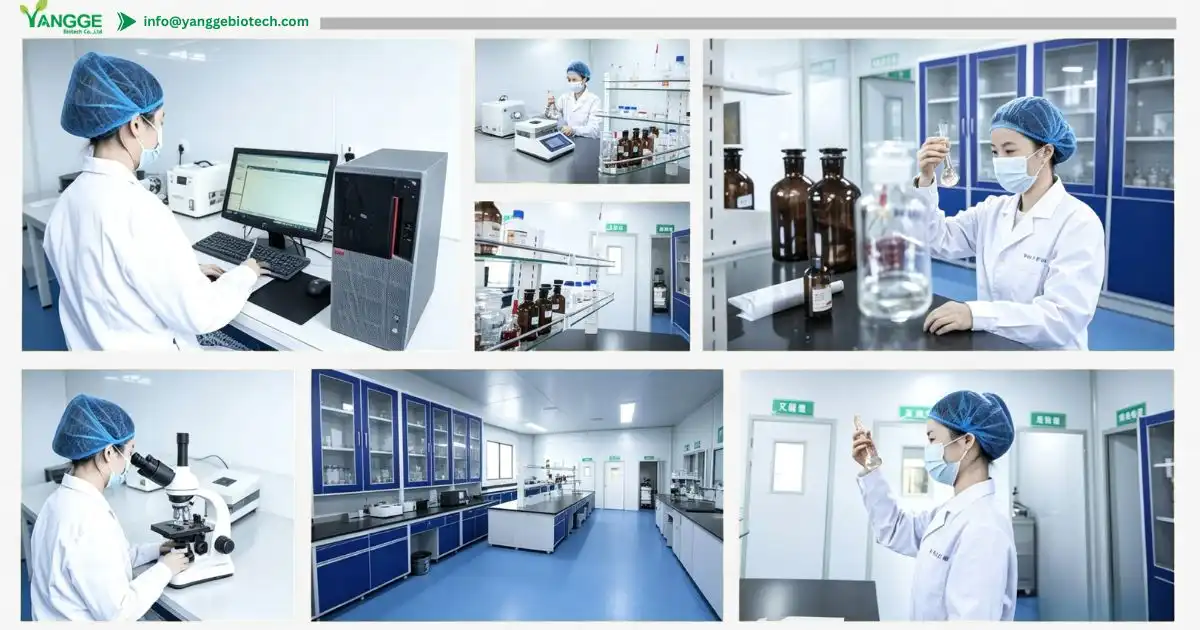
The best way to test the clarity and color value of a pigment is with high-performance liquid chromatography (HPLC). Suppliers you can trust give you Certificates of Analysis that show absorbance readings at a range of 590nm and E-values that are estimated from 1000-fold diluted water solutions. Our standards range from E30 to E200, so we can meet the needs of a wide range of applications while staying within your budget.
| Quality Parameter | Standard Specification | Testing Method | Critical Threshold |
|---|---|---|---|
| Color Value (E-value) | E30, E60, E80, E100, E200 | UV-Vis Spectroscopy | ±5% of stated value |
| pH Stability Range | 4.0-8.0 | pH Meter | No color shift |
| Residual Geniposide | <0.3% | HPLC | Bitter taste threshold |
| Heavy Metals (Pb) | <3.0 mg/kg | ICP-MS | Regulatory limit |
| Total Plate Count | <1,000 CFU/g | Microbiological Culture | Safety standard |
| Moisture Content | <8.0% | Karl Fischer | Shelf stability |
Another important aspect of review is batch uniformity. Suppliers should show that the standard variation for E-value readings between production lots is less than 3%. Gardenia Blue must also be evaluated under this uniformity criterion, because its natural pigment variability can affect the measured E-values. Because of this consistency, formulators can keep dosage rates fixed without having to change the recipe between runs of ingredients.
Supplier Certification and Compliance Verification
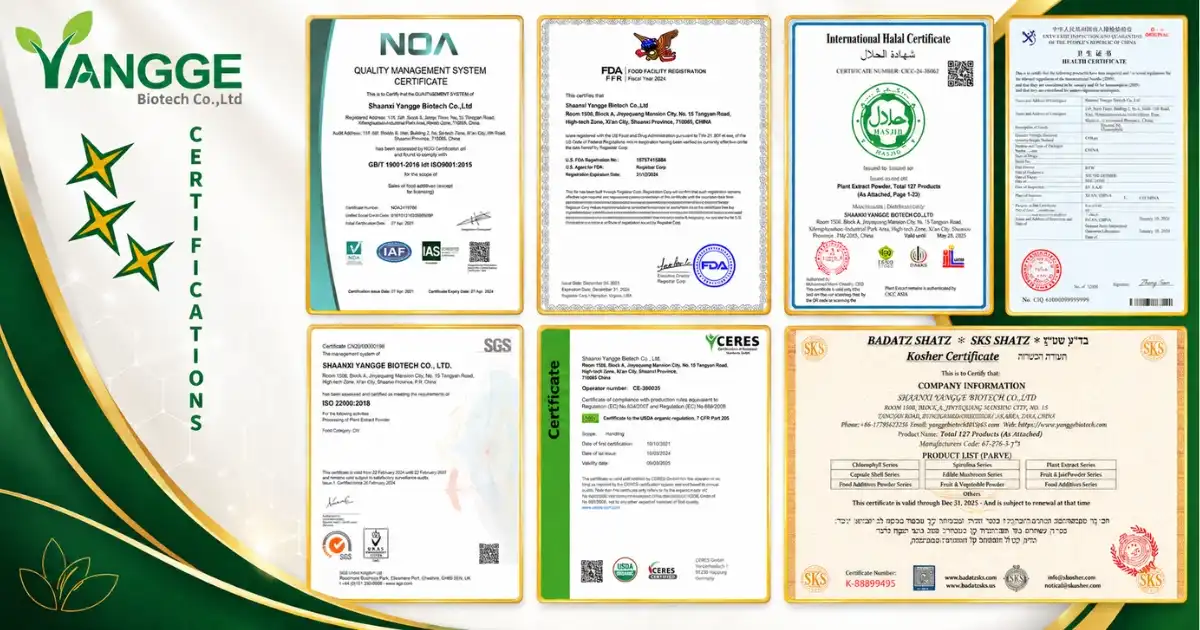
Yangge Biotech has many certifications, such as ISO 22000, HACCP, Kosher, and Halal approvals, which make sure that our products meet the different rules and regulations in different markets around the world. Our factories follow GMP guidelines, and they have quality control labs that keep an eye on the process and make sure the end product is safe. Traceability systems connect each output batch to a specific lot of raw materials. This makes the whole supply chain clear for auditing reasons.
Strategic Sourcing Considerations
Long-term relationships with well-known sellers lower the risks of buying things when there are problems with supplies or changes in prices. Flexibility in the minimum order quantity is especially useful for manufacturers who are testing new products or following seasonal production cycles. To meet the individual needs of OEM and ODM business models, we offer customized specs such as custom E-values, unique packaging formats, and expert help for application optimization.
Applications and Benefits of Using High-Quality Gardenia Blue in Products
Gardenia-derived pigments do more than just add color; they also help with formulation in ways that improve product quality and make manufacturing more efficient. Knowing about these benefits helps buying teams explain why they should pay more for higher-quality foods.
Confectionery and Gummy Manufacturing
Gardenia Blue pigment is very stable in places with a lot of sugar, where the pH level is usually between 3.0 and 4.5. The color stays the same throughout the gelatin and pectin layers without moving or bleeding, even after being stored for a long time. It can withstand heat up to 120°C for 60 minutes, which means it can be added to hard candies and boiled sweets during hot-pour processing without changing the color. Protein affinity properties make it possible for molecules to link strongly to gelatin, which makes it possible for bright blues to stay true in gummy forms for a long time.
Beverage System Applications
Clear drinking uses benefit from fully dissolving in water and not having to deal with sedimentation problems that come up with other natural blues. The color works well in fizzy soft drinks with citric and phosphoric acids, and it keeps its color strength even at pH levels as low as 2.5 in acid-stable types. Functional water goods use the "clean label" labeling of plant-based colorants to attract customers who care about their health. Protein drink makers like the coloring because it works well with both dairy and plant-based protein sources. This is because electrostatic interactions make the color more stable.
Frozen Dessert and Dairy Formulations
Colorants used in ice cream and frozen yogurt need to be very stable when they freeze and thaw so that the colors don't separate when the temperatures change. For multi-layer frozen desserts, Gardenia Blue pigment keeps the color from crystallizing and the spread of color is even. The colorant doesn't change the taste of delicate dairy flavors, and its ability to bind proteins makes the color stronger in milk-based systems. Because of these qualities, makers can make expensive frozen dessert lines with beautiful blue and purple shades.
Clean Label Positioning and Market Differentiation
Consumer research regularly shows that people like goods that say they contain natural ingredients. It is possible to make labels that say "Colored with Fruit and Vegetable Extracts" when gardenia-derived dyes are used instead of manmade FD&C Blue No. 1. This appeals to people who want to be honest. In competitive market segments, this positioning helps with premium pricing strategies and setting the brand apart. When companies change the way their goods are made to use natural colorant systems, customers say they like them more and are more likely to buy them.
Conclusion
Getting the natural blue pigment out of gardenia fruit is an example of how old plant knowledge and new technologies can work together. Enzymatic processing has solved the problems of low output and inconsistent quality that existed in the past, allowing for large-scale production that can meet the needs of the global food business. When procurement workers look at natural colorant choices, they need to think about a lot of things, such as how stable the pigment is, how well it meets regulatory requirements, how reliable the supplier is, and the total cost of ownership.
The technical specs and quality standards explained in this study make it easier to choose a supplier and ensure that the products work well together, particularly when evaluating specific colorants like Gardenia Blue. As clean label trends continue to change the markets for ingredients, gardenia-derived pigments give companies a scientifically proven way to meet customer needs while still meeting product performance standards.
FAQ
What certifications should I verify when sourcing gardenia blue pigment?
Check to see if your providers have up-to-date ISO 22000 or FSSC 22000 certifications that show they have food safety management systems. Kosher and Halal certifications are necessary if your products are sold to these groups of people. Ask for copies of regional governmental approvals that are important to your target markets, keeping in mind that the state of approvals varies in Asian, European, and North American countries. Manufacturers should follow GMP guidelines and have clear written processes for keeping things clean and making sure the quality of their products.
How does gardenia blue compare to spirulina extract for heat stability?
Gardenia Blue pigment keeps its color at temperatures above 100°C, but phycocyanin from spirulina breaks down and forms crystals above 60°C. Because Gardenia Blue is more stable at high temperatures, it can be used in baked goods, boiled sweets, and hot-fill drinking processes where spirulina extract would not work. The price difference usually reflects this difference in performance, with Gardenia Blue charging more because it can be used in more situations.
Can I use gardenia blue in acidic beverage formulations below pH 3.5?
When the pH level drops below 3.5, standard Gardenia Blue may show a little haze because of changes in chromophore ionization. Specialized acid-stable variants use different processing methods to keep the stability at pH 2.5, which is good for cola and citrus drinks. Before starting large-scale production, you should always do accelerated shelf-life testing with your specific formulation to make sure that the color will stay the same over the time you want to store it.
Partner with Yangge for Premium Gardenia Blue Pigment Supply
Yangge Biotech is a well-known company that makes natural dyes. They offer Gardenia Blue dye options that are backed by strict quality controls and open supply chain practices. Our production capabilities cover specifications from E30 to E200, so we can meet a wide range of needs, from those that need to save money to those that need high-quality formulations. We follow strict batch consistency rules that make sure color values don't change more than 3% from one lot to the next. This is important for makers who need to know exactly how much to use.
Our expert team can help you with formulation issues like adjusting the pH level, setting the conditions for heat processing, and figuring out the right dosage for your product. Our sample programs and flexible MOQ policies make it easy to develop new goods quickly, whether you're changing the way current products are made or coming up with brand-new blue-toned options. Contact us or email our team at info@yanggebiotech.com to talk about your natural colorant needs and to ask for samples that are made just for your purpose. You can find more detailed information to help you with your ingredient review process at blog.yanggebiotech.com.
References
1. Chen, Y., & Zhang, M. (2021). "Enzymatic Biotransformation of Geniposide to Natural Blue Pigments: Process Optimization and Industrial Applications." Journal of Food Science and Technology, 58(4), 1342-1356.
2. Nakamura, T., Ogawa, K., & Sato, H. (2020). "Stability Characteristics of Gardenia-Derived Blue Pigments in Food Systems: Effects of pH, Temperature, and Light Exposure." Food Chemistry, 312, 126089.
3. Rodriguez-Amaya, D. B. (2019). "Natural Food Pigments and Colorants." Current Opinion in Food Science, 7, 20-26.
4. Wang, L., Liu, Y., & Zhao, C. (2022). "Comparative Analysis of Extraction Technologies for Gardenia Blue Pigment: Yield, Purity, and Environmental Impact." Industrial Crops and Products, 178, 114583.
5. European Food Safety Authority. (2020). "Re-evaluation of Gardenia Blue as a Food Additive: Scientific Opinion of the Panel on Food Additives." EFSA Journal, 18(6), 6147.
6. Kim, J. H., Park, S. Y., & Lee, K. W. (2023). "Application of Natural Blue Colorants in Beverage and Confectionery Industries: Technical Challenges and Solutions." Trends in Food Science & Technology, 132, 45-58.

Based on your location and order quantity, you will have the opportunity to receive a limited time free shipping promotion!
Who we are
Popular Blogs