How do heat and acidity affect phycocyanin stability
Heat and acidity are the two worst external variables for a protein-bound chromatic extract from Arthrospira platensis. Blue phycocyanin decreases its colour and activity as an antioxidant at a temperature higher than 45 degree Celsius or below pH 5.0. Nutraceutical manufacturers and formulation teams must understand degradation pathways, as this defines if the substance sourced performs as labelled when packaging, processing and shelf life.

Understanding Phycocyanin Stability: Basics and Challenges
Phycocyanin is a member of the phycobiliprotein family. Its intense azur absorption at 615-620 nm is due to its standard chromophore (phycocyanobilin) covalently bound to an apoprotein. Protein structural changes induced by heat, acid, oxidisation or light lead to increased chromophore exposure by irreversible fading of the pigment.
Primary Destabilizing Factors
Four environmental variables consistently appear in published degradation studies:
- Temperature — Protein unfolding begins around 45°C and accelerates sharply above 60°C.
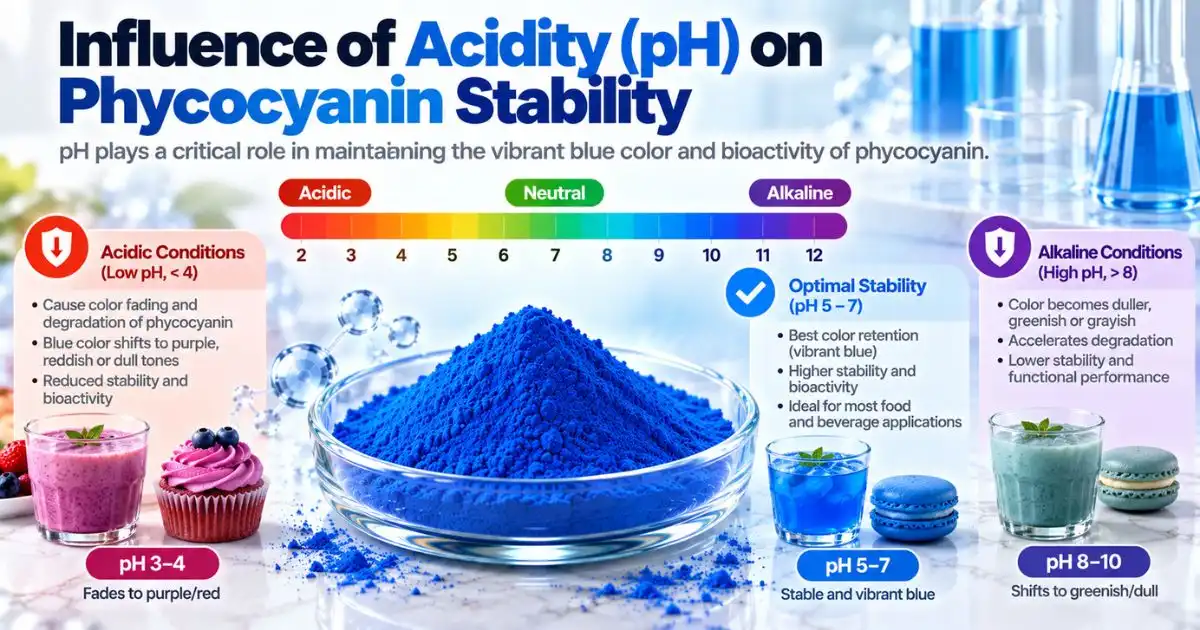
- pH — Stability peaks between pH 5.5 and 7.0; below pH 4.0, rapid denaturation occurs.
- Light/UV — Photodegradation of the chromophore is well-documented even at room temperature.
- Dissolved oxygen — Oxidative bleaching proceeds in parallel with thermal or acid-driven denaturation.
Among these, temperature and pH are the variables procurement teams can most directly control through supplier specifications, formulation choices, and storage protocols.
Why Stability Data Matters in B2B Sourcing
Essentially, a supplier who does not offer batch specific stability profiles including colour value retention under defined pH as well as temperature conditions is asking you to take on unquantified risk. That risk is translated directly into regulatory scrutiny and product recalls for supplement vendors making label suggests around blue phycocyanin (phycocyanin) content (25%+).
Specification Grades and What They Signal
| Grade | Color Value (E1%, 618 nm) | Phycocyanin % | Protein % | Typical Application |
|---|---|---|---|---|
| E10 | ≥100 | ~10–15% | 60–70% | Beverage coloring, dairy |
| E18 | ≥180 | ~25% | 60–70% | Nutraceutical actives, supplements |
| E25 | ≥250 | ~30%+ | 60–70% | High-potency formulations, cosmetics |
Yangge Biotech's phycocyanin is available in E10, E18, and E25 grades, all verified by HPLC and 100% water-soluble, with KOSHER/USP certification and 1 ton in stock.

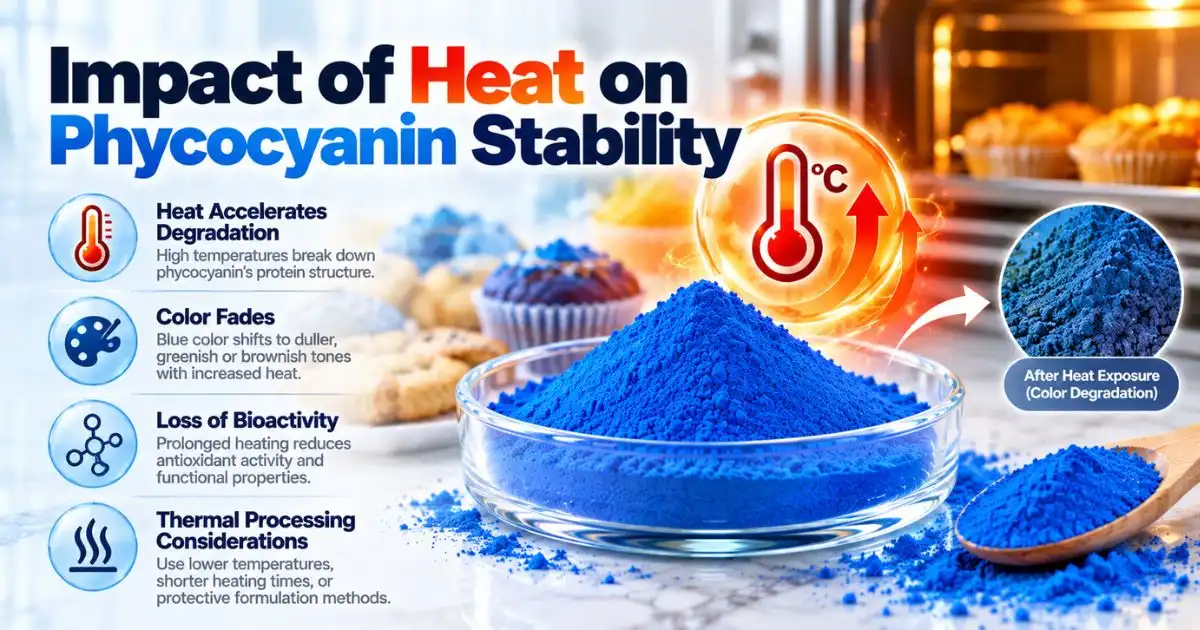
Impact of Heat on Phycocyanin Stability
Temperature Thresholds You Need to Know
Researchers have described first-order phycocyanin breakdown. Water shortens the half-life to a period of 10 at 45°C. Over half the colour fades in an hour at 70°C. Spray drying is common. The material enters at 150–180°C but cools out and at the result. Faster spray-drying and lower outlet temperatures preserve and measure more activity.
Industrial Processing Implications
It is very hard for formulators to deal with pasteurization (72°C/15 sec) and UHT (135°C/few sec). Putting maltodextrin or whey protein matrices inside microencapsulated drinks has been shown to cut heat loss by 30–40%. When phycocyanin powder is mixed at room temperature after steps that are sensitive to heat, it stays away from direct heat. This is important for dry dosage forms like pills, tablets, and gummies.
What to Ask Your Supplier
Before you buy a lot of phycocyanin, make sure you have these things ready:
- Accelerated stability study results (40°C/75% RH, 3 months minimum)
- Inlet/outlet temperature records from the spray-drying batch
- Residual moisture content (target: ≤5%) as a proxy for thermal processing quality
Influence of Acidity (pH) on Phycocyanin Stability
The pH Stability Window
Research has shown that the best pH range for blue phycocyanin is always between 5.5 and 7.0. Within this range, the apoprotein stays in its natural shape, which keeps the chromophore safe. As pH falls below 4.5, hydrogen ions start to break down hydrogen bonds inside the molecule. It breaks down the structure and changes the color from blue to a greenish-gray color.
Formulation Scenarios Where pH Becomes a Problem
| Application | Typical pH | Risk Level | Recommended Strategy |
|---|---|---|---|
| Gummies | 3.0–3.5 | High | Microencapsulated form; add post-gel set |
| Fruit beverage | 3.5–4.2 | High | Buffered solution; cold-fill process |
| Dairy (yogurt) | 3.8–4.5 | Medium-High | Post-fermentation addition |
| Capsules/tablets | ~6.5–7.0 | Low | Standard blending; ambient temp |
| Smoothie powder | 5.5–6.5 | Low | Direct blending |
Supplier Verification Checklist for pH Tolerance
An honest service should give you pH stability data for at least three locations (pH 4, 6, and 7) and show you how much of the color value is still there. That information shouldn't be on a detailed document if it isn't there.
Combined Effect of Heat and Acidity: Challenges and Solutions
It's not easy to explain how degradation speeds up when heat and low pH work together. When pH 4.0 and 55°C were used together, Antelo et al. (2010) found that color retention dropped to less than 20% in just two hours. This is faster than either stressor would do on its own. This is important to know when making acidic drinks and softgels that use heat and organic acid ingredients.
Practical Mitigation Approaches
There are three strategies that always work, whether the data is public or private:
- Microencapsulation: Encapsulating phycocyanin in a maltodextrin or protein matrix physically separates it from acid and heat. Retention rates of 70–85% after pasteurization have been reported.
- Antioxidant co-addition: Ascorbic acid at low concentrations (0.05–0.1%) acts as an oxygen scavenger and delays oxidative bleaching that runs concurrently with thermal/acid degradation.
- Process sequencing: In gummy and beverage production, adding phycocyanin after the highest-temperature and lowest-pH process steps reduces cumulative stress exposure by design.
You don't need any special tools to use these methods; they can be used in normal ways to make supplements and food containing blue phycocyanin.

Practical Buyer's Guide: Ensuring Quality in Phycocyanin Procurement
When you look for bulk phycocyanin suppliers, the color value grade (E10, E18, or E25) is not the only thing you should think about. These are the main things that will tell you a source is safe or not:
- HPLC-verified phycocyanin %: Spectrophotometric readings alone cannot distinguish phycocyanin from other phycobiliproteins. HPLC confirmation is the standard for nutraceutical-grade material.
- Batch COA with color value, protein %, moisture, heavy metals, and microbial counts: Each shipment should carry a full certificate, not a generic spec sheet.
- Third-party testing compatibility: Reputable suppliers accept and facilitate third-party re-testing of samples before and after shipment.
- Cold-chain shipping capability: Phycocyanin powder shipped without temperature control in warm climates can lose measurable activity in transit.
- Certifications: KOSHER, USP-grade, Non-GMO, and GMP compliance reduce regulatory friction for both US and EU market filings.
Yangge Biotech's phycocyanin E18 has a 25% phycocyanin yield and a MOQ of 25 kg. It's also 100% water-soluble, has 60–70% protein, and is certified KOSHER/USP. We offer OEM packages in 60g, 100g, or 8oz sizes for brands that need their own capsules, tablets, powder mixes, or gummies.

Conclusion
Blue phycocyanin is a unique, effective chemical. Heat above 45°C plus pH below 5.0 can break it down, but together they work faster. Buying teams must understand blue phycocyanin breakdown before using it in foods or supplements. This distinguishes good products from those that fail retest. Before ordering, check colour value grades, request HPLC batch reports, and verify that your supplier can provide stability data for relevant temperature and pH ranges.
FAQ
What temperature is safe for processing phycocyanin?
Keep phycocyanin below 45°C during blending and below 60°C if it must be in an aqueous system. For processes requiring higher temperatures—such as pasteurization—use encapsulated forms or add phycocyanin after the heat step.
What is the optimal pH range for phycocyanin stability?
Published research places the optimal range at pH 5.5–7.0. Avoid direct exposure below pH 4.5 in liquid formulations. For acidic product formats, buffering or encapsulation is necessary to preserve color value and bioactivity.
How do I verify that a supplier's phycocyanin content is accurate?
Request an HPLC certificate of analysis for each batch, not just spectrophotometric color value data. Send a sample to an independent third-party laboratory (e.g., Eurofins, NSF) before approving a new supplier or a new batch.
What is the difference between E10, E18, and E25 phycocyanin?
These designations refer to color value (E1%, 618 nm). E18 corresponds to ≥25% phycocyanin and is the standard nutraceutical active grade. E25 offers higher potency for specialized formulations. E10 is suited to food and beverage coloring applications where color value matters more than functional concentration.
Does phycocyanin powder require cold-chain shipping?
Dry powder in sealed, moisture-proof packaging tolerates ambient shipping if kept out of high-heat environments. For liquid extracts or extended transit in warm climates, refrigerated shipping is advisable. Always check residual moisture (≤5%) on arrival.
Source Yangge Phycocyanin Request a Sample or Bulk Quote
There are three types of phycocyanin that Yangge Biotech makes: E10, E18, and E25. Their batch records have been checked by HPLC, and they have one ton of stock on hand right now. Trust us to get you blue phycocyanin, and with a MOQ of 25 kg, we can package powders, capsules, tablets, and gummies. You can email our scientific team at info@yanggebiotech.com or visit our blog at blog.yanggebiotech.com to get samples, stability data, or a bulk price.
References
1. Chaiklahan,, R., Chirasuwan N., & Bunnag, B. (2011). Phycocyanin Stability extracted from Spirulina sp. The Effect of Temperature, pH and Preservatives. Process Biochemistry 46, 1380–1386.
2. Antelo, F. S., Costa, Justice, A. V., & Kalil, S. v. J. (2010). Thermal degradation of phycocyanin to Spirulina platensis. Biochemical and Engineering Journal, 41 (1), 43-47.
3. Martínez-Meza, G., Peinado, an I., & Heredia, A. . Encapsulation of phycocyanin for improving its stability or bioavailability to food systems. Food Hydrocolloids, a 107, 105935.
4. Boussiba, S., Richmond, Richmond, A. E. (1979) C-phycocyanin, a storage protein of the blue-green alga Spirulina, is responsible for platensis. Archives of Microbiology, 120 (2), 155-159.
5. Eriksen, N. T. (2008). : Production of phycocyanin-A pigment with applications in biological sciences, biotechnology, and food and medicine. Applied Biology and Biotechnology 80(1): 1-14.
6. Romay, C., González, R., & Ledón, N., Remirez, D., e & Rimbau, V. (2003). C-phycocyanin: A biliprotein via antioxidant, anti-inflammatory and neuroprotective properties Current Protein & Peptide Science, 4(3), 207-216.
Based on your location and order quantity, you will have the opportunity to receive a limited time free shipping promotion!
Who we are
Popular Blogs