Gardenia Blue Color vs Synthetic Dyes: Which Is Best for Export?
When food manufacturers ask whether gardenia blue color or synthetic dyes are the better choice for export, the answer depends on where you sell and what your buyers expect. Gardenia blue color a water-soluble pigment extracted from Gardenia jasminoides fruit — holds stable across pH 4.0–8.0 and withstands processing temperatures above 120°C for 60+ minutes. Synthetic blues like FD&C Blue No. 1 offer cost predictability but face mounting restrictions in the EU and several Asian markets. For clean-label and export-focused production, the natural option is pulling ahead.

Understanding Gardenia Blue Color: Origin and Real-World Performance
What It Is and Where It Comes From?
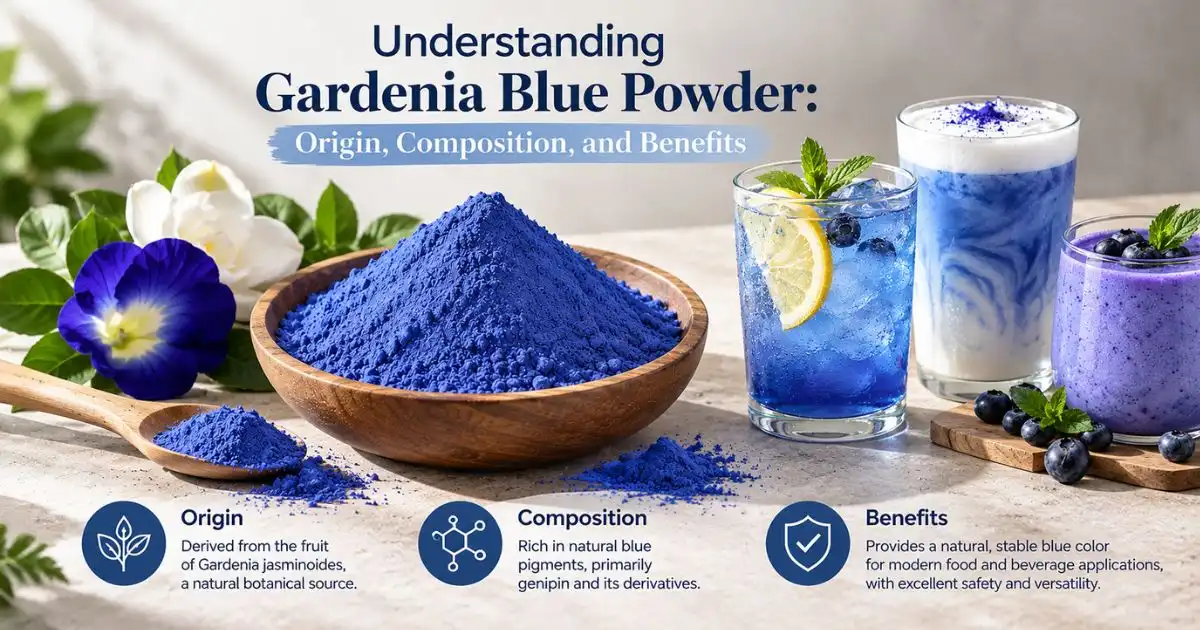
Geniposide is a chemical that is found in Gardenia jasminoides fruit. It is turned into gardenia blue color powder with food-grade β-glucosidase and amino acids. It is possible to make a steady iridoid pigment that looks like a fine gray to dark blue powder. It mixes well with water and watery ethanol, but not with fats or chemical liquids. Specifications E30, E60, E80, E100, and E200 are all part of Yangge's product line. An HPLC test was used to make sure that the color values and low geniposide leftovers were all the same.
Why Stability Matters for Formulators?
When making food, color instability means extra work and batches that have to be thrown out. Other pigments, like anthocyanin-based ones, change color when mixed with different kinds of sugar, drinks, and jams. Gardenia blue color doesn't. It doesn't change color. For more than an hour at 120°C, the color doesn't change much. When there is a lot of heat, like when making hard candies or hot drinks, algae and butterfly pea flower can't do this.
Application Scope Across Food Categories
As long as the temperature is above 130°C, the color will boil in gummy and hard candies. It will stay stable for a long time in store lighting for alcoholic and RTD drinks. Baked goods with fillings or frosting will not bleed or dull in the oven. And at low pH, the color will stay the same without shifting purple in fruit jams. When gardenia yellow is mixed with green, the greens always look the same. This is an advantage of co-production, and it also saves money per kilogram compared to buying two separate natural colorants.
Synthetic Dyes: What They Offer and Where They Fall Short?
Performance Strengths of Synthetic Colors
If you use a small amount of Brilliant Blue FCF (FD&C Blue No. 1) or Indigo Carmine (FD&C Blue No. 2), the color will be clear and consistent. There are well-established supply chains for these things that reach places all over the world. The price per kilogram is less at the commodity scale. In places where marking rules don't exist, fake blues are still useful for manufacturers.
Regulatory and Market Access Risks
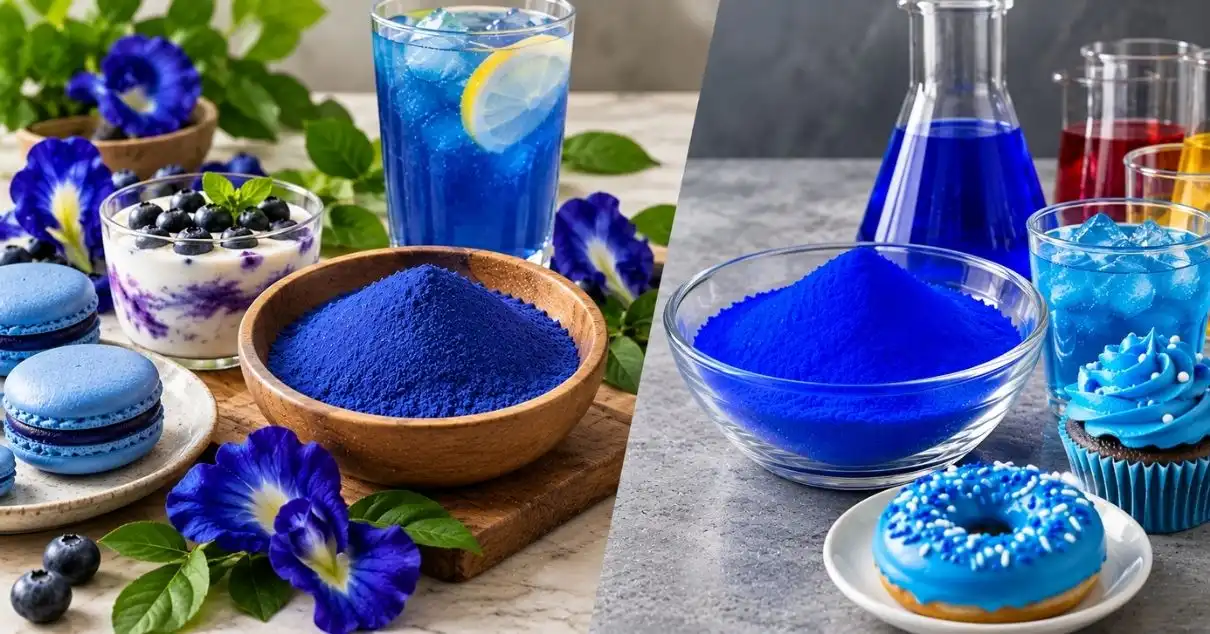
Because of the "Southampton Six" decision and the restrictions that followed on some azo dyes, stores in Europe have to change the way their goods are made and put clean labels on them. The UK Food Standards Agency says that warning signs must be put on products that use certain man-made colors. In order for synthetic colorants to be brought into South Korea and Japan legally, extra forms need to be filled out. Because of these rules and laws, it takes longer for exporters to get into the best markets and costs more to change their goods. gardenia blue color has emerged as a leading natural alternative to these synthetic dyes, particularly for exporters targeting multiple regulated markets.
Brand Perception and Consumer Demand Trends
In a study from 2023, Mintel found that 67% of people around the world would rather buy food that isn't colored with chemicals. When a company sends goods to North America, Western Europe, and East Asia, putting "naturally colored" on something really does affect sales. Not all synthetic colors are "clean," and the fact that they are linked to allergens and kids being hyperactive keeps getting them bad news in countries that want to buy their goods.

Side-by-Side Comparison: Key Performance Metrics
| Performance Factor | Gardenia Blue Powder | Synthetic Blue (FD&C Blue No. 1) |
|---|---|---|
| Heat stability (120°C / 60 min) | Stable, minimal loss | Stable |
| pH stability (range 4.0–8.0) | Color holds, no shift | Stable |
| Clean-label compliance | Yes | No |
| EU / UK market suitability | Yes | Restricted / warning label |
| Water solubility | High | High |
| Fat solubility | No | No |
| Green blending (co-pigment) | Yes (with gardenia yellow) | Requires separate dye |
| GMO-free / Gluten-free | Yes | Varies |
How to Choose the Right Color Solution for Your Export Markets?
Match Your Color to Your Target Region
It's clear that businesses that sell goods in the EU, UK, or Japan should switch to natural gardenia blue color dyes. In these places, clean label rules make fake choices more of a pain to deal with than a way to save money. If you're selling in a place with less strict rules, you should compare the risk of having to change the recipe when the rules get tighter, which is happening more and more in most big export destinations.
Application Dosage Reference by Food Matrix
The table below shows the suggested dose levels for gardenia blue color powder based on how it is normally used. These numbers give formulators a place to start their own tests.
| Food Matrix | Suggested Use Level | Notes |
|---|---|---|
| Hard candy | 0.05–0.15% (w/w) | Add after dissolving in minimal water |
| RTD beverage (pH 4–6) | 0.01–0.05% (w/w) | Adjust for target shade intensity |
| Fruit jam / preserve | 0.03–0.08% (w/w) | Stable at low pH, no purple shift |
| Bakery frosting | 0.05–0.10% (w/w) | Mix with water phase before fat incorporation |
| Green blending (+ gardenia yellow) | 1:1 to 1:3 ratio | Test ratio at target pH for hue accuracy |
Evaluate Suppliers on Data, Not Just Price
If a formulator gets a price quote without stable data, regulatory paperwork, or application advice, they don't know what to do. If you want to buy natural blue colorants, make sure they have HPLC-verified color value certificates, heat and pH stability test results, proof that they are legal in the places you want to sell to, and sample amounts that you can use to test them in your own lab. When you ask for a sample, Yangge sends you full scientific information because they are certified in ISO, HACCP, Kosher, and Halal.

Conclusion
Artificial dyes can't make food that is exported look as good as gardenia blue color powder does. It has a clean label, stays stable through heat and pH changes, and is approved by regulators in the most important markets. It can handle the same amount of heat, keep its color, and dissolve in water as synthetics. However, it doesn't come with the risks of marking and compliance that make it harder for makers to get into the market. If formulators have the right application data, they can switch from synthetic blue to natural blue in drinks, jams, or candies.
FAQ
Is gardenia blue color approved for use in the United States?
The gardenia blue color comes from natural sources in the United States. The way it is regulated is different from how fake approved colors are regulated. People who want to buy things to sell in the US should talk to their legal team to make sure they know about the different uses. Yangge can back up compliance review with proof.
How does gardenia blue compare to spirulina for hot-process applications?
Spirulina phycocyanin degrades significantly above 70°C, making it unsuitable for hard treats, hot drinks, or baked goods. When heated to 120°C, gardenia blue color powder stays blue for more than an hour. This makes it the best choice for things that will be heated.
Can gardenia blue be used in oil-based or fat-continuous food systems?
No, gardenia blue color doesn't go straight into fat; it only dissolves in water. First, mix the color with water or propylene glycol before adding it to the fat. This is done for things like chocolate coatings or butter-based frostings.
What specifications are available from Yangge?
Yangge has gardenia blue color powder in grades E30, E60, E80, E100, and E200. HPLC has checked all of them. The item can be bought in large quantities, and if kept in cases that are sealed and don't let light in, it should last for 24 months.
How long does the sample-to-production process typically take?
Most buyers finish the whole process in 4 to 8 weeks. This includes asking for examples, checking for stability, doing trial production, and then going to full scale. In order to speed up the internal testing phase, Yangge sends samples with business cards.
Request a Sample from Yangge Your Gardenia Blue Color Supplier
Yangge Biotech sells gardenia blue color to food makers in the Middle East, North America, East Asia, and Southeast Asia. ISO, HACCP, Kosher, and Halal have all approved our products. Each order comes with full technical support and papers about the color values that have been checked by HPLC. You can ask for a sample and an application data sheet for your food matrix by emailing info@yanggebiotech.com. We can help you find an alternative to manufactured colors that will still work in your factory.
References
1. Downham, A., & Collins, P. (2000). Colouring our foods in the last and next millennium. International Journal of Food Science & Technology, 35(1), 5–22.
2. Mortensen, A. (2006). Carotenoids and other pigments as natural colorants. Pure and Applied Chemistry, 78(8), 1477–1491.
3. Houghton, J. D., & Hendry, G. A. F. (Eds.). (1996). Natural Food Colorants (2nd ed.). Blackie Academic & Professional.
4. Mintel Group Ltd. (2023). Global Food & Drink Trends: Clean Label and Natural Ingredients Report. Mintel.
5. European Food Safety Authority (EFSA). (2010). Scientific opinion on the re-evaluation of Brilliant Blue FCF (E 133) as a food additive. EFSA Journal, 8(11), 1853.
6. Zhao, J., Li, S., & Wang, R. (2018). Stability and color characteristics of genipin-derived blue pigments under thermal and pH conditions. Food Chemistry, 245, 1024–1031.

Based on your location and order quantity, you will have the opportunity to receive a limited time free shipping promotion!
Who we are
Popular Blogs