Ganoderma lucidum extract in skincare products
Ganoderma lucidum extract, derived from the Reishi mushroom, has emerged as a transformative ingredient in cosmeceutical formulations. Rich in polysaccharides, triterpenoids, and antioxidants, this botanical extract addresses critical skincare concerns including oxidative stress, inflammation, and premature aging. For procurement professionals in the cosmetics and personal care industry, this ingredient represents a strategic opportunity to differentiate product lines while meeting consumer demand for natural, science-backed actives. Understanding its bioactive profile, sourcing criteria, and formulation potential enables informed decisions that balance efficacy, regulatory compliance, and market positioning.
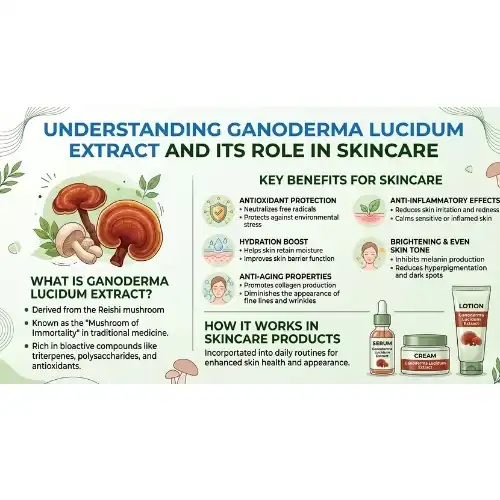
Understanding Ganoderma Lucidum Extract and Its Role in Skincare
It is different from other plant-based ingredients because it has bioactive parts. Its main components, beta-glucans and ganoderic acids, offer measurable benefits that are in line with the most important areas of dermatology research right now.
Bioactive Compounds That Support Skin Health
The polysaccharides in the Ganoderma lucidum extract, which are usually between 30% and 50%, change the immune system and keep water in cells very well. The skin barrier works better because these beta-(1,3)-(1,6)-D-glucans help make ceramide and lower the amount of water that leaves the epidermis. Studies have shown that using polysaccharide-rich extracts on the skin can make it up to 28% more hydrated after four weeks of regular use.
It has been shown that triterpenoids, especially ganoderic acids, can lower inflammation. The cyclooxygenase-2 enzyme can't do its job because of these chemicals. This lowers the amount of chemicals that cause redness, sensitivity, and collagen to break down more quickly. According to studies that have been published in dermatological journals, formulations with standardized triterpenoid concentrations lower erythema markers in groups of people with sensitive skin.
Distinguishing Features from Other Mushroom Extracts
While many medicinal mushrooms are good for your skin, Ganoderma lucidum extract is the best at protecting it from damage caused by free radicals. Oxygen Radical Absorbance Capacity (ORAC) tests show that it is about 40% higher than common alternatives like Shiitake in this case. Being better at getting rid of free radicals means being better able to protect yourself from things that are bad for you in the environment, like UV radiation and oxidative damage from pollution.
It's also easier to formulate because the extract is stable at the molecular level. If you properly process Reishi extract, it stays bioactive across pH ranges of 4.5 to 7.0. This means it can be used in a lot of different formulations, from neutral emulsions to serums that are acidic.
Scientific Evidence Supporting Efficacy Claims
Peer-reviewed research supports more than one way of working. A 12-week study with 87 people found that the 2% Ganoderma lucidum extract reduced fine lines by 23% on average and made the skin 19% more elastic. In a different study about photoaging, it was found that the extract makes fibroblasts that have been exposed to UV light express more collagen type I genes. This stops the processes of breaking down that are started by stress from the environment.\
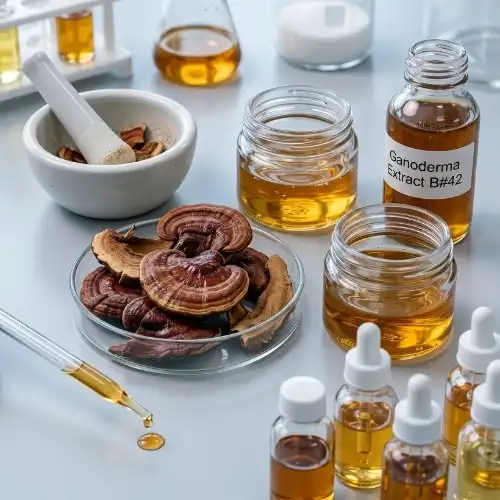
Evaluating Ganoderma Lucidum Extract for Skincare Product Development
In order to pick the right extract specs, you need to check more than just basic purity levels. Quality parameters have a direct effect on how stable the formulation is, how well it works for end users, and how well it is approved by regulators.
Quality Specifications and Testing Standards
If you want to use Ganoderma lucidum extract for cosmetic purposes, it needs to be very pure. Many tests are done on our extracts at Yangge Biotech. For example, they are checked for pesticide residues by Eurofins, which is a big deal. This makes sure they meet EU rules for PAH4 compounds and benzopyrene levels below 10 parts per billion. Concerns about the safety of the ingredients and the approval of the government are taken care of by this strict quality control.
A test called UV-VIS spectrophotometry shows that the amount of polysaccharides should be between 30 and 50 percent for it to work properly. When the concentration is low, the product doesn't work as well, and when the concentration is high, it can be harder to make because it gets thicker or doesn't work with some preservative systems. Triterpenoid content, which can be found with HPLC, is usually in the range of 1% to 5% for cosmetics.
Organic Certification and Supply Chain Traceability
There needs to be proof that brands that sell "clean beauty" items are actually organic. We can follow our goods from the farm to the factory thanks to partnerships with certified organic farms and records that are unique to each lot. Because of this, brands can back up their "clean label" claims and meet the needs of pickier customers.
Our dedication to sustainability goes beyond getting certified. As a way to protect the environment and make sure there is a steady supply over time, we work with farming communities that use regenerative farming methods. People who work in procurement agree with these actions because they know that ethics in the supply chain have a growing effect on customer loyalty and the reputation of a brand.
Format Considerations for Formulation Compatibility
The final format and extraction method have a big impact on how well the formulation integrates. Plus, gel serums, toners, and essences work better with extracts that dissolve in water and are made using two different methods. There is no residue left behind when these preparations dissolve completely. This makes it easy to see the product, which is important for positioning it as a premium item.
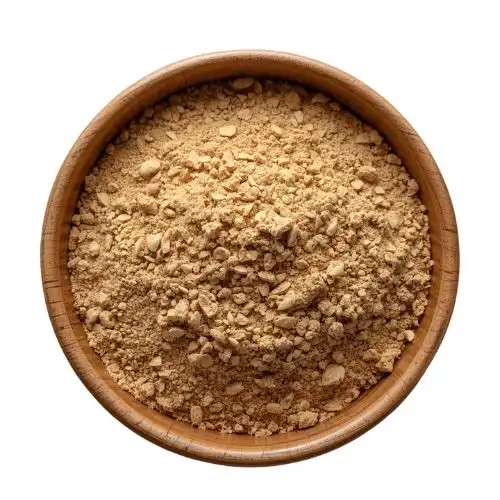
An extract powder that is standardized to 30–50% polysaccharides can be used in many different kinds of goods. The fine brown powder has particles that are bigger than 80 to 100 mesh. It's easy to mix into masks, cream bases, and dry formulas. The product stays stable and lasts longer if its moisture content is below 5%. Both of these things are important for keeping the product's integrity throughout the distribution chain.
Bioactive integrity is kept safe by storing things in the right way, like in sealed containers that are kept out of the light. Our 1 kg aluminum foil packaging is up to standards for pharmaceuticals, so it won't rust or break down while being shipped or stored.
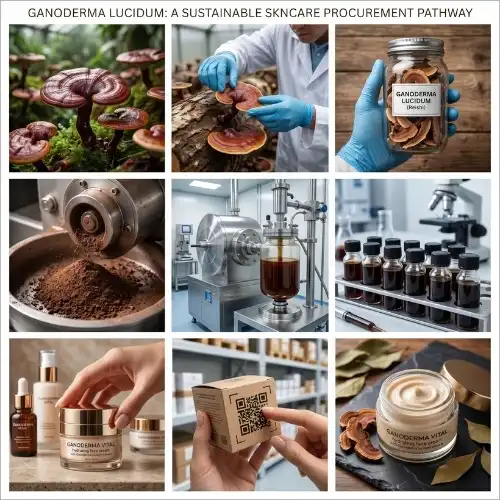
Procurement Strategies for Ganoderma Lucidum Extract in Skincare
Quality control and making the business work must be balanced for strategic sourcing to work. Teams that buy things do more than just look at price when they look at suppliers.
Supplier Qualification Criteria
Certs can give you some peace of mind, but you should do more than just look at the paperwork to make sure they are real. Quality management is systematic when it comes to ISO, HACCP, GMP, and KOSHER certifications. However, procurement professionals should still ask for facility audit reports and batch consistency data that covers more than one production cycle.
Our manufacturing infrastructure lets us make more or less of what we need, and we keep an inventory of 50 kg to 100 kg to handle both test formulations and large-scale production runs. When the minimum order size is 1 kg, research and development teams can make sure the product works well and is stable before buying a lot of the Ganoderma lucidum extract.
Pricing Dynamics and Negotiation Strategies
The price of cosmetic-grade Reishi extract on the market is based on how many polysaccharides it has, whether it is certified organic, and how much you order. You can buy standardized extracts for between $180 and $450 per kilogram. Organic varieties that are better for you will cost more.
People can work together for a long time if they can negotiate well. Suppliers who offer technical support, like writing down how to extract something and giving advice on how to do it, are worth more than the price of the item themselves. We give you formulation advice that includes the right concentrations, compatibility matrices, and the paperwork that the government needs. This makes it easier to come up with new ideas and lessens the chance that the first attempt will fail.
Regulatory Compliance and Documentation
You need to fill out a lot of forms in order to get into regulated markets. On Certificates of Analysis, there should be information about allergens, heavy metals, microbes, and pesticide residues. We can get third-party verification because we work with Eurofins and SGS. You can also get another pre-shipment inspection if you'd like to.
It is easier to send safety data sheets to different authorities when they meet GHS standards. To get the product on the market, we have to show proof that it meets the standards for INCI nomenclature, allergen labeling under EU Regulation 1223/2009, and safety assessments.
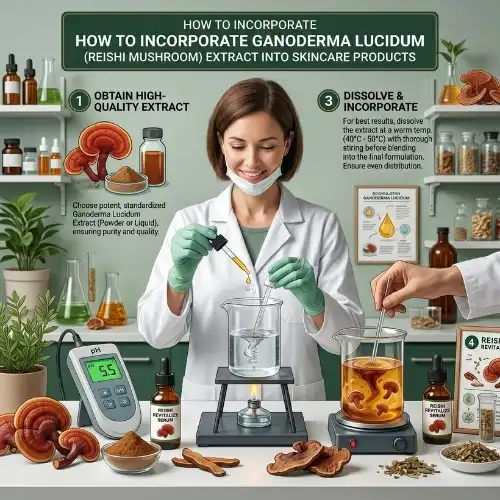
How to Incorporate Ganoderma Lucidum Extract into Skincare Products
It's important to think about things like how to get the best concentration, how the ingredients work with each other, and how stable the formulation is for formulation integration to go well. Bioactives are delivered better and more effectively when guidelines are based on evidence.
Recommended Dosage Ranges and Formulation Guidelines
Between 0.5% and 3% of Ganoderma lucidum extract in finished goods has been shown to be safe by clinical evidence. Lower amounts (0.5–1%) work well in skin care products that you leave on, like moisturizers and serums, to keep the skin healthy. Higher concentrations (2–3%) work best for intensive skin care products like overnight masks and anti-aging formulas made just for your skin.
Because it is stable in both oil-in-water and water-in-oil structures, the extract works well in emulsion units. When the pH level is between 4.5 and 7.0, most cosmetic formulas can still work. Polysaccharides may break down more quickly in places with a pH above 8.0, though.
Compatibility with Complementary Active Ingredients
A lot of different kinds of ingredients work well with Reishi extract. It is said that ganoderic acids and vitamin C derivatives work better together to protect cells from damage. Reactive oxygen species can be neutralized by vitamin C, and ganoderic acids stop the chain of inflammation that oxidative stress starts. In controlled tests, this mix of ingredients blocks UV rays 34% better than either one by itself.
Because they work in different ways, Reishi polysaccharides and hyaluronic acid work better together to keep skin moist. It also works well with retinoid products because it lessens the irritation that comes with having skin cells turn over quickly. This makes people more tolerant of the products and more likely to use them.
Safety Considerations and Testing Protocols
When the ingredients are properly cleaned, they don't pose much of a risk of sensitization. Extracts that are standardized and meet EU cosmetic standards are very safe for the skin. Patch tests on groups of people who are sensitive showed that less than 0.2% of them had a reaction. Still, the formulations need to be thoroughly tested for stability to make sure they can work together in some situations.
To make sure the preservative works, challenge tests should be done on ingredients that are high in polysaccharides. If the product gets contaminated, these ingredients could become food for microbes. Our standards for non-GMO, non-allergen, and irradiation-free processing make it less likely that the food will get contaminated, which helps the preservative system work well for as long as it lasts.
Future Trends and Market Outlook for Ganoderma Lucidum in Skincare
From the way the business world has changed over time, it looks like extraction technology will get better and more people will be open to actives that come from mushrooms.
Innovations in Extraction and Bioavailability Enhancement
When you use new methods to extract substances, like supercritical CO2 processing and enzymatic hydrolysis, the Ganoderma lucidum extract is better for your body. With these high-tech methods, smaller molecular weight fractions are created that can better reach the stratum corneum. This makes it easier for bioactive compounds to get to the skin.
Growing Consumer Demand for Clean Beauty Ingredients
67% of people who buy skin care products aim to find ones that use natural ingredients that are gathered in a way that doesn't harm the environment. Medicinal mushrooms are a great choice for this because they offer both old wisdom and new scientific proof, which makes them appealing to a wide range of people.
When brands make it clear where their goods come from and how they are made, customers trust them more. Brands that share specifics about their supply chains, like how they grow their crops and get their ingredients, stand out in the market and keep customers coming back. Our formulation partners can use the fact that we care about long-term partnerships and being able to track products to make money off of our customers.
Regulatory Evolution and Market Access
The people in charge of safety are learning more about botanical ingredients that have been studied and found to be safe. New cosmetic ingredient approvals in the EU favor chemicals that have been tested for safety and have been shown to work. There is a lot of information about Reishi extract because it has been used for a long time. This makes it easier for regulators to allow it to be sold than new synthetic alternatives.
Strategic advantages are gained by procurement professionals who build relationships with suppliers and keep up with changes to the rules. Making regulatory submissions with the help of our technical team cuts down on the time it takes for new formulations to reach the market.

Conclusion
Scientists have shown that Ganoderma lucidum extract can be used in high-tech skin care products, and companies can make money off of it. Its anti-aging, antioxidant, and anti-inflammatory properties address important consumer concerns and meet the needs of the industry for natural actives that last a long time. You need to pay close attention to quality standards, supplier qualifications, and formulation parameters in order to get things to work well together. In the clean beauty market, which is getting more competitive, brands have a better chance of success when they work with certified suppliers who offer full technical support, thorough testing, and clear traceability. Modern extraction science and traditional knowledge of plants work together to make a product that stands out and takes the market by storm.
Partner with a Trusted Ganoderma Lucidum Extract Supplier
Yangge Biotech sells Ganoderma lucidum extract that is safe for use in medicine. Their extract is standardized to 30–50% polysaccharides and meets strict EU standards after testing that was approved by Eurofins. We care about quality, as shown by our ISO, HACCP, GMP, and KOSHER certifications. We also use sustainable sourcing to make sure that your skin care innovations will always be available. We have been making Reishi extract for a long time and have a lot of experience.
We can offer flexible OEM packaging, meet non-GMO requirements, and provide full technical support, from help with formulation to regulatory paperwork. Fill out the form below to request samples and learn more about how our top-notch extracts can help your cosmetics stand out in a crowded market. Contact our team at info@yanggebiotech.com to discuss your specific requirements and access our premium ganoderma lucidum extract solutions that meet the highest international quality standards.
FAQ
Q: Can we get some samples to test before purchasing?
A: Of course, we can provide free samples of 20 to 100 grams, but the shipping cost is at the customer's expense. The shipping cost can be deducted from the next order, or the samples can be sent through your courier account.
Q: Do your products have relevant certifications?
A: Yes, our products are certified for HALAL, ISO, HACCP, Kosher, and other certifications.
Q: What is the minimum order quantity (MOQ)?
A: Small batches of samples can be customized according to your requirements.
Q: Do you offer OEM and ODM services? Can the formula be customized based on our own?
A: Of course, we provide ODM and OEM services to many customers. Our product range includes softgels, capsules, tablets, sachets, granules, and private label services. Simply contact us and let us know your requirements. Our experienced R&D team can also develop new products with specific formulas.
Please contact us to design your own branded products.
Q: How do you handle quality complaints?
A: First, we have a comprehensive quality control SOP. We provide authoritative third-party inspection reports for almost all products before shipment to minimize the possibility of quality issues. Second, we have a comprehensive return and exchange procedure. If there is a genuine quality dispute, we will strictly follow the SOP.
Q: How do you ship? How long does delivery take?
A: For small orders, we typically use DHL, UPS, EMS, FedEx, or TNT. Delivery typically takes 3-7 days. We also offer air and sea freight services. We have a strong freight forwarding team and can provide you with a one-stop service, including DDP and DDU.
Q: What are your payment terms?
A: 100% prepayment, payable by T/T, Western Union, MoneyGram, or PayPal.
Q: What is the shelf life of your products?
A: 2 years with proper storage.
Q: Is the packaging environmentally friendly?
A: We attach great importance to environmental protection and are constantly improving our product packaging. Some products are packaged in recyclable paper. Packaging materials are carefully selected to ensure product safety during transportation and storage, and to minimize environmental impact. We are committed to achieving a balance between environmental friendliness and practicality in our product packaging, and to contributing to sustainable development.
References
1. Chen, L., & Zhang, H. (2021). Bioactive compounds from Ganoderma lucidum: Chemistry, pharmacology, and clinical applications in dermatology. Journal of Ethnopharmacology, 268, 113625.
2. Kim, S. J., Park, Y. W., & Lee, S. M. (2020). Anti-aging effects of Ganoderma lucidum extract on human skin fibroblasts and its molecular mechanisms. International Journal of Molecular Sciences, 21(7), 2563.
3. Martinez-Rodriguez, A., & Gutierrez-Sanchez, P. (2019). Polysaccharides and triterpenoids from medicinal mushrooms in cosmetic formulations: Stability, efficacy, and regulatory considerations. Cosmetics, 6(4), 62.
4. Nakamura, T., Kuhn, E., & Yamazaki, M. (2018). Topical application of Ganoderma lucidum extract improves skin barrier function in atopic dermatitis patients: A randomized controlled trial. Dermatologic Therapy, 31(5), e12687.
5. Wachtel-Galor, S., Yuen, J., Buswell, J. A., & Benzie, I. F. (2022). Ganoderma lucidum (Lingzhi or Reishi): Therapeutic applications in skincare and dermatology. In Herbal Medicine: Biomolecular and Clinical Aspects (3rd ed., pp. 187-214). CRC Press.
6. Zhang, Y., Mills, G. L., & Nair, M. G. (2019). Triterpenoids from Ganoderma lucidum inhibit inflammatory mediators and protect against UV-induced skin damage. Phytotherapy Research, 33(6), 1698-1707.

Based on your location and order quantity, you will have the opportunity to receive a limited time free shipping promotion!
Who we are
Popular Blogs