Does kombucha help constipation?
Yes, kombucha can help with constipation due to its probiotic content and organic acids that support digestive health. The fermented tea contains beneficial bacteria that promote gut microbiome balance and regular bowel movements. Kombucha powder offers a concentrated, shelf-stable alternative to liquid kombucha, providing similar digestive benefits while offering manufacturers enhanced convenience for product formulation and improved supply chain efficiency.
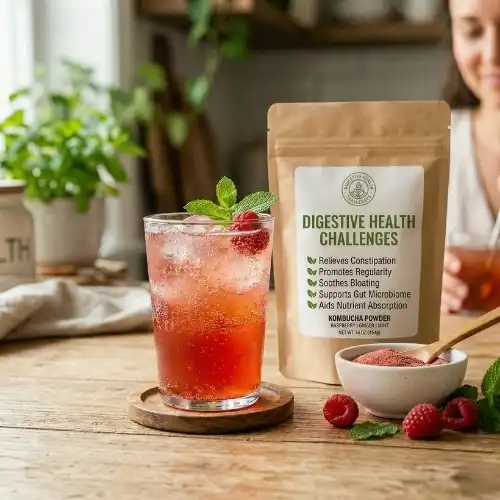
Understanding Constipation and Digestive Health Challenges
It is estimated that millions of individuals all over the world suffer from constipation, which means that there are enormous market opportunities for manufacturers of health goods. This disorder of the digestive tract may be brought on by a variety of factors, including as consuming inadequate quantities of fiber, not drinking enough water, having a sedentary lifestyle, and taking certain medications. In addition, the condition has a significant impact on the quality of life of individuals, which in turn increases the demand among consumers for treatments that are not only efficient but also natural.
Clinical Aspects of Constipation
According to the definitions provided by medical professionals, constipation is a condition that is related with bowel irregularity. Constipation is characterized by having less than three bowel movements per week and having difficulty passing stools. The issue expresses itself as stools that are difficult to pass because they are dry, hard, and tough to pass. This is because the colon takes in an excessive quantity of water from waste, which causes the stools to be difficult to pass. In addition to the aforementioned causes, there are a number of other factors that contribute to this digestive problem. A wide variety of factors, including hormonal imbalances and poor dietary habits, are responsible for these reasons.
Market Demand for Digestive Health Products
As consumers become more aware of the connection between gut health and overall wellness, the global market for digestive health continues to expand at a rapid rate. This is being driven by the increased awareness among consumers. As the manufacturing business continues to grow, there is a growing need for products that include natural compounds that are able to improve digestive function without generating any potential adverse effects. There is an increasing tendency among regulatory agencies all over the world to create more severe requirements for digestive health claims. These claims need considerable scientific data to back up the advantages of the product.
It is necessary for product producers to navigate complex regulatory settings while also meeting the expectations of customers for digestive aids that are not only effective but also safe. including natural ingredients that have been shown to be beneficial, such as fermented tea extracts, into formulations is a strategic method that may be utilized to win market share while simultaneously maintaining compliance with quickly evolving standards. This can be accomplished by including natural constituents into formulations.
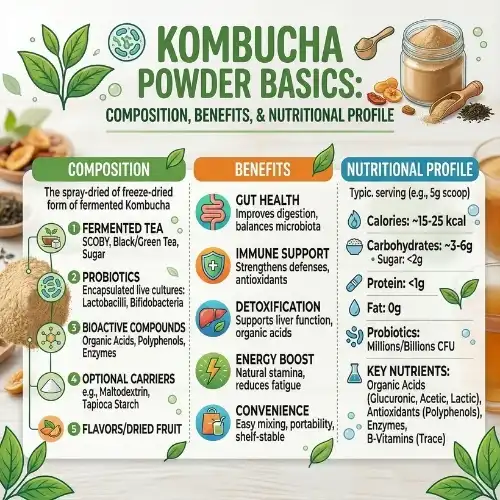
Kombucha Powder Basics: Composition, Benefits, and Nutritional Profile
An innovative approach of provide the health advantages that are typically associated with kombucha In a way that is both concentrated and stable, the use of fermented tea powder is a representation of this. During the process of dehydration, essential nutrients are kept, and issues about the alcohol content and the need for refrigeration that are linked with liquid versions are avoided.
Production Process and Active Compounds
Beginning with the fermentation of kombucha is the first step in the manufacturing process. using the traditional approach, which entails the use of SCOBY bacteria and tea that has been sweetened. After the fermentation process has produced the necessary quantity of probiotics, the liquid is next exposed to a dehydration procedure that is carried out with great care in order to preserve the beneficial bacteria, enzymes, and organic acids that existed in the starting liquid. This method not only leads in the formation of an ingredient that is shelf-stable and suitable for a wide range of product applications, but it also results in the concentration of the active components.
Kombucha powder has a wide variety of bioactive components that assist in maintaining digestive health. Lactic acid bacteria, acetic acid bacteria, helpful yeasts, B vitamins, vitamin C, and antioxidant chemicals generated from tea polyphenols are some of the organisms that are included in this category. Additionally, the concentration of these components in powder form often surpasses the amounts that are present in liquid kombucha.
Nutritional Profile and Functional Benefits
It is possible to get a significant number of probiotics from the dried fermented tea extract, which does not include the sugar that is often found in liquid forms. This extract cannot be consumed in liquid form. There are millions of active probiotic organisms included inside each gram of probiotics, which are useful to the health of the intestinal tract and the operation of the digestive system. Additionally, the presence of organic acid helps to keep the pH levels in the stomach at a healthy level, which in turn produces an environment that is conducive to the growth of bacteria that are helpful to the body.
Antioxidant compounds are included in the powder, and in addition to the aid they offer for the digestive system, they also provide further health benefits. In addition to enhancing the overall function of the immune system, these substances also assist in shielding intestinal cells from the potentially harmful effects of oxidative stress. Probiotics, organic acids, and antioxidants all work together to provide a synergistic effect, which ultimately results in a comprehensive approach to the health of the digestive tract.
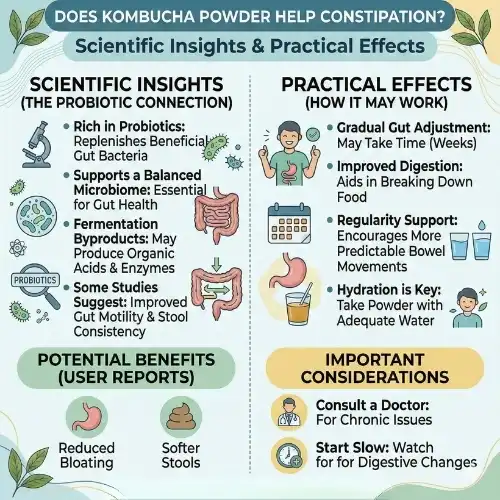
Does Kombucha Powder Help Constipation? Scientific Insights and Practical Effects
There have been a number of scientific studies that have shown that fermented tea products have the ability to effectively cure constipation via a range of various mechanisms. The inclusion of these probiotic strains in these products helps to restore a healthy microbiome balance in the gut, which is a crucial component in the process of guaranteeing regular bowel movements. These strains are included in these products.
Mechanisms of Action for Constipation Relief
Fermented tea extracts include probiotic microorganisms that are responsible for the production of short-chain fatty acids. These acids are crucial for softening the consistency of feces and are responsible for promoting intestinal peristalsis to occur. These beneficial microorganisms also compete with harmful bacteria for space in the intestinal system, which helps to decrease inflammation. Inflammation is a factor that may contribute to digestive issues, and these microorganisms assist to reduce inflammation. Organic acids are included in the powder, and these acids help to ensure that the digestive system maintains the optimum levels of pH. While these acids promote the growth of beneficial bacteria, they inhibit the development of species that are toxic to the digestive system.
In clinical studies that have studied the use of probiotic supplements for the treatment of constipation, there has been consistent evidence of improvements in both the frequency of bowel movements and the consistency of the stool. The use of probiotics on a regular basis, as shown by research that was published in journals that are dedicated to gastroenterology, has the potential to reduce the length of time it takes for stools to pass and the symptoms that are associated with functional constipation.
Safety Considerations and Quality Control
While fermented tea powders generally demonstrate excellent safety profiles, quality control measures are essential for ensuring consistent probiotic viability and absence of contaminants. Kombucha powder products must undergo rigorous testing to verify bacterial counts, identify potential pathogens, and confirm absence of harmful substances that could arise during fermentation.
The implementation of procedures for comprehensive quality assurance is something that manufacturers should do. These processes have to involve testing of the raw materials that are being received, monitoring of the manufacturing process, and analysis of the goods that are being produced. We ensure that every batch fulfills the criteria for the quantity of probiotics that it contains by taking these steps, and we also ensure that the safety standards that are essential for consumer products are maintained.
Selecting the Right Kombucha Powder for Your Business Needs
In order to choose the most suitable providers of fermented tea powder, it is necessary to carefully evaluate a number of variables that have an effect on the quality of the product, compliance with regulations, and the success of the company. In order to guarantee dependable sourcing, procurement teams are required to evaluate the skills of suppliers, product requirements, and quality management systems.
Quality Assessment Criteria
In order to pick providers of fermented tea powder, the following are the main quality factors that should be evaluated:
• Probiotic viability and count verification through third-party laboratory testing ensures products meet label claims and deliver expected health benefits
• Certification compliance including organic, non-GMO, kosher, and halal designations that align with target market requirements and regulatory standards
• Contamination testing protocols that screen for pathogenic bacteria, heavy metals, pesticide residues, and other potentially harmful substances
• Stability data documentation demonstrating product shelf life under various storage conditions and temperature ranges
Having trust in the skills of the supplier while simultaneously limiting the risks connected with product recalls or regulatory difficulties is the purpose of these quality indicators. It is possible to guarantee that the performance of the product is constant throughout all manufacturing batches by establishing unambiguous quality agreements with suppliers.
Supplier Reliability and Logistics Considerations
When it comes to the supply chain, reliability comprises not only the quality of the product by itself, but also the consistency of delivery, the management of inventory, and the capacity to provide help to consumers. Companies that supply products and services should have a number of characteristics, including a robust production capacity, backup inventory systems, and flexible logistics arrangements that are able to accommodate varying order quantities and delivery dates.
One of the components of successful supplier partnerships is the provision of technical support services. These services include aid with product integration, formulation guidance, and documentation of regulatory compliance. These value-added services not only strengthen the overall relationship with the supplier, but they also reduce the number of resources that are needed from the product development teams that are located inside the organization.

How to Integrate Kombucha Powder into Product Lines and Supply Chains?
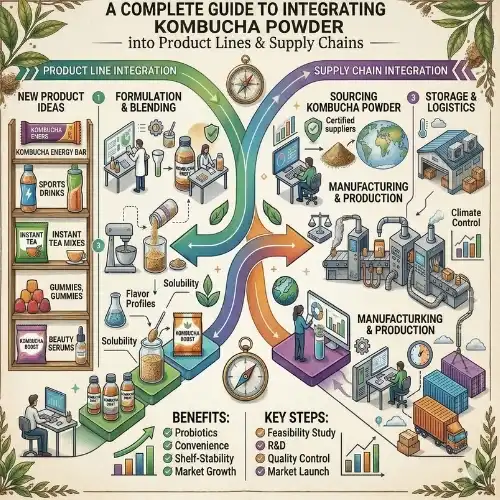
Additionally, in order to effectively incorporate fermented tea powder into existing product lines, it is vital to participate in strategic planning across a number of different operational domains. It is necessary for manufacturing teams to take into account formulation compatibility, processing requirements, and storage conditions in order to guarantee that the integrity of the ingredients is maintained throughout the production and distribution processes.
Formulation Considerations and Applications
Kombucha powder demonstrates excellent compatibility with various delivery formats including capsules, tablets, functional beverages, and food products. It is possible to easily include high-quality powder formulations into liquid goods without having to worry about settling or separation problems since these formulations are water-soluble. In order to produce the ideal taste profiles, it may be necessary to use masking agents or complimentary chemicals in order to take flavor into account.
At the same time as the required product attributes are being produced, it is essential that the viability of the probiotic be preserved throughout the production procedure. Because beneficial bacteria are more sensitive to heat than other types of bacteria, it is essential to maintain a high level of temperature control during the whole manufacturing process. Due to the fact that mixing, granulating, and packing are operations that have the ability to impact the survival rates of organisms, it is imperative that special attention be given to these activities.
Storage and Transportation Requirements
It is necessary to store probiotics in the optimal conditions in order to maintain their efficacy throughout the supply chain. This will ensure that the effectiveness of the treatment is not compromised. It is necessary to keep the powder in settings that are cold, dry, and with humidity levels that are controlled in order to prevent the powder from collecting moisture, which might put the bacteria's ability to survive in jeopardy. The criteria for the packaging should include moisture barriers and oxygen scavengers wherever they are applicable. This will allow the product to have a longer shelf life from the time it is manufactured until it is consumed.
During the shipping process, it is essential for protocols to take into account variations in temperature as well as techniques of handling that protect the integrity of the items. It is possible that the needs for the cold chain may change depending on the specific probiotic strains and stabilization strategies that are used during the manufacturing process. Being able to ensure that the product is of excellent quality from the point of production all the way to the end user is made easier by having defined standards for handling.
Conclusion
Kombucha powder offers significant potential for addressing constipation through its concentrated probiotic content and organic acid profile. The scientific evidence supporting fermented tea products for digestive health continues growing, with clinical studies demonstrating measurable improvements in bowel function and gut microbiome balance. For manufacturers seeking natural ingredients that deliver proven health benefits, fermented tea powder represents an innovative solution that meets consumer demand while providing supply chain advantages over liquid alternatives.
Partner with Yangge for Premium Kombucha Powder Solutions
With our excellent kombucha, Yangge Biotech Co., Ltd. is prepared to assist you in developing cardiovascular health products. powder formulations. Our USP-grade, 100% water-soluble powder offers concentrated SCOBY advantages in a stable, brown-yellow powder structure while retaining unique kombucha flavor characteristics. Our goods satisfy a variety of market demands and guarantee 12-month shelf stability thanks to extensive certifications including Kosher, Halal, and non-GMO status.
Our experienced team provides technical support throughout your product development journey, from initial formulation guidance to scale-up assistance. With 1-ton inventory availability and 25KG packaging options, we accommodate both prototype development and commercial production needs. Contact our specialists at info@yanggebiotech.com to discuss your specific requirements and discover why leading manufacturers choose Yangge as their trusted kombucha powder supplier for innovative health product solutions.
FAQ
Q: Can we get some samples to test before purchasing?
A: Of course, we can provide free samples of 20 to 100 grams, but the shipping cost is at the customer's expense. The shipping cost can be deducted from the next order, or the samples can be sent through your courier account.
Q: Do your products have relevant certifications?
A: Yes, our products are certified for HALAL, ISO, HACCP, Kosher, and other certifications.
Q: What is the minimum order quantity (MOQ)?
A: Small batches of samples can be customized according to your requirements.
Q: Do you offer OEM and ODM services? Can the formula be customized based on our own?
A: Of course, we provide ODM and OEM services to many customers. Our product range includes softgels, capsules, tablets, sachets, granules, and private label services. Simply contact us and let us know your requirements. Our experienced R&D team can also develop new products with specific formulas.
Please contact us to design your own branded products.
Q: How do you handle quality complaints?
A: First, we have a comprehensive quality control SOP. We provide authoritative third-party inspection reports for almost all products before shipment to minimize the possibility of quality issues. Second, we have a comprehensive return and exchange procedure. If there is a genuine quality dispute, we will strictly follow the SOP.
Q: How do you ship? How long does delivery take?
A: For small orders, we typically use DHL, UPS, EMS, FedEx, or TNT. Delivery typically takes 3-7 days. We also offer air and sea freight services. We have a strong freight forwarding team and can provide you with a one-stop service, including DDP and DDU.
Q: What are your payment terms?
A: 100% prepayment, payable by T/T, Western Union, MoneyGram, or PayPal.
Q: What is the shelf life of your products?
A: 2 years with proper storage.
Q: Is the packaging environmentally friendly?
A: We attach great importance to environmental protection and are constantly improving our product packaging. Some products are packaged in recyclable paper. Packaging materials are carefully selected to ensure product safety during transportation and storage, and to minimize environmental impact. We are committed to achieving a balance between environmental friendliness and practicality in our product packaging, and to contributing to sustainable development.
References
1. Marco, M.L., Sanders, M.E., Gänzle, M., et al. "The International Scientific Association for Probiotics and Prebiotics consensus statement on the scope and appropriate use of the term probiotic." Nature Reviews Gastroenterology & Hepatology, 2017.
2. Ford, A.C., Quigley, E.M., Lacy, B.E., et al. "Efficacy of prebiotics, probiotics, and synbiotics in irritable bowel syndrome and chronic idiopathic constipation: systematic review and meta-analysis." American Journal of Gastroenterology, 2014.
3. Dimidi, E., Christodoulides, S., Scott, S.M., Whelan, K. "Mechanisms of action of probiotics and the gastrointestinal microbiota on gut motility and constipation." Advances in Nutrition, 2017.
4. Jayabalan, R., Malbaša, R.V., Lončar, E.S., et al. "A review on kombucha tea-microbiology, composition, fermentation, beneficial effects, toxicity, and tea fungus." Comprehensive Reviews in Food Science and Food Safety, 2014.
5. Villarreal-Soto, S.A., Beaufort, S., Bouajila, J., et al. "Understanding kombucha tea fermentation: A review." Journal of Food Science, 2018.
6. Martínez Leal, J., Valenzuela Suárez, L., Jayabalan, R., et al. "A review on health benefits of kombucha nutritional compounds and metabolites." CyTA - Journal of Food, 2018.

Based on your location and order quantity, you will have the opportunity to receive a limited time free shipping promotion!

Who we are
Popular Blogs