Common food products that use vegetable black E153
Vegetable carbon formally listed as E153 is a jet-black powder produced by carbonizing coconut shells or bamboo under controlled heat. It carries no taste, no odor, and it will not dissolve in water or organic solvents. Food manufacturers across bakery, confectionery, dairy, and plant-based categories rely on it as a clean-label black colorant. Because it comes entirely from plant material, it supports "natural ingredient" labeling in ways that synthetic dyes cannot. This guide walks through where E153 is used, why it matters for procurement, and how to source it responsibly.Contact us at info@yanggebiotech.com to learn more about products.

What Is Vegetable Black E153 and How Is It Made
Origin and Chemical Nature
Materials made from plants, like bamboo or coconut shells, are heated in a low-oxygen area until only a stable carbon structure is left. This is how E153 veggie black is made. Fine, smellless black powder is what you're left with. It's very opaque and can be used to make strong colors. The INS number for it is E153, which is accepted by systems around the world that identify food additives. The stuff that Yangge makes is made from bamboo and coconut shells. It has been tested by HPLC and is KOSHER/USP grade.
How It Differs from Activated Charcoal and Other Carbon Blacks
| Property | Vegetable Black E153 | Activated Charcoal | Industrial Carbon Black |
|---|---|---|---|
| Raw material | Coconut shell / Bamboo | Wood, coconut shell | Petroleum residues |
| Food-grade | Yes | Conditional | No |
| Adsorption activity | Low | High | Not applicable |
| Suitable for labeling | "Natural color (E153)" | Limited | Not permitted |
Regulatory Standing
The European Food Safety Authority (EFSA) looked at E153 and says that it can be used in some EU foods. Like, in the US, the FDA says it's not a color additive if it comes from animals or plants. Anyone who wants to buy should check the local rules first, as the kinds of things that are allowed vary from place to place.

Common Food Products That Use Vegetable Black E153
Bakery and Bread Products
In 2012, Burger King Japan sold its first black burger buns. Specialty bakers in North America and Europe quickly started using them. The dough has even amounts of E153, and the color doesn't change in the oven, so the crumb is always a deep black color. This dye is also used to add color to crackers, waffle cones, and buns with a charcoal theme.
Ice Cream, Dairy, and Beverages
There is always black soft serve and black ice cream in high-end treat shops. It's easy for vegetable carbon, also known as plant carbon black, to mix into fat-based matrices, which makes the color smooth and not grainy. It's in bubble tea, black lemonade, and charcoal coffee, among other things. The dose rate changes the shade color. Tones range from gray to charcoal when the rate is low, and a real deep black when the rate is high.
| Food Category | Typical Application | Key Formulation Note |
|---|---|---|
| Bread & buns | Black burger buns, crackers | Mix with dry flour first |
| Ice cream | Black soft-serve, gelato | Disperse in fat phase |
| Beverages | Charcoal latte, black lemonade | Pre-disperse in carrier |
| Confectionery | Dark chocolates, hard candy shells | Low moisture system preferred |
| Plant-based foods | Black sausage casings, vegan cheese rind | pH-stable across 4–8 range |
Confectionery and Plant-Based Foods
On top of dark chocolate, hard candy shells, and chewy shapes, E153 is used to make things look very different. For shoppers who care about clean labels, this supports the use of "natural ingredient" claims on plant-based foods like vegan sausage casings, nut-based cheese rinds, and veggie burgers. Since E153 comes from plants, it can be called both Halal and Kosher. This makes it more appealing to people all over the world.

Benefits and Safety Considerations of Using Plant Carbon in Food
Functional Advantages Over Synthetic Dyes
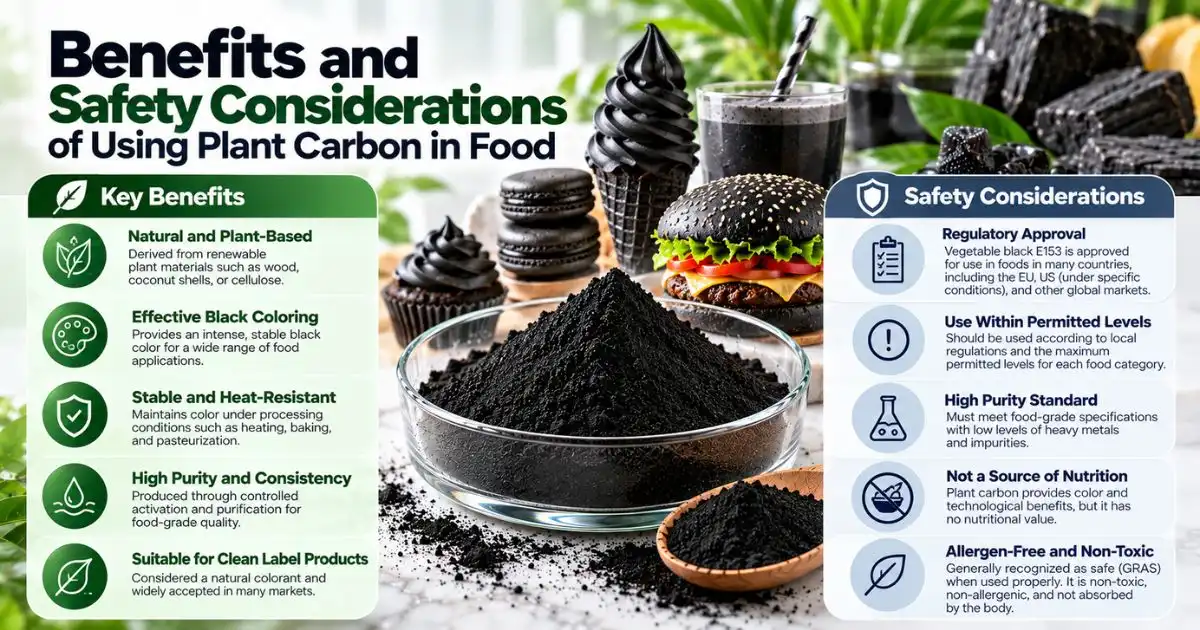
You can use plant carbon black instead of synthetic black dyes like Brilliant Black BN (E151), which helps with clean-label reformulation right away. It doesn't bleed into other layers of the product and stays stable at pH levels between 4 and 8. Because of these traits, batches are less likely to be different from one another, and manufacturers can keep the look of their goods the same over time.
Safety Standards and Quality Assurance
Heavy metals like arsenic and lead, as well as polycyclic aromatic hydrocarbons (PAHs), are the main safety concerns with carbon-based colorants. Suppliers with a good name check each batch against FDA and EU rules before sending it out. Yangge's Vegetable carbon Black E153 is FDA, Halal, and Kosher approved, and it is checked by international labs before each release. If you keep pigments in a cool, dry place away from water, they will stay whole for as long as they are on the shelf.
Clean-Label and Vegan Labeling Benefits
These claims can be backed up by E153, which only comes from plants like bamboo or coconut shell. For example, "colored with vegetable carbon" or "natural color." A report by FMCG Gurus in 2023 found that 68% of U.S. customers actively seek goods with natural colorants. This is in line with what people want. Some black dyes come from animals, but E153 doesn't. It can be used in vegan and plant-based products.
How to Choose the Right Vegetable Carbon Supplier
Key Certifications to Verify
A company that sells vegetable carbon that is safe for food should be registered with the FDA, have Halal and Kosher certifications, be in line with ISO standards, and be under HACCP. Having these credentials shows that the factory follows strict rules and the product is as pure as it can be. Each batch is given a Certificate of Analysis (COA), which means that Yangge Biotech has all of these.
Evaluating Product Consistency and Grade
Many people who make products worry about making sure that the colors are the same from one batch to the next. This is because even small changes in the tinting strength need to be reformulated. Before you choose a provider, you should get details on the E color difference for at least three production batches in a row. Check how the particle sizes are spread out. It is easier for smaller particles to spread out in water-based and emulsified systems. You must be able to tell the difference between industrial grade and food grade; always ask for proof, not just a promise.
Assessing Supply Reliability
It's important to have stock on hand. Five tons of Vegetable carbon Black E153 are in stock at Yangge right now. They ship FOB/CIF, and the least you can order is 1 ton. Get free samples (10–30g) to test and learn more about the product before you buy it. This makes creation a lot less risky, especially during the pilot-batch process, when it's still important to make sure the color will work in different pH environments.

Procurement Tips and Best Practices for E153 Buyers
You need to know more than just where to buy something. You also need to know how to make the best purchase. There are a few main steps that experienced buying managers take when they want to find this ingredient:
- Request the COA and lab reports first. Before any pricing discussion, ask for the Certificate of Analysis, heavy metal test results (arsenic, lead), and PAH screening data. This single step screens out non-compliant suppliers immediately.
- Order a free sample for formulation trials. Testing 10–30g in your actual recipe not a generic dispersibility test tells you whether the color performance matches your label claims and product specs. Yangge provides this at no charge.
- Confirm regulatory scope for your target market. E153 is approved in the EU for specific food categories; U.S. rules differ. Your QA team should confirm approved uses before finalizing any formulation.
- Negotiate batch consistency guarantees into the contract. Ask for a maximum allowable ΔE value between shipments, and request that the supplier include color data in each delivery's COA.
Get a free taste of the mix to try it out. Using 10–30g in your own recipe, not a general dispersibility test, will tell you if the color works the way it says on the label and in the product specs. This is free from Yangge.– Look into the rules that apply to the people you want to sell to. Not all foods can have E153 in the EU. In the US, the rules are different. Your QA team should make sure that any formula can be used for the right things before it is set in stone.

Conclusion
Vegetable Black E153, or vegetable carbon, fills a genuine gap in food manufacturing: a plant-derived, clean-label black colorant with heat stability, broad pH tolerance, and full certification compliance. From black burger buns to charcoal ice cream and plant-based sausage casings, the applications are real, growing, and commercially proven.
Selecting a supplier who provides third-party lab data, consistent batch color values, and recognized certifications protects both product quality and regulatory standing. Yangge Biotech's E153 meets these benchmarks, and the 5-ton stock position means lead times stay short even for urgent production runs.
FAQ
Is Vegetable Black E153 safe for all food categories?
E153 is approved for specific food categories — not blanket use across all foods. In the EU, EFSA permits it in categories including confectionery, edible cheese rinds, and certain alcoholic beverages. In the U.S., it falls under exempt color additives when plant-derived. Always confirm the approved categories for your specific market with a regulatory specialist before finalizing any formulation.
How is E153 different from activated charcoal used in detox products?
Activated charcoal has a highly porous structure that actively adsorbs substances including medications and nutrients in the digestive tract. E153 is produced for coloring only and does not carry that adsorption activity. Using activated charcoal as a food colorant is not equivalent and raises different safety and labeling considerations.
Is Vegetable Carbon Black suitable for vegan and Halal-certified products?
Yes. Because E153 is derived entirely from plant sources such as coconut shell and bamboo, it contains no animal inputs. Yangge's product holds both Halal and Kosher certification, making it suitable for vegan, Halal, and Kosher-certified product lines.
What is the typical dosage range to achieve a true black color?
Dosage depends on the food matrix and desired shade. Lower rates produce grey-to-charcoal tones; higher rates approach a deep black. Testing in your specific formulation using a 10–30g sample is the most reliable way to determine the exact dosage for your product.
Request Your Free Sample of Yangge Vegetable Carbon Black E153
E153 can't be used on all foods; it can only be used on some types. Some foods and drinks in the EU are okay with it, like candy, cheese rinds that you can eat, and some alcoholic drinks. In the U.S., if it comes from plants, it is not taxed as a spice. Always check with a lawyer before finishing any formulation to make sure that the categories you want to sell are legal in your market. Contact us at info@yanggebiotech.com to learn more about products.
References
1. European Food Safety Authority (EFSA). Re-evaluation of vegetable carbon (E 153) as a food additive. EFSA Journal, 2012.
2. U.S. Food and Drug Administration. Color Additives Exempt from Certification. Code of Federal Regulations Title 21, Part 73, 2023.
3. FMCG Gurus. Natural Ingredients and Clean Label Trends: U.S. Consumer Survey Report. 2023.
4. Downham, A., & Collins, P. Colouring our foods in the last and next millennium. International Journal of Food Science & Technology, 2000.
5. Rymbai, H., Sharma, R. R., & Srivastav, M. Biocolorants and its implications in health and food quality. International Journal of PharmTech Research, 2011.
6. Codex Alimentarius Commission. General Standard for Food Additives (GSFA): INS 153 Vegetable Carbon. FAO/WHO, 2019.

Based on your location and order quantity, you will have the opportunity to receive a limited time free shipping promotion!
Who we are
Popular Blogs