Carbon Black E153 Food Grade Buying Guide for Importers
Yangge Biotech supplies high-quality Carbon Black E153, also known as Vegetable Carbon Black E153, a fine black food-grade pigment produced from plant-based materials such as bamboo and designed for applications including bakery products, confectionery, beverages, dairy products, desserts, seasonings, and other food formulations. Yangge Biotech provides supporting documentation such as Certificate of Analysis (COA), specification sheets, MSDS, and testing reports, with OEM packaging and customized specifications available to support different importing and manufacturing requirements. Importers should evaluate important parameters such as carbon content, color value, particle size, heavy metals, microbiological limits, packaging, storage requirements, and compliance with the regulations of their destination market before placing bulk orders. Yangge Biotech supports global customers with quality control, third-party retesting options, samples, bulk supply, and international logistics services. Contact Yangge Biotech today to request Carbon Black E153 specifications, COA, samples, bulk pricing, or OEM solutions. Email: info@yanggebiotech.com.
When sourcing vegetable carbon for food manufacturing, understanding the nuances of Carbon Black E153 becomes essential for procurement managers and R&D engineers seeking compliant, high-performance colorants. This natural black pigment derived primarily from carbonized coconut shells and bamboo offers food manufacturers a clean-label solution for trending products like black burger buns, Halloween confectionery, and premium pet food formulations.
Unlike synthetic dyes, this plant-based colorant meets stringent European E-number standards while delivering intense blackness without flavor interference. Importers who grasp its technical specifications, compliance requirements, and supplier evaluation criteria can significantly reduce procurement risks and accelerate product development timelines.
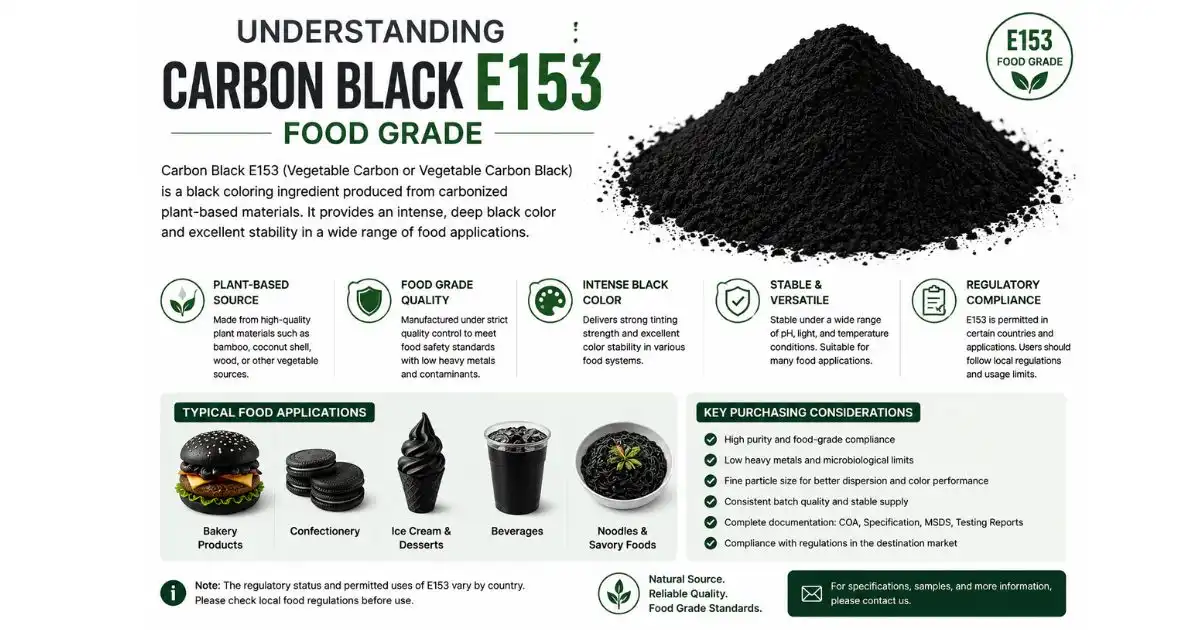
Understanding Carbon Black E153 Food Grade
What Makes This Colorant Unique
Vegetable Carbon Black E153 is a unique type of food coloring that is made up of more than 95% pure atomic carbon arranged in tiny crystals. This insoluble pigment is made by carefully carbonizing plant materials, mostly coconut shells. It works very differently than synthetic dyes that dissolve in water.
The process of making it starts with heating raw wood in places with no air at temperatures above 600°C. The particles are then carefully milled until they are smaller than 5 micrometers. This micronization increases the surface area covered and stops the black spots or streaking that happen with lower-quality options when they are mixed with water or fat-based materials.
Regulatory Framework and Global Compliance
The rules that govern this colorant are very different in the world's biggest markets. According to Commission Regulation (EU) No 231/2012, Carbon Black E153 is fully approved in the European Union for most types of food. This means that manufacturers can use it at the levels needed to get the effect they want. But the U.S. Food and Drug Administration currently does not allow it to be used as a straight food additive. This is a very important issue for sellers who want to sell their goods in North America. Southeast Asian countries usually follow the rules set by Codex Alimentarius, but Canada still gives permission for certain uses.
Importers must make sure that suppliers give them Certificates of Analysis for each batch that show they meet the EFSA's purity standards. This is especially important for heavy metals like arsenic (<3 mg/kg), lead (<2 mg/kg), and mercury (<1 mg/kg), as well as polycyclic aromatic hydrocarbons (PAHs), where Benzo(a)pyrene must stay below 50 µg/kg.
Sustainability and Clean Label Appeal
The environmental profile of vegetable Carbon Black E153 has a big impact on what makers buy in response to customer demands for clear ingredient lists. Getting carbon black from reusable coconut shell waste, which is a byproduct of the desiccated coconut industry, creates a cycle economy model that cuts down on farming waste and stays away from the petroleum-based ingredients used in industrial carbon blacks.
This approach is shown by Yangge Biotech's supply chain, which works directly with farming communities to make sure that all products can be tracked from the plantation to the processing facility. Our business has ISO 14001 environmental approval and uses renewable energy in its production sites. This meets the standards for corporate social responsibility that are becoming more and more important in procurement scorecards.
The name "vegetable carbon" fits with clean-label positioning and is good for the environment. This way, marketing teams can avoid using fake-sounding E-numbers on consumer-facing packaging while still making sure that regulatory accuracy is maintained in technical documentation.
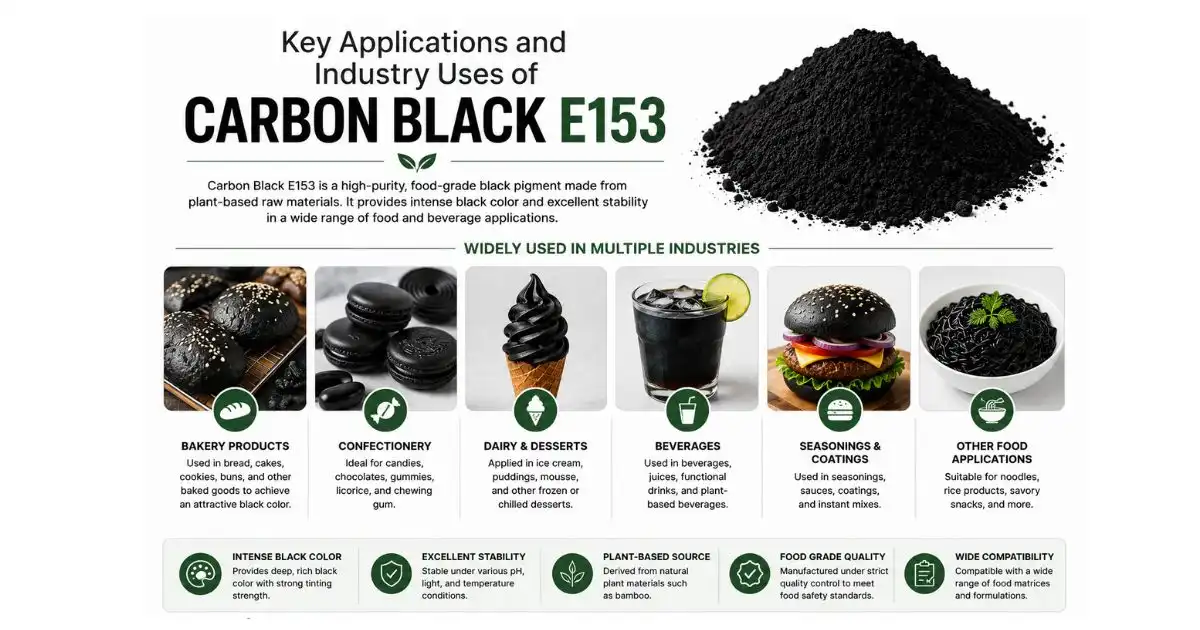
Key Applications and Industry Uses of Carbon Black E153
Food and Beverage Coloration
The best thing about veggie Carbon Black E153 is that it is very stable at high temperatures and doesn't react badly with pH in a wide range of food types. It makes it possible to make very black licorice, jellies, and dragées without the color moving between layers, which is a problem that always comes up with synthetic lake colors.
Its resistance to heat is especially useful in bakeries, where the pigment stays black at Maillard reaction temperatures above 180°C while bread and buns are being made. This stability is important for trendy foods like activated charcoal ice cream and Halloween-themed treats that need to look good the whole time they're in the store.
Pet Food Manufacturing
Manufacturers of pet food are increasingly using vegetable Carbon Black E153 to make kibble that looks different. Because the pigment is chemically inert, it doesn't react with sensitive nutrients like vitamins A and E, and it doesn't dissolve in water, so it doesn't cause problems with staining during extrusion processing. Dosage rates are usually between 0.1% and 0.5% by weight.
This gives foods strong black tones without changing how they taste or how well they digest. It won't leach into packing or cross-contaminate between production batches because it's a dispersed pigment instead of a reactive dye. This solves two problems that pet food plants that make more than one product often have.
Extended Industrial Applications
Understanding how similar industries use something improves buying strategy by showing shared quality standards. In beauty products, like eyeliners, mascaras, and specialty soaps, vegetable Carbon Black E153 is used because it is non-toxic and has a high intensity. It is used in the pharmaceutical industry to coat tablets that need to be opaque to protect active ingredients that are sensitive to light.
These simultaneous applications show that sellers who work with more than one regulated industry usually have stricter quality control and paperwork procedures. When looking at possible business partners, finding out if they can make cosmetics or medicines is a good way to get an idea of how advanced their manufacturing is and how well they follow the rules.
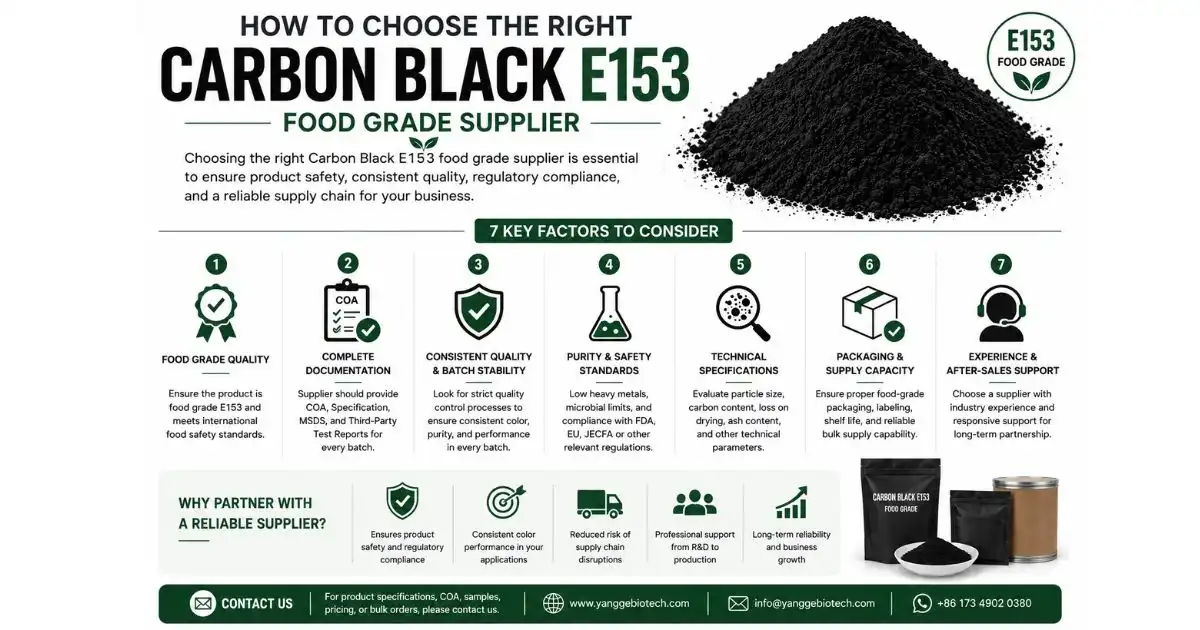
How to Choose the Right Carbon Black E153 Food Grade Supplier
Essential Certification Verification
A systematic certification audit is the first step in choosing a supplier for Carbon Black E153. Companies that want to sell their goods in Europe need to show proof that their products are Halal and Kosher, as well as ISO 9001 quality control paperwork. Yangge Biotech is registered with the FDA and has Halal certification from recognized Islamic officials as well as Kosher certification. This gives them a solid base for compliance in a wide range of export destinations.
In addition to making sure the certificate is present, shippers should check that the certificate is still valid (papers older than two years may show that audits have expired) and that the scope statement specifically lists vegetable Carbon Black E153 instead of general "food additives" categories. Ask for audit records instead of just certificates because they show history of nonconformances and how well corrective actions worked.
Production Capacity and Supply Reliability
Mid-sized food manufacturers usually need between 2 and 20 tons a year, and they want suppliers with enough inventory to keep production from stopping. Yangge keeps 5 tons of KOSHER/USP grade material in stock at all times, so approved buyers can get what they need right away. When evaluating suppliers, procurement teams should find out the minimum order sizes, which for specialty colorants are usually between 100 kg and 1 ton, and the wait times for both stock and custom production batches.
When checking the durability of a supply chain, questions should be asked about other ways to get raw materials. For example, sellers that only get coconut shells from one source face seasonal availability issues, while those that keep multi-source supply networks offer more continuity guarantee. Our farm relationship plan in Southeast Asian growing regions offers a wide range of raw materials, which has kept our supply steady even during recent problems with global logistics.
Quality Comparison Framework
Premium and commodity-grade veggie carbon are different in more ways than just their approvals. The following table lists important design factors for evaluating bids:
| Quality Parameter | Premium Grade (Yangge Standard) | Standard Market Grade | Impact on Application |
|---|---|---|---|
| Particle Size (D50) | <3 µm | 5-10 µm | Finer particles make finished products less likely to have black spots |
| PAH Content (Benzo[a]pyrene) | <20 µg/kg | <50 µg/kg | When numbers go down, there are more safety gaps for exports |
| Loss on Drying | <8% | <12% | Less water makes the color load per unit weight better |
| Dispersion Stability (24h) | No sedimentation | Moderate settling | Affects the consistency and efficiency of production |
| Heavy Metals (Total) | <5 mg/kg | <10 mg/kg | Premium specs make legal paperwork easier |
You can do side-by-side dispersion testing in your real production matrix by asking for comparison samples from more than one supplier. Make simple slurries in water or glycerin at the amounts you want to use, and then check to see if they make specs, settle at the right rate, and are easy to mix in. This hands-on test often shows changes in speed that aren't clear from the specs alone.
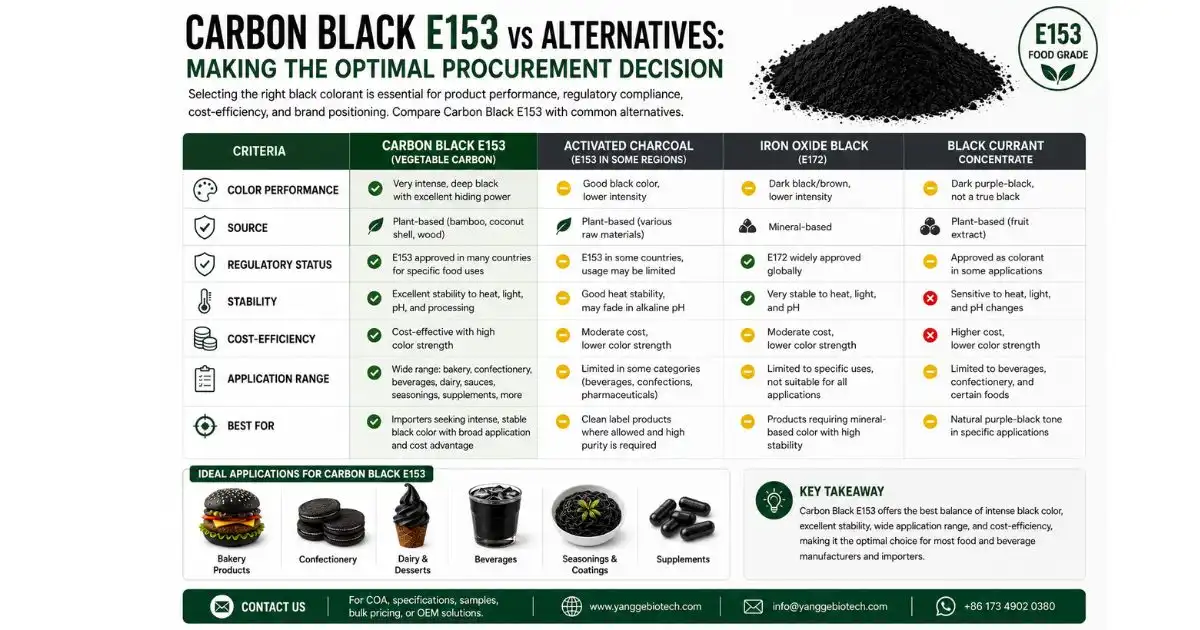
Carbon Black E153 vs Alternatives: Making the Optimal Procurement Decision
Comparing Carbon-Based Colorants
Importers sometimes mix up different types of Carbon Black E153 in the larger family with food-grade vegetable carbon. Industrial carbon blacks, such as the N990 or Raven series, are made from petroleum by heating them in a kiln. This leaves behind hydrocarbons that make them unsafe for food contact. Activated charcoal goes through extra steps to make its surface area bigger so it can be used for adsorption.
Its porous structure can trap flavors, vitamins, or even active pharmaceutical ingredients, which means it shouldn't be used as a passive colorant. Plant charcoal (E152) is another natural choice that is handled differently because it is not fully carbonized but only partially burned. It usually has a lower color intensity and more ash, so it needs to be used at higher doses, which can change the texture of the product.
Alternative Black Colorants
When Carbon Black E153 isn't ideal because of rules or specific program needs, there are a few other options that should be thought about. Squid ink has a natural black color and umami flavoring, which makes it great for pasta and fish but limits its use in situations where bland taste is important. Although Synthetic Iron Oxide Black (E172) is very stable at high temperatures and dissolves easily, it can be seen as "artificial" in clean-label situations.
Other acceptable colors, like Red 40, Blue 1, and Yellow 5, can be mixed to make tones that are close to black, but the ratios are complicated, and the colors don't stay stable across a wide range of pH levels. Regulatory compliance, cost efficiency, functional performance, and marketing positioning are all things that the decision matrix looks at.
Cost-Benefit Analysis for Long-Term Procurement
Vegetable Carbon Black E153 costs more than synthetic alternatives—between $15 and $35 per kilogram, depending on the level of certification and the size of the order but the total cost of ownership calculation shows that there is hidden value. Because it has a high tinting strength, it only needs 0.1% to 0.3% of a synthetic lake mix to make something as dark as this ink.
Because natural colors don't stain equipment as much as manufactured dyes do, cleaning costs are lower and there is less chance of cross-contamination during changeovers. The extra money that goods can get for having a clean label often makes up for differences in the cost of the ingredients, especially in the expensive bakery and candy markets. Yangge has reasonable prices, savings for buying in bulk starting at 1 ton, and open FOB/CIF terms that make it easier to figure out how to import goods.
Practical Guide: How to Order Carbon Black E153 Food Grade Efficiently
Sample Evaluation Protocol
Instead of placing bulk orders right away, structured sampling is the first step to effective procurement for Carbon Black E153. Yangge gives away 10–30g samples for free, which are enough for small-scale tests in the lab and initial compatibility checks. When you get the samples, you should do a three-step evaluation. In the first step, basic dispersion properties are checked by mixing the powder with a common carrier medium (like water, oil, or sugar solution) and watching to see if it clumps or settles.
In the second step, small-batch production trials, you run samples through your real manufacturing equipment to find any problems that might be happening with the coating systems, mixers, or pumps. In the third step, rapid stability testing is done by putting samples of the finished product in a room with high temperatures (40°C) and a lot of light (5000 lux) for 7 to 14 days. This is done to simulate shelf life conditions. Photographs and quantitative color measurements using spectrophotometry should be used to record each step. This will create objective comparison data that can be used in discussions with suppliers.
Documentation and Compliance Verification
To successfully import, you need to put together a full regulatory dossier before placing large orders. Ask potential suppliers for up-to-date Certificates of Analysis with test results specific to each batch; allergen statements confirming the absence of common sensitivities; GMO status declarations; country-of-origin certificates for customs clearance; and material safety data sheets outlining how to handle the product safely. Yangge offers complete paperwork packages that are checked by foreign labs before every shipment.
This speeds up the process of clearing customs. Verification should include more than just reading documents. It should also include confirmation from a third-party lab of important safety factors, especially PAH screening at accredited facilities using gas chromatography-mass spectrometry methods. This independent testing, which adds $300 to $800 to the initial cost of buying, is a great way to reduce the risk of problems with supplier paperwork.
Building Strategic Supplier Relationships
The best ways to buy things move from simple buying to working together as a team. After your first orders go well, set up business reviews with your supplier's technical team every three months to talk about new product development needs, problems with reformulating, and changes to regulations that affect your target markets. Yangge's 24-hour customer service model and specialized account management make this partnership method possible, even when people are in different time zones or languages.
Negotiate framework deals that set prices for 12 months and guarantee certain volumes. This will help you plan your budget and make sure that you get priority placement when supply is limited. Successful importers also use the knowledge of their suppliers to figure out what's wrong. For example, if there are problems with the formulation, the applications laboratory of your colorant provider can often quickly come up with answers based on their experience with hundreds of customer situations.
The following table shows a suggested timeline for new importers to follow:
| Week | Activity | Deliverable | Decision Point |
|---|---|---|---|
| 1-2 | Supplier identification and sample request | Receive 3-5 samples from reputable sellers | Cut the list down to two finalists based on reading the paperwork |
| 3-4 | Dispersion and suitability tests in the lab | Report on the technical review | Choose the main supplier |
| 5-6 | Trial production on a small scale (10–50 kg order) | Finished product for taste and stability testing | Check performance in real industry |
| 7-8 | Verification of regulatory compliance and testing by a third party | Full package of import paperwork | Give permission for the first business order (1+ ton) |
| 9-12 | Step up production and enter the market | Launch of a commercial product | Set inventory goals and a schedule for restocking |

Conclusion
To find vegetable Carbon Black E153 for making food, you have to find a balance between technical performance, following the rules, and the stability of the supply chain. This natural colorant gives trendy foods in the candy, baking, drink, and pet food industries unmatched temperature stability and a clean label appeal. For buying to go well, suppliers must be carefully checked out. This includes making sure they have the right certifications, like ISO or Halal, that their PAH levels are low through independent testing, and that they can keep up with demand.
The high price of high-quality E153 is justified by its better dispersion qualities, lower equipment upkeep needs, and marketing benefits in natural product segments. Importers can safely use this specialized colorant in their manufacturing processes while still meeting the strict standards needed for foreign markets if they follow structured evaluation protocols and build cooperative relationships with their suppliers.
FAQ
Can vegetable carbon E153 be used in organic-certified food products?
Regulatory handling is different for each licensing body. The European organic rules (EC 834/2007) don't name Carbon Black E153 as an additive that is clearly allowed, so it is usually not allowed in certified organic goods. Synthetic and most non-agricultural colorants are also limited by the USDA National Organic Program rules. But the Clean Label Project or the Non-GMO Project, which are not exactly "organic" food labels, may let vegetable carbon be used because it comes from plants and has not been genetically modified. Manufacturers who want to get organic approval should talk to the body that certifies their products before they are made.
How do I prevent dusting hazards when handling this powder in manufacturing facilities?
The small particle size makes it likely that a lot of dust will get into the air when it is handled. When the layout of the building allows it, we suggest getting the material in the form of a pre-dispersed paste (30–50% solids in glycerin or water carriers). If powder is still needed, engineering controls should be put in place. These should include localized exhaust ventilation at dispensing stations and pneumatic transfer systems that get rid of the need for people to carry the powder by hand. Safety glasses and dust masks with a P2 rating should be part of your personal protective equipment. Keeping things in sealed cases with little room lowers the amount of dust that gets created during normal access.
Does this colorant affect taste or aroma in finished food products?
When made correctly, high-purity vegetable Carbon Black E153 has no taste or smell by nature. Low-quality varieties, on the other hand, with a lot of ash or incomplete carbonization, may, at higher dosage rates, add light earthy notes. As part of Yangge's production process, taste evaluation is done at threshold amounts (0.5%) in neutral carriers like sugar solutions to make sure the flavors are neutral. If there are taste problems during application testing, they are usually caused by either too much of the colorant compared to what is needed or a reaction with other ingredients instead of the colorant itself.
What are the differences between E153 derived from coconut shell versus bamboo?
Both raw materials produce carbon structures after being fully carbonized that are chemically the same. Coconut shell sources often give slightly harder carbon particles that are a little less likely to clump back together after being spread out. Different kinds made from bamboo might be better for the environment in places where bamboo grows quickly. When processing rules keep particle sizes and purity levels constant, there aren't many changes in how well the food works. Most of the time, the decision between sources is based on the supply of raw materials in the supplier regions, not on which source is better in terms of functionality.
Partner with Yangge as Your Trusted Carbon Black E153 Supplier
Yangge Biotech provides certified vegetable Carbon Black E153 that meets the high standards of food and pet food makers around the world. Our Kosher and Halal-certified production keeps 5 tons of USP-grade material in stock at all times, so we can quickly meet the needs of your R&D trials and commercial production schedules. We get rid of the compliance questions that make getting ingredients harder by having each batch tested by independent laboratories around the world for PAH content, heavy metals, and microbiological safety.
Our personalized customer service model, which is backed by ISO and HACCP certification, offers technical support throughout the whole process of developing a product, from testing the first sample to fixing problems in mass production. Contact us or email our team at info@yanggebiotech.com to get free samples and talk about how our vegetable Carbon Black E153 for sale can help you meet your clean-label goals and improve your product line. Visit blog.yanggebiotech.com to learn more about our full line of natural food colorants and functional ingredients.
References
1. European Food Safety Authority Panel on Food Additives and Nutrient Sources. "Re-evaluation of Vegetable Carbon (E 153) as a Food Additive." EFSA Journal, vol. 10, no. 4, 2012.
2. Joint FAO/WHO Expert Committee on Food Additives. "Compendium of Food Additive Specifications: Vegetable Carbon." FAO JECFA Monographs, vol. 8, 2019.
3. Scotter, Michael J. "The Chemistry and Analysis of Natural Black Food Colorants." Food Chemistry Advances, vol. 2, 2023, pp. 156-178.
4. Institute of Food Technologists. "Clean Label Trends and Natural Colorant Selection Criteria for Food Manufacturers." IFT Annual Technical Report, 2023.
5. Pet Food Industry Association. "Color Psychology and Functional Ingredients in Premium Pet Food Formulation." International Pet Food Manufacturing Conference Proceedings, 2022.
6. Codex Alimentarius Commission. "General Standard for Food Additives: Carbon Black Specifications and Usage Limitations." Codex Stan 192-1995, Revision 2023.

Based on your location and order quantity, you will have the opportunity to receive a limited time free shipping promotion!
Who we are
Popular Blogs