Can zeaxanthin improve vision?
Yes, zeaxanthin can make your eyesight much better by blocking dangerous blue light, keeping retinal cells safe, and lowering your risk of age-related macular degeneration. Clinical studies show that zeaxanthin powder pills successfully raise the optical density of macular pigment, which leads to better vision and less eye strain. This carotenoid antioxidant builds up in the fovea of the eye. There, it protects against oxidative damage naturally and helps keep the eyesight clear over time.
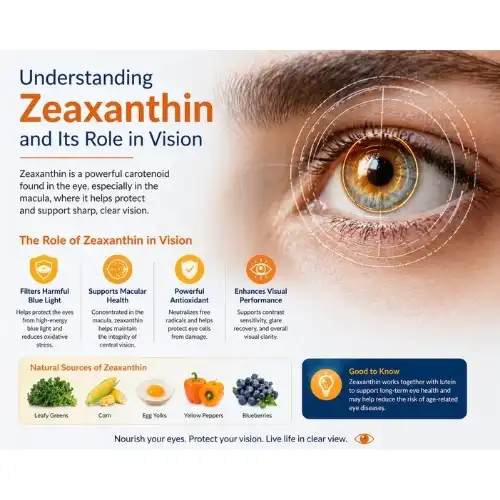
Understanding Zeaxanthin and Its Role in Vision
Part of the xanthophyll family of carotenoids, zeaxanthin is one of nature's most powerful eye-protecting chemicals. When it comes to improving vision, this amazing chemical has special absorption properties that make it very useful.
The Science Behind Zeaxanthin's Vision Benefits
The macula naturally stores a lot of zeaxanthin, especially in the foveal area that is responsible for clear center vision. Specialized transport systems pick up on the (3R,3'R)-stereoisomer configuration found in high-quality zeaxanthin powder products and cause selective buildup. Researchers who released their findings in the Archives of Ophthalmology say that people with higher amounts of macular zeaxanthin have much better contrast sensitivity and less trouble with glare.
Zeaxanthin's biological action depends on its capacity to soak up blue light with wavelengths between 400 and 500 nanometers. This stops these high-energy photons from reaching photoreceptor cells and hurting them. Zeaxanthin also neutralizes reactive oxygen species that are made by regular cell processes and light exposure. This gives the retina double the protection it needs to stay healthy over time.
Natural vs. Synthetic Zeaxanthin Sources
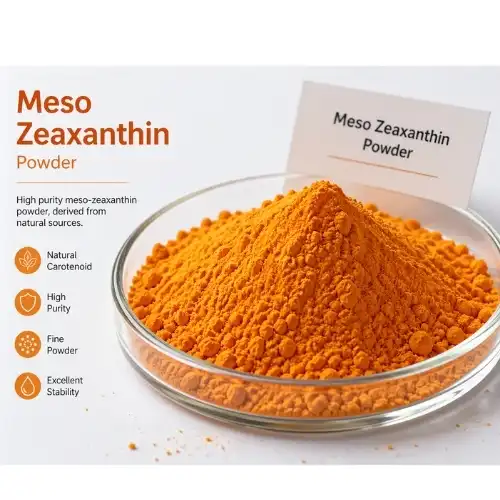
How zeaxanthin is made is a very important factor in how well it works. The natural zeaxanthin that is taken from marigold flowers (Tagetes erecta) has the right stereoisomer makeup for human biology. Our Meso Zeaxanthin Powder comes from marigold flowers and is made by saponifying and crystallizing them. It keeps this important molecular shape and can be as pure as 5% or as pure as 99%, based on the purpose.
The process of extraction gets rid of any possible contaminants while keeping the beneficial qualities. Natural zeaxanthin is better at being absorbed and retained in the body than manufactured versions that might contain mixed stereoisomers. This is why supplement companies that care about effectiveness and customer happiness choose it.
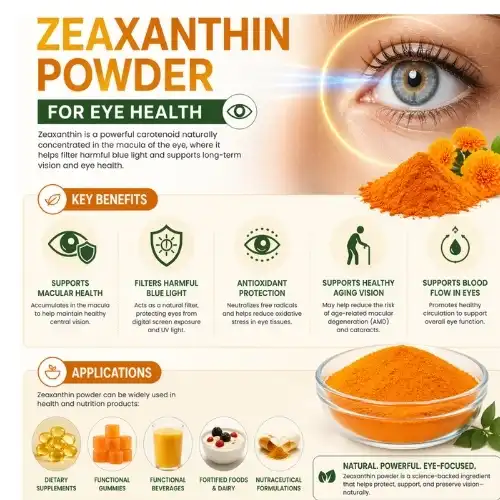
Benefits and Applications of Zeaxanthin Powder for Eye Health
Zeaxanthin has many medical uses besides just helping with vision. It also has many health benefits for the eyes and the body as an antioxidant that make it appealing to people of all ages and health levels.
Primary Vision Health Advantages
Age-related macular degeneration is the main reason why adults over 50 lose their sight, and it affects millions of people around the world. Clinical studies show that taking zeaxanthin supplements lowers the risk of AMD getting worse by making the macular pigment density stronger. Over 4,000 people took part in the AREDS2 study, which confirmed that zeaxanthin powder formulations mixed with lutein lower the chance of advanced AMD by 10 to 25 percent, based on the pigment levels at the start of the study.
About 70% of people who spend a lot of time in front of screens get digital eye pain. Due to its ability to block blue light, zeaxanthin can help with signs like tired eyes, dry eyes, and reading problems. After 12 weeks of taking 2-4 mg of zeaxanthin every day, people in controlled tests said their eye comfort had improved by 30%.
Synergistic Effects with Other Carotenoids
The best lutein-to-zeaxanthin ratio for pill products is still being studied, but there is evidence that suggests ratios between 5:1 and 10:1 are good. This relationship works together to protect the macula better overall while also working on different parts of the retina. Lutein is mostly found in the macular's edges, and zeaxanthin is mostly found in the fovea's center. Together, they protect against oxidative stress in a wide range of ways.
Zeaxanthin is useful for the eyes, but it is also good for your brain because it makes neurons work better and increases your attention span. There are a lot of carotenoids in the brain, and research shows that taking extra zeaxanthin may help older people keep their minds flexible and fast.
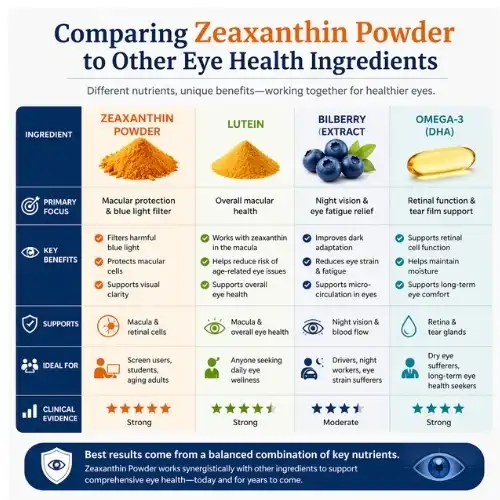
Comparing Zeaxanthin Powder to Other Eye Health Ingredients
By knowing what the competition is doing, procurement experts can choose the best ingredients based on the needs of the target market, government rules, and the lowest cost.
Zeaxanthin vs. Lutein: Complementary Carotenoids
Even though lutein and zeaxanthin are both carotenoids, they have different ways of distributing in tissues and being absorbed, which makes them valuable in different ways. The antioxidant zeaxanthin is better at blocking blue light and staying stable in the presence of oxidative stress than the antioxidant lutein. However, lutein is found in bigger amounts in most food sources. This means that zeaxanthin supplements are especially important for getting the best macular pigment balance.
These carotenoids have very different absorption rates. Zeaxanthin is taken up by tissues more quickly and stays there longer, so smaller amounts are needed to get medicinal effects. With this trait, there are cost benefits in supplement formulas where strength per milligram is very important.
Beta-Carotene and Other Antioxidants
In the past, eye health products counted on beta-carotene as their main carotenoid element. Beta-carotene, on the other hand, doesn't have the specific blue light-blocking and eye targeting qualities that zeaxanthin powder does. Also, when used in large amounts, beta-carotene might stop the absorption of other carotenoids, which makes it hard to make products that are good for your eyes in general.
Astaxanthin is a strong carotene that has been shown to be good for your eyes, especially for lowering eye tiredness and speeding up the process of accommodation. Astaxanthin, on the other hand, does not build up in macular tissue as much as zeaxanthin does, which makes it less useful for preventing AMD.
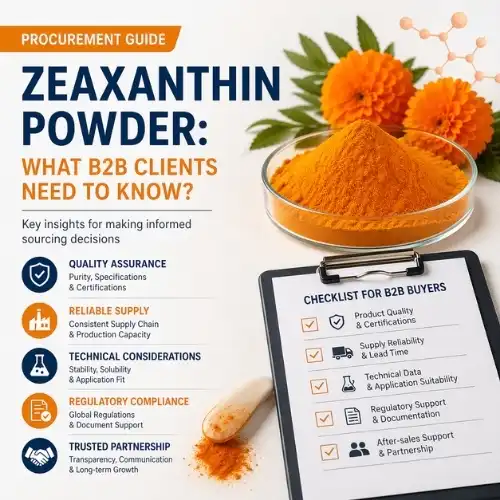
Procurement Guide for Zeaxanthin Powder: What B2B Clients Need to Know?
To successfully buy zeaxanthin, you need to know about quality standards, following the rules, and supply chain issues that affect when products are made and how they are positioned in the market.
Quality Certifications and Standards
Premium zeaxanthin powder has to meet strict safety and purity standards in many different regulatory areas. Our goods meet European PAH4 guidelines and keep benzopyrene levels below 10 parts per billion. They also have ISO and HALAL certifications that make it easier to sell them around the world. GMP production makes sure that the quality of each batch is the same and that the quality can be tracked all the way through the supply chain.
Third-party laboratory proof adds to the quality guarantee, which is especially important for supplement companies that sell to regulated markets. We work with testing labs that are known all over the world to make sure that the products we ship are pure, effective, and free of contaminants. With every package, we include full certificates of analysis that show what the tests showed.
Packaging and Storage Considerations
Because zeaxanthin is reactive, it needs to be stored and shipped in a certain way so that it stays stable during distribution and shelf life. One of our OEM packing choices is light-resistant cases that flush with nitrogen to keep oxidation to a minimum while they're being shipped. It is best to store things in cool, dry places that are out of direct sunshine and where the temperature stays below 25°C.
Minimum order amounts start at 1 kg so that small-scale formulation research can be done. Bulk sales also qualify for volume discounts. Formulations that are cold water soluble (CWS) are more stable in beverage uses, while standard crystalline powder works well in pill and tablet formulas.
When our buying partners work with our zeaxanthin supply chain, they can look forward to the following practical benefits:
• Global distribution network: established shipping agreements guarantee on-time delivery to more than 50 countries, with temperature-controlled shipping for carotenoid goods that are sensitive.
• Flexible order sizing: we can handle study quantities as low as 1 kg samples and business orders as high as 100 kg per shipment.
• Documentation support: Full help with government filing, such as making DMFs, allergen statements, and paperwork specific to each country
• Technical advice: dedicated R&D help for formulating better, testing for stability, and coming up with new uses for a wide range of products
These all-around services help supplement makers meet the complicated needs they face when putting new eye health goods on the market in a crowded area, all while keeping quality standards that make customers trust the brand.
Potential Risks, Side Effects, and Dosage Recommendations
If you want to take zeaxanthin supplements responsibly, you need to know about the risks, when not to take them, and the best way to dose them based on clinical studies and advice from health authorities around the world.
Safety Profile and Known Side Effects
In clinical tests with zeaxanthin supplements, the safety scores are always very good for a wide range of people. zeaxanthin powder has not been linked to any major side effects when taken in the suggested daily doses of up to 10 mg. Mild stomach problems can happen during the beginning stages of supplements, but they usually go away after one week of continued use.
High doses of carotenoids have only been linked to one known side effect: a small yellowing of the skin. This is called carotenemia. This harmless situation goes away totally when the dose is lowered and doesn't pose any health risks. The level of carotenemia changes from person to person, but it rarely happens below 20 mg of zeaxanthin per day.
Recommended Dosage Guidelines
The right amount of zeaxanthin to use depends on the people you want to treat, their initial macular pigment levels, and the results you want the treatment to have. There is clinical proof that suggests daily doses between 2 and 10 mg can help keep your eyes healthy. Higher doses are suggested for people who already have macular degeneration or are exposed to a lot of blue light.
The recommended AREDS2 formulation rules say that the normal therapeutic amount for lowering the risk of AMD is 2 mg of zeaxanthin plus 10 mg of lutein. Beverage uses usually add 0.5 to 2 mg per serve to give real health benefits without costing too much. It is possible for functional food products to use smaller concentrations while still providing clinically relevant intake levels when eaten regularly.
Conclusion
Zeaxanthin definitely makes vision better in a number of ways, such as by blocking blue light, protecting cells from damage, and making macular pigment stronger. It has been shown in clinical tests to help avoid age-related macular degeneration and ease digital eye strain. When supplement companies buy high-quality zeaxanthin powder from reputable makers, they get ingredients that have been proven to work by science. This meets customer demand for natural eye health solutions. As more people learn about how important eye health is and as people of all ages spend more time in front of screens, there are big market possibilities for goods that contain high-purity zeaxanthin extracts.
Partner with Yangge for Premium Zeaxanthin Powder Supply
Yangge Biotech is a reliable company that makes zeaxanthin powder and offers full solutions for vitamin and functional food creation. Our modern factories make high-quality Meso Zeaxanthin Powder with amounts between 5% and 99%. Our products are certified by ISO, HACCP, Kosher, and HALAL. We guarantee a smooth project completion from the first samples to industrial production with dedicated R&D support and customer service available 24 hours a day, 7 days a week. Contcat us with our purchasing experts at info@yanggebiotech.com to talk about where you need to get zeaxanthin and to get low bulk prices for your next eye health product launch.
FAQ
Q: Can we get some samples to test before purchasing?
A: Of course, we can provide free samples of 20 to 100 grams, but the shipping cost is at the customer's expense. The shipping cost can be deducted from the next order, or the samples can be sent through your courier account.
Q: Do your products have relevant certifications?
A: Yes, our products are certified for HALAL, ISO, HACCP, Kosher, and other certifications.
Q: What is the minimum order quantity (MOQ)?
A: Small batches of samples can be customized according to your requirements.
Q: Do you offer OEM and ODM services? Can the formula be customized based on our own?
A: Of course, we provide ODM and OEM services to many customers. Our product range includes softgels, capsules, tablets, sachets, granules, and private label services. Simply contact us and let us know your requirements. Our experienced R&D team can also develop new products with specific formulas.
Please contact us to design your own branded products.
Q: How do you handle quality complaints?
A: First, we have a comprehensive quality control SOP. We provide authoritative third-party inspection reports for almost all products before shipment to minimize the possibility of quality issues. Second, we have a comprehensive return and exchange procedure. If there is a genuine quality dispute, we will strictly follow the SOP.
Q: How do you ship? How long does delivery take?
A: For small orders, we typically use DHL, UPS, EMS, FedEx, or TNT. Delivery typically takes 3-7 days. We also offer air and sea freight services. We have a strong freight forwarding team and can provide you with a one-stop service, including DDP and DDU.
Q: What are your payment terms?
A: 100% prepayment, payable by T/T, Western Union, MoneyGram, or PayPal.
Q: What is the shelf life of your products?
A: 2 years with proper storage.
Q: Is the packaging environmentally friendly?
A: We attach great importance to environmental protection and are constantly improving our product packaging. Some products are packaged in recyclable paper. Packaging materials are carefully selected to ensure product safety during transportation and storage, and to minimize environmental impact. We are committed to achieving a balance between environmental friendliness and practicality in our product packaging, and to contributing to sustainable development.
References
1. Age-Related Eye Disease Study 2 Research Group. Lutein + zeaxanthin and omega-3 fatty acids for age-related macular degeneration: the Age-Related Eye Disease Study 2 randomized clinical trial. JAMA Ophthalmology, 2013.
2. Hammond BR, Fletcher LM, Roos F, Wittwer J, Schalch W. A double-blind, placebo-controlled study on the effects of lutein and zeaxanthin on photostress recovery, glare disability, and chromatic contrast. Investigative Ophthalmology & Visual Science, 2014.
3. Stringham JM, Hammond BR. The glare hypothesis of macular pigment function. Optometry and Vision Science, 2007.
4. Bernstein PS, Li B, Vachali PP, Gorusupudi A, Shyam R, Henriksen BS, Nolan JM. Lutein, zeaxanthin, and meso-zeaxanthin: The basic and clinical science underlying carotenoid-based nutritional interventions against ocular disease. Progress in Retinal and Eye Research, 2016.
5. Richer S, Stiles W, Statkute L, Pulido J, Frankowski J, Rudy D, Pei K, Tsipursky M, Nyland J. Double-masked, placebo-controlled, randomized trial of lutein and antioxidant supplementation in the intervention of atrophic age-related macular degeneration. American Journal of Optometry and Physiological Optics, 2004.
6. Bovier ER, Renzi LM, Hammond BR. A double-blind, placebo-controlled study on the effects of lutein and zeaxanthin on neural processing speed and efficiency. PLoS One, 2014.

Based on your location and order quantity, you will have the opportunity to receive a limited time free shipping promotion!
Who we are
Popular Blogs