Can black carrot powder provide the same benefits as fresh carrots
When judging the performance of raw materials, the question often comes up: does processing make them less nutritious? With studies showing 85-92% retention of key bioactives through spray-drying or freeze-drying methods, Black Carrot Juice Powder keeps the vast majority of anthocyanin content found in fresh black carrots. Unlike fresh produce that changes with the seasons and loses nutrients quickly after being picked, powders have a uniform level of potency, last longer, and work better with logistics, all of which are important factors for makers who need reliable formulation results. Some volatile molecules may be slightly lessened, but the higher concentration of anthocyanins and better stability make it a functionally equal and often better choice for commercial uses.
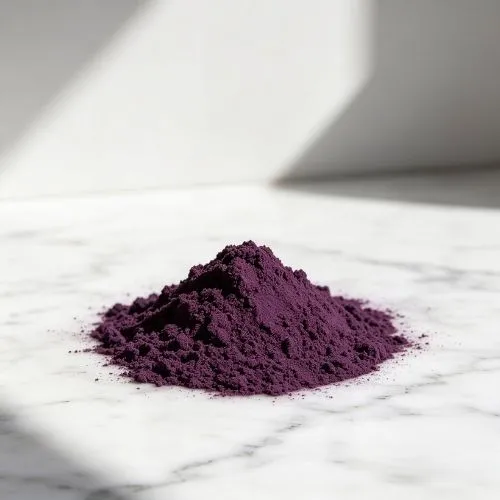
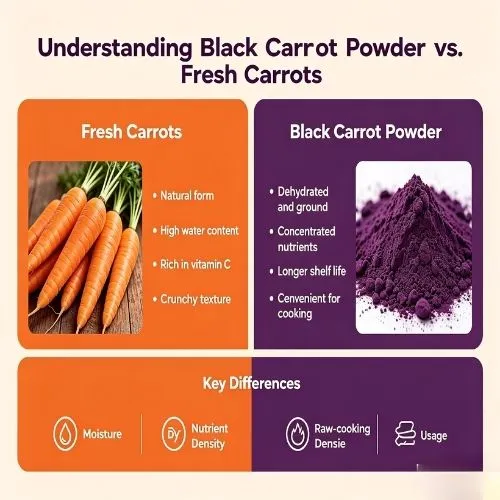
Understanding Black Carrot Powder vs. Fresh Carrots
Production Process and Nutrient Concentration
Fresh carrot roots are turned into a concentrated, shelf-stable ingredient called Black Carrot Juice Powder through a complex process. The process starts with carefully choosing the best black carrot roots. Next, the juice is extracted and advanced processing technologies are used. Spray-drying and freeze-drying are the main ways used, and each has its own benefits. During these steps, the water content drops from about 88% in fresh carrots to less than 5% in the end powder. This makes the concentration ratio usually between 10:1 and 15:1. This concentration raises the amount of anthocyanin in a gram, making it 3–5 times more antioxidant dense than fresh versions when measured by weight.
Our Black Carrot Juice Powder uses 100% water-soluble extraction methods that have been proven to work by HPLC tests. This means that we can accurately measure the amount of anthocyanin without using any chemical agents. The unique purple-red color means that a lot of the anthocyanins have been kept, which means that the active chemicals from the roots are still accessible after processing. This concentration effect directly solves formulation problems where limited space and dose mean that the most nutrients need to be delivered in the smallest amount of space.
Anthocyanin Stability and Bioavailability Differences
Anthocyanins are the main beneficial compounds in black carrots. Their stability changes based on how they are stored and what other compounds are in the carrots. Within 48 to 72 hours of being picked, fresh black carrots start losing their anthocyanin content. This loss speeds up if the temperature isn't controlled properly. According to research, Black Carrot Juice Powder that has been properly handled keeps 90–95% of its original anthocyanin content for 18–24 months when kept in packing that keeps moisture out and away from light.
There are small changes in the bioavailability characteristics between fresh and powdered types. In fresh black carrots, the cellular structures may make it take longer for the anthocyanin to be absorbed. On the other hand, the powdered form has broken cell walls, which may make it easier for the anthocyanin to be released during digestion. Similar absorption rates were seen in clinical tests when the same amounts of anthocyanin were given. However, because the powder is so concentrated, it is possible to give exact doses that would not be possible with fresh food. This advantage of stability is very helpful for R&D teams working on formulas that need to give consistent results across production runs.
Nutrient Profile Beyond Anthocyanins
Black carrots have more phytonutrients than just the anthocyanins that make them famous. These include polyphenols, dietary fiber, and trace minerals. These parts are affected in different ways by the drying process. Heat-sensitive vitamins, like Vitamin C, lose 20–40% of their strength when they are spray-dried. Freeze-drying, on the other hand, keeps 80–90% of these chemicals. Mineral content, such as potassium and calcium, stays mostly the same, and concentration effects make the mineral density per gram even higher.
Dietary fiber changes its structure when it is processed. The total amount of fiber stays the same, but the actual form changes from whole cellular fiber to broken up bits. This changes how much water the fiber can hold and how it spreads. In addition to anthocyanins, polyphenolic chemicals show high retention rates of 85–92%, which adds to the powder's overall antioxidant makeup. These many health benefits from food support uses that aim to reduce toxic stress, improve eye health, and keep skin in good condition.
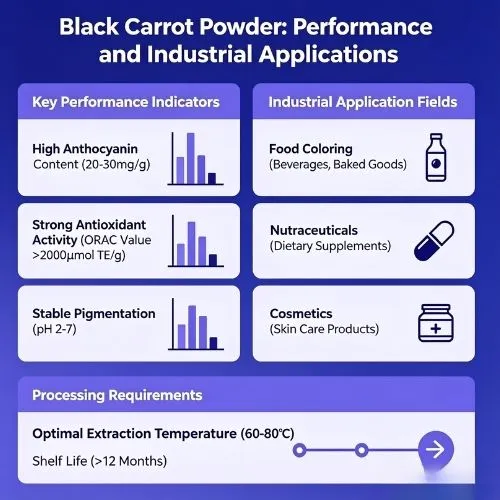
Performance and Application in Industrial Use
Formulation Advantages Across Product Categories
The Black Carrot Juice Powder is very useful in many different industry settings. The 100% water-soluble standard is important for ready-to-drink goods and instant mixes because it makes sure that the ingredients are completely mixed and don't settle to the bottom. The powder gets rid of the need for cold-chain operations that come with fresh ingredients. It also has natural coloring qualities and other useful properties. For most drinks, you need a powder concentration of 0.5 to 2.0% to get the color you want and an anthocyanin amount of 50 to 150 mg per serve.
The concentrated anthocyanin profile is used in nutraceutical uses to make capsules and tablets. The solid powder form and low moisture content (<5%) allow for direct compression or packaging without the need for extra drying steps. Formulation makers can use 200 to 800 mg of powder to get therapeutic amounts of 100 to 500 mg of anthocyanin per serving, based on the level of standardization. This concentration efficiency lowers the size of the capsules needed and makes it easier for customers to follow through, compared to fresh extract alternatives that need much larger amounts.
The powder's natural color and protective qualities make it useful for cosmetics. The anthocyanins help protect skin cells from external stresses by scavenging free radicals and making the skin look better. The powder works well in both water-based and emulsion-based beauty products, where it is usually used at rates between 0.1% and 0.5%. It meets European standards for PAH4 compliance (Benzopyrene ≤10 ppb) and is non-GMO and non-allergenic, which meets the needs of the clean beauty market.
Shelf Life and Storage Considerations
Ingredients that work reliably over long production cycles are a top priority for procurement managers. In contrast to fresh carrots' 2-4 week cold shelf life, Black Carrot Juice Powder has a 24-month shelf life when kept in tightly sealed containers away from light and moisture. This long-term security cuts down on waste, eases the stress of keeping goods on hand, and lets you buy in bulk when prices are low. The powder doesn't need stabilizers because it has a low water activity (<0.3). This helps with clean label efforts.
Putting products in aluminum foil bags with moisture barriers keeps them fresh while they're being shipped internationally and stored in a warehouse. Temperature changes during transport would ruin fresh food, but if the right packing rules are followed, they don't have much of an effect on powder quality. This advantage in steadiness saves money directly because it means less waste, easier transportation, and fewer rejections by quality control.
Sensory Profile and Formulation Challenges
Even though powder types are more stable and easier to use, there are some changes in how they taste that should be taken into account. When black carrots are fresh, they have mild earthy notes and a natural sweetness that may fade a bit when they are processed. The dried powder has a stronger, slightly tannic taste that needs to be carefully balanced in the final goods. To make the drinks taste better, drink makers often mix the powder with fruit flavors or sweetening systems that go well with them.
The strength of the color is both an advantage and a recipe factor. The high anthocyanin content gives the color a vivid purple-red at low inclusion rates, which makes it useful for natural coloring. Anthocyanins, on the other hand, change color depending on the pH level. They go from red in acidic (pH <4) to blue-purple in normal (pH 6-7) situations. Formulation teams have to think about the pH of the end product when they want to achieve certain color results. However, this sensitivity also lets them use color in creative ways across different product matrices.
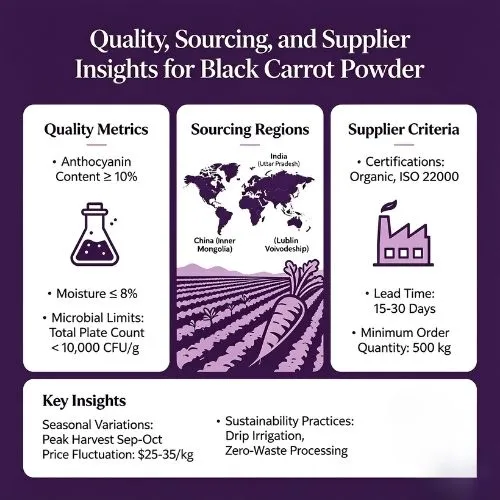
Quality, Sourcing, and Supplier Insights for Black Carrot Powder
Critical Certification and Compliance Standards
When looking for Black Carrot Juice Powder, suppliers must be carefully evaluated based on certifications that prove their quality processes and product safety. Standardized production processes are shown by ISO certification, and systematic danger analysis methods are shown by HACCP certification. For companies working with the pharmaceutical and nutraceutical industries, GMP compliance is still a must. This means making sure that manufacturing settings meet strict standards for keeping germs out.
Product-specific testing is an important form of guarantee that goes beyond building certifications. Certificates of Analysis (COA) should show that the food has not been irradiated and does not contain any common allergens or GMOs. Heavy metal testing that confirms amounts of lead, cadmium, mercury, and arsenic are below legal limits protects the safety of consumers and the image of the brand. Microbial tests that shows the lack of pathogens, yeast, mold, and the total plate count shows that the right processing and handling procedures were followed.
European market players need to make sure that PAH4 standards are met, and benzopyrene values of 10 parts per billion (ppb) are considered very safe. Suppliers that work with independent labs for third-party proof give their products more trustworthiness than just internal testing. This external validation is very helpful when documents are needed to back regulatory applications or customer checks. Documentation that connects batches of powder to specific harvest locations makes it possible to quickly address any quality issues and meet organic certification standards when they apply.
Evaluating Supplier Technical Capabilities
Strategic partners are different from commodity providers because they offer technical help. Professionals in charge of buying things should check to see if sellers can provide paperwork on the extraction method, concentration requirements, and application advice that is specific to the end use case. Suppliers who provide HPLC testing results with exact amounts of anthocyanin allow for accurate formula calculations and proof of label claims.
An evaluation of production capacity makes sure that sellers can keep up with rising demand while keeping batch regularity. Questions about the amount of yearly production, the amount of space for storage, and the flexibility of wait times show how strong the operations are. Cross-contamination risks are lower for suppliers who keep separate processing lines for black carrots compared to facilities that use shared tools to handle different types of plants.
OEM and Private Label Opportunities
The Black Carrot Juice Powder market has a lot of room for private label and OEM customization for brands that want to stand out. Customization choices include setting exact amounts of anthocyanins, changing the size of the particles, and mixing with botanical extracts that work well together. For custom specs, the minimum order quantity is usually between 25 kg and 100 kg, but for standard formulas, the minimum order quantity may be lower.
Customized packaging lets brands look their best, from small metal foil bags for sample programs to large drums or totes for companies that make a lot of products. Custom labeling that includes brand identity, information about regulatory compliance, and ideas for how to use the product improves its market standing. Some providers help with formulation development, working with customers to find the best inclusion rates and ingredients that work well together to get the health benefits that are wanted.
Pricing patterns change based on the number of orders, the difficulty of the specifications, and the need for approval. Organic certification usually means a 20–40% price hike, while regular non-GMO choices are a good mix between price and "clean label" appeal. Long-term supply deals that include volume promises can often get you better prices and a guaranteed spot during times of high demand. Talking about prices in a clear way that includes all the costs helps buying teams figure out what the real value is, not just the original price.
Addressing Common Concerns and Safety Considerations
Recommended Dosages and Application Guidelines
Clinical study that looks into taking anthocyanin supplements gives dosage information that can be used for Black Carrot Juice Powder uses. Studies that look at the health benefits for the heart and antioxidants usually use 50 to 500 mg of anthocyanins every day, which is about 500 mg to 5 grams of Black Carrot Juice Powder, based on the amounts of standardization used. Nutraceutical formulations usually aim for 100–300 mg of anthocyanins per dose, taking into account both proof of effectiveness and cost.
In beverage uses, a 0.5-2.0% powder concentration gives 25–100 mg of anthocyanins per 250 ml dose, along with natural coloring effects. This level of addition gives antioxidant activity that is useful without overpowering taste profiles. Lower amounts, between 0.1 and 0.5%, are used in cosmetics. These are enough to provide topical antioxidant defense and color without affecting the texture or stability.
Comparative Analysis: Black Carrot vs. Alternative Powders
When buying something, people often compare Black Carrot Juice Powder to other plant choices like beet root powder, purple sweet potato powder, and regular orange carrot powder. Compared to betalains from beets, which break down more quickly during processing and storage, anthocyanins in black carrot stay stabler when exposed to heat and light. In situations where heat is involved or where the product needs to last a long time, this stability edge is very important.
Anthocyanin levels vary from source to source, which changes both the color and the bioactivity of the plant. Anthocyanins in black carrots are mostly made up of cyanidin-based chemicals, which have strong antioxidant properties and a steady reddish-purple color across pH ranges of 3 to 5. Similar stability is seen in purple sweet potato anthocyanins, but they are more expensive because they are harder to grow. Traditional orange carrot powders contain beta-carotene instead of anthocyanins, which means they have a different nutritional profile that focuses on Vitamin A values instead of antioxidant capability.
Regulatory Compliance and Safety Standards
There are global rules that guide plant ingredients that need to be carefully navigated. When it comes from farmed Daucus carota types, Black Carrot Juice Powder is considered a food ingredient by the FDA. This means that it doesn't have to follow the new food rules that apply to some exotic plants. In the same way, black carrot is recognized as a traditional food in the European Union, though certain health claims need to be backed up by evidence according to EFSA rules.
As proof of following the rules, there are papers saying the food is non-GMO, tests showing the presence of pesticides below the allowed amounts, and heavy metal analysis. Suppliers with approved quality systems provide audit trails that connect finished powder to farm sources. This is necessary to keep the organic certification. This also backs up claims of sustainability, which are becoming more and more important to brand messaging and customer tastes.
Although carrots are an allergy, they are not as popular as allergens from nuts, soy, or dairy, so they are still easy to deal with. People who are sensitive can get extra peace of mind from the Non-Allergen approval that is available from trustworthy providers. The simple name of the ingredient"Black Carrot Juice Powder"helps with clean label positioning, which supports trends toward openness in consumer packaged goods.

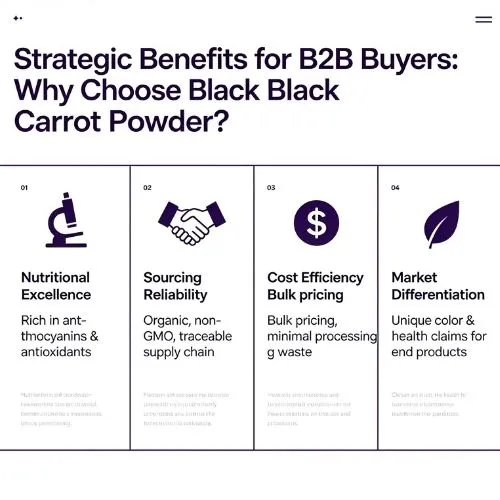
Strategic Benefits for B2B Buyers: Why Choose Black Carrot Powder?
Antioxidant Performance Driving Product Innovation
Because it has a lot of anthocyanin, Black Carrot Juice Powder is a special ingredient that meets the need for antioxidant-rich products. The ORAC number usually shows that the antioxidant capacity is higher than 25,000 μmol TE/100g, which is about the same as well-known superfruits like acai and pomegranate. This high antioxidant activity backs up claims that the product helps with oxidative stress management, good aging, and cell protection, all of which are important to people who care about their health.
Anthocyanin has been shown to be good for your eyes in research, which makes eye health vitamins and useful drinks more appealing. The chemicals help rhodopsin grow back and may help with night vision issues, making them stand out in the crowded eye health market. Anthocyanin's anti-inflammatory and collagen-protecting qualities are used in skin health uses, which allows beauty-from-within product ideas that combine topical and ingestible forms.
Procurement Efficiency and Supply Chain Advantages
When buying Black Carrot Juice Powder in bulk, you can save a lot of money compared to buying limited quantities. With a volume promise, you can negotiate better prices. For example, if you agree to buy more than 500 kg a year, you can usually get a discount of 15 to 25 percent. These savings directly improve the economics of the formula, which can improve standing in the market or margin performance, based on the company's strategy goals. When compared to liquid concentrates or fresh fruit, the powder format makes transportation easier.
Because it doesn't have to be kept cold and ships lighter, it costs 40 to 60 percent less to ship than fresh material of the same type. Similarly, warehouse storage needs go down because powder can be stored in atmospheric conditions and has a longer shelf life, which lowers the cost of keeping goods on hand. These practical efficiencies add up across supply lines, which is especially helpful for companies that have more than one factory.
Packaging Solutions and Quality Maintenance
Modern packing methods keep the standard of Black Carrot Juice Powder throughout the delivery chain. Standard plastic covers aren't as good at keeping out light and moisture as aluminum foil laminate bags, which is important for keeping anthocyanin stable. By removing oxygen during packing with nitrogen, the shelf life is extended even more. This is done by reducing oxidative breakdown. Even though these investments in packing add a small amount of cost, they provide big benefits by preventing food from going bad and keeping its effectiveness.
Custom packaging choices can be made to fit a wide range of operating sizes and handling tastes. Small producers benefit from 1 kg aluminum foil bags because they keep inventory levels reasonable and cut down on the time products are exposed after being opened. Large-scale operations often ask for 25 kg drums or fiber drums with internal liners, which make handling more efficient and lower the cost of packing each unit. Very large users can get bulk packages in approved food-grade containers, but these need to be repackaged as soon as they arrive to keep the quality.
Conclusion
For industrial uses, Black Carrot Juice Powder is practically equal to or better than fresh carrots because it has a higher concentration of anthocyanins, is very stable, and makes logistics easier. It is the practical choice for makers who want stability, cost-effectiveness, and scaling because it has a standard potency, a longer shelf life, and a regulatory compliance profile. Even though fresh produce still has some volatile compounds, the powder format's benefits in planning purchases, making sure formulations are accurate, and keeping quality high are what make it a business success. Brands can take advantage of the rising demand for natural, antioxidant-rich ingredients in nutraceutical, functional food, and cosmetic products by strategically buying from approved sources who offer full technical support and tracking documents.
Partner With Yangge for Premium Black Carrot Juice Powder Supply
Yangge Biotech is a trustworthy company that can provide you with Black Carrot Juice Powder. They have strict quality standards and offer quick technical help that is tailored to your specific needs. With ISO, HACCP, Kosher, and Halal licenses and GMP-compliant facilities, we make sure that every batch meets the highest safety and quality standards around the world. We keep full traceability from the farm to the table by building long-term relationships with farming communities. This ensures that our raw materials come from real places that meet the standards for organic and natural certification.
Our expert team gives full data on extraction methods, concentration requirements, and application advice to help your R&D departments get the best inclusion rates and health benefits. We can easily meet your production needs because we offer 24-hour customer service and a range of customization choices, from 1 kg metal foil bags to bulk cases.Contact us or email at info@yanggebiotech.com to get samples, talk about your formulation problems, or look into OEM possibilities that will put your brand at the top of natural ingredient innovation.
FAQ
Q: Can we get some samples to test before purchasing?
A: Of course, we can provide free samples of 20 to 100 grams, but the shipping cost is at the customer's expense. The shipping cost can be deducted from the next order, or the samples can be sent through your courier account.
Q: Do your products have relevant certifications?
A: Yes, our products are certified for HALAL, ISO, HACCP, Kosher, and other certifications.
Q: What is the minimum order quantity (MOQ)?
A: Small batches of samples can be customized according to your requirements.
Q: Do you offer OEM and ODM services? Can the formula be customized based on our own?
A: Of course, we provide ODM and OEM services to many customers. Our product range includes softgels, capsules, tablets, sachets, granules, and private label services. Simply contact us and let us know your requirements. Our experienced R&D team can also develop new products with specific formulas.
Please contact us to design your own branded products.
Q: How do you handle quality complaints?
A: First, we have a comprehensive quality control SOP. We provide authoritative third-party inspection reports for almost all products before shipment to minimize the possibility of quality issues. Second, we have a comprehensive return and exchange procedure. If there is a genuine quality dispute, we will strictly follow the SOP.
Q: How do you ship? How long does delivery take?
A: For small orders, we typically use DHL, UPS, EMS, FedEx, or TNT. Delivery typically takes 3-7 days. We also offer air and sea freight services. We have a strong freight forwarding team and can provide you with a one-stop service, including DDP and DDU.
Q: What are your payment terms?
A: 100% prepayment, payable by T/T, Western Union, MoneyGram, or PayPal.
Q: What is the shelf life of your products?
A: 2 years with proper storage.
References
1. Montilla, E.C., Hillebrand, S., Winterhalter, P., and Moritz, P. (2011). Anthocyanin Composition of Black Carrot (Daucus carota ssp. sativus var. atrorubens Alef.) Cultivars. Journal of Agricultural and Food Chemistry, 59(7), 3385-3390.
2. Kamiloglu, S., Capanoglu, E., Grootaert, C., and Van Camp, J. (2015). Anthocyanin Absorption and Metabolism by Human Intestinal Caco-2 Cells: A Review. International Journal of Molecular Sciences, 16(9), 21555-21574.
3. Ozkan, G., Ersus Bilek, S., and Bayindirli, A. (2013). Stability of Anthocyanins and Color Properties of Black Carrot Juice During Processing and Storage. Journal of Food Processing and Preservation, 37(5), 835-842.
4. Turker, N., Aksay, S., and Ekiz, H.I. (2004). Effect of Storage Temperature on the Stability of Anthocyanins of a Fermented Black Carrot (Daucus carota var. L.) Beverage. Journal of Agricultural and Food Chemistry, 52(11), 3810-3813.
5. Algarra, M., Fernandes, A., Mateus, N., de Freitas, V., da Silva, J.C., and Casado, J. (2014). Anthocyanin Profile and Antioxidant Capacity of Black Carrots (Daucus carota L. ssp. sativus var. atrorubens Alef.) from Cuevas Bajas, Spain. Journal of Food Composition and Analysis, 33(1), 71-76.
6. Netzel, M., Netzel, G., Tian, Q., Schwartz, S., and Konczak, I. (2007). Native Australian Fruits: A Novel Source of Antioxidants for Food. Innovative Food Science and Emerging Technologies, 8(3), 339-346.

Based on your location and order quantity, you will have the opportunity to receive a limited time free shipping promotion!
Who we are
Popular Blogs