Black Carrot Extract Benefits for Food Applications
Black Carrot Extract from Yangge Biotech is a high-quality natural food color ingredient derived from black carrots and naturally rich in anthocyanins, providing attractive red, purple, and burgundy shades for a wide range of food and beverage applications. It is suitable for use in beverages, dairy products, confectionery, gummies, bakery products, desserts, and other food formulations where manufacturers are looking for a plant-based alternative to synthetic colors. Yangge Biotech supports global food and beverage manufacturers with consistent product quality, bulk supply, COA documentation, third-party testing, samples, and customized ingredient solutions. Contact Yangge Biotech today for Black Carrot Extract specifications, samples, pricing, and bulk orders. Email: info@yanggebiotech.com.
For beverage manufacturers and supplement brands navigating the clean-label revolution, Black Carrot Extract emerges as a dual-function ingredient solving two critical industry challenges simultaneously: natural coloring and functional anthocyanin delivery. Extracted from the roots of Daucus carota subspecies, this deep purple powder provides vibrant hues ranging from pink to violet while contributing up to 25% anthocyanin content by weight far exceeding synthetic alternatives in both visual appeal and health positioning.
Unlike artificial dyes facing regulatory scrutiny across North American and European markets, this plant-based concentrate meets stringent PAH4 compliance standards and carries Non-GMO, allergen-free certifications that procurement managers prioritize during supplier evaluation.
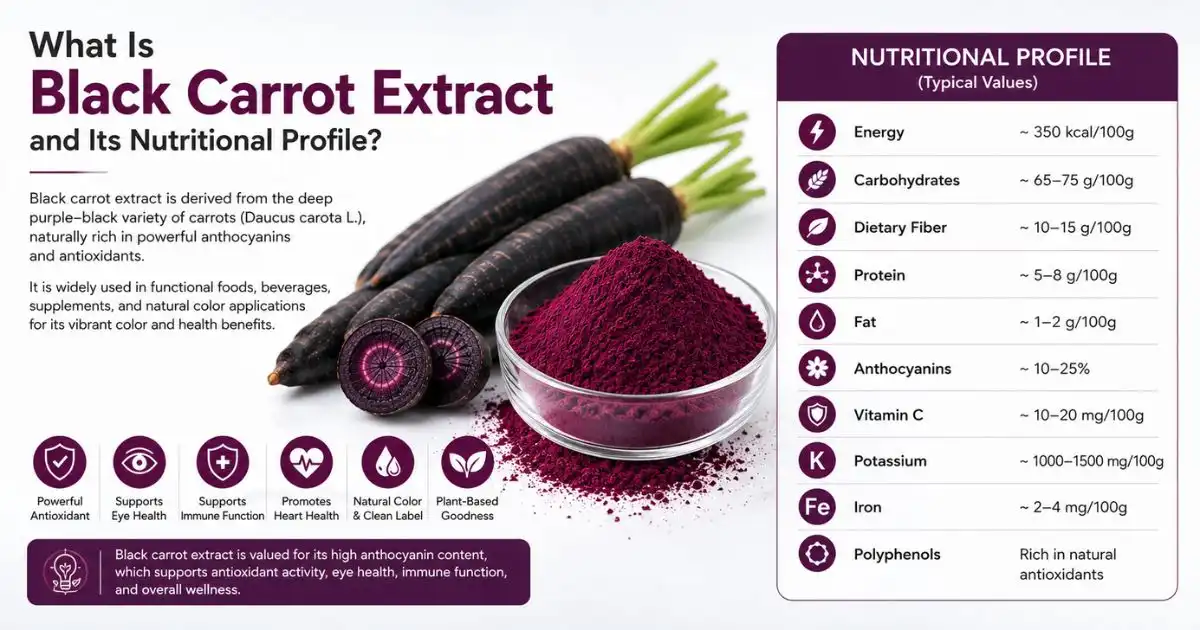
What Is Black Carrot Extract and Its Nutritional Profile?
The Botanical Origin and Extraction Process
Black Carrot Extract comes from specially grown types of carrots that are mostly grown in Turkey and some parts of the Middle East, where the plants naturally get dark colors because they have adapted to their environment. The process of extraction uses solvent-based and cold-pressing methods that protect heat-sensitive anthocyanins, mostly cyanidin-3-glucoside and cyanidin-3-xylosylglucosylgalactoside.
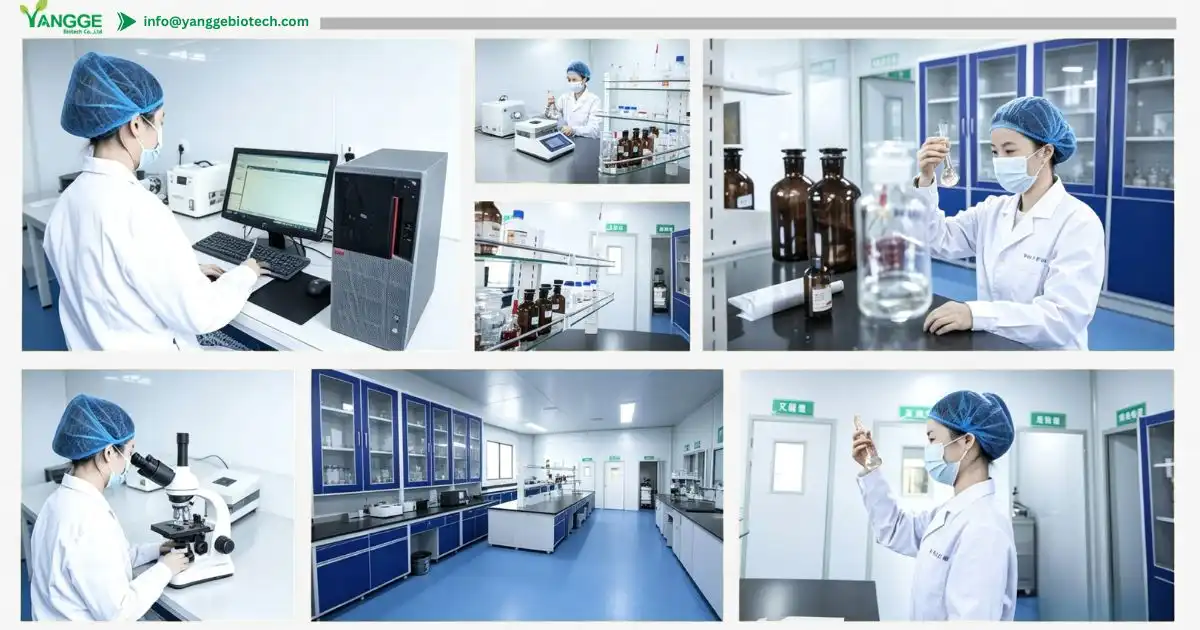
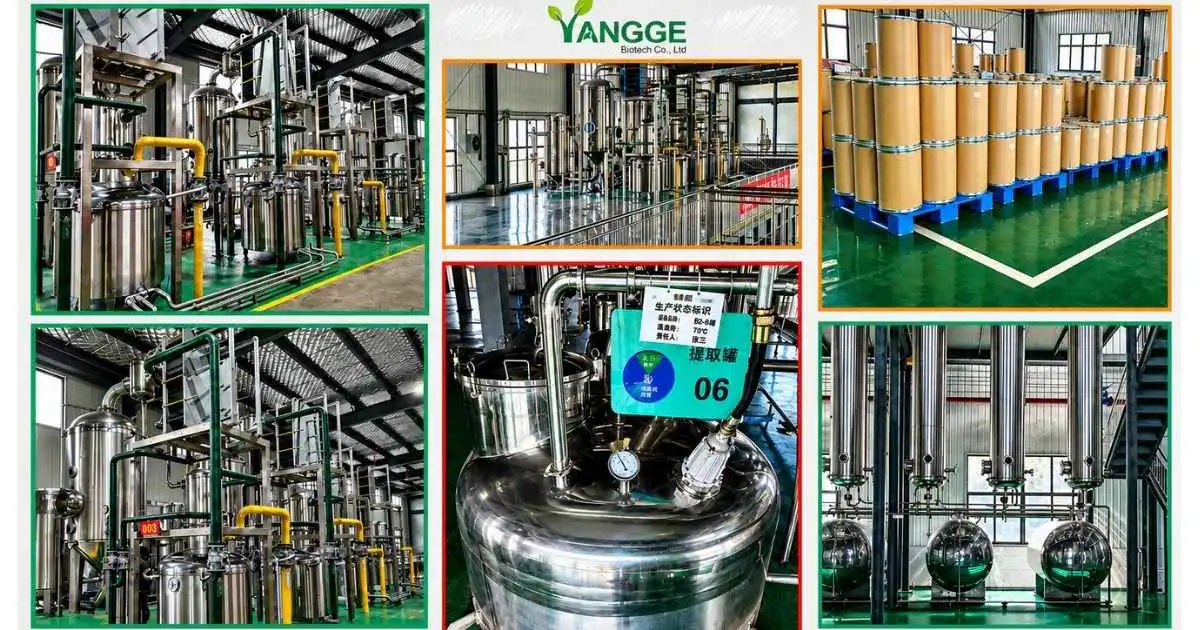
Advanced HPLC testing checks the level of purity and the concentration of the pigment, making sure that the consistency from batch to batch that is needed for food-grade applications. Yangge Biotech's processing center follows GMP guidelines while extracting the raw roots, turning them into a dark red-purple powder that mixes easily with water and can be used in liquid products without settling.
Dense Nutritional Composition
The nutritional value of raw Black Carrots shows why this veggie can be used for more than just colors. There are 35 calories in a 100-gram amount, along with 8.2 grams of carbs and 2.9 grams of fiber. The real difference is the amount of micronutrients in each food: 334% of the daily value for Vitamin A, 6% for Vitamin C, and 7% for potassium, according to USDA guidelines.
When turned into an extract, the amount of anthocyanin can reach up to 25–25%, based on how it was processed. This gives it 150–300 micromoles of Trolox equivalents of antioxidant power per gram. Formulators can make functional health claims with lower inclusion rates when using this quantity instead of whole-fruit powders.
Functional Benefits Beyond Color
Aside from their aesthetic benefits, Black Carrot pigments have been shown to protect cell structures from oxidative damage. Anthocyanins from Black Carrots are better at getting rid of free radicals than those from red cabbage or elderberry, according to a study published in the Journal of Agricultural and Food Chemistry.
The beta-carotene helps keep your eyes healthy by making up for deficits that can lead to night blindness and macular degeneration. New studies show that anthocyanin molecules may help protect the liver from damage caused by chemotherapy drugs. This is especially important for people who are trying to make useful foods that people who care about their health will like.
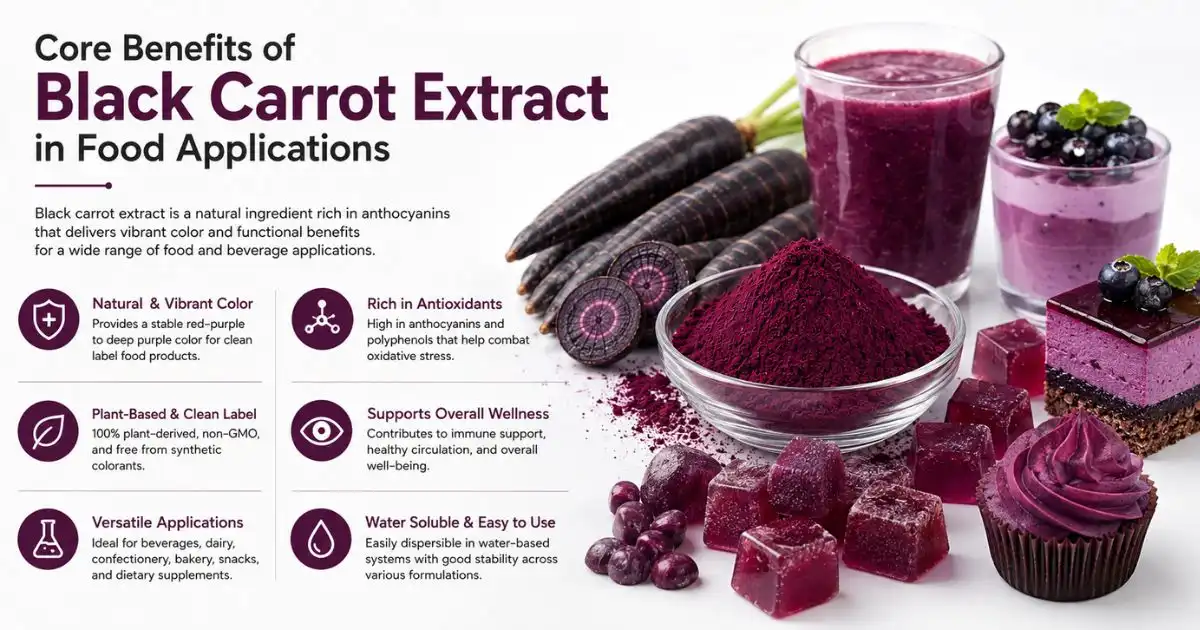
Core Benefits of Black Carrot Extract in Food Applications
Superior Natural Colorant Performance
Black Carrot Extract keeps its color better than most plant-based options even when processing conditions are tough. Anthocyanin retention rates are higher than 85% when heated to 80°C for 30 minutes, which is the normal pasteurization temperature for juice drinks. For beetroot extract, retention rates are only 60–70%. The extract changes from bright red at pH 3.0 to purple-blue at pH 7.0, which lets formulators target specific shade profiles by making the substance more acidic. With color loss rates below 10% over 12 months when stored in light-protected packaging at room temperature, this stability makes the shelf life much longer.
When compared to artificial dyes like Allura Red AC (Red 40) or Tartrazine, Black Carrot Extract gets rid of the regulatory questions that come with artificial colorants. Because the European Food Safety Authority is still looking into synthetic dyes, major beverage brands have had to change their recipes. This has created an immediate need for natural alternatives that look the same. Consumer perception studies show that 68% of North American shoppers actively avoid fake food colors. This fits with the extract's "clean label" messaging.
Enhanced Antioxidant Capacity and Nutritive Value
By adding Black Carrot Extract to food items, they become more useful than just providing protein. A drink with a 0.5% extract concentration adds about 50 to 80 milligrams of anthocyanins per serve, which is close to the amount found in expensive berry juices. With this addition, brands can back up their antioxidant claims with ORAC (Oxygen Radical Absorbance Capacity) testing, which sets goods apart in the functional beverage market, which is already very crowded. Anthocyanins and ascorbic acid (Vitamin C) work together to make preservation even better, so artificial stabilizers like sodium benzoate aren't needed as much.
Versatile Format Options for Process Integration
Yangge Biotech offers Black Carrot Extract in both powder and liquid concentrates to meet the needs of different production processes. The powder form, which comes in metal foil bags that keep out moisture, can be used for dry-mix tasks like making candy, baking mixes, and supplement pills. Its great water solubility gets rid of the problems that come up with spreading oil-soluble carotenoids. For beverage operations that make a lot of drinks, liquid concentrates are helpful because inline dosing systems need solutions with a consistent viscosity and no particles. This format's adaptability lets purchasing teams choose materials that work with current equipment without having to buy new processing equipment.
| Application Category | Recommended Dosage Range | Primary Functional Benefit | Color Output (pH 3-4) |
|---|---|---|---|
| Functional Beverages | 0.2% to 0.8% | Antioxidant claims + coloring | Pink to dark red |
| Confectionery & Gummies | 0.5% to 1.5% | Looks good + label clean | Purple-red |
| Dairy Products | 0.1% to 0.5% | Stability in acidic systems | Rose to magenta |
| Dietary Supplements | 2-5% | Getting concentrated pigment | Shades of dark purple |
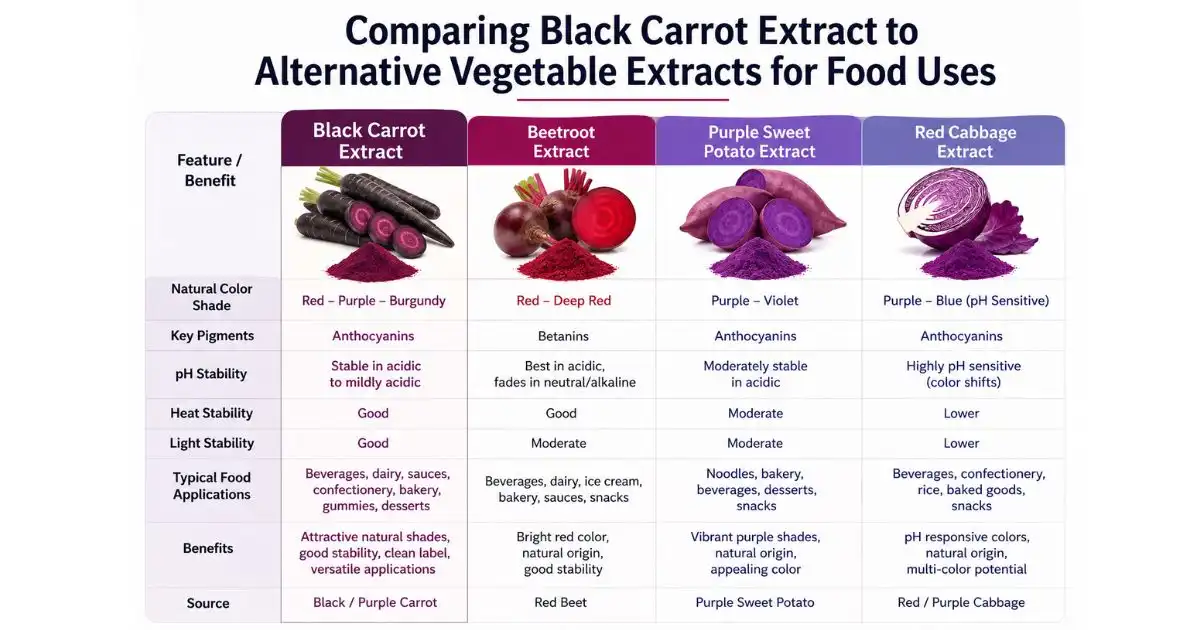
Comparing Black Carrot Extract to Alternative Vegetable Extracts for Food Uses
Stability Advantages Over Beetroot Extract
Beetroot juice is often used as a natural red colorant, but its betalain pigments break down quickly in heat and light, so they can only be used in goods that can stay stable at room temperature. Comparative rapid shelf-life testing shows that drinks colored with Black Carrot Extract keep 90% of their color after six months at 25°C, while drinks colored with beetroot lose 65% of their color under the same conditions. The earthy taste of beetroot can also be a problem in delicate applications like fruit-flavored drinks. On the other hand, Black Carrot Extract has almost no effect on taste at the right coloring concentrations.
Cost-Benefit Analysis for Mass Production
At first glance, Black Carrot Extract seems to cost 15–30% more than regular carrot or beetroot extracts. This difference is often brought up during talks for purchases. This equation changes in a good way because of the longer shelf life and lower effective dose rates. A drink that needs 0.5% Black Carrot Extract looks the same as one that needs 0.8% beetroot extract, which saves 37.5% of the material used in production. When you look at the lower costs of redistribution caused by color loss and the higher marketing value that comes from claims of anthocyanin content, Black Carrot Extract is often the better choice for products that will be sold over a number of years.
Positioning Against Berry Extracts
Blueberry and elderberry products have similar amounts of anthocyanins, but the supply line is unstable because of changes in agriculture and competition from the pharmaceutical industry. Growing Black Carrots gives more consistent yields in a range of climates, which keeps the cost of raw materials stable. The anthocyanin makeup is slightly different. The acylated anthocyanins in Black Carrot are more stable in acidic environments than the non-acylated forms that are more common in berries. When pH levels drop below 3.5, which happens in carbonated soft drinks or sports drinks with added acid, this chemical difference becomes very important.
How to Integrate Black Carrot Extract into Food Manufacturing Processes
Dosage Optimization and Regulatory Compliance
For integration to work, the dosage needs to be carefully calculated so that it matches the desired color intensity and functional claims. For beverage uses, light pink colors that work with flavored waters usually need 200 to 800 ppm (0.02-0.08%), and bright red sports drinks need 2,000 to 5,000 ppm (0.2 to 0.5%). In the US, Black Carrot Extract is a color additive that doesn't need to be certified under 21 CFR 73.260. This means that it can be used in foods at levels that are generally in line with good manufacturing practices. According to EU rules, it can be found as E163 (anthocyanins), and it can be used in most types of food without any specific amount limits. However, for organic approval, it needs to be accompanied by proof that the food did not come from GMO crops.
Labeling transparency remains essential; ingredient lists should say "Black Carrot Extract" or "carrot extract (color)" rather than vague "natural flavors," as this meets consumer expectations for clarity. When concentrations hit functionally important levels, usually above 20 milligrams per serving, as shown by third-party laboratory analysis, nutritional panels may highlight the anthocyanin content.
Best Practices for Process Integration
To successfully incorporate, you need to pay attention to a number of technical factors that affect how the color develops and how stable it is. When making acidic drinks, mix the extract with a small amount of water first. This will make sure that it is evenly distributed and stop any pH shocks that could lead to precipitation. It is best to keep the temperature under control while mixing. Processing temperatures below 70°C keep the most anthocyanin activity, but pasteurization at standard parameters can still be done while keeping the color.
If you're making candy that needs sugar to be cooked in steps, add Black Carrot Extract while it's cooling (below 85°C) to keep it from breaking down too quickly. To get the extract to work with milk proteins in dairy products, the pH needs to be raised to 4.0–4.5 using citric acid or lactic acid. This makes a stable liquid system that doesn't separate when stored in the fridge. Emulsifying agents, such as modified food starch or gum arabic, can help spread ingredients even more in high-fat foods like yogurt or ice cream.
To solve common processing problems, you need to be proactive about finding and fixing problems. If sludge forms in clear drinks, add more citric acid to help the anthocyanin dissolve better, or use binders like pectin at a level of 0.1 to 0.3%. Light-protective packaging is needed because fluorescent lighting can fade colors over time. Amber PET bottles or aluminum cans are better at keeping pigments intact than clear glass.
Real-World Implementation Examples
A sports nutrition brand in North America changed the recipe for its line of pre-workout drinks so that Black Carrot Extract was used instead of Red 40. During blind taste tests, customers who cared about their health were 23% more likely to buy the new formula. The recipe included 0.35% extract concentration, ascorbic acid, and natural fruit flavors. This gave the product a stable red color that looked good for 18 months. After the product came out, customers said that the "clean ingredient list" was one of the main reasons they bought it, which proved that the money spent on natural coloring was worth it.
European candy companies have used Black Carrot Extract in gummy products meant to help the immune system. The antioxidants and coloring properties help the health message. A case study from a medium-sized German producer showed that the costs of synthetic additives dropped by 30% while the company became eligible for organic certification. This allowed the company to sell its products in higher-end retail segments. Problems with production during manufacturing that was sensitive to humidity were resolved by encasing the hygroscopic powder in ways that kept it safe while it was being stored.
Procuring Black Carrot Extract: What B2B Buyers Should Consider
Quality Attributes and Certification Requirements
When purchasing managers look at different suppliers, they need to make a list of a few important quality indicators that make sure the suppliers follow the rules and the products work well. Organic approval (USDA Organic, EU Organic) checks that farming methods don't use synthetic chemicals or GMOs, which is a must for brands that want to sell natural products in stores. Cross-contamination risks during processing are taken care of by allergen-free licensing.
This is especially important for facilities that make gluten-free or nut-free product lines. Food-grade compliance includes following PAH4 standards (polycyclic aromatic hydrocarbons). Yangge Biotech's product specification guarantees benzopyrene levels below 10 parts per billion, which is a lot lower than the 10 ppb limit set by the European Union.
Third-party testing relationships give you extra peace of mind about the quality, and when suppliers work with accredited labs to check batches, it shows that they are committed to being open and honest. Asking for Certificates of Analysis (CoA) that list the anthocyanin content by HPLC method lets you compare products from different sellers, since testing methods have a big effect on the numbers that are reported. The pH 1.0 differential method makes it easier to choose a supplier by reducing the variation that comes with measuring anthocyanin levels.
Supplier Evaluation Framework
A long-term partnership depends on more than just quality certifications. It also depends on operational reliability. Checking suppliers' production capacity makes sure they can keep up with rising demand. Minimum order quantities (MOQ) of 25 to 100 kilograms work well for testing purposes, but for established goods, suppliers need to be able to produce multiple tons with regular lead times. Black Carrot Extract inventory is kept on hand by Yangge Biotech to support shipping windows of two to three weeks to North American targets. This keeps the supply chain from getting messed up by changes in the harvest or delays in operations.
There is a lot of information to be learned about how prices are set. For example, bulk savings usually start at 500 kilograms, lowering the cost per unit by 12 to 18%. Mid-sized producers who don't have a lot of cash on hand can better handle their cash flow when they have payment terms like net-30 or net-60. Premium providers stand out because they offer better technical support. Having access to application experts who can help with formulation problems speeds up product development and cuts down on expensive reformulation cycles.
| Supplier Evaluation Criterion | Yangge Biotech Standard | Industry Baseline | Procurement Impact |
|---|---|---|---|
| Anthocyanin Level (HPLC) | 15–25% | 10–20% | More useful effectiveness per gram |
| Lead Time (North America) | 14 to 21 days | 30 to 45 days | More quickly getting products to market |
| Organic Certification | EU and USDA Organic | varies | Access to high-end shopping channels |
| MOQ Can Change | 25 kg for testing, 100 kg for standard | 100 to 500 kg | Lower the hurdles for making new products |
| Technical Support | Dedicated team for applications | Limited | Lessened the risk of formulation |
Format Selection: Powder vs. Liquid Concentrate
Which format to use—powder or liquid—depends on the manufacturing facilities and the needs of the product. Powder extract can be used with systems that are already in place for handling dry ingredients. It also has practical benefits, like being lighter to ship and able to be stored at room temperature. Because it is so concentrated (up to 25% anthocyanins), it can be used to make supplement capsules or sachets with very small doses.
Liquid concentrates make it easier to integrate automated dosing pumps into high-throughput beverage lines, which means there are no worries about dust generation in places where food safety is important. Storage needs are different for powders and liquids. Powders need to be kept dry (relative humidity below 60%) and protected from light, while liquids need to be kept cold to stay stable after six months.
Market Dynamics and Pricing Trends
The price of global Black Carrot Extract changes depending on how much is harvested in Turkey, which provides about 70% of the market supply. New information from agriculture shows that production levels are staying the same. The price of standard-grade powder (15–20% anthocyanins) stays between $45 and $75 per kilogram, while the price of premium organic varieties stays between $85 and $120 per kilogram.
Because of the way politics affect shipping routes in the Middle East, lead times are sometimes longer than expected. This shows how valuable it is for suppliers to have a wide range of sources they can use. Forward contracting strategies, which involve agreeing to set prices and quarterly volumes, protect against volatility in the spot market. This is especially helpful for brands that are starting new goods with long-term store agreements.
Conclusion
Black Carrot Extract is a smart move for food companies that want to meet the needs of clean labels and functional health positioning. Its ability to provide both vibrant natural coloring and substantial anthocyanin content solves major procurement issues by replacing synthetic dyes and improving nutritional profiles that appeal to health-conscious consumers. Because this ingredient is more stable than other plant extracts, comes in a variety of formats, and is legal in all major markets, it is seen as a value-adding ingredient rather than a cheap input.
Buying from suppliers with strong quality certifications, technical support, and clear pricing structures gets the best return on investment because it lowers the cost of reformulation and speeds up entry into the market. As people's tastes continue to change toward products that come from plants, Black Carrot Extract is well-positioned to gain more market share in the functional foods and natural colorants industries.
FAQ
What is the typical shelf life of black carrot extract powder?
Black Carrot Extract powder stays effective for 24 months after it was made as long as it is kept in sealed, light-protected containers at temperatures below 25°C and relative humidity below 60%. Under these conditions, anthocyanin breakdown stays low (less than 10%), so the color richness and antioxidant activity are both kept. Direct sunshine or wetness speed up the breakdown of pigment, which shows how important it is to store things properly.
Can black carrot extract withstand high-temperature processing?
The extract can handle normal scalding temps (72–85°C for 15–30 seconds) and still keep more than 85% of its color. Ultra-high temperature (UHT) processing at 135°C breaks down the anthocyanin content even more, dropping it by 25–35%. For tasks that need to be exposed to very high temperatures, increasing the original dosage by 30% makes up for heat loss while keeping the goal color strength.
How does pH affect color expression in formulations?
Anthocyanins in Black Carrot change color depending on the pH level. They turn bright red at pH levels 2 to 3 (great for sports drinks), purple-red at pH levels 4 to 5 (good for yogurt), and blue-gray above pH 7 (not good for food uses). Most food formulas work best when the pH level is between 3 and 5, because that's when the red-to-purple colors of the extract look their best. Acidifiers, such as malic acid or citric acid, change the pH to help colors develop better.
Is black carrot extract suitable for organic product certification?
Black Carrot Extract from Yangge Biotech is certified as organic by both the USDA and the EU, so it can be used in organic products. The strict requirements of organic standards are met by the Non-GMO certification and the lack of synthetic processing aids. However, buyers should always check the current certification status through updated documentation before placing an order.
Partner with Yangge for Premium Black Carrot Extract Supply
Yangge Biotech is a reliable company that makes Black Carrot Extract. They are dedicated to providing consistent quality that meets the high standards of food and drink producers all over the world. Our fully connected supply chain, which includes contracted organic farms and ISO-certified processing plants, makes sure that the purity and traceability that purchasing managers look for in suppliers are always met. We offer more than just ingredients.
Our anthocyanin content is checked by HPLC testing at approved labs, we have Halal and Kosher certifications to support global distribution, and our technical knowledge helps make sure that formulations work. Contact us or you can email our applications team at info@yanggebiotech.com to get samples, talk about custom requirements, or find out how our Black Carrot Extract for sale can help your product line while meeting clean-label requirements.
References
1. Montilla, E.C., Hillebrand, S., Winterhalter, P., & Moritz, P. (2011). Anthocyanin composition of black carrot (Daucus carota ssp. sativus var. atrorubens Alef.) cultivars. Journal of Agricultural and Food Chemistry, 59(7), 3385-3390.
2. Kamiloglu, S., Serali, O., Unal, N., & Capanoglu, E. (2013). Antioxidant activity and polyphenol composition of black carrots. European Food Research and Technology, 236(2), 309-319.
3. Algarra, M., Fernandes, A., Mateus, N., de Freitas, V., & da Silva, J.C.G.E. (2014). Anthocyanin profile and antioxidant capacity of black carrots (Daucus carota L. ssp. sativus var. atrorubens Alef.) from Cuevas Bajas, Spain. Journal of Food Composition and Analysis, 33(1), 71-76.
4. Barba, F.J., Criado, M.N., Belda-Galbis, C.M., Esteve, M.J., & Rodrigo, D. (2014). Sterilization of food products by pulsed electric fields. Critical Reviews in Food Science and Nutrition, 54(3), 385-395.
5. Chandrasekhar, J., Madhusudhan, M.C., & Raghavarao, K.S.M.S. (2012). Extraction of anthocyanins from red cabbage and purification using adsorption. Food and Bioproducts Processing, 90(4), 615-623.
6. Rodriguez-Amaya, D.B. (2016). Natural food pigments and colorants. Current Opinion in Food Science, 7, 20-26.

Based on your location and order quantity, you will have the opportunity to receive a limited time free shipping promotion!
Who we are
Popular Blogs