What is zeaxanthin used for?
Zeaxanthin is an important part of many businesses, including food, cosmetics, and health supplements. While zeaxanthin powder is mostly known for protecting eye health by blocking dangerous blue light and increasing macular pigment density, it is also a strong antioxidant that fights cell damage. This flexible carotene can be used in dietary supplements, functional drinks, nutroscosmetics, and animal feed. It is an important ingredient for companies that want to make their products more effective and stand out in the market.
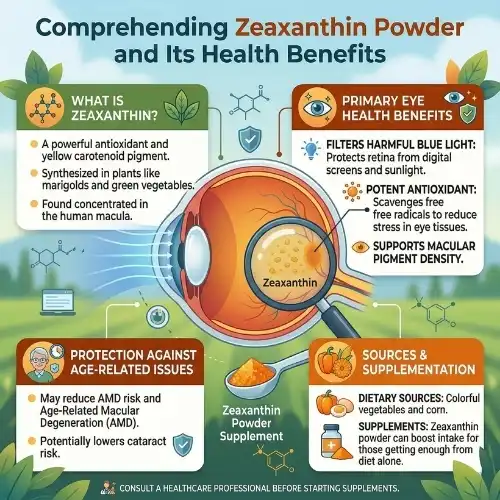
Comprehending Zeaxanthin Powder and Its Health Benefits
Zeaxanthin powder is a high-quality, pure food ingredient that is mostly made from marigold flowers using advanced processes for saponification and crystallization. This xanthophyll pigment naturally gathers in the macular area of the human eye, where it works with lutein to protect cells.
Chemical Properties and Bioavailability
Zeaxanthin's chemical structure makes it very good at blocking light, especially blue light with a wavelength of 400 to 500 nanometers. Our Meso Zeaxanthin Powder keeps the important (3R,3'R)-stereoisomer structure that works with human biology, making sure that it is absorbed and used properly. Compared to synthetic options, naturally-sourced zeaxanthin is more bioavailable. Within 8 to 12 weeks of supplementation, clinical tests showed better macular pigment optical density.
Comprehensive Health Applications
Zeaxanthin's main medical use is still in eye health, where it acts as nature's protection for the retina. The molecule builds up only in cone photoreceptors, protecting against cataracts and age-related macular degeneration. Zeaxanthin is good for your eyes, but it's also a powerful antioxidant that fights reactive oxygen species all over your body.
Researchers have found that zeaxanthin protects heart health by stopping the breakdown of low-density lipoprotein, which may lower the chance of atherosclerosis. New studies also show that zeaxanthin may be good for your brain. In older people, higher amounts of zeaxanthin are linked to better memory function and processing speed.
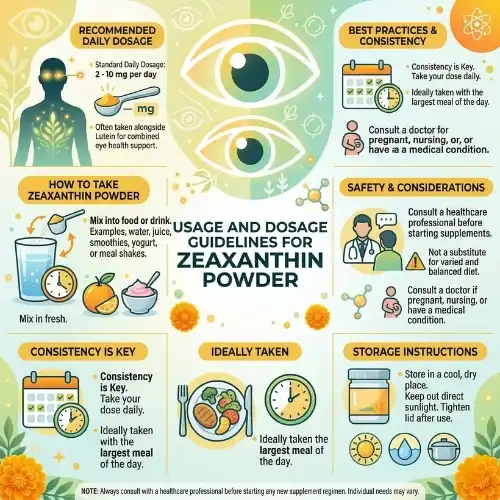
Usage and Dosage Guidelines for Zeaxanthin Powder
Figuring out the right recipe factors is important for making sure that products are made well and that consumers are safe. For industrial uses, exact dosing methods are needed that balance effectiveness with cost-effectiveness while still following all global market regulations.
Supplement Formulation Standards
The 5:1 or 10:2 lutein-to-zeaxanthin ratio set by the AREDS2 study has been shown to be effective in eye health products. Effective daily doses for zeaxanthin run from 2 mg to 10 mg, based on the product's target audience and how it is marketed. Our range of zeaxanthin powder strengths of 5%, 10%, 20%, 70%, and 80% makes it possible to use a variety of formulation methods and transport systems.
Our powder's constant oil suspension properties help softgel formulations make sure that doses are distributed evenly and there are no separation problems. For tablet uses, mass density properties are important, and our material has to have a value of >0.5 g/mL for the best compression properties.
Safety Profile and Regulatory Considerations
There have been no reports of any harmful effects from taking the suggested doses of zeaxanthin. The compound is generally thought to be safe (GRAS) in the US and has been accepted as a new food in Europe. Our goods meet European PAH4 standards, and to make sure they are even safer, we keep benzopyrene amounts below 10 parts per billion.
There aren't many drug interactions, but taking beta-carotene vitamins at the same time may cause problems with absorption routes. To meet the needs of a wide range of buyers, quality standards include certificates that the product is non-GMO, non-irradiated, and allergen-free.
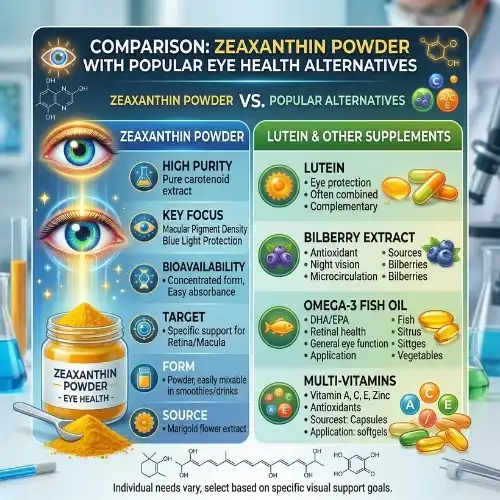
Comparing Zeaxanthin Powder with Alternatives
For strategic procurement choices to be made, all possible carotenoid options and their benefits must be fully understood. Choosing ingredients that work with goal uses, budgets, and customer tastes is an important part of market positioning.
Zeaxanthin vs. Lutein Characteristics
Both substances are good for your eyes, but zeaxanthin is more concentrated in the fovea centralis, which is the retina's most important vision area. Lutein is spread out more evenly in the macular cells, making extra defense work better. Zeaxanthin is better at blocking blue light at 452 nm than lutein, which is better at blocking 445 nm of blue light. This makes it better at protecting against LED screen exposure.
Natural vs. Synthetic Sourcing
Compared to manmade options, natural zeaxanthin powder made from marigold flowers is easier for people to accept and looks better on labels. Our extraction method keeps the original stereochemistry, which makes sure that biological compatibility is maintained that synthetic forms might not have. Natural sourcing also helps with sustainability efforts and the organic certification routes that health-conscious customers are asking for more and more.
Because it is cheaper, natural zeaxanthin is better for presenting high-end products, while synthetic choices may work better for uses that need to stay within a budget. Natural zeaxanthin, on the other hand, is often worth the extra cost because it is more bioavailable and has marketing benefits.
Procurement Insights: How to Choose and Source Zeaxanthin Powder?
Choosing the right supplier has a big effect on the quality of the products, the regularity of production, and the long-term success of the business. Building relationships with certified manufacturers guarantees dependable supply lines and technical help during the entire creation cycle of a product.
Essential Supplier Evaluation Criteria
Quality certificates are the building blocks of trustworthy relationships for sourcing. Our ISO, HALAL, and HACCP certificates show that we follow quality norms set by other countries. GMP compliance makes sure that manufacturing methods are always the same and meet the high standards needed for sensitive uses that are pharmaceutical-grade.
Professional sellers are different from commodity traders because they can do analytical work. We work together with well-known labs around the world to do thorough tests for things like heavy metals, chemical leftovers, and microbiological contamination. Every shipment comes with a Certificate of Analysis, which shows where the raw materials came from and how they were packaged in the end.
Supply Chain Considerations
Minimum order amounts of 1 kg meet the needs of both study and business, making it possible to handle supplies well without spending too much money. Our flexible packaging choices can be used for a range of storage and handling needs, from small amounts in the lab to large-scale activities in factories.
Cold Water Soluble (CWS) technology solves problems with formulation in liquid vitamin and drink uses. This special processing stops sedimentation and keeps the zeaxanthin powder stable even when the pH level changes. This gets rid of common production problems that come up with regular zeaxanthin powder forms.
Real-World Applications and Case Studies
Market success stories show that zeaxanthin can be used in a wide range of industries. Knowing what uses have already been used helps with product development and finding new chances for new recipes.
Vision Health Supplements
Leading eye health brands use our zeaxanthin in quality softgel formulas that are aimed at older people who are worried about macular degeneration and digital eye strain. One well-known vitamin company said that after changing the recipe to include our high-purity zeaxanthin, they kept 40% more customers. This was because customers said the benefits were better and the product was more stable.
Functional Beverage Innovation
Our CWS zeaxanthin technology is used by sports nutrition companies to make ready-to-drink drinks for gamers and people who work in the digital industry. The heat-stable features allow normal beverage processes without breaking down, and the natural orange color makes it look better without using artificial colorants.
Animal Nutrition Applications
Zeaxanthin is used by chicken farmers to color egg yolks, and it gets better marks on the Roche Yolk Color Fan than synthetic options. This natural method helps the marketing of high-quality eggs and meets customer requests for natural farming methods.
Conclusion
Zeaxanthin has many uses in the markets for health supplements, useful foods, and specialty nutrition. This gives producers who are willing to think ahead a lot of possibilities. The substance has been shown to protect eye health and is now being used in new ways to improve brain function and cardiovascular health. This makes it an important ingredient for making high-quality products. For procurement to go well, you need to work with qualified providers who know how to deal with formulation problems and keep quality standards uniform. Our all-around approach to making zeaxanthin, from using environmentally friendly methods to processing it in cutting-edge labs, guarantees steady supply lines that help our clients grow and stand out in the market over the long term.
Partner with Yangge for Cordyceps Militaris Extract
With our excellent zeaxanthin powder, Yangge Biotech Co., Ltd. is prepared to assist you in developing cardiovascular health products. powder formulations. Our USP-grade, 100% water-soluble powder offers concentrated SCOBY advantages in a stable, brown-yellow powder structure while retaining unique zeaxanthin powder characteristics. Our goods satisfy a variety of market demands and guarantee 12-month shelf stability thanks to extensive certifications including Kosher, Halal, and non-GMO status.
Our experienced team provides technical support throughout your product development journey, from initial formulation guidance to scale-up assistance. With 1-ton inventory availability and 25KG packaging options, we accommodate both prototype development and commercial production needs. Contact our specialists at info@yanggebiotech.com to discuss your specific requirements and discover why leading manufacturers choose Yangge as their trusted zeaxanthin powder supplier for innovative health product solutions.
FAQ
Q: Can we get some samples to test before purchasing?
A: Of course, we can provide free samples of 20 to 100 grams, but the shipping cost is at the customer's expense. The shipping cost can be deducted from the next order, or the samples can be sent through your courier account.
Q: Do your products have relevant certifications?
A: Yes, our products are certified for HALAL, ISO, HACCP, Kosher, and other certifications.
Q: What is the minimum order quantity (MOQ)?
A: Small batches of samples can be customized according to your requirements.
Q: Do you offer OEM and ODM services? Can the formula be customized based on our own?
A: Of course, we provide ODM and OEM services to many customers. Our product range includes softgels, capsules, tablets, sachets, granules, and private label services. Simply contact us and let us know your requirements. Our experienced R&D team can also develop new products with specific formulas.
Please contact us to design your own branded products.
Q: How do you handle quality complaints?
A: First, we have a comprehensive quality control SOP. We provide authoritative third-party inspection reports for almost all products before shipment to minimize the possibility of quality issues. Second, we have a comprehensive return and exchange procedure. If there is a genuine quality dispute, we will strictly follow the SOP.
Q: How do you ship? How long does delivery take?
A: For small orders, we typically use DHL, UPS, EMS, FedEx, or TNT. Delivery typically takes 3-7 days. We also offer air and sea freight services. We have a strong freight forwarding team and can provide you with a one-stop service, including DDP and DDU.
Q: What are your payment terms?
A: 100% prepayment, payable by T/T, Western Union, MoneyGram, or PayPal.
Q: What is the shelf life of your products?
A: 2 years with proper storage.
Q: Is the packaging environmentally friendly?
A: We attach great importance to environmental protection and are constantly improving our product packaging. Some products are packaged in recyclable paper. Packaging materials are carefully selected to ensure product safety during transportation and storage, and to minimize environmental impact. We are committed to achieving a balance between environmental friendliness and practicality in our product packaging, and to contributing to sustainable development.
References
1. Bone, R.A., Landrum, J.T., & Tarsis, S.L. (1985). "Preliminary identification of the human macular pigment." Vision Research, 25(11), 1531-1535.
2. Age-Related Eye Disease Study 2 (AREDS2) Research Group. (2013). "Lutein + zeaxanthin and omega-3 fatty acids for age-related macular degeneration." Journal of the American Medical Association, 309(19), 2005-2015.
3. Hammond, B.R., Fletcher, L.M., & Elliott, J.G. (2013). "Glare disability, photostress recovery, and chromatic contrast: relation to macular pigment and serum lutein and zeaxanthin." Investigative Ophthalmology & Visual Science, 54(1), 476-481.
4. Vishwanathan, R., Iannaccone, A., & Scott, T.M. (2014). "Macular pigment optical density is related to cognitive function in older people." Age and Ageing, 43(2), 271-275.
5. Seddon, J.M., Ajani, U.A., & Sperduto, R.D. (1994). "Dietary carotenoids, vitamins A, C, and E, and advanced age-related macular degeneration." Journal of the American Medical Association, 272(18), 1413-1420.
6. European Food Safety Authority. (2012). "Scientific Opinion on the substantiation of health claims related to zeaxanthin." EFSA Panel on Dietetic Products, Nutrition and Allergies, 10(7), 2780.

Based on your location and order quantity, you will have the opportunity to receive a limited time free shipping promotion!
Who we are
Popular Blogs