What Is PDRN Powder and How Is It Used in Professional Skin Care?
Polydeoxyribonucleotide or PDRN powder is a bioactive ingredient derived from purified salmon DNA fragments, recognized across regenerative medicine and professional skin care for its capacity to accelerate cellular repair, stimulate collagen synthesis, and modulate inflammatory responses. Acting as an A2A adenosine receptor agonist, it activates pathways that drive tissue regeneration at the dermal level. Whether you are formulating injectable skin boosters, high-performance cosmeceutical serums, or advanced wound care products, PDRN functions as a scientifically validated raw material that bridges superficial skin treatment and true regenerative biology. Reach us directly at info@yanggebiotech.com to explore product specifications and request your sample today.
Understanding PDRN Powder: Definition and Mechanism of Action
What Makes PDRN Biologically Distinct
There is a chemical called PDRN powder that comes from the milt (sperm cells) of wild salmon (Oncorhynchus keta). More than 95% of its DNA pattern is the same as human DNA. The molecular weights of its DNA fragments are generally between 50 and 1,500 kDa. It works well with living things and doesn't cause any immune system effects because of its close structure. Chemicals used in medicine have optical density ratios (OD260/OD280) that are between 1.8 and 2.0, which proves this.
The A2A adenosine receptor on fibroblasts and keratinocytes is turned on by PDRN powder at the molecular level. This starts a chain of events that raises VEGF (Vascular Endothelial Growth Factor), speeds up DNA production through the salvage pathway, and drops levels of cytokines that cause inflammation, such as TNF-α and IL-1β. To sum up, these processes make it possible for wounds to heal faster, skin to become more elastic, and obvious signs of age to fade.
| Parameter | PDRN Specification (Yangge Biotech) |
|---|---|
| Assay (Purity) | 99% (HPLC/UV verified) |
| Appearance | White crystalline powder |
| Molecular Weight Range | 50–1,500 kDa |
| Solubility | Slightly soluble in water; insoluble in ethanol |
| Shelf Life | 24 months |
| Certifications | HACCP / ISO9001 / ISO22000 / Kosher |
The PDRN powder made by Yangge Biotech is subject to strict quality control. It is extracted using HPLC and tested again by a third-party lab. It is not GMO, has not been sterilized, and does not contain any allergens.
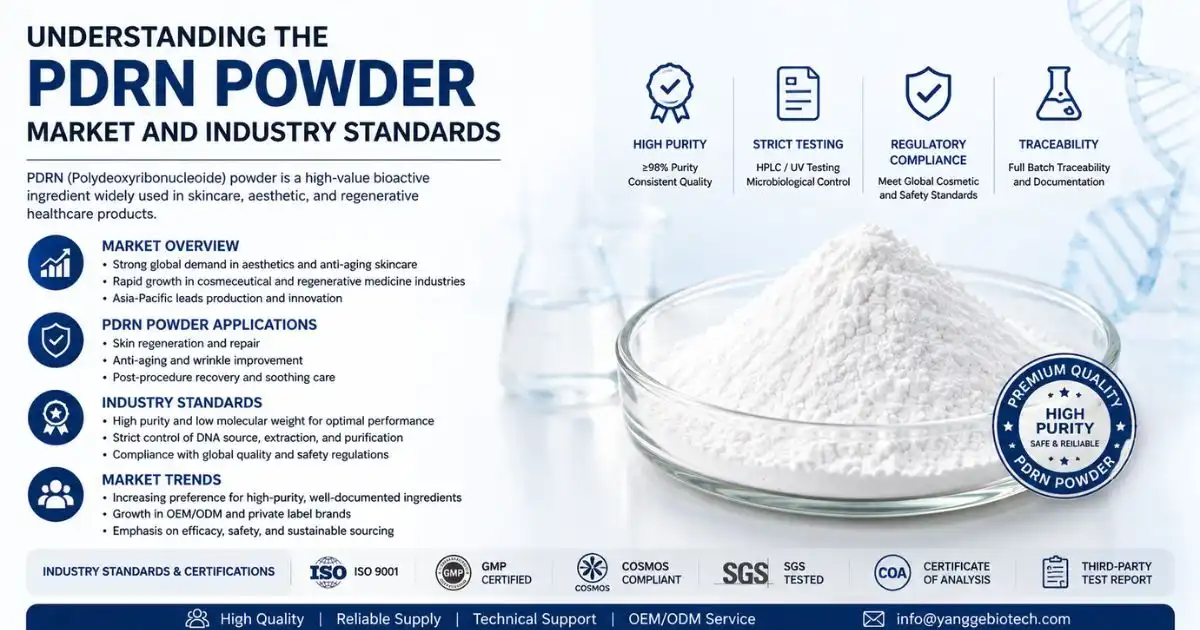
Professional Applications and Usage of PDRN Powder in Skin Care
Injectable Delivery: Mesotherapy and Skin Boosters
A lot of the time, hyaluronic acid or clean water are mixed with PDRN powder right before it is injected into the skin. The middle to deep layers of the skin are where this method works. Photoaging stops there, tissue moisture is restored, and healing time is sped up after laser or microneedling treatments. This is where the powder form comes in handy; it eliminates the risk of hydrolysis while being shipped around the world, and it lets hospitals or producers precisely control the final concentration.
Topical Cosmeceutical Formulations
Smaller molecular weight pieces (50–300 kDa) are better at getting through the skin when used on the outside. Barrier-repair serums, freeze-dried ampoule kits, and sheet masks are all easy to make with PDRN powder. "Preservative-free" and "fresh-activation" beauty items sell for a lot of money in the U.S. and Korea. These product positionings are supported by the powder packaging.
Here are the key formulation scenarios where PDRN powder delivers differentiated value:
- Mesotherapy injectables: If you mix PDRN powder (0.5–2% concentration) with sterile saline or HA, it sends a steady signal to the dermis to help fibroblasts grow and keep moisture in. This is much more than what actives put on the skin's surface can do.
- Serum and ampoule development: As little as 0.01 to 0.5% of PDRN powder in water-based solutions can improve barrier function, reduce redness after surgery, and make co-actives like niacinamide, peptides, and vitamins work better. This is what OEM makers say about their high-end "DNA repair" goods.
- Wound care and regenerative medicine: PDRN powder raises VEGF and angiogenesis at therapeutic concentrations, which is useful for wound care and regenerative medicine. This means it can be used in special wound care bandages for diabetic sores and wounds from surgery. This is a growing area of the U.S. drug market.
These application scenarios represent the three highest-value channels for PDRN powder procurement in the current North American and global aesthetic medicine market.
PDRN Powder vs. Other Professional Skin Care Actives
Research professionals and purchasing teams frequently ask how PDRN powder compares to well-known actives before they spend money on a formulation. This comparison is based on clinical writing that has already been done:
| Active Ingredient | Primary Mechanism | Key Limitation | PDRN Advantage |
|---|---|---|---|
| Hyaluronic Acid | Hydration via water retention | No cellular regenerative signal | PDRN stimulates endogenous repair |
| Collagen (hydrolyzed) | Surface film + dietary precursor | Poor dermal bioavailability topically | PDRN triggers native collagen synthesis |
| Peptides (e.g., Matrixyl) | Signal peptide for fibroblast activity | Stability and penetration challenges | PDRN operates at receptor-activation level |
| PRP (Platelet-Rich Plasma) | Growth factor release from autologous blood | Requires clinical setting; batch variability | PDRN is a standardized, scalable raw material |
A study published in 2014 in the Journal of Cosmetic Dermatology found that PDRN powder injected under the skin for 30 and 60 days made skin much more flexible and hydrated compared to controls that used saline. PDRN powder performs consistently and according to specifications, unlike PRP, which can be biologically different from patient to patient. This is very helpful for OEM product makers who want to ensure that clinical results are always the same.
Procurement Guide: Sourcing PDRN Powder for Professional Use
It's hard to find PDRN powder raw material that has been checked out. On the world market, low-purity goods are sold as pharmaceutical grade. The CPHI and in-cosmetics supply networks have both pointed this out as a problem.
When evaluating a PDRN powder supplier, prioritize these verification steps:
- Confirm assay purity via independent HPLC/UV test reports instead of paperwork from the supplier.
- Request endotoxin (LAL) test data and sterile certificates for injectable-grade applications.
- Validate source traceability — specifically that DNA originates from salmon milt, not alternative species.
- Review GMP or cGMP manufacturing compliance documentation.
- Confirm OD260/OD280 ratio is within 1.8–2.0, confirming DNA purity over protein contamination.
HPLC tests show that Yangge Biotech's PDRN powder is 99% pure. They have a minimum order size of 1 kg and 10 kg of stock on hand right now. You can also get OEM packing. There are no GMOs in any of the batches, and they have all been confirmed as HACCP, ISO9001, ISO22000, or Kosher. You can get a 1g sample for expert approval.
Safety, Side Effects, and Regulatory Considerations
Clinical Safety Profile
PDRN powder is safe, as shown by many written clinical studies. This is because the immune system doesn't respond strongly to it because it is a lot like human DNA. After getting a shot, most people only have short-term side effects, like redness or swelling at the injection site that goes away in 24 to 48 hours. It is even safer to use topical-grade PDRN powder in cosmetics, and it has not been linked to systemic sensitivity.
For injectable formulations in the U.S. market, regulatory classification typically falls under medical device or drug categories depending on final product claims. Regulatory affairs experts should be hired early on in the development process to help buying teams figure out how to best line up a product for 510(k), NDA, or cosmeceutical use. Yangge Biotech's PDRN powder is safe to use in cosmetics and can be added to the process of controlled formulation.
Conclusion
It is possible to defend PDRN powder because it is one of a kind when it comes to professional skin care products. Scientists use it to make a lot of different products, from topical cosmeceuticals to injectable skin boosters. It is very important for companies that work in medical esthetics, advanced skin care, and wound care because it works at the receptor level and has regenerative effects that have been shown in clinical trials. As markets in North America and around the world become more competitive, it is no longer a choice but to find a high-purity supply source that can be tracked.
FAQ
Q1: Is PDRN powder compatible with all skin types?
A: In fact, PDRN powder is good for all skin types because it works well with the body and lowers inflammation. This includes skin that is sensitive or that has just been through surgery. It's much less likely to be sensitive because its makeup is so close to human DNA.
Q2: How long does it take to see visible results from PDRN-based products?
A: Practitioners usually notice changes in the skin's elasticity and moisture levels after 4 to 8 weeks of injectable mesotherapy. Before the shield effect can be seen, topical forms need to be used every day for a longer time, usually 8–12 weeks.
Q3: What are the storage requirements for PDRN powder?
A: Place the item in its original container and make sure it stays out of the light and at 15–25°C. The shelf life is 24 months at this point. Solutions should be kept in the fridge between 2 and 8°C and used as soon as they are mixed again.
Q4: What is the difference between PDRN and PN (polynucleotide)?
A: PDRN powder refers to smaller pieces of DNA (50–1,500 kDa) that mainly work on the A2A receptor to help the body heal and reduce swelling. In medical equipment, longer-chain structures called PN are mostly used as skin fillers or to support moisture.
Q5: Can PDRN powder withstand autoclaving?
A: Yes. Because it is made of phosphodiester, it is safe at high temperatures. This means that it can be put in a standard autoclave (121°C, 15–20 minutes) and not lose much of its bioactivity. It works better than growth factors and actives based on peptides because of this.
Partner With Yangge Biotech A Trusted PDRN Powder Supplier for Professional Formulations
Yangge Biotech sells 99% pure PDRN powder that is fully certified (HACCP, ISO9001, ISO22000, and Kosher), comes in different packaging options, and has a program for scientific qualification that lets you send in a 1g sample. The R&D teams get help from our team, which makes formal papers and gives them advice on how to formulate things.Contact us directly at info@yanggebiotech.com to explore product specifications and request your sample today.
References
1. Guida, S., et al. "Polydeoxyribonucleotide (PDRN) Stimulates Human Fibroblast Proliferation." Journal of Dermatological Science, 2013.
2. Squadrito, F., et al. "Adenosine A2A Receptor Activation by PDRN Reduces Inflammation and Promotes Wound Repair." European Journal of Pharmacology, 2010.
3. Lee, J. H., et al. "Clinical Efficacy of Intradermal Polydeoxyribonucleotide for Skin Rejuvenation." Journal of Cosmetic Dermatology, 2014.
4. Galeano, M., et al. "Polydeoxyribonucleotide Stimulates Angiogenesis and Wound Healing in Diabetic Rats." Surgery, 2008.
5. Bitto, A., et al. "PDRN Reduces TNF-α and Promotes Tissue Healing Via Adenosine Receptor Agonism." Pharmacological Research, 2011.
6. Veronesi, F., et al. "Polydeoxyribonucleotide Improves Outcomes in Osteoarthritis by Modulating Inflammatory Mediators." Journal of Orthopaedic Research, 2015.

Based on your location and order quantity, you will have the opportunity to receive a limited time free shipping promotion!
Who we are
Popular Blogs