What Is Liposomal Glutathione Powder Used For?
Liposomal Glutathione Powder from Yangge Biotech is a premium-quality glutathione ingredient formulated with advanced liposomal delivery technology to support improved stability and bioavailability. It is suitable for use in dietary supplements, functional foods, beverages, capsules, tablets, and customized nutritional formulations. Yangge Biotech provides bulk supply, OEM/ODM services, customized specifications, and international shipping for brands, distributors, and manufacturers worldwide.
For product specifications, COA, samples, MOQ, bulk pricing, or OEM/ODM inquiries, please contact Yangge Biotech or email info@yanggebiotech.com.
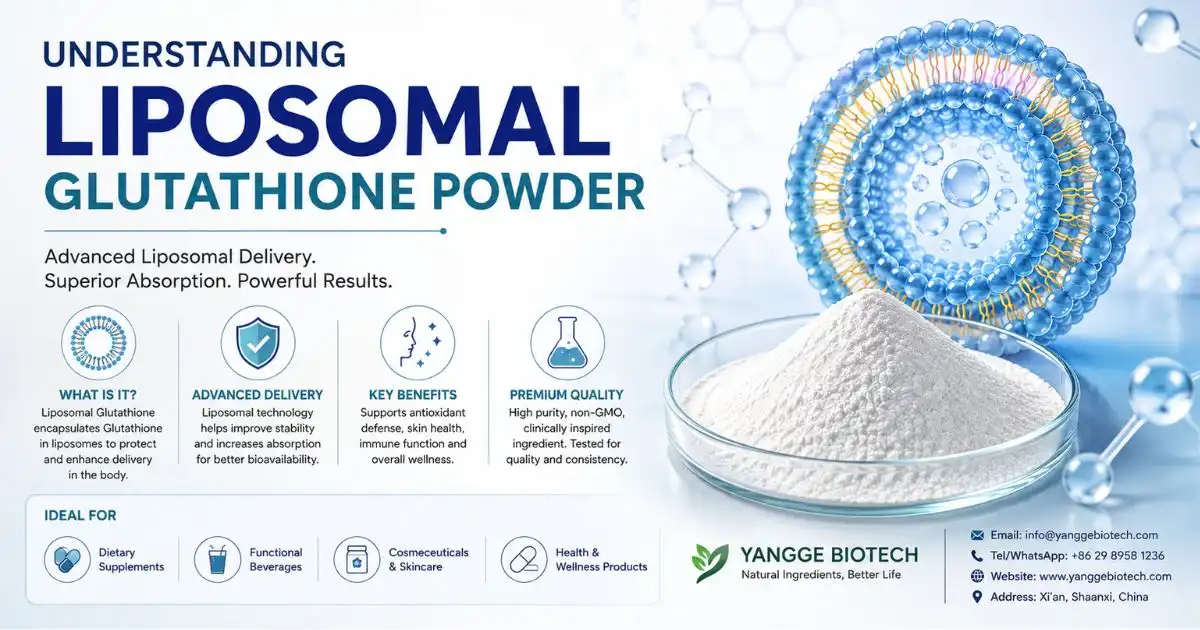
Liposomal glutathione powder is used primarily to enhance cellular antioxidant defense, support detoxification pathways, and improve oral bioavailability of reduced glutathione in dietary supplements, functional beverages, and cosmetic formulations. By encapsulating glutathione within phospholipid vesicles, this advanced delivery system protects the active compound from digestive degradation and enables efficient absorption into systemic circulation. Its applications span anti-aging products, liver health supplements, skin-brightening formulations, and immune support solutions, making it a valuable ingredient for manufacturers seeking premium nutraceutical and cosmeceutical offerings.
Understanding Liposomal Glutathione Powder
Glutathione is one of the most important antioxidants inside cells. It protects cells from oxidative stress and helps the body's detoxification processes. Traditional oral glutathione pills have a big problem: they aren't very bioavailable because stomach acid and enzymes in the digestive system break them down. Liposomal Glutathione transport technology gets around this problem by putting glutathione molecules inside phospholipid spheres that look like the membranes of human cells.
The phospholipid membrane protects the active ingredient from tough digestive conditions. This lets it get into the bloodstream without any damage and then be taken up by cells. With this new structure, glutathione goes from being a compound that isn't well absorbed to one that is. This makes it a highly bioavailable ingredient that can be used in high-end supplement formulations. Studies show that liposomal encapsulation can greatly improve the absorption rates of glutathione compared to traditional oral forms. This can lead to measurable increases in blood glutathione levels.
Technical Characteristics of Liposomal Encapsulation
Dynamic Light Scattering analysis shows that the particles in Yangge Biotech's Liposomal Glutathione powder are usually between 50nm and 150nm in size. The encapsulation efficiency is higher than 90% in optimized formulations, which means that most of the glutathione stays safe inside the phospholipid vesicles. The powder is a white to pale yellow substance that doesn't smell much like sulfur. This is a big improvement over regular reduced glutathione, which usually has a bad smell. These technical features make it easier to make a wide range of products, such as capsules, oral liquids, functional beverages, and beauty-from-within products.
Stability and Shelf Life Considerations
When purchasing professionals look at glutathione ingredients, stability is one of the most important things they look at. Liposomal encapsulation makes things much more stable by keeping the reduced form from oxidizing while they are being stored. Liposomal Glutathione powder stays active for two years if it is kept in the right way, in cases that are tightly closed and kept out of light. This longer-term steadiness lowers the risk of running out of inventory and makes manufacturing more flexible for brands that are making goods with longer development cycles or that need to be shipped around the world.
Core Applications of Liposomal Glutathione Powder in B2B Markets
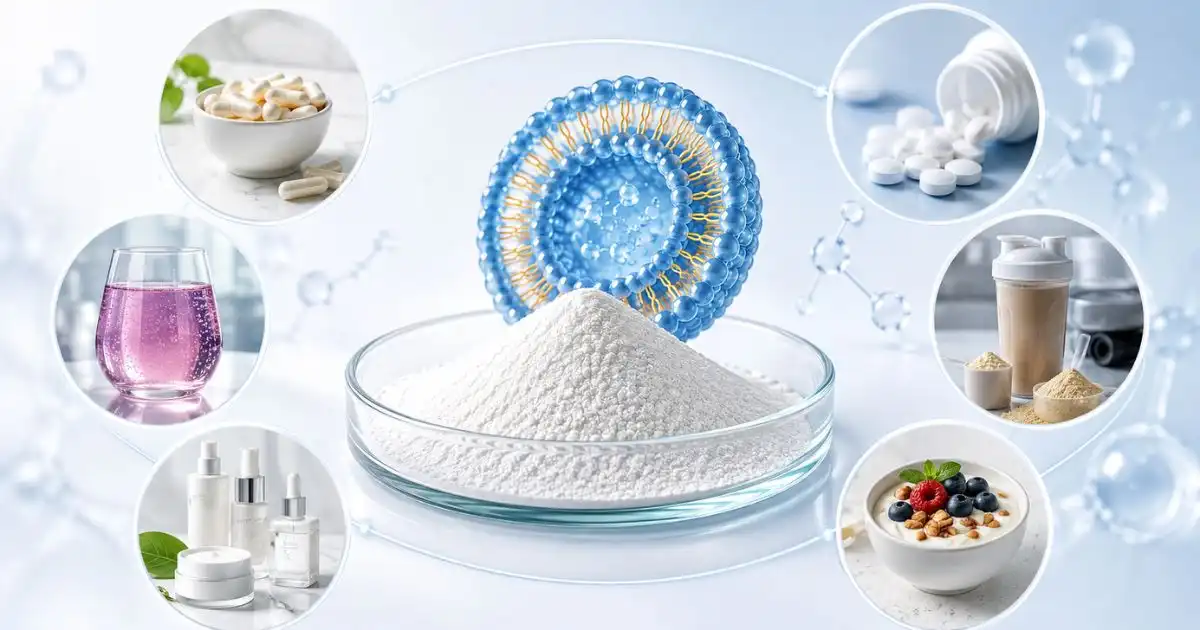
Liposomal Glutathione powder can be used in a lot of different types of products in the pharmaceutical, cosmetic, and nutraceutical industries because it is so flexible. When procurement teams understand these uses, they can find new market possibilities and make more focused product plans.
Detoxification and Liver Health Support
Liposomal Glutathione is an important part of cleansing plans and vitamins for liver health. Glutathione is very important for Phase II detoxification reactions in the liver. This is where harmful compounds are joined together and made ready to be eliminated. Liposomal Glutathione is being used more and more by companies that make liver support items to make sure that the liver organs get enough of this important antioxidant.
The better bioavailability that liposomal delivery offers is especially helpful for products that are meant to treat liver damage caused by booze, environmental toxins, or drugs. This ingredient is very important for brands that want to stand out in the premium wellness market and make claims about how well their products work.
Anti-Aging and Skin Health Formulations
The cosmetics industry loves Liposomal Glutathione because it makes skin look younger and brighter. Glutathione affects the pathways that make melanin, which is why it is used in products that claim to improve skin tone and reduce hyperpigmentation. Liposomal Glutathione is becoming a more important ingredient in beauty-from-within supplements because people want to use oral treatments instead of topical ones.
Because it is an antioxidant, it also slows down the aging process of cells, which makes it useful for making all-around anti-aging supplements. Liposomal Glutathione is very useful for procurement professionals looking for ingredients for beauty products that you eat or drink because it is better absorbed than other oral forms.
Immune System Enhancement
Liposomal Glutathione powder can also be used to improve the health of your immune system. Glutathione is an important part of how lymphocytes work and how the immune system works. When the immune system is under a lot of stress, cellular glutathione levels can drop, which could make the immune system less effective.
Liposomal Glutathione is added by supplement companies to immune support formulas to keep immune cells working at their best. The higher bioavailability makes sure that supplements work to restore and keep healthy levels of glutathione, which helps both the innate and adaptive immune systems. This practice has become more important as people choose supplements that are good for their immunity systems.
Comparing Liposomal Glutathione Powder with Other Supplement Forms
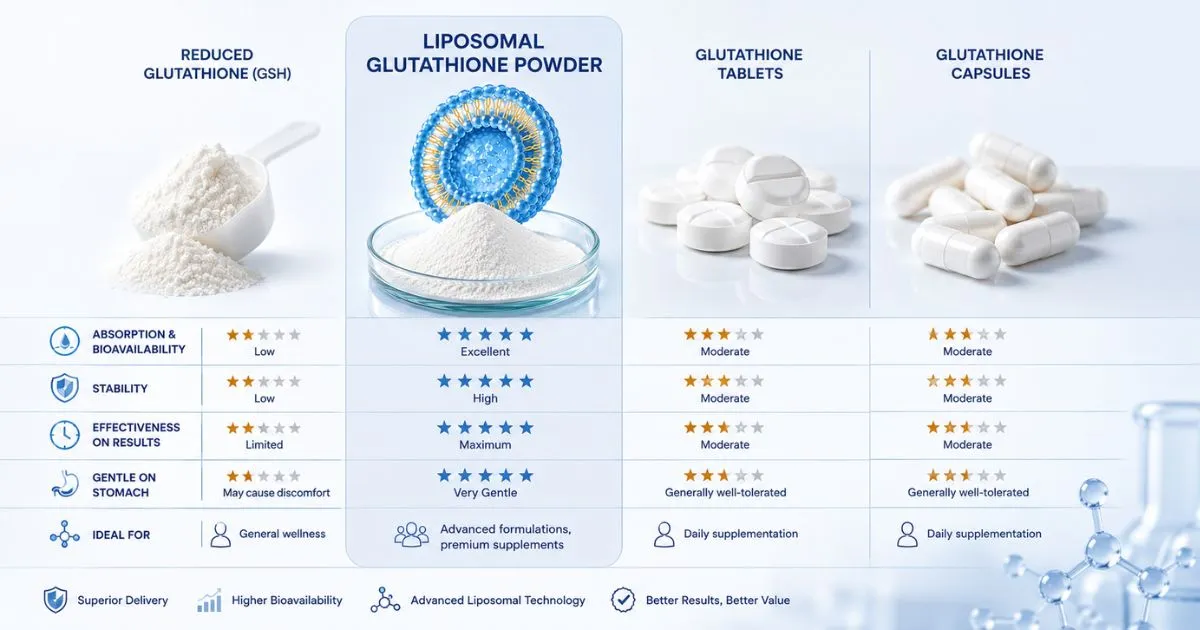
Before making a purchase decision, it's important to carefully compare the different glutathione delivery systems to find the best one for performance, price, and positioning in the market. Each style has its own pros and cons that affect how formulations are made and how appealing they are to the target market.
| Delivery Format | Bioavailability | Cost Factor | Best Application |
|---|---|---|---|
| Liposomal Powder | 85–95% encapsulation efficiency | Moderate to High | High-end vitamins and healthy drinks |
| Standard Oral Tablets | 10 to 20 percent estimated absorption | Low | Products for people on a budget |
| IV Administration | Almost 100% | Very High | Only in clinical settings |
| N-Acetylcysteine (Precursor) | Changeable (indirect path) | Low to Moderate | Support for antioxidants in general |
Liposomal Glutathione is a medium-sized supplement that strikes a balance between better bioavailability and lower production costs. Even tho intravenous glutathione has the best absorption, it is still not useful for market goods and is hard to regulate. Standard oral glutathione pills and capsules are less expensive, but they are not well absorbed, which makes them less effective and less satisfying for customers. Indirectly, precursors like N-Acetylcysteine help make glutathione, but it depends on the person's metabolic ability and the nutrients that are already present.
Liposomal Glutathione powder's higher cost as a raw material is justified by its proven effectiveness and ability to set itself apart from other products in the same category. With this technology, companies can back up claims about absorption and market their products as more advanced alternatives to regular supplements. This positioning approach works especially well with direct-to-consumer brands that focus on science progress and results that can be measured.
Procurement Guide: How to Source Liposomal Glutathione Powder for Business
To get Liposomal Glutathione powder, you need to carefully look at the supplier's skills, quality control systems, and business terms. The following approach helps procurement workers make important decisions.
Quality Certifications and Compliance
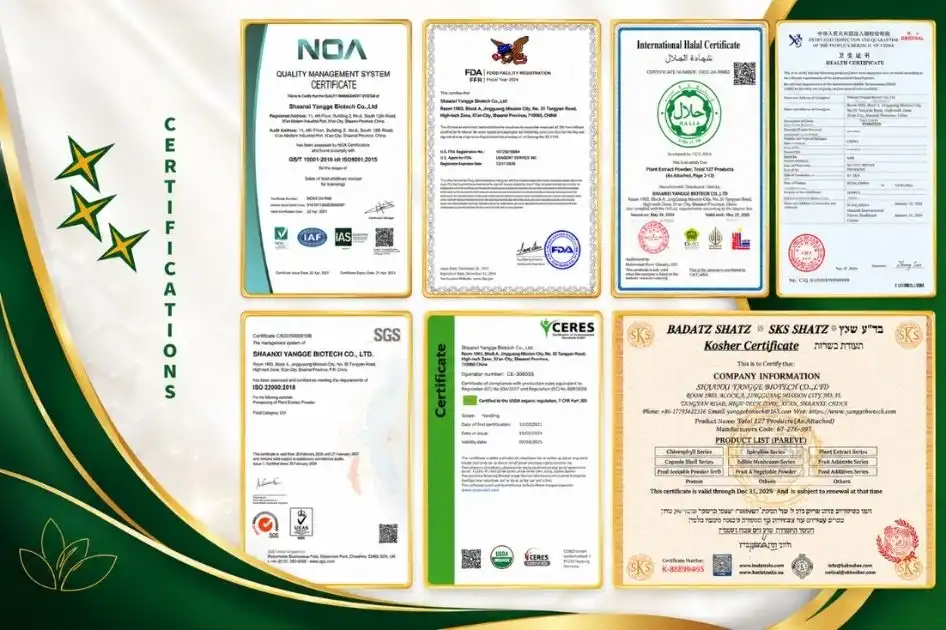
Companies that make ingredients for regulated markets need to keep up with a lot of different quality certifications. ISO9001 for quality management systems, ISO22000 for food safety management, HACCP for hazard analysis routines, and religion licenses like Kosher and Halal for certain markets are all necessary.
All of these certificates show that Yangge Biotech is committed to meeting world quality standards. Teams in charge of buying things should make sure that the providers they work with have up-to-date licensing paperwork and can give them Certificates of Analysis for every batch of production. These quality guaranties keep brands safe from problems with the law and disruptions in the supply chain.
Technical Specifications and Testing Capabilities
In addition to basic certificates, sellers should give full technical details, such as data on how well the particles are encapsulated, how they are distributed in size, and the results of stability tests. Some important quality control tests for Liposomal Glutathione are the HPLC assay, which checks for reduced glutathione content, the Dynamic Light Scattering particle size analysis, the ultra-centrifugation encapsulation efficiency test, and the Transmission Electron Microscopy test, which checks the shape of the vesicles visually. Suppliers who can provide detailed analysis data show they have the technical know-how and honesty that helps buyers make smart choices.
Customization and OEM Capabilities
In order to set one brand apart from others, custom specs are often needed in addition to standard catalog goods. When looking at possible providers, see how flexible they are with concentration requirements (for example, Yangge Biotech offers a range of 50% to 70%), custom particle size profiles, and helping with formulation development.
With OEM and ODM capabilities, brands can create their own formulas thru private labeling agreements. Suppliers who offer these services add strategic value beyond just providing basic ingredients; they act as development partners instead of just transactional vendors. This joint method cuts down on formulation risks and speeds up the product development process.
Inventory Availability and Supply Chain Reliability
Supply chain consistency is an important thing to think about when buying things, especially for goods that are already popular. Suppliers who keep a lot of stock on hand, like Yangge, can reply quickly to orders and make changes to production without having to wait for longer lead times.
Check to see if the supplier has enough capacity to handle both the launch of new products and future volume increases as the products become more popular. Reliability in the supply chain also includes the ability to change the way things are packaged, experience sending goods internationally, and correct paperwork for customs clearing. These operating skills reduce the risk of disruptions and help make sure that products are always available.
Safe Usage and Dosage Recommendations for Liposomal Glutathione
The right dosage instructions make sure that the product is safe, that regulations are followed, and that customers are happy. Specific suggestions should be made with the help of trained healthcare workers and in line with local laws, but for now, basic guidelines should help with the first steps of formulation.
Recommended Dosage Ranges
Glutathione supplements are usually studied at doses between 250 mg and 1000 mg per day in clinical trials. Liposomal Glutathione forms are often more beneficial at smaller doses because they are better absorbed. Products meant to help with antioxidants in general usually have 250 to 500 mg per serving. Formulations meant to help with specific health problems, like liver support or skin brightening, may have 500 to 1000 mg daily.
Because liposomal delivery makes the drug more bioavailable, these doses have a bigger effect on the body than comparable amounts of non-Liposomal Glutathione. When making product specifications, procurement teams should think about what the target market wants, how they want to position themselves in the market, and how much it will cost.
Safety Profile and Contraindications
Taking glutathione supplements has been shown to be very safe in clinical studies, with few side effects even at higher doses. Mild stomach problems can happen sometimes, but they usually go away after a while or when the dose is changed. Because glutathione contains cysteine, people who are sensitive to sulfur should be careful.
As with any food product, women who are pregnant or nursing should talk to their doctors before taking this one. A lot of knowledge about safety helps with regulatory submissions and gives marketing teams trust in how they present products. It is recommended that brands put the right warnings on their labels to follow local laws and best practices in the industry.
Conclusion
Liposomal Glutathione powder is a new technology that solves the problems with traditional glutathione supplements' absorption. This lets companies make high-quality goods in the nutraceutical, cosmetic, and functional food categories. The phospholipid encapsulation method keeps glutathione from being broken down by digestion and makes it easier for cells to take it up, which leads to changes in absorption and effectiveness that can be seen.
The fact that the ingredient can be used for liver health, immune support, anti-aging, and skin brightening shows how versatile it is and how much of a market there is for it. To make sure that products always work right and that regulations are followed, it's important to carefully look at a supplier's quality certifications, technical skills, ability to make changes, and dependability of the supply chain.
FAQ
What makes liposomal glutathione more effective than regular glutathione supplements?
Liposomal encapsulation protects glutathione molecules with a phospholipid membrane that stops them from breaking down in the digestive system. This way of delivering the drug allows for much higher absorption rates than regular oral forms. This leads to higher amounts of Liposomal Glutathione in the blood and better uptake by cells.
How should B2B buyers verify the quality of liposomal glutathione powder?
As part of quality control, seller certificates like ISO, HACCP, and Kosher should be looked at, batch-specific Certificates of Analysis should be asked for to show how well the particles are encapsulated and how they are distributed in size, and stability testing data should be looked at. Advanced buyers can have a third party test the product on their own to make sure it meets the technical requirements.
Can liposomal glutathione powder be formulated into various product types?
Yes, the powder format gives you a lot of options for how to make the medicine. It can be put into pills, capsules, oral liquids, functional drinks, and beauty-from-within products. The color ranges from white to pale yellow, and there isn't much of a smell. This makes it easy to mix into different formulations without changing the taste properties.
What is the typical shelf life for liposomal glutathione powder?
Liposomal Glutathione powder stays stable for about two years if it is kept in the right way, in sealed containers that are kept away from light and moisture. The packaging method stops oxidation, which would break down reduced glutathione while it is being stored.
Partner with Yangge Biotech for Premium Liposomal Glutathione Supply
Yangge Biotech makes high-quality Liposomal Glutathione powder for brands that want to work with reputable providers who have a track record of technical skill and full certifications. Our building has ISO9001, ISO22000, HACCP, Kosher, and Halal certifications, which means that your formulations will meet strict international standards. Our specifications are flexible, ranging from 50% to 70% concentration, and the particle size profiles can be changed to fit your needs. Our experienced research and development team and OEM/ODM capabilities help with private label development.
We keep 500–1000 kg of stock on hand so that orders can be filled quickly, and the products have a shelf life of two years, which gives your supply chain freedom. This gives your business the stability it needs. Our dedication goes beyond just supplying ingredients; we also act as strategic development partners, helping you reach your recipe goals from the initial idea to the final product. Sustainable sourcing methods and being able to track food from farm to table show that we care about the environment and being open about our supply chain.
Contact us or email our team at info@yanggebiotech.com to talk about the needs of your project, get detailed paperwork, or set up a sample review. Liposomal Glutathione powder from a company that cares about quality, creativity, and partnerships can help you make your product line stronger.
References
1. Schmitt B, Vicenzi M, Garrel C, Denis FM. Effects of N-acetylcysteine, oral glutathione (GSH) and a novel sublingual form of GSH on oxidative stress markers: A comparative crossover study. Redox Biology. 2015;6:198-205.
2. Sinha R, Sinha I, Calcagnotto A, et al. Oral supplementation with liposomal glutathione elevates body stores of glutathione and markers of immune function. European Journal of Clinical Nutrition. 2018;72(1):105-111.
3. Richie JP, Nichenametla S, Neidig W, et al. Randomized controlled trial of oral glutathione supplementation on body stores of glutathione. European Journal of Nutrition. 2015;54(2):251-263.
4. Allen J, Bradley RD. Effects of oral glutathione supplementation on systemic oxidative stress biomarkers in human volunteers. Journal of Alternative and Complementary Medicine. 2011;17(9):827-833.
5. Watanabe F, Hashizume E, Chan GP, Kamimura A. Skin-whitening and skin-condition-improving effects of topical oxidized glutathione: a double-blind and placebo-controlled clinical trial in healthy women. Clinical, Cosmetic and Investigational Dermatology. 2014;7:307-317.
6. Witschi A, Reddy S, Stofer B, Lauterburg BH. The systemic availability of oral glutathione. European Journal of Clinical Pharmacology. 1992;43(6):667-669.

Based on your location and order quantity, you will have the opportunity to receive a limited time free shipping promotion!
Who we are
Popular Blogs