Top Matcha Powder Suppliers for B2B Buyers - Yangge
It can be hard for buying managers to find trustworthy Matcha Powder sellers because the market is full of companies with mixed quality and unclear certifications. Yangge Biotech Co., Ltd. is a reliable partner for business buyers looking for high-quality Matcha Powder that can be tracked back to its source, can be customized in a wide range of ways, and meets all international standards.
Our KOSHER and USP-grade Matcha Powder, which comes in large sizes starting at 1 ton, solves the main problems that health supplement, beverage, and cosmetic formulators face when they need to make sure that each batch is the same and follows the rules. Yangge offers solutions that turn procurement problems into competitive benefits. Their specs range from 800 to 3000 mesh, and they can work with any OEM.
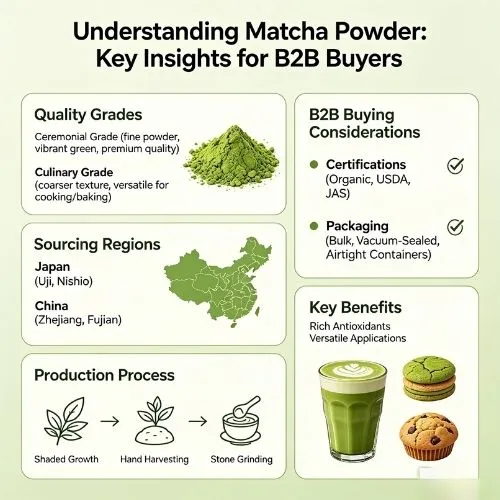
Understanding Matcha Powder: Key Insights for B2B Buyers
Matcha is a very strong type of green tea made from Camellia sinensis leaves that have been grown in shade. Twenty to thirty days before harvest, the shading process makes the plants make too much chlorophyll and builds up special amino acids like L-theanine. This farming method sets real Matcha Powder apart from the many generic green tea powders that flood trade markets.
Grade Classifications and Industrial Applications
There are two main types of Matcha Powder in the industry: ceremonial-grade Matcha Powder, which is used to make traditional tea, and culinary-grade Matcha Powder, which is used to make food and drinks. The ceremonial grades have a bright green color and a light sweetness, while the cooking grades have strong flavors that work well in baking, smoothies, and functional foods. To get the best value for money without lowering quality standards, procurement managers need to make sure that the grade they choose matches the needs of the final product.
Critical Quality Indicators for Bulk Procurement
The spread of particle sizes has a direct effect on the stability of suspensions in liquid uses. The microparticles in premium commercial Matcha Powder stay between 1,000 and 2,000 mesh, which is about 5 to 15 microns. This gives the Matcha Powder a better taste and more consistent appearance. Chemical makeup standards say that the wetness content must be less than 4% to stop the growth of microbes and the breakdown of enzymes while the food is being stored.
For functional effectiveness claims, the phytochemical makeup must show that it has at least 5% total catechins and more than 2% L-theanine. Color measurement using CIELAB analysis is an objective way to check the quality of the processing. High negative a* values mean that the antioxidant capacity has been maintained.
Common Procurement Challenges
Verification of authenticity is still very important because the market is still being diluted with lower-quality green tea powders or artificial colors. Heavy metals, herbicide leftovers, and microbiological threats can contaminate food, so it needs to be tested carefully according to FDA, EU, and GMP guidelines. It's hard to keep things fresh because oxidation destroys both the taste and nutritional worth of food. These routes of degradation can be successfully blocked by suppliers who offer nitrogen-flushed packaging and cold-chain services.
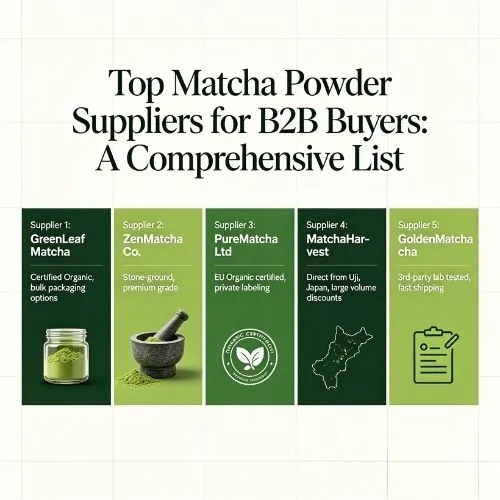
Top Matcha Powder Suppliers for B2B Buyers: A Comprehensive List
When choosing providers, you need to carefully look at their success in a number of different areas. Long-term partnership success depends on a lot of things, like consistent products, a wide range of certifications, the ability to produce large amounts of goods, the quality of professional help, and the service provided after the sale.
Yangge Biotech: Premium Quality and Customization Excellence
Yangge Biotech makes natural plant products that are used in drinks, foods, supplements, and superfoods. Our Matcha Powder comes from carefully choosing leaves that were grown in the shade and then baked at low temperatures and ground very finely to keep the medicinal and volatile aromatic chemicals. We keep our ISO, HACCP, KOSHER, and HALAL certifications up to date, which makes sure we follow a wide range of foreign rules.
Our product line includes different mesh sizes (800, 2000, and 3000 mesh) to meet the needs of different formulations. Tea polyphenols are at the center of the active ingredient profile. They work as powerful antioxidants in a wide range of applications. As of right now, we have 1-ton stocks of grades KOSHER and USP that are especially made for making food and drinks.
Yangge's service is different because it offers full customization support. As part of our mixed services, we can mix Matcha Powder with other healthy ingredients based on what the client wants, making each product stand out. Customized services include changing specifications, changing packing, and adding logo designs. This adaptability solves the problem of finding sellers who can meet the unique needs of each brand without making it hard to meet minimum order requirements.
Our factory follows GMP guidelines and has specialized R&D and production teams that offer technical help 24 hours a day, 7 days a week. We put sustainability first by working closely with farming communities to make sure that food can be tracked from farm to table in a way that meets the standards of natural and organic certification. Using renewable energy and following known environmental practices show a dedication to responsible sourcing that connects with end customers who care more and more about sustainability.
Comparative Supplier Landscape
The global network of Matcha Powder suppliers includes specialized Japanese exporters who offer traditional ceremonial grades at higher prices, cost-effective Chinese manufacturers who offer culinary grades that can be used in large quantities, and hybrid suppliers who balance quality with scalability. Japanese sellers usually put a lot of emphasis on geographical origin certificates and handcrafted methods of production.
Chinese providers use the large scale of agriculture and advanced processing technology to offer low prices without lowering quality standards. Hybrid suppliers like Yangge combine quality control standards with adaptable customization and quick technology help. They see themselves as all-around solution providers instead of just selling goods.
Procurement managers should judge providers based on how open they are about their certifications, how they test samples, how much they require as a minimum order, how reliable their lead times are, and how good their technical paperwork is. When suppliers give full testing results that include heavy metal screening, pesticide residue analysis, bacterial testing, and nutritional profiling, it shows that they are very good at running their businesses, which means that buyers don't have to do as much quality control work.
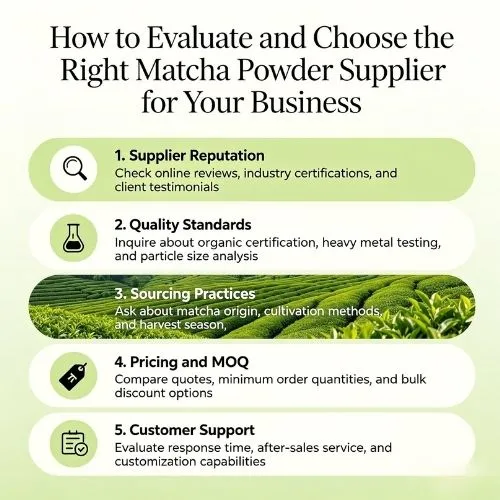
How to Evaluate and Choose the Right Matcha Powder Supplier for Your Business
Costly mistakes in choosing a provider can be avoided with structured evaluation systems. To find a good balance between quality needs and budget limitations, you need to know how differences in specifications affect prices and how promises to buy a lot of something affect your negotiating power.
Decision Framework for Supplier Assessment
Verification of certification is the first step in the review process. ISO certifications show that a quality management system is mature, and HACCP standards show that food safety protocols are being followed. KOSHER and HALAL approvals make it easier for goods that are aimed at certain groups of people to reach more customers. Organic approvals check the farming methods and the food's processing chain of custody, which makes sure that natural product claims are true.
Assessing production capacity keeps supplies from being interrupted when demand changes or when a business is growing. Suppliers should show that they can make things on a large or small scale by showing proof of their production numbers, inventory management systems, and transportation partnerships that can keep delivery dates consistent. Yangge keeps key inventory positions and set up global transport networks to make sure that deliveries happen on time and in line with the needs of production planning.
Yangge's Competitive Positioning
Value optimization, not lowest-cost placement, guides how we set our prices. We find the right mix between high-quality sourcing and operating speed so that we can offer low prices without sacrificing quality. Clear price models get rid of hidden costs, and structures with multiple levels of sales reward partners who stay with the business for a long time.
Customer reviews from companies that make health supplements rave about how consistent our batches are and how quickly we can help with technical issues. A functional food company praised our recipe help in creating a line of protein powders with Matcha Powder in them, stating that our R&D team's knowledge of extraction methods and concentration specifications sped up the time it took to launch the products. Manufacturers of drinks like our OEM packaging options and image customization services, which make it easier to use the same name on a variety of products.
Authenticity Verification and Quality Assurance
Documentation openness tells the difference between trustworthy providers and dishonest commodity traders. Ask for detailed sheets that list the plants that were used, where they came from, how they were processed, the sizes of the particles, the phytochemical profiles, and the results of any contamination tests that were done. During supplier site checks, the conditions of the processing areas, quality control labs, and storage areas are directly observed. Video views of facilities are useful when you can't visit in person because of trip issues.
Testing samples by independent third-party labs backs up what suppliers say. The testing procedures should include smelling and tasting, measuring particle size, measuring moisture content, counting catechins, checking for heavy metals, checking for pesticide residues, and testing for microbes. When there is a consistent link between supplier paperwork and independent testing results, it builds trust and makes it easier to work together in the long run.
Leveraging Matcha Powder in Your Product Line: Applications and Trends
It can be used in a lot of different product groups, and each one uses its functional and taste properties in a unique way. Application success depends on the grade chosen, the concentration level, and the way the ingredients are paired to work best together.
Industry-Specific Applications
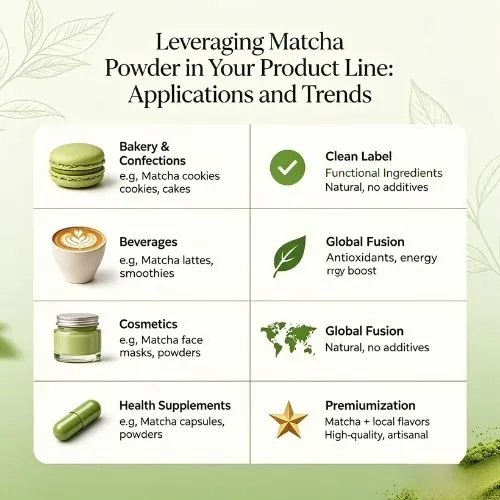
Food companies use culinary-grade Matcha Powder in the making of cookies, candies, ice cream, and snacks. The strong taste profile can handle being heated up, and the natural green coloring makes it look nice. Matcha Powder is used by beverage companies to make ready-to-drink coffee, energy drinks, smoothie mixes, and latte mixes. Better suspension properties keep things from settling and keep the look consistent throughout the shelf life.
Dietary supplement companies turn Matcha Powder into pills, tablets, and powder mixes that help the brain, the metabolism, and the body's antioxidant defenses. The high catechin content and L-theanine profile back up useful claims that are based on clinical studies. Scientists who make cosmetics use Matcha Powder's antioxidant properties to make anti-aging products and its anti-inflammatory properties for sensitive skin products.
Contemporary Market Trends
Reformulation efforts in all food and drink categories are driven by consumer desire for organic and clean-label goods. Matcha Powder's natural origin and minimum handling are in line with strategies for selling products with clean labels. More people are interested in functional foods, which means there are chances to come up with new ways to use Matcha Powder's unique phytochemical profile to improve brain health, lower stress, and improve digestive health.
Sustainability factors are becoming more and more important in purchasing decisions. Buyers give more weight to providers who care about the environment, source goods in a decent way, and make the supply chain clear. These buying requirements are met by Yangge's community-based sustainable sourcing model and the integration of green energy. This lets buyers meet their corporate social responsibility goals while also getting high-quality raw materials.
Yangge's Innovation Support
Our method to working together goes beyond simple supply agreements. R&D teams work directly with client formulation engineers to find the best ways to incorporate Matcha Powder, tackling issues such as hiding flavors, keeping colors stable, and increasing digestibility. We provide detailed documents that speeds up the development of new products. This documentation includes information about the extraction method, the concentration, and how to use the product. Custom mixing services let you make quick prototypes of your own formulas without having to buy blending tools or keep track of your ingredients.
Procurement Process: How to Buy Matcha Powder Bulk from Yangge
Transparent purchase methods cut down on delays and speed up the buying process. It's easier to work together when everyone knows about the steps of the process and the decision points.
Step-by-Step Procurement Roadmap
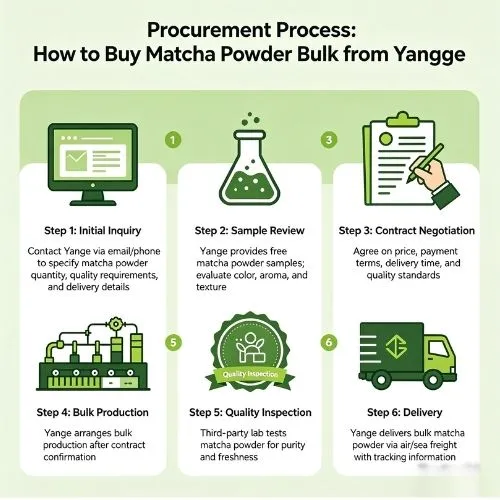
The first step is to get in touch with us directly by email at info@yanggebiotech.com or through our online chat system. Procurement managers give information about the needs of applications, expected volumes, preferred specifications, and certifications. In response, our expert team sends product suggestions, specification sheets, price quotes, and relevant testing documents.
Sample requests come after informal talks. We give you example samples that match the specs you give us, so you can test the formulation and check the quality. Once you approve a sample, production can begin. Lead times are shared based on the number of orders and the level of customization.
Production follows GMP guidelines and includes quality control tests that are unique to each batch. Certificates of Analysis, origin certificates, and regulatory compliance paperwork that is specific to the needs of the target market are all examples of pre-shipment documents. Logistics management includes things like choosing the right packaging, the best way to ship, filling out customs paperwork, and keeping track of deliveries.
Bulk Purchasing Models
Subscription models are good for buyers whose needs are known and will come up again and again. They offer stable prices and sure sharing when supply is limited. When you buy in bulk, you get better prices for bigger orders, which helps buyers with extra space manage their cash flow. Spot sales allow for trial buying and changes in demand without requiring a long-term commitment.
After-Sales Support and Partnership Development
Quality verification is more than just accepting the delivery. We keep lines of communication open so that we can talk about any quality issues or application problems that come up during product integration. The reordering process is sped up by using standard specs and quality standards, which lowers the clerical work needed for repeat purchases. Scalability support helps sellers handle business growth by increasing production capacity and transportation capabilities as customer needs change. Matcha Powder bulk solutions remain central to our client success stories.
Conclusion
Quality control, legal compliance, supply dependability, and cost effectiveness must all be considered when sourcing premium Matcha Powder. Yangge Biotech's all-around approach to these complex buying problems includes certified goods, clear methods, the ability to customize, and partnerships for expert support. Our KOSHER and USP-grade Matcha Powder, which is offered in bulk with different mesh sizes and OEM possibilities, is the basis for successful product development in a number of different businesses. Yangge is a great long-term provider for B2B buyers who are committed to greatness because they use sustainable sourcing methods, advanced processing technology, and service that focuses on the customer.
Partner with Yangge: Your Trusted Matcha Powder Supplier for Long-Term Success
Yangge Biotech does more than just give basic materials. We offer complete raw material solutions that help makers of health supplements, functional foods, and drinks deal with the complicated problems they face today. Our Matcha Powder source can offer high-quality goods along with technical know-how, easy customization, and an unwavering dedication to quality standards.
Whether you're coming up with new ways to make drinks, adding more food supplements, or improving your cosmetics line, our team is ready to help you reach your buying goals through quick service and dependable supply. Contact us or email at info@yanggebiotech.com right now to get samples, talk about your needs, and find out how our Matcha Powder options can help your products stand out and make you more competitive in the market.
FAQ
Q: Can we get some samples to test before purchasing?
A: Of course, we can provide free samples of 20 to 100 grams, but the shipping cost is at the customer's expense. The shipping cost can be deducted from the next order, or the samples can be sent through your courier account.
Q: Do your products have relevant certifications?
A: Yes, our products are certified for HALAL, ISO, HACCP, Kosher, and other certifications.
Q: What is the minimum order quantity (MOQ)?
A: Small batches of samples can be customized according to your requirements.
Q: Do you offer OEM and ODM services? Can the formula be customized based on our own?
A: Of course, we provide ODM and OEM services to many customers. Our product range includes softgels, capsules, tablets, sachets, granules, and private label services. Simply contact us and let us know your requirements. Our experienced R&D team can also develop new products with specific formulas.
Please contact us to design your own branded products.
Q: How do you handle quality complaints?
A: First, we have a comprehensive quality control SOP. We provide authoritative third-party inspection reports for almost all products before shipment to minimize the possibility of quality issues. Second, we have a comprehensive return and exchange procedure. If there is a genuine quality dispute, we will strictly follow the SOP.
Q: How do you ship? How long does delivery take?
A: For small orders, we typically use DHL, UPS, EMS, FedEx, or TNT. Delivery typically takes 3-7 days. We also offer air and sea freight services. We have a strong freight forwarding team and can provide you with a one-stop service, including DDP and DDU.
Q: What are your payment terms?
A: 100% prepayment, payable by T/T, Western Union, MoneyGram, or PayPal.
Q: What is the shelf life of your products?
A: 2 years with proper storage.
References
1. Hu, Frank B. "Nutritional Properties and Health Benefits of Matcha Green Tea." Harvard T.H. Chan School of Public Health, Department of Nutrition Research Publications, 2022.
2. Japanese Agricultural Standards Association. "Quality Specifications and Grading Standards for Commercial Matcha Powder Production." JAS Certification Guidelines for Tea Products, 2021.
3. Chen, Wei and Tanaka, Hiroshi. "Phytochemical Composition and Antioxidant Capacity of Shade-Grown Camellia Sinensis: A Comparative Analysis." Journal of Agricultural and Food Chemistry, Volume 68, 2020.
4. International Organization for Standardization. "Food Safety Management Systems Requirements for Organizations in the Food Chain." ISO 22000:2018 Standard Documentation, 2018.
5. United States Pharmacopeia. "Quality Standards for Botanical Dietary Supplements and Herbal Ingredients." USP-NF Dietary Supplements Compendium, 2023.
6. Wong, Sarah and Martinez, Elena. "Global Market Trends in Functional Beverages and Clean-Label Food Ingredients." B2B Procurement Insights for Food Manufacturing, Industry Analysis Report, 2023.

Based on your location and order quantity, you will have the opportunity to receive a limited time free shipping promotion!
Who we are
Popular Blogs