Is shiitake good for the gut?
People who are interested in stomach health have found that shiitake mushrooms are very helpful. The clear answer is that shiitake is very good for the gut. Researchers have found that shiitake mushroom extract, which is high in beta-glucans and lentinan, helps the gut bacteria variety and the function of the intestinal barrier in a big way. As prebiotics, these functional polysaccharides feed good bacteria and change how the immune system responds in the digestive tract. Instead of eating whole mushrooms, concentrated extracts provide consistent amounts of these healing chemicals. This makes them very useful for supplement and functional food makers who want to include gut health benefits.
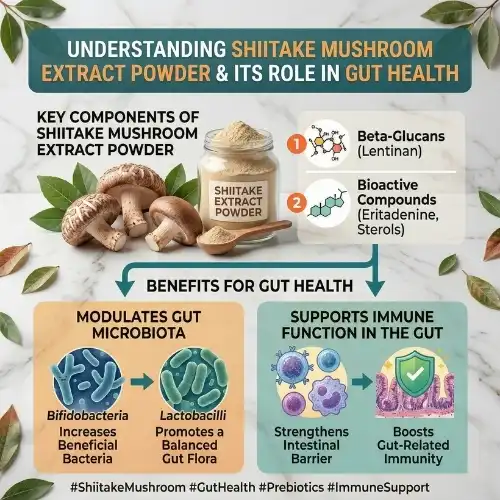
Understanding Shiitake Mushroom Extract and Its Role in Gut Health
What Makes Shiitake Extract Different from Raw Mushrooms?
Shiitake mushroom extract is an example of how farming waste can be turned into a standard medicinal ingredient that meets pharmaceutical standards. The process of extraction breaks down the chitin cell walls of the mushrooms, which normally make it hard for nutrients to get to the mushrooms. This increases the carbohydrate content from about 2-4% in dried mushrooms to 10-40% in good extracts. This concentration factor directly affects how well the supplement works—a 500mg extract tablet can provide the same bioactive effects as eating 10-15 grams of fresh mushrooms. This solves the problem of "pill burden" that many natural supplement recipes have.
Bioactive Composition and Mechanisms Unique to the Gut
Shiitake products are good for your gut health because they have a lot of different kinds of sugars in them. Beta-1,3/1,6-D-glucans are the part that has been studied the most. They have amazing prebiotic activity, which means they specifically boost good bacteria like Bifidobacterium and Lactobacillus. Lentinan is a beta-glucan that is only found in shiitake mushrooms. It has been shown to increase tight junction proteins in intestinal epithelial cells. This improves the stability of the gut barrier and stops endotoxin from moving to other parts of the body and causing inflammation.
According to research published in nutritional biochemistry journals, shiitake polysaccharides don't break down in the acidic environment of the stomach. They make it to the colon whole, where bacteria there turn them into short-chain fatty acids. These molecules, especially butyrate, give colonocytes their main source of energy and reduce inflammation throughout the digestive mucosa.
Immune-Gut Axis Interaction
About 70% of the immune system's cells are found in the gut. This means that immunity regulation is closely linked to digestive health. The beta-glucans in shiitake mushroom extract bind to specific receptors on immune cells in the gut. This sets off controlled immune reactions that protect against pathogens without causing too much inflammation. This ability to do two things at once meets an important formulation need: it boosts immunity while keeping the delicate inflammation balance that is needed for healthy digestion.
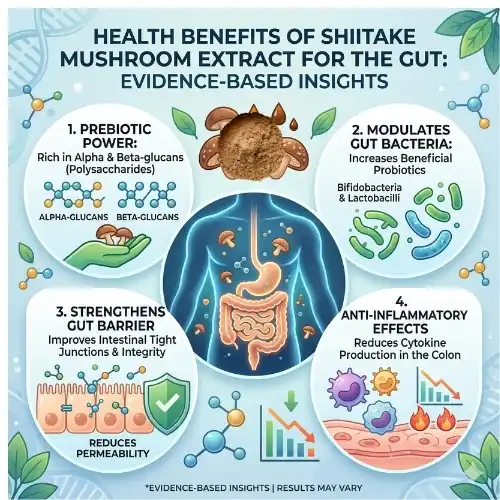
Health Benefits of Shiitake Mushroom Extract for the Gut: Evidence-Based Insights
Prebiotic Activity and Microbiome Enrichment
Shiitake polysaccharide supplements have been shown to change the makeup of gut microbes in a big way within 4 to 6 weeks of regular use in clinical tests. The prebiotic effect feeds good bacteria that make stomach enzymes and vitamins more than it feeds bad bacteria that look for opportunities to cause disease. This competitive exclusion process is a better choice than adding probiotics, which can make final goods less viable and harder for them to colonize.
Product developers who want to improve gut health can use this prebiotic activity to their advantage by including shiitake mushroom extract as a main ingredient that boosts the effectiveness of other probiotic strains. The synbiotic potential makes it possible for products to stand out in a supplement market that is getting more and more crowded.
Anti-Inflammatory and Antioxidant Protection
Many stomach problems, like irritable bowel syndrome and inflammatory bowel diseases, are caused by low-grade inflammation that lasts for a long time in the walls of the intestines. Shiitake products have ergothioneine and other antioxidants that cancel out reactive oxygen species that are made by the body's usual digestive processes and pathogens. These defenses help keep the structure of the gut barrier strong, which lowers the permeability that leads to food allergies and systemic inflammatory reactions.
There is more to the anti-inflammatory qualities than just passive antioxidant action. Certain types of polysaccharides change how cytokines are made in immune cells in the gut. This changes the balance from messages that cause inflammation to pathways that control inflammation without stopping the immune system from doing its job.
Digestive Enzyme Support and Nutrient Absorption
New study shows that shiitake polysaccharides may increase the activity and secretion of pancreatic enzymes, which could make it easier for proteins, fats, and carbohydrates to be broken down. This help for enzymes means that nutrients are better absorbed and there is less stomach pain from incomplete processing. The way it works seems to have something to do with how hormones in the gut work, especially cholecystokinin signaling, which controls stomach fluids.
For gut health purposes, the daily amount of a standardized shiitake mushroom extract having at least 20% polysaccharides should be between 500 mg and 2000 mg, spread out over two meals. Powder forms let you make a lot of different useful drinks and protein supplements, and encapsulated forms let you give the right amount to each person and keep them from going bad while they're in storage.
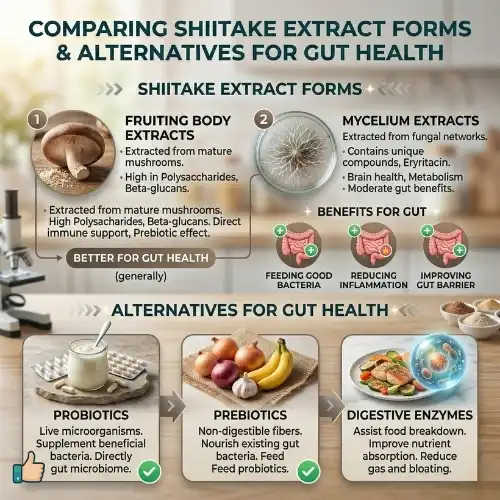
Comparing Shiitake Extract Forms and Alternatives for Gut Health Solutions
Extract Standardization and Quality Benchmarks
When looking at shiitake mushroom extract specs, people who work in procurement have to make important choices. Polysaccharide content amounts alone are not enough to judge quality; the measuring method is very important. High-performance liquid chromatography research tells the difference between the real amount of beta-glucans and the total amount of polysaccharides, which may include starches that make the numbers look better without adding any therapeutic value. Reliable sellers list the amount of beta-glucan separately, and the best kinds have 30 to 40 percent beta-glucans in their total polysaccharide fraction.
The spread of particle sizes affects both absorption and formulation behavior. Extracts that have been processed to a consistency of 80 to 100 mesh mix better into powdered products and dissolve faster than coarser grades. This technical factor has a direct effect on how the customer feels about the product and how well it works, especially in beverage uses where sedimentation or grittiness makes the product less acceptable.
Organic Certification and Control of Pollutants
The choice between organic and standard goes beyond marketing appeal and comes down to quality. Heavy metals and pesticide residues from growth materials build up in mushrooms, so it's important to check the source. The strict safety standards set by European regulations, especially the limits on PAH4 and benzopyrene, are sometimes hard for traditional farming methods to meet.
Yangge's shiitake mushroom extract meets EU standards; Eurofins tests confirmed that the amount of benzopyrene in it is less than 10 parts per billion. This meets the legal requirements for both European and North American markets. The fact that the product is non-GMO and non-irradiated fits with the move toward clean labels, and the fact that it is allergen-free gives manufacturers more options for making products that sensitive consumers can enjoy.
Shiitake Versus Alternative Medicinal Mushrooms
When making medicines for gut health, formulators often compare shiitake to reishi, maitake, and other medicinal mushrooms. Shiitake has unique benefits for gut health—its prebiotic polysaccharide profile is better than reishi's triterpene-dominant makeup for supporting the microbiome in particular. It is easier for foods and drinks to incorporate the umami flavor profile of shiitake mushroom extract than the bitter notes that are typical of reishi preparations.
Depending on the level of standardization and approval, pharmaceutical-grade shiitake extract is usually priced in bulk in a range from affordable to premium. To find out what the real value is, buyers should look at the cost-per-dose of active beta-glucans instead of just the price per kilogram. Minimum order amounts of 1 kg allow for both small-batch creativity and large-scale production needs. Stock levels of 50–100 kg support stable supply lines.
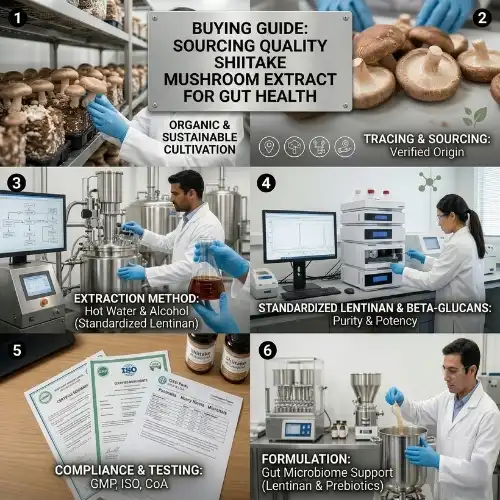
Buying Guide: How to Choose and Source Quality Shiitake Mushroom Extract for Gut Health Products?
Defining Technical Requirements and Regulatory Needs
Clear definition of end-product needs is the first step to successful buying. Supplement companies that want to sell their products in regular stores need ingredients that are GMP-certified and come with full analytical paperwork that includes microbiology, heavy metals, pesticide screening, and identity proof. To meet store standards and customer demands, functional food applications may put organic certification and non-GMO verification at the top of their list of priorities.
The description sheet only gives you a small glimpse of how good something is. Ask for Certificate of Analysis samples from several production batches to check for uniformity. Changes in polysaccharide content or moisture levels are a sign of poor process controls that will make the end product less stable. Instead of less accurate colorimetric tests that overestimate active chemical levels, beta-glucan testing should use enzymatic-HPLC methods.
Supplier Evaluation Criteria Beyond Price
Suppliers who work as ingredient partners are different from commodity sellers because they can offer technical help. Check to see if possible providers offer help with formulation, data from stability tests in different grids, and help with regulatory paperwork. Being able to change the parameters of extraction or make your own specs shows that the production process is advanced, which helps with strategies for product differentiation.
When planning the supply chain, production volume and lead time dependability are very important. Ask for facility audit reports, production schedules, and backup plans in case crops don't grow as expected or demand goes up. Suppliers who keep strategic inventory stocks of 50–100 kg of shiitake mushroom extract show that they care about their customers and protect them from formulation delays or stockouts during busy production times.
Initiating Supplier Partnerships and Sample Evaluation
Start the qualification process for suppliers by sending them focused questions that test their response and technical depth. Send particular formulation settings, like a beverage powder, capsule blend, or topical cosmeceutical, and ask for advice on the best extract grades, particle sizes, and ways to handle the material. Quality providers know that the success of an ingredient depends on how well the finished product works, not just on the specs of the raw materials.
Protocols for evaluating samples should include more than just lab tests; they should also include small-scale formulation trials. Check how it dissolves, how it affects taste, how stable the color is under the right processing conditions, and how well it works with other ingredients in the recipe. Write down sensory features and processing observations to build institutional knowledge that helps with fixing and future choices about where to get materials.
Yangge Biotech helps with this evaluation process by letting you place flexible 1 kg minimum orders that are packed in protective aluminum foil bags that keep the ingredients' integrity while they are being shipped and stored. Private label needs can be met by OEM packaging, and the technical team gives formulators the extraction method paperwork and concentration specs they need for precise product development.
Conclusion
Shiitake mushroom extract has been used for a long time and has been studied recently. It has been shown to help with many important aspects of gut health, including protecting the barrier, feeding the bacteria, changing the immune system, and keeping inflammation in check. The extraction method increases the concentration of beneficial polysaccharides to amounts that are useful in clinical settings. It also gets around the problems that come with eating whole mushrooms, like low bioavailability.
When making digestive wellness products, procurement workers should know the technical differences between extract grades, the rules that govern quality claims, and the skills of suppliers that go beyond just selling goods and include technical partnerships. Because the ingredient can be used in supplements, useful foods, and cosmetics, it is a good choice for brands that want to stand out in the growing gut health market.
Partner with Yangge Biotech Your Trusted Shiitake Mushroom Extract Supplier
Yangge Biotech provides pharmaceutical-grade shiitake mushroom extract that meets the strict needs of making gut health products. Our extraction plant has ISO, HACCP, Kosher, and Halal certifications, and it makes polysaccharide-standardized extracts with concentrations ranging from 10 to 40 percent, which are backed by Eurofins testing proof. The ingredient meets EU PAH4 standards, and its benzopyrene amounts are always less than 10 parts per billion. This gives regulators faith that the product can be sold in Europe and the US.
We help formulation creation by giving you expert advice on things like the best way to remove the ingredients, how much to use, and how to use them in a way that works best for your product. Our research and development team gives procurement managers the analytical paperwork and stability data they need when making functional drinks, specialized gut health recipes, or immune-digestive combination supplements. Flexible minimum orders starting at 1 kg allow for everything from initial prototyping to large-scale production, and smart store backups help keep supply partnerships stable. Connect with our technical team at info@yanggebiotech.com to talk about your needs for shiitake mushroom extract and to ask for analytical specs that meet your quality standards and legal goals.
FAQ
Q: Can we get some samples to test before purchasing?
A: Of course, we can provide free samples of 20 to 100 grams, but the shipping cost is at the customer's expense. The shipping cost can be deducted from the next order, or the samples can be sent through your courier account.
Q: Do your products have relevant certifications?
A: Yes, our products are certified for HALAL, ISO, HACCP, Kosher, and other certifications.
Q: What is the minimum order quantity (MOQ)?
A: Small batches of samples can be customized according to your requirements.
Q: Do you offer OEM and ODM services? Can the formula be customized based on our own?
A: Of course, we provide ODM and OEM services to many customers. Our product range includes softgels, capsules, tablets, sachets, granules, and private label services. Simply contact us and let us know your requirements. Our experienced R&D team can also develop new products with specific formulas.
Please contact us to design your own branded products.
Q: How do you handle quality complaints?
A: First, we have a comprehensive quality control SOP. We provide authoritative third-party inspection reports for almost all products before shipment to minimize the possibility of quality issues. Second, we have a comprehensive return and exchange procedure. If there is a genuine quality dispute, we will strictly follow the SOP.
Q: How do you ship? How long does delivery take?
A: For small orders, we typically use DHL, UPS, EMS, FedEx, or TNT. Delivery typically takes 3-7 days. We also offer air and sea freight services. We have a strong freight forwarding team and can provide you with a one-stop service, including DDP and DDU.
Q: What are your payment terms?
A: 100% prepayment, payable by T/T, Western Union, MoneyGram, or PayPal.
Q: What is the shelf life of your products?
A: 2 years with proper storage.
Q: Is the packaging environmentally friendly?
A: We attach great importance to environmental protection and are constantly improving our product packaging. Some products are packaged in recyclable paper. Packaging materials are carefully selected to ensure product safety during transportation and storage, and to minimize environmental impact. We are committed to achieving a balance between environmental friendliness and practicality in our product packaging, and to contributing to sustainable development.
References
1. Chen J, Seviour R. Medicinal importance of fungal beta-(1→3), (1→6)-glucans. Mycological Research. 2007;111(6):635-652.
2. Bisen PS, Baghel RK, Sanodiya BS, Thakur GS, Prasad GB. Lentinus edodes: a macrofungus with pharmacological activities. Current Medicinal Chemistry. 2010;17(22):2419-2430.
3. Dai X, Stanilka JM, Rowe CA, et al. Consuming Lentinula edodes (Shiitake) mushrooms daily improves human immunity: A randomized dietary intervention in healthy young adults. Journal of the American College of Nutrition. 2015;34(6):478-487.
4. Finimundy TC, Dillon AJP, Henriques JAP, Ely MR. A review on general nutritional compounds and pharmacological properties of the Lentinula edodes mushroom. Food and Nutrition Sciences. 2014;5(12):1095-1105.
5. Xu X, Yan H, Chen J, Zhang X. Bioactive proteins from mushrooms. Biotechnology Advances. 2011;29(6):667-674.
6. Wasser SP. Medicinal mushroom science: Current perspectives, advances, evidences, and challenges. Biomedical Journal. 2014;37(6):345-356.

Based on your location and order quantity, you will have the opportunity to receive a limited time free shipping promotion!
Who we are
Popular Blogs