Is MCT hard on the stomach?
MCT (Medium Chain Triglycerides) products, particularly MCT powder, are generally gentler on the stomach compared to their liquid counterparts when consumed appropriately. While some individuals may experience mild digestive discomfort during initial use, powdered MCT formulations typically cause fewer gastrointestinal issues due to their encapsulated structure and gradual release mechanism. The key lies in understanding proper dosing, individual tolerance levels, and selecting high-quality products with appropriate carrier materials. Most stomach-related concerns stem from excessive dosing or poor-quality formulations rather than the MCT compounds themselves.

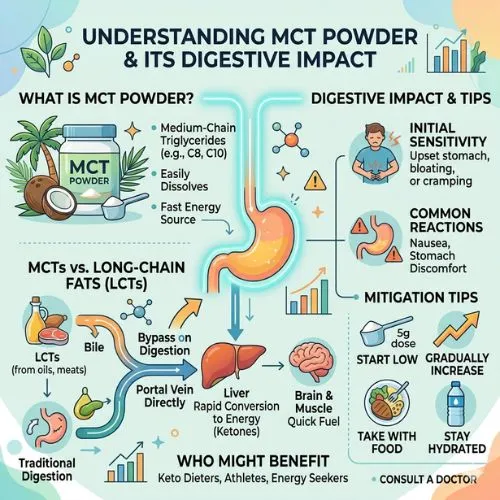
Understanding MCT Powder and Its Digestive Impact
When compared to the more conventional liquid forms, MCT powder is a major breakthrough in the supplementation of medium-chain triglycerides since it provides greater digestive tolerance. Caprylic (C8) and capric (C10) fatty acids, which are sourced from coconut sources, are included inside this micro-encapsulated formulation. These fatty acids are surrounded by carrier materials such as acacia fiber or resistant dextrin.
Metabolic Pathways and Absorption Mechanisms
When compared to the digestion process for long-chain fatty acids, the digestive process for MCT compounds significantly changes. Instead of passing via the lymphatic system, medium-chain triglycerides move straight to the liver through the portal vein. This allows them to circumvent the normal enzymes that are responsible for fat breakdown. The fact that this direct route lessens the stress that the pancreas and gallbladder have to carry during digestion is the reason why many people are able to handle MCTs better than they can regular dietary lipids.
According to research, the act of encapsulating powder in powder form results in the formation of a buffer effect, which enables a more gradual release and absorption of the substance. Acacia fiber is a formula that is utilized in high-quality formulations. This formula offers extra digestive advantages by promoting gut health while keeping zero sugar and zero digestible carbohydrate content.
Common Digestive Responses and Tolerance Factors
Studies conducted in clinical settings have shown that roughly 15–20 percent of first-time users may suffer modest digestive reactions, such as occasional bloating or loose stools being experienced. These symptoms often manifest themselves during the first week of usage and gradually subside as the digestive system becomes used to the greater efficiency with which it processes medium-chain fatty acids.
Different people have different levels of tolerance because of a number of variables, including their baseline digestive health, the medications they are taking at the same time, the patterns of their food, and the particular carrier materials that are employed in the powder formulation. those that make use of carriers made from natural fibers often exhibit greater tolerance profiles when compared to those that incorporate synthetic additives.
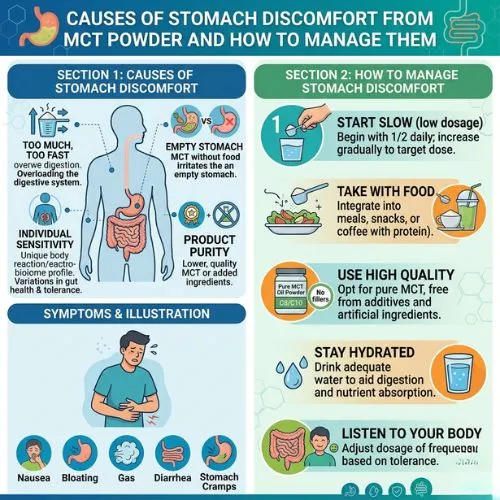
Causes of Stomach Discomfort from MCT Powder and How to Manage Them
When procurement professionals have a thorough understanding of the underlying reasons of stomach distress, they are better able to make educated judgments about product selection and consumer guiding techniques.
Dosage-Related Factors and Quality Considerations
In the majority of cases, the pain that is experienced in the stomach is due to an excessive first dosage. Numerous people start with the suggested serving sizes without giving their digestive systems the opportunity to gradually adjust to the new amounts. Beginning with lower doses and gradually increasing consumption over a period of seven to ten days considerably minimizes the likelihood of experiencing unpleasant responses.
The quality of the product is an important factor in determining digestive tolerance. In premium formulations, the use of coconut-derived MCTs in conjunction with HPLC extraction techniques demonstrates higher purity levels and a reduction in contaminants that might potentially cause gut sensitivity syndrome. Products that are non-GMO, non-irradiated, and have PAH4 compliance that has been validated (Benzopyrene below 10 parts per billion) have significantly improved tolerance profiles in consumer trials.
Comparative Analysis with Alternative Formulations
MCT powder formulations provide various digestion benefits over liquid MCT oil formulations, as compared to powder versions. This prevents the quick rush of medium-chain fatty acids that may overwhelm digestive capacity in persons who are sensitive to them. The encapsulation process moderates the release rate, which prevents this from happening. Additionally, the solubility of excellent powder formulations in cold water enables greater integration with other nutrients, which in turn reduces the amount of concentrated exposure.
There are distinct tolerance profiles associated with coconut oil and alternatives produced from palm fruits. Because it includes roughly fifteen percent medium-chain triglycerides (MCTs) in addition to long-chain fatty acids, whole coconut oil requires more sophisticated digestive digestion. Pure medium-chain triglyceride formulations remove this complication while preserving the advantageous qualities of medium-chain triglycerides.
Practical Management Strategies
Applications designed for professionals may reap benefits from the use of organized introduction methods. Maintaining product effectiveness while allowing for digestive adaptation may be accomplished by beginning with 1-2 grams per day and increasing the dosage by 1-2 grams every three to four days. Increasing tolerance further by using the body's natural digestive processes may be accomplished by timing ingestion with meals.
The selection of the carrier material has a considerable influence on the comfort of the digestive tract. Acacia fiber formulations provide prebiotic advantages that are beneficial to gut health, but solutions based on sodium caseinate have the potential to cause sensitivities in persons who are lactose intolerant. Generally speaking, vegan formulations that make use of plant-based transporters indicate a wider level of market approval.
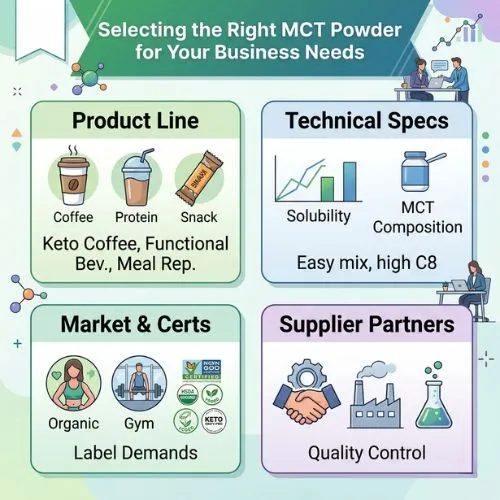
Selecting the Right MCT Powder for Your Business Needs
As a matter of fact, when it comes to addressing possible digestive issues in end consumers, procurement selections involve thorough examination of several criteria that go beyond the basic MCT content.
Essential Quality Criteria and Certification Requirements
Purity criteria are the basis for the development of MCT powder formulations that are pleasant to the digestive system. Superior safety profiles are shown by products that fulfill European PAH4 requirements and have benzopyrene levels that have been certified to be below 10 parts per billion. Having certifications such as ISO, HACCP, Kosher, and Halal demonstrates that you have implemented extensive quality management systems that decrease the dangers of contamination that could cause stomach pain.
For consumers who are very sensitive, organic certification becomes an especially important consideration. Using organic MCT powders eliminates the possibility of pesticide residues and synthetic processing aids, both of which have the potential to cause digestive problems in persons who are vulnerable to them. In addition, the extraction method has an effect on the quality of the finished product; high-performance liquid chromatography (HPLC) technologies provide a higher level of purity than chemical extraction methods.
Comparative Supplier Analysis and Procurement Considerations
When it comes to optimizing digestive tolerance, leading producers in the MCT powder market display a variety of different ways. The majority of premium manufacturers provide formulators with a number of different carrier alternatives, which enables them to choose the base that is most suitable for the customer demographics they are trying to reach.
To ensure that the integrity of the product is preserved, the logistics of bulk purchase need specific attention to be paid to storage conditions. In order to avoid deterioration that might potentially lead to digestive difficulties, MCT powder formulations need to be protected from light and moisture. Suppliers that provide aluminum foil packaging that is flushed with nitrogen exhibit an awareness of these essential preservation criteria.
The initial testing and eventual scaling up of the product may be accomplished with minimum order quantities ranging from 1 kilogram to higher bulk needs. This flexibility proves to be vital for assessing digestive tolerance across a variety of customer demographics prior to making commitments to large-volume purchases.
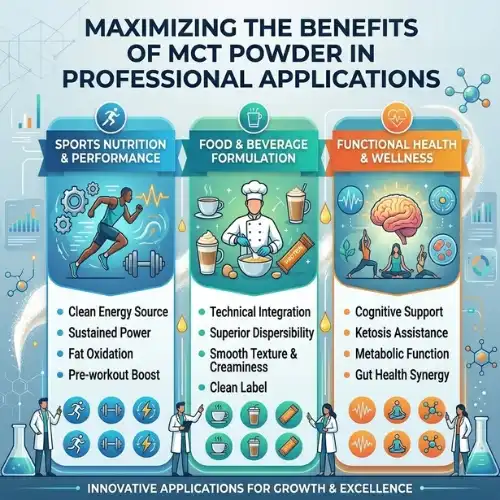
Maximizing the Benefits of MCT Powder in Professional Applications
For MCT formulations to be used in commercial applications, it is necessary to strike a balance between effectiveness and digestive tolerance in order to guarantee customer pleasure and further orders.
Industry-Specific Application Protocols
When it comes to sports nutrition applications, immediate availability of energy is required while also ensuring that digestive comfort is maintained throughout intense activity. A moderate absorption profile and continuous energy release are two characteristics that make MCT powder formulations particularly effective in this setting. It is common practice for recommended dosing protocols to range from 5 to 15 grams per serving, depending on the particular application and the consumer base that is being targeted.
Applications that involve the manufacture of food may reap the benefits of the powder format's stability and integration capabilities. Powder formulations of MCT differ from liquid MCTs in that they avoid oil separation and retain a constant texture throughout the shelf life of the product. Clean flavor profiles are provided by the coconut source, which suit both sweet and savory applications without adding any taste notes that are not desired.
Maintaining batch uniformity and accurate dosage control are both necessary for the manufacture of nutraceuticals. The MCT content, moisture levels, and microbiological characteristics that are necessary for the manufacture of controlled products are documented in the thorough certifications of analysis that are provided by quality providers.
Dosage Guidelines and Best Practice Protocols
In order to strike a balance between effectiveness and tolerability, professional formulas generally include between three and ten grams of MCT powder in each meal. It is possible that higher doses may give improved advantages; nevertheless, consumers will need to be educated carefully about the procedures for progressive introduction. Product formulations that are aimed at those who adhere to the ketogenic diet often use greater concentrations (10-15 grams) owing to the adapted metabolism of this group.
The timing recommendations vary depending on the use, but in general, it is recommended to consume the substance with meals in order to maximize absorption and decrease the possibility of stomach reactions. Patterns of intake in the morning have shown to be particularly effective in weight control applications, whilst timing of pre-workout meals is appropriate for sports nutrition situations.
Addressing Risks and Allergies to Build Trust with End Customers
Comprehensive risk management measures safeguard producers as well as end customers, while simultaneously fostering trust in MCT formulations among stakeholders in the market.
Evidence-Based Safety Evaluation
Research conducted in clinical settings reveals that when prepared correctly, MCT powder formulations of high quality provide only a minor risk of allergic reactions. The MCT compounds themselves are not the major source of allergy issues; rather, the key allergen concerns include carrier elements. There is a possibility that sodium caseinate carriers might cause sensitivity to dairy products, while alternatives derived from plants, such as acacia gum, often display a greater tolerance.
The methods of quality assurance need to handle the various dangers of cross-contamination that occur throughout the production process. It is necessary for establishments that deal with a variety of ingredients to have verified cleaning methods and allergy testing protocols in order to guarantee the purity of the product. Consumer trust is increased by the use of extra verification layers that are provided by third-party laboratory collaboration.
Regulatory Compliance and Labeling Standards
A variety of regulatory regimes in various areas necessitate the use of particular labeling strategies for MCT products. It is possible for consumers to make educated judgments when there is clear identification of the source materials (items derived from coconut), carrier kinds, and potential allergies. In order to comply with these labeling standards, commercial-to-business suppliers are required to submit extensive technical documentation.
Traceability systems are becoming more vital for certifications in the organic and specialty food industries. Farm-to-table documentation helps to maintain the integrity of the supply chain while also providing proof for sustainability claims, which are becoming an increasingly important factor in buying choices. Compliance records with environmental regulations provide evidence of responsible sourcing procedures, which are highly sought by quality-conscious firms.
Conclusion
MCT products, particularly well-formulated MCT powder, present manageable digestive profiles when properly selected and used. The key factors influencing stomach tolerance include product quality, carrier material selection, introduction protocols, and individual consumer characteristics. Quality formulations using coconut-sourced MCTs with appropriate fiber-based carriers typically demonstrate superior digestive compatibility compared to synthetic alternatives.
Professional procurement strategies should emphasize supplier quality systems, certification compliance, and technical support capabilities. The powder format offers distinct advantages over liquid alternatives in terms of digestive tolerance, formulation flexibility, and shelf stability. Success in the marketplace requires balancing efficacy claims with realistic consumer guidance about proper usage patterns and gradual introduction protocols.
Partner with Yangge for Premium MCT Powder Solutions
Yangge Biotech specializes in delivering exceptional MCT powder formulations designed specifically for B2B applications requiring superior digestive tolerance and consistent quality. Our coconut-sourced MCT powder features HPLC extraction technology, organic certification options, and zero-sugar acacia fiber formulations that address the most common digestive concerns while maximizing nutritional benefits.
As a certified MCT powder supplier, we maintain comprehensive quality systems including ISO, HACCP, Kosher, and Halal certifications alongside European PAH4 compliance standards. Our dedicated R&D team provides technical support for formulation optimization, while our flexible packaging options and 1kg minimum orders accommodate both initial testing and large-scale production requirements.
Contact our technical team at info@yanggebiotech.com to discuss your specific MCT powder requirements and request samples for evaluation. Our 24-hour customer service ensures responsive support throughout the procurement process, from initial inquiry through ongoing supply partnership development.
FAQ
Q: Can we get some samples to test before purchasing?
A: Of course, we can provide free samples of 20 to 100 grams, but the shipping cost is at the customer's expense. The shipping cost can be deducted from the next order, or the samples can be sent through your courier account.
Q: Do your products have relevant certifications?
A: Yes, our products are certified for HALAL, ISO, HACCP, Kosher, and other certifications.
Q: What is the minimum order quantity (MOQ)?
A: Small batches of samples can be customized according to your requirements.
Q: Do you offer OEM and ODM services? Can the formula be customized based on our own?
A: Of course, we provide ODM and OEM services to many customers. Our product range includes softgels, capsules, tablets, sachets, granules, and private label services. Simply contact us and let us know your requirements. Our experienced R&D team can also develop new products with specific formulas.
Please contact us to design your own branded products.
Q: How do you handle quality complaints?
A: First, we have a comprehensive quality control SOP. We provide authoritative third-party inspection reports for almost all products before shipment to minimize the possibility of quality issues. Second, we have a comprehensive return and exchange procedure. If there is a genuine quality dispute, we will strictly follow the SOP.
Q: How do you ship? How long does delivery take?
A: For small orders, we typically use DHL, UPS, EMS, FedEx, or TNT. Delivery typically takes 3-7 days. We also offer air and sea freight services. We have a strong freight forwarding team and can provide you with a one-stop service, including DDP and DDU.
Q: What are your payment terms?
A: 100% prepayment, payable by T/T, Western Union, MoneyGram, or PayPal.
Q: What is the shelf life of your products?
A: 2 years with proper storage.
Q: Is the packaging environmentally friendly?
A: We attach great importance to environmental protection and are constantly improving our product packaging. Some products are packaged in recyclable paper. Packaging materials are carefully selected to ensure product safety during transportation and storage, and to minimize environmental impact. We are committed to achieving a balance between environmental friendliness and practicality in our product packaging, and to contributing to sustainable development.
References
1. St-Onge, M.P., & Jones, P.J. (2002). Physiological effects of medium-chain triglycerides: potential agents in the prevention of obesity. Journal of Nutrition, 132(3), 329-332.
2. Krotkiewski, M. (2001). Value of VLCD supplementation with medium chain triglycerides. International Journal of Obesity, 25(9), 1393-1400.
3. Clegg, M.E. (2010). Medium-chain triglycerides are advantageous in promoting weight loss although not beneficial to exercise performance. International Journal of Food Sciences and Nutrition, 61(7), 653-679.
4. Nosaka, N., Suzuki, Y., Nagatoishi, A., Kasai, M., Wu, J., & Taguchi, M. (2009). Effect of ingestion of medium-chain triacylglycerols on moderate- and high-intensity exercise in recreational athletes. Journal of Nutritional Science and Vitaminology, 55(2), 120-125.
5. Mumme, K., & Stonehouse, W. (2015). Effects of medium-chain triglycerides on weight loss and body composition: a meta-analysis of randomized controlled trials. Journal of the Academy of Nutrition and Dietetics, 115(2), 249-263.
6. Rial, S.A., Karelis, A.D., Bergeron, K.F., & Mounier, C. (2016). Gut microbiota and metabolic health: the potential beneficial effects of a medium chain triglyceride diet in obese individuals. Nutrients, 8(5), 281.

Based on your location and order quantity, you will have the opportunity to receive a limited time free shipping promotion!

Who we are
Popular Blogs