How to choose high quality Ganoderma lucidum extract
To find a good ganoderma lucidum extract, you need to check the polysaccharide content (30–50%), make sure it passes EU standards for pesticide residues testing by a third-party lab like Eurofins, and make sure it doesn't go over 10 parts per billion for PAH4 and benzopyrene. Companies that you can trust keep their ISO, HACCP, GMP, and KOSHER certifications up to date and give you clear information that shows how the ingredients were removed. Plus, you can keep track of them from the time they are grown to the time they are sold. This makes sure that the quality of each batch of health products, makeup, and drugs stays the same.
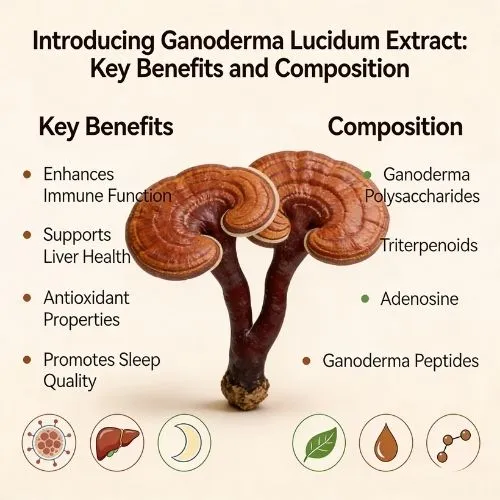
Introducing Ganoderma Lucidum Extract: Key Benefits and Composition
The well-known Reishi mushroom's fruiting bodies, mycelium, or spores are used to create the concentrated phytochemical mixture known as ganoderma lucidum extract. With improved dual-extraction methods that use both water and ethanol as solvents, the two main bioactive groups can be separated: triterpenoids, like ganoderic acids, and polysaccharides, like beta-D-glucans. A study in humans has shown that these chemicals are very good at healing.
What Makes This Extract Valuable for Industrial Applications?
Polysaccharides have a big effect on the immune system. They make natural killer cells work harder and help adapted defenses. There are studies in respected immune journals that show beta-glucans make macrophages work better and release more cytokines. In the level of cells, triterpenoids help fight oxidative stress by lowering inflammation, keeping the liver safe, and being antioxidants. The extract can be used in a lot of different kinds of goods because it does two things.
There are important production problems that raw mushroom powders can't solve, but the extract can. Materials that haven't been treated have issues like being hard to dissolve, having active chemical patterns that change, and changes that are impossible to predict from one batch to the next. It is important for businesses to use standardized extracts because they give exact dosing, dependable absorption rates, and a stable shelf life. Companies that make useful drinks, anti-aging serums, food supplements, and traditional medicine use these traits that don't change.
Common Forms and Their Specific Applications
A lot of business deals are made with brown powder extracts because they are stable and easy to change. A UV-VIS spectrophotometer is used to measure the carbohydrate level, which is between 30% and 50%. HPLC is used to measure the amounts of triterpenes, which range from 1% to 15%. The fine, slightly water-absorbing powder goes through screens with 80 to 100 meshes. This makes sure that the powder is spread out evenly in pills, capsules, and drink mixes.
Ready-to-drink ingredients that dissolve in water don't cloud or settle when they're in an acidic environment. Some extra steps are taken with these preparations to make them more soluble while still having their bioactivity. Better yet, ones made for cosmetic use are more clean and can be put on the face. They have a controlled range of particle sizes and are guaranteed to stay steady in mixtures of oil and water. Pharmaceutical-grade extracts meet the requirements of pharmacopeia papers and have full impurity profiles and testing methods that have been proven to work.
Many types of business use these forms in smart ways. When it comes to solid dosage forms that need to stay stable when pressed, nutritional companies like high-concentration powders. The people who make drinks pick ones that dissolve in water and work well with complicated liquid systems. When cosmetics are made, they use chemicals that are safe for the skin and have antioxidant qualities that are good for improved skin care.
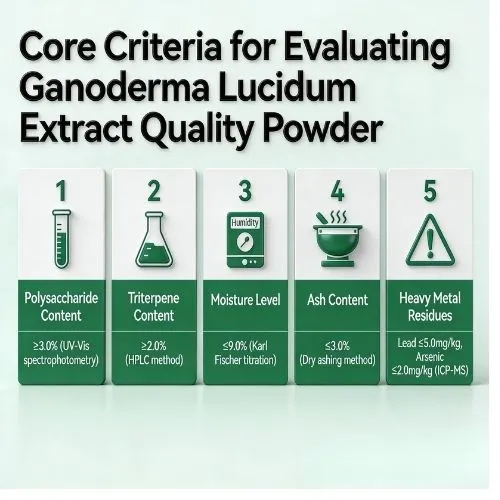
Core Criteria for Evaluating Ganoderma Lucidum Extract Quality
Systems that check for quality can tell the difference between high-end and low-end service companies. Procurement teams need to look at more than just basic specification sheets to make sure that recipes work in the long run and follow the law for ganoderma lucidum extract.
Standardization of Active Compounds
Batch-to-batch accuracy needs standardization methods that have been tested and proven to work. Most trustworthy sellers use HPLC fingerprinting to look at triterpenoid profiles and make sure that the amounts of ganoderic acid A, B, and C don't go over or under certain limits. It is safe to use the phenol-sulfuric acid method to measure carbohydrates, but molecular weight distribution study tells us more about quality. Claim about more than one statistic should be written on papers of analysis, not just one.
Advanced sellers use spectroscopic techniques, such as NMR and mass spectrometry, to look at what a product is made of in its entirety. These attempts in data show that the business is tech-savvy and wants to be open. People who are in charge of buying things should ask for proof data that includes standard curves, recovery rates, and method precision to see how good the lab is.
Cultivation Source and Raw Material Traceability
What makes an extract good starts with how it is grown. Certified organic farms don't use a lot of pesticides or heavy metals, and they don't use a lot of toxins. How much reactive chemical a mushroom makes depends on where it comes from; some places grow mushrooms with more polysaccharides than others. When oak stems are grown in a controlled environment, the chemicals they make are more likely to be the same than when they are found in the wild and exposed to different environments.
An important part of controlling risk is having tools that can connect farms to places where oil is extracted. Each batch should be tied to a particular farming lot by using details like the type of material used, the growing conditions, and the harvest time. This way of keeping track of the goods lets you react quickly to changes in quality and meets the requirements for organic approval. Suppliers usually have better ways to track goods and more moral ways to get them when they work with farming groups as part of plans for sustainable development.
Extraction Technology and Processing Standards
The way the chemicals are extracted directly impacts their quality and return. Sometimes, using hot water to remove plants can help separate polysaccharides, but it can also damage triterpenoids that are sensitive to heat. Ethanol is used to get rid of triterpenoids that stick to fat, but it leaves behind water-soluble carbs. If you use both ways of extraction at the same time, you get full working profiles, but the cost of production goes up.
When processing, some of the most important things to think about are temperature, liquid ratios, extraction time, and concentration methods. It is possible for liquid extracts to turn into powder using spray-drying as long as the temperatures and stay times are just right. At low temperatures, vacuum concentration keeps heat from breaking down things that are easily damaged. Suppliers should talk about how they handle bioactive materials and show proof data that shows these materials are kept safe during production.
GMP-certified facilities watch out for their surroundings, make sure their gear is always set, and clean in strict ways that stop germs from spreading and cross-contamination. If food safety management is approved by ISO 22000, it means that it is well organized and follows HACCP rules. The KOSHER and Halal licenses are for groups of people who have to follow religious rules. These requirements show that processes are grown and ready for approval from the government.
Third-Party Testing and Certification Documentation
Proof from a separate lab is a more objective way to show quality than the provider testing it themselves. It is possible to do full safety and quality checks when you work with well-known labs like Eurofins and SGS. Testers should look for remains of herbicides that meet EU standards, heavy metals that meet USP limits, microbes, aflatoxins, and PAH4 chemicals like benzopyrene that are less than 10 parts per billion.
Asking for plans to test the product again before shipping shows that the supplier is sure of the quality of the goods and ready to meet proof needs. When sellers offer to set up tests with labs chosen by the customer, it helps build trust and meets some legal requirements. It's not as easy to understand generic Certificates of Analysis than full test reports that include chromatograms, method references, and lab accreditation numbers.
Reports that say a product is free of allergens, GMOs, and radiation meet more legal and market placement needs. It is easier to reach new customers and meet the needs of health-conscious people with these extra licenses.
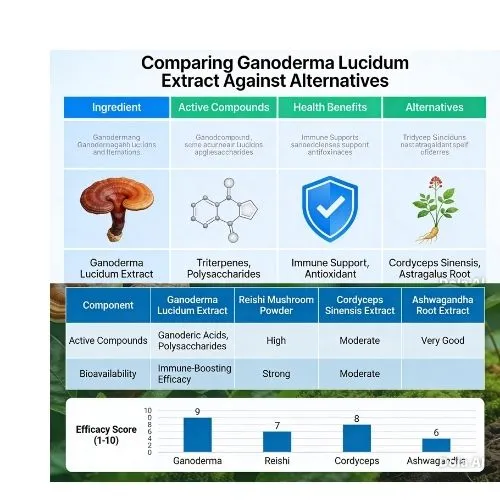
Comparing Ganoderma Lucidum Extract Against Alternatives
Finding out how different goods compare in terms of their benefits can help you pick the best one for each job. There are a lot of different kinds of useful mushrooms on the market. Each one has its own qualities that affect how it is made for ganoderma lucidum extract.
Powder Extract Versus Raw Mushroom Powder
Body powders made from ground fruit have 10 to 50 times less bioactive density than concentrated liquids. Because of this concentration, smaller doses can be used in finished goods. This means that supplement companies can make fewer pills and drinks that change the taste less. The chitin cell walls in raw powders can't be digested and stop nutrients from being taken. Extraction gets rid of these cell walls. This makes the products work better for healing and make them easier for the body to use.
Minerals, fiber, and proteins are just a few of the nutrients that raw powders have that cooked products don't. People who make medicines sometimes mix liquids and powders to get the concentrated active ingredients and the nutrients that help them work. When making things on a tight budget, raw powders are often the best choice. However, customers often get more for their money with extract efficiency.
Liquid Extracts Versus Powder Forms
Medicines that come in liquid or concentrated form are more accessible right away because they don't have to dissolve first like solid forms do. The people who make drinks just add liquid extracts to their lines, so they don't need to be treated any further. But liquid forms are hard to store and move because they are big, heavy, and can become unstable during long supply lines.
It is easier to send powdered extracts abroad, they stay stable longer on shelves, and they take up less space in the warehouse. While the food is being kept, bacteria can't grow and chemicals can't break down if the moisture level is below 5%. The safety rules for hygroscopic substances are easier to handle than the rules for cooling liquids because they only need to be wrapped in metal foil and kept in a climate-controlled space. Because reconstitution is flexible, companies can come up with methods that work at the amounts they need for their own needs.
Organic Versus Conventional Cultivation
For farms to be certified organic, it means that no synthetic fertilizers, pesticides, or herbicides are used during the growing process. This cuts down on the dust, which is in line with strict EU rules and meets customer demands for clean labels. Even though organic extracts cost more, the fact that they are less likely to pollute and use natural ingredients more than makes up for it.
A lot of different types of farming can use certain poisons as long as they don't go over the government's limits. Tough testing can prove that safety rules are being followed even if the product hasn't been approved by an organic body. If brands want to stick to their budgets and get their extracts from natural sources, they should make sure that they are fully checked according to international standards for pesticide residues. When the right farming methods are used and tests are done to prove them, the quality difference between normal farms and well-run organic farms might not be possible to see.
There is a big shift in the market toward organic brands, especially in North America and Europe, where people are looking for organic approvals. Value-oriented brands may focus on using approved common sources to save money, while premium brands say they use organic products to stand out.
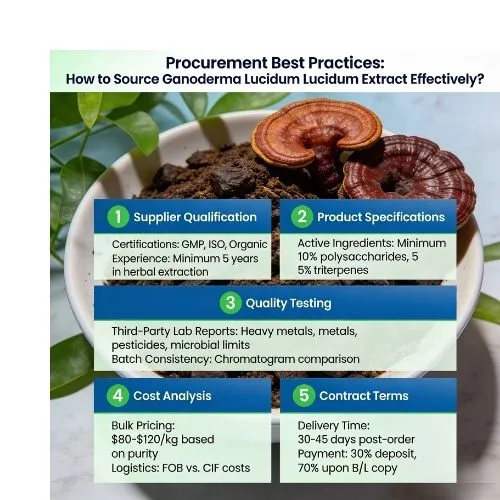
Procurement Best Practices: How to Source Ganoderma Lucidum Extract Effectively?
To buy strategically, you need to find ways to judge things that take quality, price, and supply security into account for ganoderma lucidum extract. It is helpful for buying teams to have structured ways to deal with technical, business, and logistical problems.
Defining Precise Specification Requirements
The first step to an effective buy is to write down all of your needs. It should say how much of a certain type of polysaccharide, triterpenoid, moisture, microbes, heavy metals, and chemical waste is allowed in the technical specs. Processing compatibility is influenced by the spread of particle sizes, the bulk density, and the solubility. These should be as strong as the tools used for production.
Different types of goods and target groups have different needs when it comes to following the rules. It's not the same for the FDA to regulate food supplements as it is for cosmetics and medicine fillers. In the purchase specs, the rules and regulations that apply must be taken into account. This includes rules about how to label things, what health claims are allowed, and good production practice. Making these things clear from the start can help you avoid costly changes to the recipe or trouble with the law in the future.
Forecasts of volume change how prices are set and which providers are picked. Things that should be true about minimum order sizes, common package layouts, and shipping times are that they should match how things work in the real world. Depending on the source, different amounts of goods are kept on hand, and production plans can be changed. This means that matching amount is important for a steady supply line.
Supplier Vetting and Qualification Processes
When someone is fully reviewed, their professional skills, quality methods, ability to follow rules, and business stability are all looked at. Someone or a service can do a site audit to look at the building, the tools, the area, and the way records are kept. The audit can be done in person or by a third party. It's more interesting to watch live work processes than to just read documents.
If a quality management system has ISO 9001 approval, it means that processes are handled in a planned way and there is a culture of growth all the time. Food safety certifications like HACCP and ISO 22000 show that risks have been found and rules have been put in place to stop them. To find out how stable your operations are and how well you can fix problems, you can ask for quality guides, batch records, and deviation investigation reports.
If a seller goes out of business, goods won't be cut off because of a financial security review. It is possible to do due diligence checks by getting customer reference lists, business licenses, and export credentials. A long-term customer is a sign that you can trust them and that they are happy with your business. You can get a good idea of how well a seller is doing by talking to their present customers. This includes how quickly they reply and how they solve problems.
The seller should give you Certificates of Analysis, but the sample process should also include a lot more tests. Before making big claims, compatibility issues are found by having an outside lab check on key factors, conducting sense evaluations, and conducting small-scale recipe trials. You can guess how long something will last and how much space it needs by running accelerated stable tests under stress.
Pricing Structures and Negotiation Strategies
This is because the price of an extract changes based on how many orders it gets, how recognized it is, and how the market is changing. It costs more because it takes more raw materials and more complicated methods to make things more uniform. The fee for organic approval and the cost of farming both go up. It costs more to ship and wrap small things than to ship and handle big amounts.
Volume deals allow for better prices by using economies of scale and making sure that production plans are carried out as planned. The pros and cons of annual contracts with delayed supplies are weighed against the need for flexibility and the cost of having stocks. You protect both sides from changes in the market and the quality of the goods when you talk about payment terms, quality guarantees, and ways to change prices.
Clear descriptions of costs help people find ways to work more efficiently that benefit everyone. When people talk about different ways to pack, joining packages, and making technical specs better, they often come up with more than just lower prices. Building relationships based on partnerships instead of sales is good for the economy in the long run.
Logistics and Import Considerations
Different countries have different rules about how to classify goods, how much tax to charge, how to get import permits, and what paperwork you need when you buy something from another country. Tax rates are set by Harmonized System codes, which also make sure that government offices keep an eye on things. Botanical goods might need phytosanitary certificates, paperwork for pesticides, or special import licenses depending on where they are sold.
How stable an extract is and how well its quality is kept depend on how it is transported. As the temperature changes during shipping, germs can get inside crates that don't have climate control. This can happen when rainwater condenses. These risks can be lowered by picking the right shipping method and packing materials, such as desiccant. Most of the time, sending things safely is best done with aluminum foil bags inside fiber drums that are vacuum-sealed.
When planning the wait time, you need to think about things like when to start production, when to test for quality, how long it will take to ship the goods, and how customs clearance times can change. Having extra stock on hand in case of delays that were not planned for keeps production going. Freight forwarders who know how to deal with plant products can help you with paperwork and following the rules.
Conclusion
If you want to find a good ganoderma lucidum extract, you should carefully look at its certifications, how it is grown, how it is extracted, and how it is standardized. When professionals buy something, they need to make sure that the amounts of polysaccharides and triterpenoid are checked by a third party and that they meet EU standards for pesticide residues, such as PAH4 limits. They also need to be able to track the whole process from the farm to the finished product. It's always better to do business with sellers who follow the rules, know their stuff when it comes to technology problems, and are always looking for ways to get better. For steady material performance, new ideas, and long-term business growth in nutraceutical, cosmetic, and functional food uses, having strategic buying relationships based on openness, teamwork, and shared quality goals is key.
Partner with Yangge for Premium Ganoderma Lucidum Extract Supply
Yangge Biotech knows a lot about Reishi mushroom oils that can be used for medicine, beauty products, and food. It has been checked to make sure that their extracts don't have any pesticide levels that are higher than EU guidelines. They are fixed to 30–50% polysaccharides for ganoderma lucidum extract. Our ISO, HACCP, GMP, and KOSHER-certified plants always make high-quality brown powder extracts. Eurofins and SGS check these to make sure that all PAH4 standards are met and that the amount of benzopyrene stays below 10 ppb. We always have 50–100 kg of stock on hand, and we can pack it in anything from 1 kg metal foil bags to unique designs.
We also offer full technical support, such as information on the extraction method and formulation ideas. Our provider is committed to sustainable buying and keeping track of products from the farm to the table. We work closely with formulation engineers, research and development teams, and sourcing managers to make sure that the raw materials we offer meet your unique needs for quality, regulation, and use. Contact us and Send an email to info@yanggebiotech.com to get samples, certificates, and detailed specs that are made to fit your needs for product creation.
FAQ
Q: Can we get some samples to test before purchasing?
A: Of course, we can provide free samples of 20 to 100 grams, but the shipping cost is at the customer's expense. The shipping cost can be deducted from the next order, or the samples can be sent through your courier account.
Q: Do your products have relevant certifications?
A: Yes, our products are certified for HALAL, ISO, HACCP, Kosher, and other certifications.
Q: What is the minimum order quantity (MOQ)?
A: Small batches of samples can be customized according to your requirements.
Q: Do you offer OEM and ODM services? Can the formula be customized based on our own?
A: Of course, we provide ODM and OEM services to many customers. Our product range includes softgels, capsules, tablets, sachets, granules, and private label services. Simply contact us and let us know your requirements. Our experienced R&D team can also develop new products with specific formulas.
Please contact us to design your own branded products.
Q: How do you handle quality complaints?
A: First, we have a comprehensive quality control SOP. We provide authoritative third-party inspection reports for almost all products before shipment to minimize the possibility of quality issues. Second, we have a comprehensive return and exchange procedure. If there is a genuine quality dispute, we will strictly follow the SOP.
Q: How do you ship? How long does delivery take?
A: For small orders, we typically use DHL, UPS, EMS, FedEx, or TNT. Delivery typically takes 3-7 days. We also offer air and sea freight services. We have a strong freight forwarding team and can provide you with a one-stop service, including DDP and DDU.
Q: What are your payment terms?
A: 100% prepayment, payable by T/T, Western Union, MoneyGram, or PayPal.
Q: What is the shelf life of your products?
A: 2 years with proper storage.
Q: Is the packaging environmentally friendly?
A: We attach great importance to environmental protection and are constantly improving our product packaging. Some products are packaged in recyclable paper. Packaging materials are carefully selected to ensure product safety during transportation and storage, and to minimize environmental impact. We are committed to achieving a balance between environmental friendliness and practicality in our product packaging, and to contributing to sustainable development.
References
1. Batra, P., Sharma, A. K., & Khajuria, R. (2013). Probing Lingzhi or Reishi medicinal mushroom Ganoderma lucidum: contemporary perspectives and new insights. Journal of Ethnopharmacology, 150(2), 395-415.
2. Cör Andrejč, D., Knez, Ž., & Marevci, M. K. (2016). Antioxidant, antibacterial, antitumor, antifungal, antiviral, anti-inflammatory, and nevroprotective activity of Ganoderma lucidum: An overview. Current Pharmaceutical Biotechnology, 17(8), 689-699.
3. Patel, S., & Goyal, A. (2012). Recent developments in mushrooms as anti-cancer therapeutics: a review. 3 Biotech, 2(1), 1-15.
4. Wachtel-Galor, S., Yuen, J., Buswell, J. A., & Benzie, I. F. (2011). Ganoderma lucidum (Lingzhi or Reishi): A medicinal mushroom. In Herbal Medicine: Biomolecular and Clinical Aspects, 2nd edition. CRC Press/Taylor & Francis.
5. Ahmad, M. F. (2020). Ganoderma lucidum: Persuasive biologically active constituents and their health endorsement. Biomedicine & Pharmacotherapy, 107, 507-519.
6. Xia, Q., Zhang, H., Sun, X., Zhao, H., Wu, L., Zhu, D., & Yang, F. (2014). A comprehensive review of the structure elucidation and biological activity of triterpenoids from Ganoderma spp. Molecules, 19(11), 17478-17535.

Based on your location and order quantity, you will have the opportunity to receive a limited time free shipping promotion!
Who we are
Popular Blogs