How Gardenia Blue Is Made: From Extraction to Powder Process
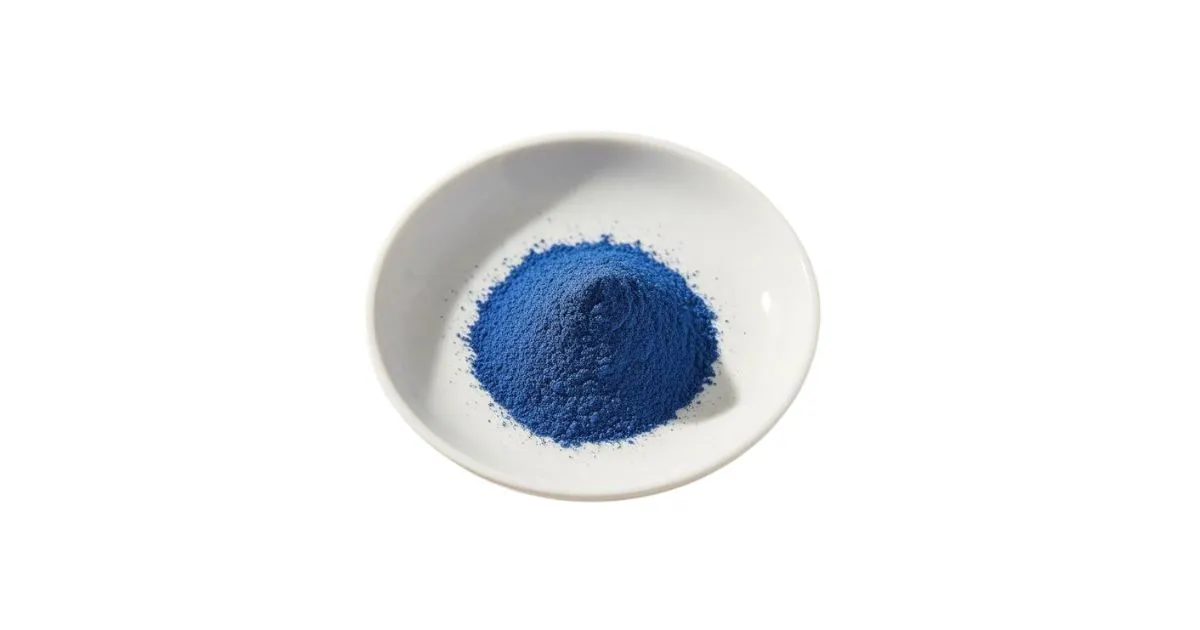
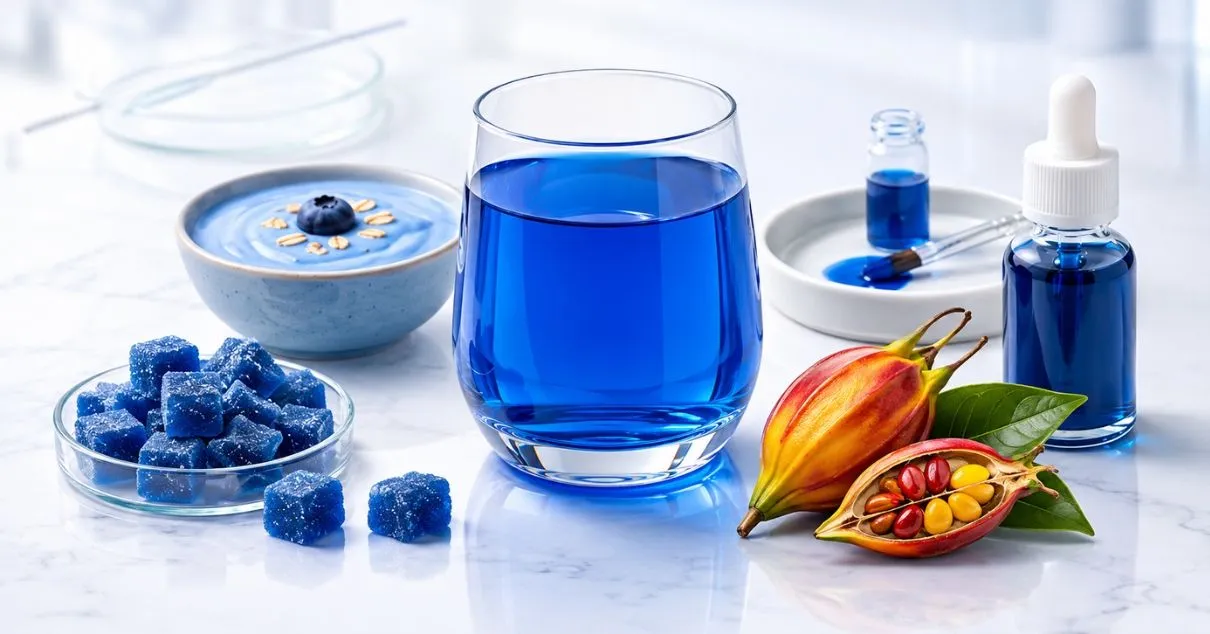
Gardenia blue powder is made from the fruit of Gardenia jasminoides. Manufacturers extract geniposide from the dried fruit, convert it into genipin with the enzyme β-glucosidase, and react it with amino acids to form a stable blue pigment. The purified liquid is then standardized and spray dried into a fine powder, which is milled, tested, and packed. Each step affects shade, color value, solubility, and batch consistency. In this guide, we walk through the full process, from fruit selection to storage, so formulators and buyers can judge quality with confidence.
From Gardenia Fruit to Blue Pigment
Step 1: Selecting and Preparing Gardenia Fruit
Gardenia fruit is used to start the process. There are a lot of iridoid compounds in this fruit, mostly geniposide. These are the things that make a difference: color yield, color strength, smell, and batch stability. Of course, the food that comes in first is checked to make sure it's good. It's a good habit to be able to find out where food comes from and to check for things like plant type, moisture, foreign matter, microbial load, pesticide residues, and contaminants.
To get the juice out of the fruit, they wash, sort, dry, and crush it. More of the plant's tissue shows when it is crushed. This lets the liquid get to the chemicals it needs more quickly. Yangge helps farming groups make sure that the path of food from the farm to the table is clear. Find out where the fruit comes from, how each batch is tracked, and whether each order comes with a certificate of analysis (COA) that is unique to that batch before you buy from a company.
Step 2: Extracting Geniposide from the Fruit
The crushed fruit then goes through a controlled process to get the juice out of it. It is taken out of the plant matter with water or something else that has been approved. People who work on the machine keep an eye on the temperature, the number of cycles, the amount of solids to liquids, and the time it takes to extract. This is because the output and quality change with each setting. Then, to make the liquid clearer, plant matter that doesn't break down is taken out of it.
The liquid could be made stronger before going on to the next step. If there is too much heat or not enough sifting, the end powder might smell, have hazes, or change colors. This is what we have to say about HPLC. This kind of chromatography is used in labs to check the amount of marker chemicals that meet the standards.
Step 3: Converting the Extract into Blue Pigment
Geniposide won't blue itself. Fujikawa and colleagues described geniposide-to-genipin conversion in 1987. They also employ β-glucosidase. Genipin is combined with amino acids to generate blue pigments. Many molecules make up these hues. This makes gardenia blue more than a plant extract. Manufacturers select pH, temperature, reaction duration, material quantity, amino acid type, and air exposure. Change the tone to blue, blue-violet, or deeper. The laboratories measure light absorption to determine each batch's L, a, and b* color numbers. Note the color, strength, and amount if you can't see them.
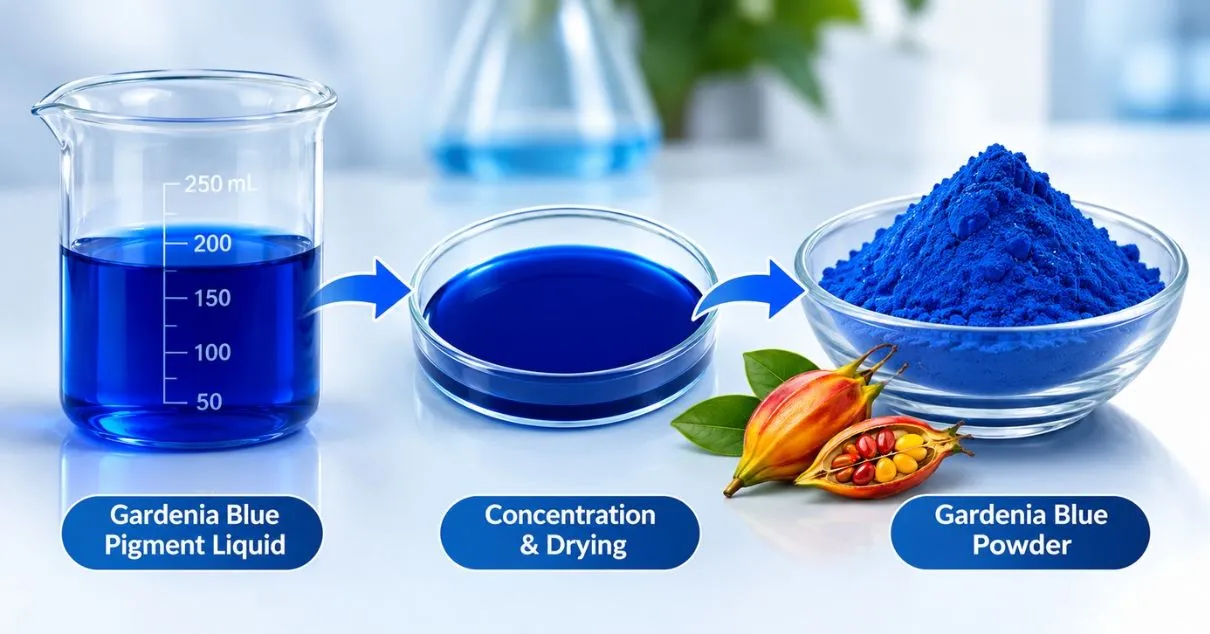
From Pigment Liquid to Finished Gardenia Blue Powder
Step 4: Purification, Filtration, and Standardization
The blue tint indicates that further filtering is needed to remove insoluble particles, plant materials, and trash. Cleaning makes food seem and distribute more evenly. After that, the concentrate maker evens it by adding or removing solids or mixing with the correct bucket. This regulates color for gardenia blue powder. Sellers may provide E30, E60, E80, E100, and E200 dosages that are the same but have varying strengths with this step. How well something breaks down and absorbs water relies on the carrier. Discover the item's material and if it dissolves completely or spreads in water.
Step 5: Drying Gardenia Blue into Powder
Producers spray standard liquid to dry it most often. Fluid splits into small droplets when cooled hot air strikes it. Dry droplets are collected and screened. This process rapidly removes water and creates a stable powder. Maintaining indoor and outdoor temperatures is crucial to color preservation. Freezing dry uses less heat but costs more and moves less. After drying, the dust is crushed, sieved, blended, and metal identified to regulate size, flow, and quantity. Packing and drying are equally critical because fine blue powder draws water from the air. Further details are under "Storage."
Yangge Gardenia Blue Powder at a Glance
Here is the product information for our gardenia blue powder, taken from our current listing.
| Item | Detail |
|---|---|
| Brand | Yangge |
| Product | Gardenia blue powder (natural blue colorant) |
| Part used | Fruit |
| Specifications | E30, E60, E80, E100, E200 |
| Appearance | Blue fine powder |
| Solubility | Easily soluble in water and ethanol aqueous solution; insoluble in organic solvents |
| Availability | In stock |
| Documents | TDS available for E80 |
| Uses | Food, beverages, cosmetics, pharmaceuticals |
The color's E number tells you how strong it is. You might not need as much powder to get the same shade as the value goes up. Gluten, GMOs, man-made ingredients, and things that keep food from going bad are not in the powder.
Testing and Applying Gardenia Blue Powder
Step 6: Testing for Performance, Safety, and Compliance
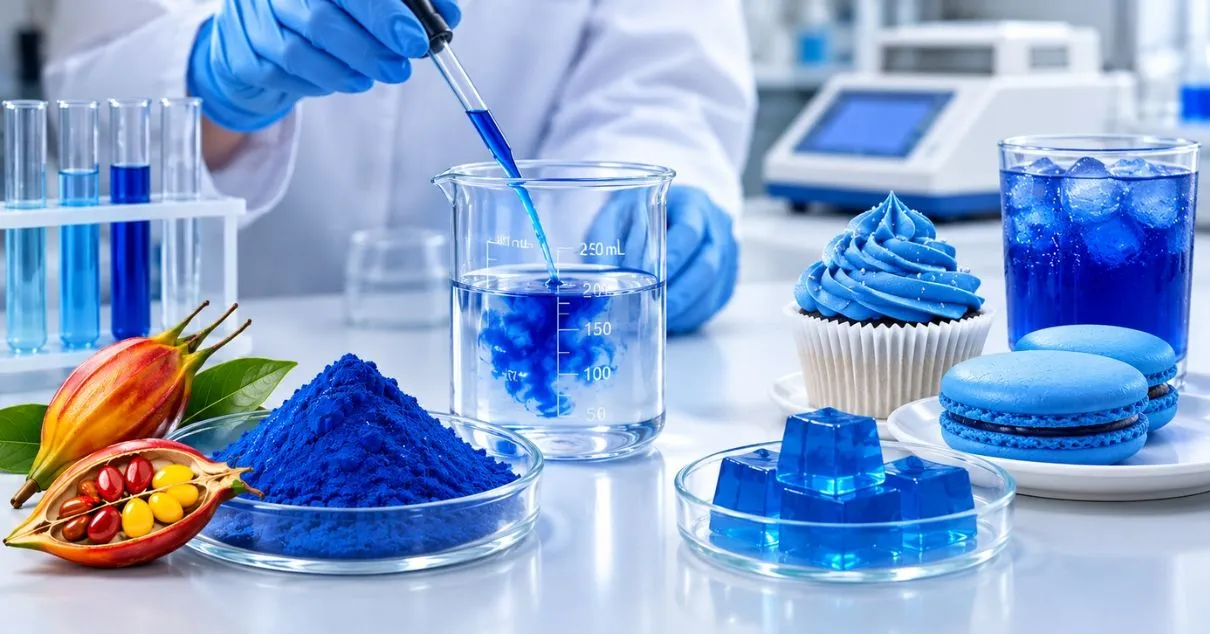
A lot of it works for your recipe and your market, according to tests. See how the powder blends and spreads in drinks, cakes, syrups, gels, and hot and cold water. Some things that work well for one powder might not work so well for another. To see if something is stable, you should check its pH, heat, light, air, and how long it has been stored. Gardenia blue pigments have been tested against pH, temperature, and light before, such as the 2001 test by Paik and his colleagues.
Check these stress points too. It's not enough to just ask for the COA. You should also ask for the standard, microbiological, heavy metal, allergen, and non-GMO claims. Before gardenia blue powder (genipin‑glycine blue) could be sold in the U.S. in 2025, the FDA permitted its use only for specified applications. To find out what you can bring and how much of it you can bring, look at the most current list.
Step 7: Applying Gardenia Blue Powder in Candy, Desserts, Drinks, and Jams
pH, food type, cooking method, and amount utilized determine what occurs. Test candy and jello powder at high solids, cooking heat, and gelation. See what happens to dairy-like desserts and dishes when fat and proteins are added, mixed, then frozen. Check acidity, sedimentation, light exposure, and taste mixing in alcoholic and non-alcoholic beverages. Learn how sour jams are and how long to cook. Check the bread's color during mixing, baking, and finishing. Before producing several powders, try one in your base. If it works in beverages, it may color baked items.
Pairing with Gardenia Yellow for Green Shades
A natural green is simplest to get by mixing blue and yellow. Gardenia blue and yellow originate from the same plant, thus Yangge plants them together. These greens are created together, so buying them from the same manufacturer saves money. We can immediately determine your base, color, and pH. Start with a brief bench press. The grid and yellow electricity determine the final green color. Write down any precipitation or color change you detect in high-acid and clear beverages and monitor them throughout the fridge. Moving from lab testing to production is easier with this strategy.
Comparing and Choosing Gardenia Blue Powder
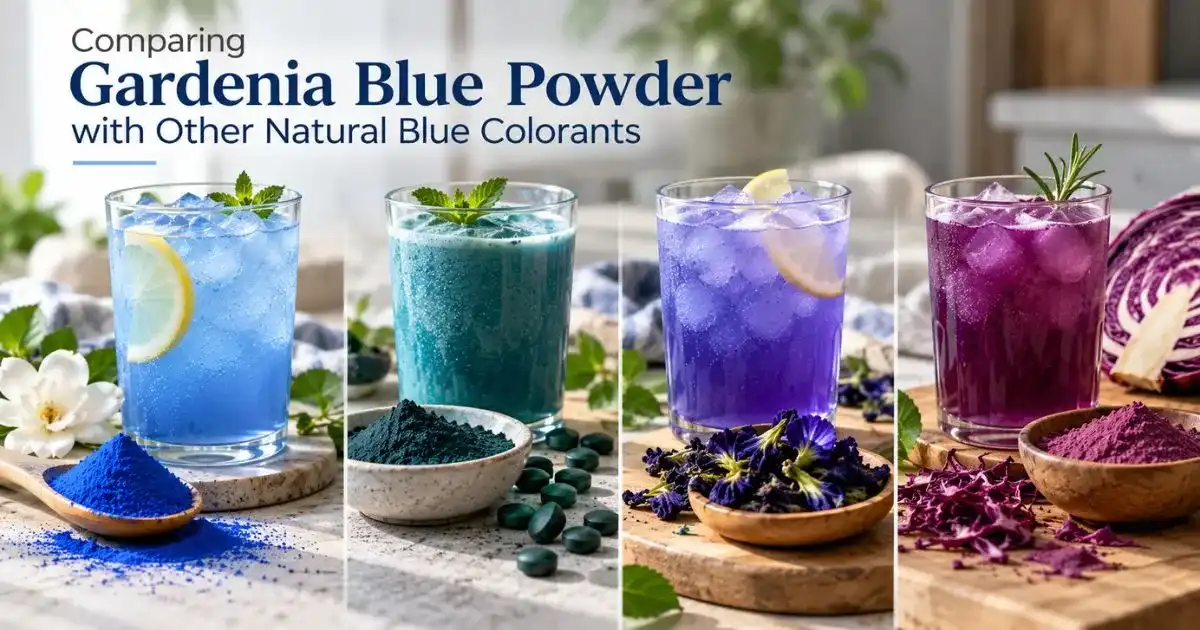
Gardenia Blue Compared with Other Blue Food Colorants
You shouldn't just look at how much blue colorants cost per kilogram. You should also look at how well they work and how much they cost per finished product.
| Colorant | Origin | Heat response | pH response |
|---|---|---|---|
| Gardenia blue | Gardenia fruit (genipin-based) | Relatively stable | Relatively stable; test very acidic bases |
| Spirulina blue (phycocyanin) | Spirulina algae | Sensitive; fades above about 60°C | Best in near-neutral systems |
| Butterfly pea | Flower anthocyanins | Varies by system | Hue shifts from blue toward purple or pink in acid |
| Brilliant Blue FCF | Synthetic | Stable | Stable; not a natural-label option |
When you ship colors that come in powder form, they take up less room and don't need extra water. But they need to be mixed together very carefully.
How to Choose a Gardenia Blue Powder Supplier
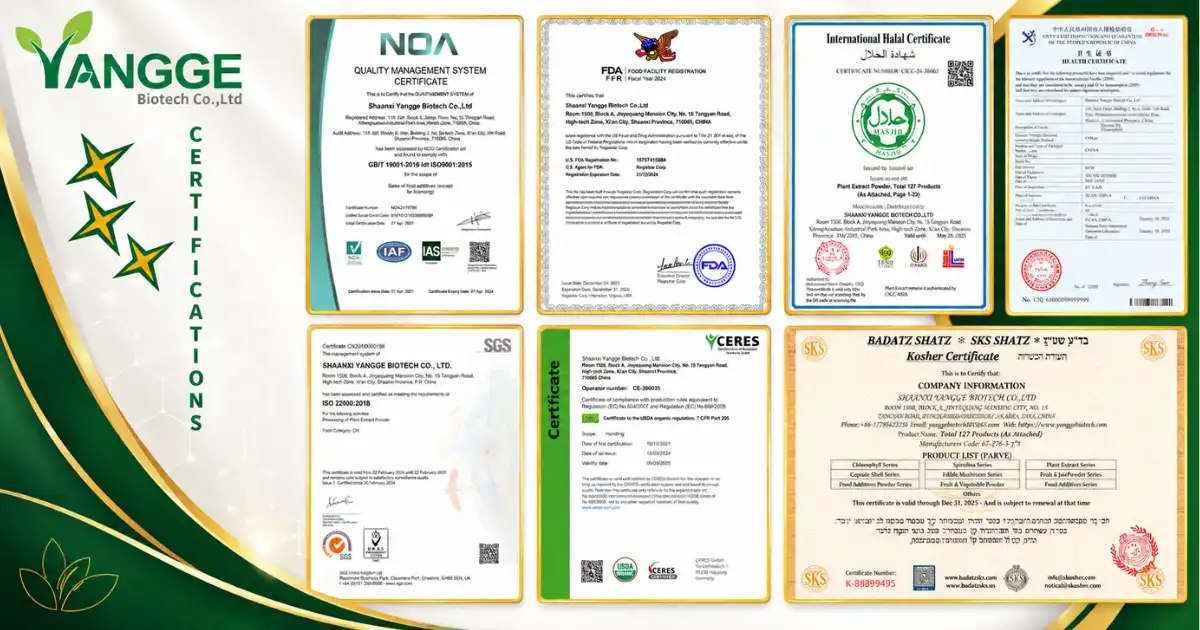
Check out more than just the price per unit. Find out if the company can make gardenia blue powder, if they've exported before, if they offer technical support, what kinds of packing they have, how long the wait time is, and how much of an order they need to be placed. Before you buy something, make sure that the HACCP, ISO, GMP, Halal, and Kosher certificates are up-to-date and cover both the item and the factory where it was made.
Confirm the base and color value, get a sample and TDS, make sure your matrix is stable, place a small trial order, and then start full production. This way, you can be sure of the color. Make plans for the next three to eight weeks. The company Yangge Biotech has won awards from ISO, HACCP, Kosher, and Halal. They also follow GMP rules when they make their goods and send them to many other countries.
Storage, Shelf Life, and Handling
Gardenia blue powder should be kept in a cool, dry place that is not in full sunlight. Keep it away from air, water, and strong smells. When you open a fine powder bag, make sure you quickly close it back up again so the powder doesn't fall to the bottom and the color doesn't fade. If you want to know how long something will last, look at the date it was made and compare it to the last rules.
The quality of the packing, the amount of moisture, the weather, and the amount of light can all change how long something will last. As you ship the goods, make sure that the boxes, packages, seals, batch marks, and humidity that they were exposed to are in good shape. For smaller orders, bags and boxes that keep water out can work. For bigger orders, though, food-grade bulk containers are better. "First-in, first-out" is another way to move things around in the warehouse.
Conclusion
Gardenia blue powder appears on fruit. Amino acids form genipin from geniposide after genes remove it. It becomes a stable natural blue after cleaning, standardizing, and drying. Buyers of E30 or E200 grades shouldn't base their choice on shade. Each step alters shade, solubility, batch stability, and hue. They should inspect aircraft and study articles. The powder is tested on jam, candy, dessert, drink, and drink mix to evaluate how it reacts to pH and heat. Gardenia blue is great for heat- and pH-tolerant plants. When blended with gardenia yellow, it becomes green. The government also monitors and oversees market water supplies.
FAQ
Is gardenia blue powder stable in heat and acidic drinks?
It keeps its color better than spirulina blue or butterfly pea when it gets hot or the pH level changes. Check the pH and the steps you use to make the drink before you put it on the market. The color can change even in very acidic drinks.
How do I choose between E30 and E200?
The color's E number tells you how strong it is. For example, E200 needs less powder than other grades to make the same color. On the other hand, lower grades work better for recipes that need more. Send us your base color and the color you want to get. We'll give you a number.
How do I prevent caking?
Put the powder somewhere cool, dry, dark, and with the lid on tight. Close the bag again after each use. Things stick together because the fine powder can take in water from the air.
Request Gardenia Blue Powder Samples from Yangge
Gardenia blue powder can be bought from Yangge Biotech in amounts of E30, E60, E80, E100, and E200. They have them already. We sell this gardenia blue powder. It is good enough for ISO, HACCP, Kosher, and Halal. We know the best way to test your candy, treat, drink, or jam, as well as the TDS and COA. Go to blog.yanggebiotech.com or email info@yanggebiotech.com with your base color, the shade you want, and how much you want to get.
References
1. Trends in Food Science & Technology, 2016. Martins et al., "Food colorants: Challenges, opportunities and current desires of agro-industries to ensure consumer expectations and regulatory practices."
2. Trends in Food Science & Technology, 2017. Neri-Numa et al., "Genipin: A natural blue pigment for food and health purposes."
3. Journal of Fermentation Technology, 1987. Fujikawa et al., "Brilliant skyblue pigment formation from gardenia fruits."
4. Journal of Agricultural and Food Chemistry, 2001. Paik et al., "Physical stability of the blue pigments formed from geniposide of gardenia fruits: Effects of pH, temperature, and light."
5. Process Biochemistry, 2014. Martelli et al., "Thermal stability improvement of blue colorant C-Phycocyanin from Spirulina platensis for food industry applications."
6. U.S. Food and Drug Administration, 2025. Color Additive Status List.

Based on your location and order quantity, you will have the opportunity to receive a limited time free shipping promotion!
Who we are
Popular Blogs