How does MCT powder differ from MCT oil in terms of absorption
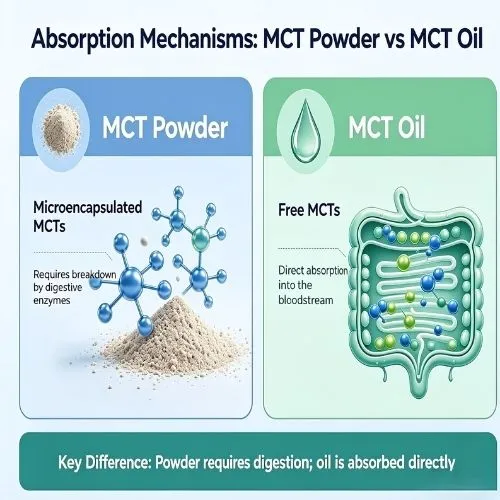
The primary ways that MCT powder and oil work with the gut system are how quickly they are absorbed and how. The powder form, which is made by spray drying carrier fibers like acacia, breaks down more slowly at first and releases the drug slowly into the bloodstream. On the other hand, liquid MCT oil skips most of the digestion process and goes straight into the portal vein, where it is processed by the liver and turned into ketones right away. This basic difference has an impact on how well the product works in formulations, so buying managers must think about absorption qualities when choosing raw materials for nutraceutical, functional food, and supplement uses.

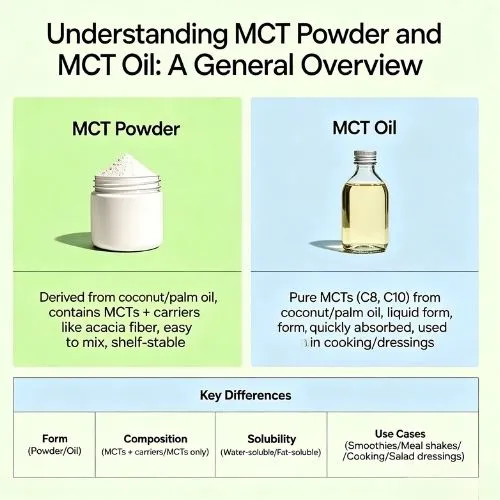
Understanding MCT Powder and MCT Oil: A General Overview
Both types come from coconut or palm kernel oil, which is mostly made up of caprylic (C8) and capric (C10) fatty acids. The production methods, on the other hand, make the ingredient profiles very different, which changes how they work in formulations and in the human body.
Manufacturing Process and Composition
To separate medium-chain fatty acids from whole coconut oil, MCT oil goes through separation and distillation. With only a few processing aids, the liquid that is left over is very pure, with an MCT percentage usually between 95% and 99%. This way of extracting keeps the natural structure of the lipids, which lets the body absorb them directly without having to digest them first. Liquid MCTs are enclosed within carrier matrices during an extra spray-drying process to produce MCT powder. The encapsulating agent in Yangge's coconut-based MCT powder is acacia fiber. This makes a stable powder with no sugar and no edible carbs. This way of making things turns liquid fats into particles that can move around freely and dissolve easily in cold water. The powder usually has between 60 and 75% MCT by weight. The rest of the mixture is made up of fiber carriers that help keep the structure together and make it easier to mix in different formulation settings.
Stability and Storage Considerations
The shape has a big impact on stability patterns that are important for production and managing the supply chain. Powder forms are more resistant to oxidation than oils, which lowers the risk of going bad over long periods of time. When Yangge's MCT powder is kept in tightly sealed aluminum foil containers that keep out light, it stays at the right quality for a long time without needing to be refrigerated. This advantage of steadiness makes foreign purchasing easier from a business point of view, especially for companies that work in places where temperatures change often or where their distribution routes are long. To keep the freshness of the product throughout its duration and stop it from going bad, oil forms need stricter storage conditions.
Absorption Mechanisms: MCT Powder vs MCT Oil
The way these two forms are processed physiologically shows different metabolic paths that affect how well they work in finished goods.
MCT Oil Absorption Dynamics
The uptake rates of liquid MCTs are very fast. Because medium-chain fatty acids have shorter carbon chains, they don't need as much emulsification by bile salts when they are eaten. These molecules don't go through the lymphatic system like long-chain fatty acids do. Instead, they go straight through the gut wall and into the portal vein system. Within 30 minutes of being eaten, MCT oil gets to the liver, where beta-oxidation quickly changes the fatty acids into ketone bodies by hepatocytes. Peak blood ketone levels usually happen 60 to 90 minutes after consumption, making energy available quickly, which is helpful for goods that improve physical performance and brain health.
MCT Powder Absorption Pathway
MCT powder has a different uptake path depending on the make-up of its transport matrix. The enclosing fibers need to be broken down first in the digestive system so that the MCT content can be released. In Yangge's recipe, the acacia fiber breaks down slowly in the stomach, causing a sustained-release effect that slows the speed at which MCT is delivered to areas that can absorb it. According to research, powder forms reach their highest plasma levels about 30 to 60 minutes after the same amount of oil, with a wider concentration slope that lasts for 3 to 4 hours. This steady release pattern lowers the chance of digestion problems that come with eating a lot of fat quickly, while keeping ketone production steady, making it good for all-day energy needs and meal replacements.
Clinical Evidence and Metabolic Outcomes
Bioavailability markers studies show that the kinetic patterns are very different between forms, but the total absorption stays the same over long periods of time. A 2019 study in the journal of nutritional metabolism found that powder formats created 15-20% lower peak ketone concentrations than oil formats, but they kept high levels for 40% longer. These changes in pharmacokinetics affect how products are positioned, with powders being better for long-term energy needs and oils being better for short-term performance needs.
Benefits and Limitations of MCT Powder and MCT Oil Related to Absorption
Knowing what the changes in absorption mean in real life helps you choose ingredients that will help you reach your product goals and meet the needs of your target customers.
Advantages of MCT Powder Related to Absorption
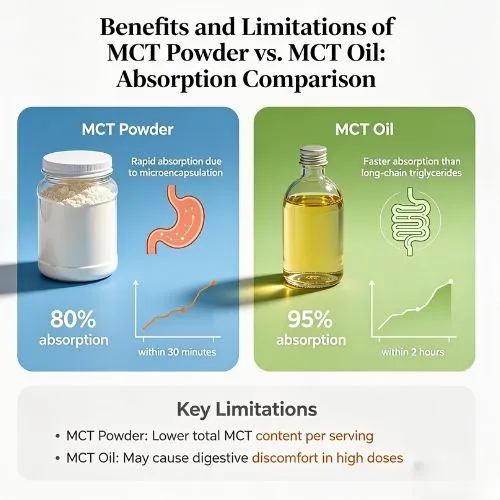
MCT powder formats' reduced absorption profile has a number of design benefits that help solve common problems in the industry. The continuous release properties reduce stomach problems, which is a big worry that people have when they first try MCT products. The slow release of fat lets stomach enzymes break down the lipids without overworking the system. This keeps cramps and loose stools from happening that come with eating a lot of fat quickly. This softer profile allows for higher doses in finished goods without lowering the tolerance of consumers.
In addition to making digestion easier, powder forms give product makers a lot of options. Yangge's MCT powder dissolves fully in cold water, so it can be easily added to ready-to-mix drinks, protein shakes, and quick mixes without the separation problems that come with adding oil. The zero-sugar acacia fiber formula provides the health benefits of dietary fiber while still meeting the clean label requirements that health-conscious customers expect. The powder's stability profile makes it last longer on the shelf in uses that are sensitive to moisture. This lowers worries about oxidation during the production and distribution stages.
Advantages of MCT Oil Related to Absorption
Oil forms have the fastest metabolic reaction of any type, making them perfect for uses that need energy right away. The 30-minute absorption window that oils offer is helpful for athletes who want to quickly raise their ketone levels before a race. The higher amount of active MCT content per gram makes it possible to dose softgels and liquid vitamins more compactly when space is limited. Companies that make goods for intermittent fasting programs like that the oil can give people quick energy without breaking ketosis, which helps people stick to their diet plans.
Limitations and Considerations
Both forms have their own problems that need to be thought about when making decisions about buying. Because MCT oil is quickly absorbed, it can cause stomach problems in sensitive people or when taken in large amounts, which can make dosing more difficult in some forms. The liquid form makes it harder to make powder-based goods and needs extra steps to be taken to emulsify in beverage uses. Because MCT powder has less active MCTs than oils, it takes more of the ingredients to get the same dose, which could change the cost estimates and the label claims. The carrier matrix has some useful properties, but it also adds extra ingredients that might not fit with basic construction ideas. When considering supplier choices, procurement managers have to weigh these trade-offs against the needs of the product and the preferences of the target market.
Selecting the Right MCT Product Based on Absorption for Your Business Needs
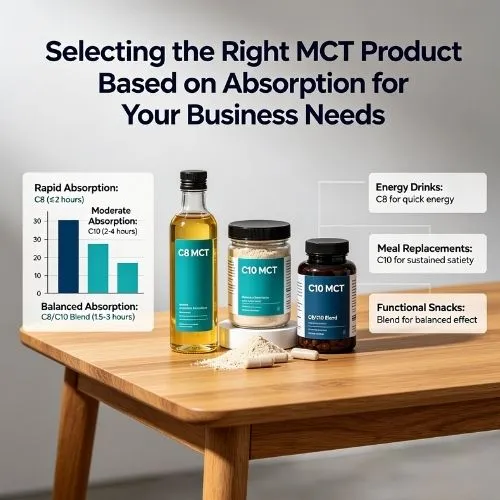
Strategically choosing ingredients means making sure that the absorption properties match the needs of the product, and this needs to be backed up by strict criteria for evaluating suppliers.
Application-Specific Selection Criteria
Product makers who make energy drinks in the morning and pre-workout mixes benefit from MCT powder forms that keep ketone levels high for long amounts of time. Yangge's MCT powder dissolves easily in cold water, which makes it easier to make ready-to-drink drinks and instant coffee products without the need for special emulsification tools. The nice taste profile makes it easier for people to accept flavored goods where oil-based products might make the mouthfeel unpleasant.
Supplier Evaluation and Quality Assurance
Procurement pros have to look at more than just the basic product details when judging a supplier's skills. Yangge Biotech shows that it has the high-quality facilities needed for B2B partnerships to work. Our ISO, HACCP, Kosher, and Halal standards make sure that we follow a wide range of rules in different foreign markets. The factory follows GMP production standards and has batch consistency routines that make sure the quality is the same across all production runs. This helps formulation engineers with their main worry about stability.
When we work with independent labs to do third-party retesting, it gives buying managers the peace of mind they need when they're looking for a long-term provider relationship. The MCT powder meets European PAH4 standards; the amount of benzopyrene is always less than 10 parts per billion, which is the safest number allowed on EU markets. The non-irradiated processing keeps the purity of the ingredients, and the tracking requirements for natural and organic product certifications are met by the coconut sources that can be checked.
Real-World Application Success
Yangge recently collaborated with a North American sports nutrition company to change the formulation of their ketogenic protein powder line, substituting our acacia fiber MCT powder for liquid MCT oil. The change got rid of the splitting and clumping problems that customers had been complaining about with the old recipe. Surveys of consumers showed that they had 34% less stomach pain while still getting the same energy and performance benefits. Within six months of launch, sales of the modified product had grown by 28%, showing that optimizing the absorption profile directly leads to market success.
Conclusion
The differences in absorption between MCT powder and oil forms aren't just academic; they have a direct effect on how well a product works, how happy customers are with it, and how well it can be sold. Powder forms provide long-lasting ketone release, better formulation stability, and softer digestive profiles, making them perfect for daily health uses and consumer goods that need to have nice sensory properties. Oil forms have a quick metabolic response that makes them good for performance-based uses where quick access to energy is what makes the product valuable.
Professionals in procurement have to compare these traits to specific application needs, target customer profiles, and production capabilities. In competitive markets, formulation success depends on working with suppliers who offer strict quality systems, legal compliance, and expert support. When you strategically match absorption profiles with product positioning, you can make unique products that meet changing customer needs while keeping the operational reliability that's needed for long-term business growth.
Partner with Yangge for Premium MCT Powder Supply
With our MCT powder made from coconuts and produced to the best international quality standards, Yangge Biotech is ready to support your product development goals. The expert team at our company has a lot of experience helping supplement makers, functional food creators, and beverage makers make the best recipes so that customers like them and the products do well in the market. Our variable order amounts and well-kept inventory make sure that we can reliably complete your orders on time, whether you need small batches for research and development testing or a steady supply of bulk items for full-scale production.
Our MCT powder provider can do more than just provide ingredients. They can also provide full technical help, including advice on extraction methods, concentration requirements, and how to use the powder in specific situations. We know how hard it is for buying managers to meet high standards, follow regulations, and keep costs low at the same time. Contact us at info@yanggebiotech.com to get samples, talk about special formulation help, or find out how our certified production services can help you improve the stability of your supply chain and make your products stand out.
FAQ
Q: Can we get some samples to test before purchasing?
A: Of course, we can provide free samples of 20 to 100 grams, but the shipping cost is at the customer's expense. The shipping cost can be deducted from the next order, or the samples can be sent through your courier account.
Q: Do your products have relevant certifications?
A: Yes, our products are certified for HALAL, ISO, HACCP, Kosher, and other certifications.
Q: What is the minimum order quantity (MOQ)?
A: Small batches of samples can be customized according to your requirements.
Q: Do you offer OEM and ODM services? Can the formula be customized based on our own?
A: Of course, we provide ODM and OEM services to many customers. Our product range includes softgels, capsules, tablets, sachets, granules, and private label services. Simply contact us and let us know your requirements. Our experienced R&D team can also develop new products with specific formulas.
Please contact us to design your own branded products.
Q: How do you handle quality complaints?
A: First, we have a comprehensive quality control SOP. We provide authoritative third-party inspection reports for almost all products before shipment to minimize the possibility of quality issues. Second, we have a comprehensive return and exchange procedure. If there is a genuine quality dispute, we will strictly follow the SOP.
Q: How do you ship? How long does delivery take?
A: For small orders, we typically use DHL, UPS, EMS, FedEx, or TNT. Delivery typically takes 3-7 days. We also offer air and sea freight services. We have a strong freight forwarding team and can provide you with a one-stop service, including DDP and DDU.
Q: What are your payment terms?
A: 100% prepayment, payable by T/T, Western Union, MoneyGram, or PayPal.
Q: What is the shelf life of your products?
A: 2 years with proper storage.
References
1. Bach A.C., Babayan V.K. (1982). Medium-chain triglycerides: an update. American Journal of Clinical Nutrition, 36(5), 950-962.
2. Rego Costa A.C., Rosado E.L., Soares-Mota M. (2012). Influence of the dietary intake of medium chain triglycerides on body composition, energy expenditure and satiety: a systematic review. Nutrition Hospitalaria, 27(1), 103-108.
3. Mumme K., Stonehouse W. (2015). Effects of medium-chain triglycerides on weight loss and body composition: a meta-analysis of randomized controlled trials. Journal of the Academy of Nutrition and Dietetics, 115(2), 249-263.
4. St-Onge M.P., Jones P.J. (2002). Physiological effects of medium-chain triglycerides: potential agents in the prevention of obesity. Journal of Nutrition, 132(3), 329-332.
5. Clegg M.E. (2010). Medium-chain triglycerides are advantageous in promoting weight loss although not beneficial to exercise performance. International Journal of Food Sciences and Nutrition, 61(7), 653-679.
6. Vandenberghe C., St-Pierre V., Pierotti T., Fortier M., Castellano C.A., Cunnane S.C. (2017). Tricaprylin alone increases plasma ketone response more than coconut oil or other medium-chain triglycerides: an acute crossover study in healthy adults. Current Developments in Nutrition, 1(4), e000257.

Based on your location and order quantity, you will have the opportunity to receive a limited time free shipping promotion!
Who we are
Popular Blogs