How does beta carotene work as a food color?
Beta Carotene Powder from Yangge Biotech is a carotenoid ingredient supplied for natural food coloring, nutraceutical, beverage, and dietary supplement applications. Available in different concentrations and forms, including powder, oil suspension, and microencapsulated powder, it provides yellow-to-orange coloration and can be used in products such as beverages, bakery goods, confectionery, dairy products, functional foods, supplements, capsules, tablets, and gummies. Yangge Biotech offers bulk supply, OEM packaging, free samples, and technical documentation such as COA and specifications to support commercial formulation needs. Contact us for samples, specifications, pricing, and bulk orders at info@yanggebiotech.com.
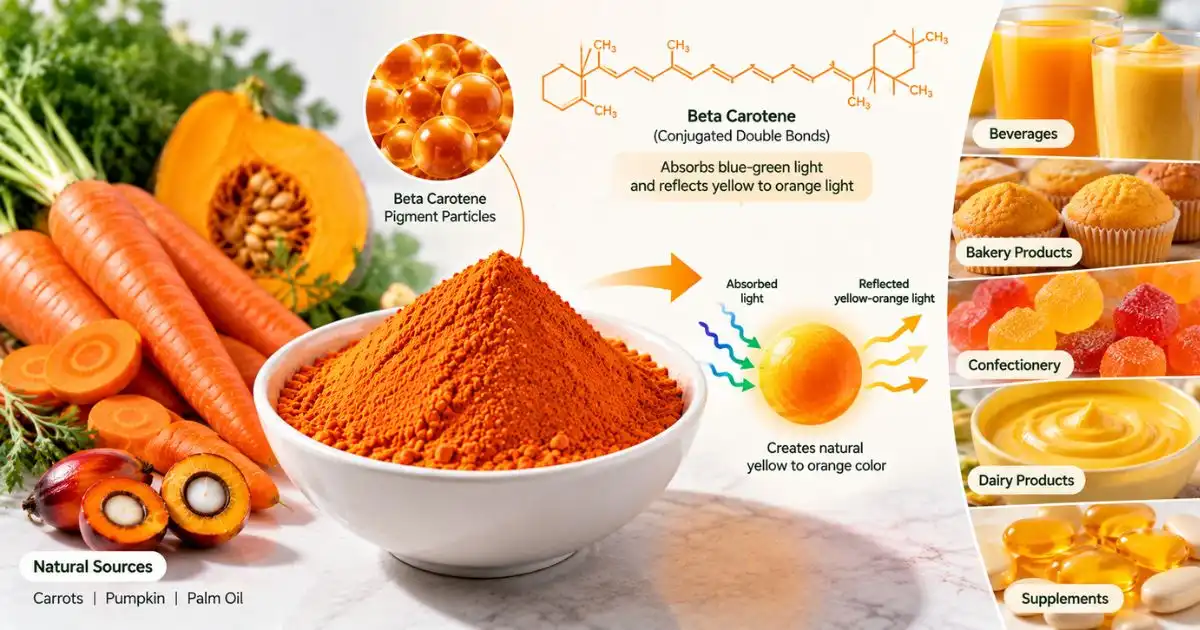
Beta carotene functions as a natural food colorant by absorbing blue and green wavelengths of light while reflecting yellow and orange hues, creating its characteristic vibrant coloration in food products. This carotenoid pigment, found abundantly in carrots and sweet potatoes, offers food manufacturers a clean-label alternative to synthetic dyes while simultaneously providing nutritional benefits as a vitamin A precursor.
When incorporated into food matrices containing fats or oils, beta carotene demonstrates enhanced stability and color intensity, making it particularly valuable for beverages, dairy products, and functional foods targeting health-conscious consumers.
Understanding Beta Carotene and Its Role as a Food Color
The Natural Pigment Behind Vibrant Hues
Beta Carotene is a naturally occurring colourant that comes from plants. It is in the carotenoid family, which is made up of over 600 different pigments that give things like autumn leaves, ripe tomatoes, and golden mangoes their bright colours. The molecule structure is made up of a long chain of conjugated double bonds that combine with light waves to give carrots and pumpkins their unique orange-yellow colour. This same quality makes it a great choice for use as a food colouring.
Why Food Manufacturers Choose Natural Over Synthetic
In the last ten years, the move toward natural ingredients has sped up a great deal. The Natural Products Insider says that 73% of North American consumers actively look for products with ingredients they can recognise. Beta Carotene is exactly what this customer wants and meets strict rules in many places.
Beta Carotene is generally recognised as safe (GRS) in the US and widely accepted in Europe, Japan, and other major markets. This is in contrast to artificial colours like Yellow 5 and Yellow 6, which are being closely looked at and need specific labels in many countries.
Dual Functionality: Color Plus Nutrition
Beta Carotene has real health benefits in addition to its good looks. This provitamin A pigment is changed into retinol by the body when it needs to. Retinol helps the immune system, eyesight, and skin stay healthy. This process of conversion is self-controlled, so it doesn't pose the health risks that come with preformed vitamin A supplements.
According to a study published in the Journal of Food Science in 2021, consumers liked foods that were fortified with Beta Carotene more than foods that were coloured with only synthetic ingredients. This is because natural ingredients have a "health halo effect" that makes them seem better for you.
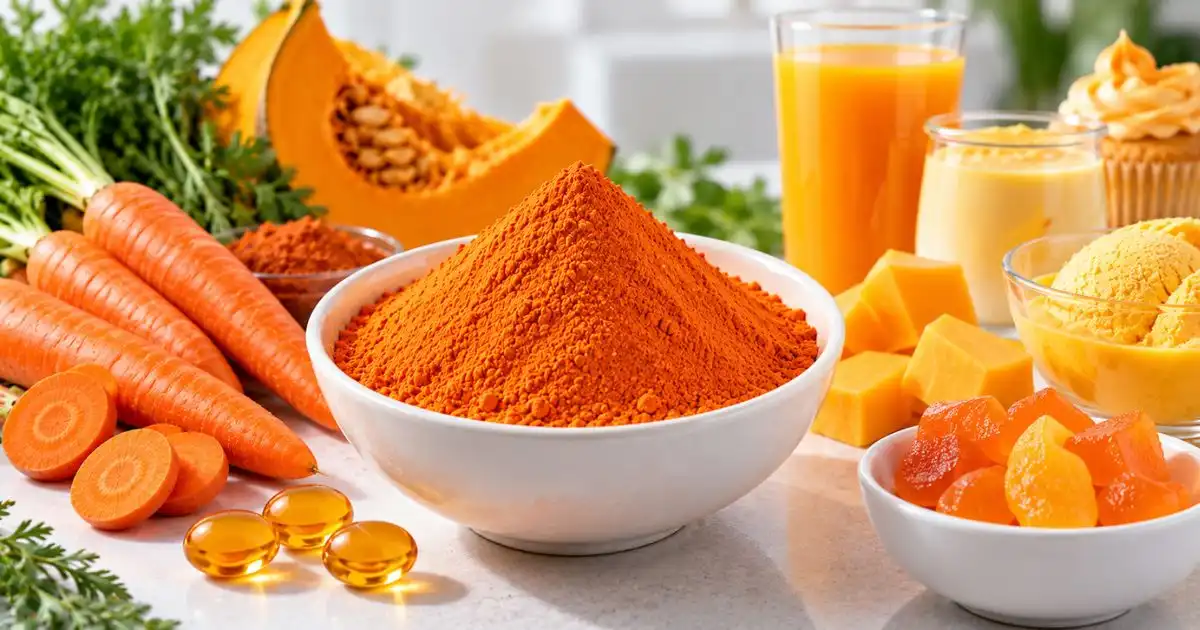
Scientific Mechanism: How Beta Carotene Works in Food Coloring
Light Absorption and Color Expression
Beta Carotene's ability to change colours comes from its large network of conjugated double bonds—eleven alternating single and double carbon bonds that make a chromophore that can absorb certain wavelengths of light. Molecular Beta Carotene absorbs light waves in the 400–500 nanometre range (blue-green spectrum) and sends back light waves in the 550–650 nanometre range (yellow-orange spectrum). The exact colour is determined by the concentration. Low concentrations produce pale yellow tones, while high concentrations produce deep orange tones.
Factors Affecting Stability and Color Performance
Temperature exposure during processing has a big effect on how well colours stay true. Beta Carotene degrades more quickly above 80°C, with oxidation rates doubling for every 10°C rise, according to research published in Food Chemistry. Changes in pH levels are also very important. Places with a pH below 4 can make colours slightly yellow, while places with a pH between 6 and 8 keep the best orange tones. Antioxidants, such as vitamin E or ascorbic acid, can protect colours from oxidative degradation, which can make them last longer.
Formulations that are based on oil spread colours more evenly than methods that are based on water. Because Beta Carotene is lipophilic, it dissolves easily in fats, giving goods like margarine, cheese, and salad sauces a consistent colour. To get water-soluble ingredients to mix properly in drinks and sweets, you need to use special packaging methods with carriers like modified starches or gum arabic.
Performance Compared to Alternative Natural Colorants
Besides Beta Carotene, other natural food colourings that can be used are annatto, lutein, and paprika extracts. For medium-sized production runs, Beta Carotene has clear benefits in terms of colour range, regulation acceptance, and cost efficiency. Even though annatto has similar orange tones, it has a slightly different flavour that might not work in all situations. Lutein gives things yellow colours, but not as bright as Beta Carotene does at the same concentrations. The following table shows the main changes in performance:
| Colorant | Primary Hue | Heat Stability | Light Stability | Typical Usage Level | Relative Cost |
|---|---|---|---|---|---|
| Beta Carotene | Orange-Yellow | Moderate (≤80°C) | Good with protection | 10-100 ppm | Medium |
| Annatto | Yellow-Orange | Good (≤120°C) | Moderate | 5-50 ppm | Low-Medium |
| Lutein | Yellow | Good (≤100°C) | Good | 5-30 ppm | High |
| Paprika Extract | Red-Orange | Moderate (≤70°C) | Poor | 50-200 ppm | Medium-High |
Beta Carotene Sourcing and Supplement Forms for Industrial Use
Natural Extraction Methods Versus Synthetic Production
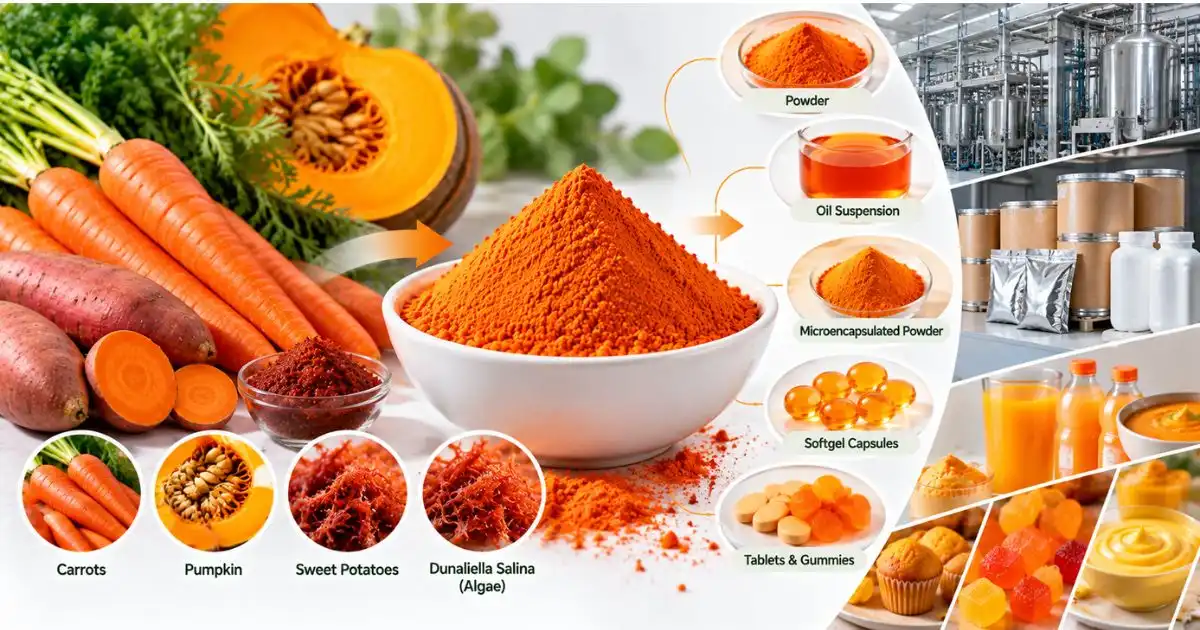
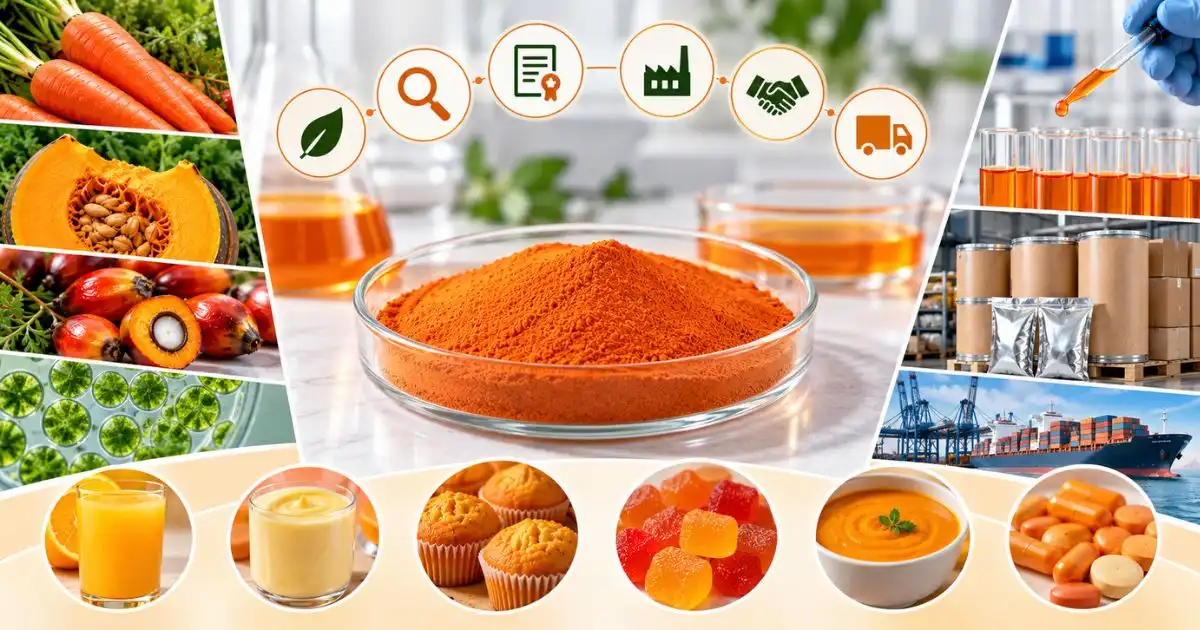
Industrial Beta Carotene comes from two main places: chemical synthesis and natural extraction. According to Grand View Research, the global market for natural Beta Carotene derived from Dunaliella salina algae cultivation is worth $186 million in 2022, or about 35% of the total. To make this product, algae are grown in high-salinity ponds under stress conditions that cause carotenoids to build up. The algae are then harvested, dried, and solvent extracted. There are both cis and trans isomers in the final product, but the all-trans type is more common.
Synthetic Beta Carotene is made using petrochemical precursors in a series of chemical reactions, producing almost 100% pure all-trans Beta Carotene. Synthetic forms are cheaper for large-scale uses, but natural sources are better for brands that want to stress their clean or non-GMO status. Beta Carotene produced through fermentation using engineered yeast or bacteria strains is a new method that bridges the gap between natural and synthetic categories. It can be scaled up while still meeting the requirements for "natural" labelling in most places.
Commercial Formats for Different Applications
Knowing the different types of product formats helps buying teams choose the best specs for their production needs. These are the main types of business:
- Powder Formulations: Yangge's Beta Carotene Powder comes in concentrations ranging from 1% to 20%, which are standardised using HPLC analysis. The orange-yellow powder mixes well in oil-based systems and does a great job in dry mix, capsule, and tablet applications. When stored, our powder form is more stable than liquid forms, and it can last longer than 24 months if kept in the right conditions.
- For oil suspensions, Beta Carotene that is already dissolved in vegetable oils (most often sunflower or MCT oil) makes it easier to add to fat-containing goods. Concentration ranges are usually between 10% and 30%, which makes dosing for drinks and emulsified foods very accurate.
- Water-Dispersible Beadlets: Beta Carotene that is encapsulated and covered by gelatin or modified starch matrices makes them suitable for use in watery environments. These unique formats cost a lot, but they solve technical problems in dairy and beverage applications.
Which format to use depends on the needs of the target application, the powers of the processing tools, and the rules in the target markets. Yangge keeps a wide range of FDA-approved, Kosher-certified, and Halal-certified products in stock to meet the needs of a wide range of markets. For R&D trials, our team offers free samples ranging from 10 to 30 grams so that you can fully evaluate the product before deciding to buy it in bulk.
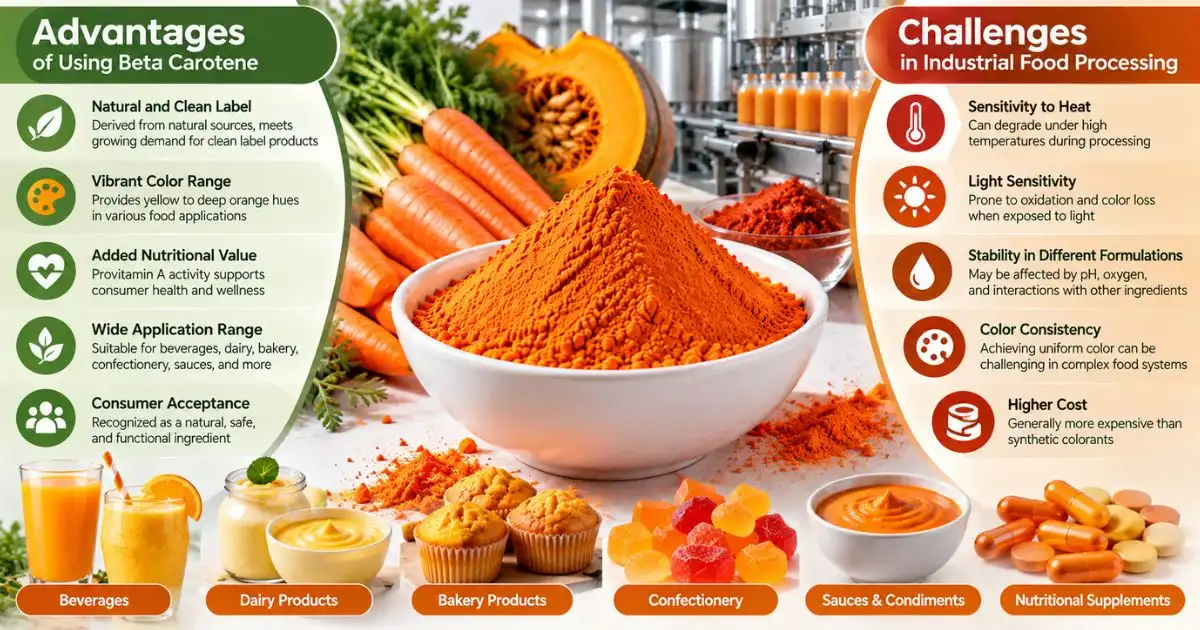
Advantages and Challenges of Using Beta Carotene in Industrial Food Processing
Compelling Benefits for Modern Food Manufacturers
Beta Carotene may have the biggest advantage in the market right now because of its natural positioning. Consumers are willing to pay an extra 15 to 20 percent for clean-label goods, according to study from Mintel in 2023, and the fact that Beta Carotene comes from vegetables makes it a popular ingredient. This natural look backs up marketing claims like "no artificial colours" and makes it easier to get organic approval if the ingredients are found correctly.
Beyond colouration, Beta Carotene's antioxidant properties make it useful in other ways. As a free radical scavenger, it can help keep goods fresh, which could increase the shelf life of fat-containing foods that are prone to going rancid. This two-in-one feature—coloring and preservation—raises the value proposition for procurement managers who are comparing costs and benefits.
Product sales go more smoothly when regulations are accepted in all foreign markets. Under Codex Alimentarius rules, Beta Carotene is accepted everywhere, while manufactured colours need to be approved by each country and come with a lot of safety information. This global regulatory alignment cuts down on time-to-market and makes paperwork easier for businesses that do business in more than one region.
Technical Challenges and Practical Solutions
The main problem with Beta Carotene's safety is that it is photosensitive. Ultraviolet (UV) and visible light speed up oxidation processes that make flavours and colours fade. This problem can be solved by using packaging materials that block UV light, like amber glass, metallized films, or UV-stabilized plastics. One of the beverage companies we work with was able to keep the bright colour of their useful orange drink by moving from clear PET bottles to amber glass. This increased the drink's shelf life from 4 months to 9 months while still keeping the bright colour customers expect.
Because handling is sensitive to temperature, the plan needs to be carefully thought out. When foods are pasteurised, treated with UHT, or baked, they are heated to high temperatures that break down carotenoids faster. Adding Beta Carotene after the thermal processing, if possible, or increasing the initial dose to make up for the expected losses solves this problem. A dairy processor in the Midwest got the colour they wanted by adding Beta Carotene after the milk was pasteurised but before it was packed. This cut down on degradation from 35% to less than 10%.
Achieving the right dose combines the strength of the colour with the limits set by the government for adding vitamin A. Beta Carotene can be converted to vitamin A, so estimates must take this into account. Different countries have different maximum amounts for vitamin A in foods. Working with experienced suppliers who know these regulatory details keeps you from having to wait for expensive reformulations.
| Application Category | Typical Dosage Range | Key Stability Factor | Common Challenge | Recommended Solution |
|---|---|---|---|---|
| Functional Beverages | 5-25 ppm | Light exposure | Color fading | Opaque packaging + antioxidant blend |
| Dairy Products | 10-40 ppm | Fat content variation | Uneven distribution | Homogenization optimization |
| Baked Goods | 15-60 ppm | Baking temperature | Heat degradation | Microencapsulation technology |
| Soft Gel Capsules | 500-2000 ppm | Oxygen permeation | Oxidation during storage | Nitrogen flushing + blister packaging |
How to Source and Evaluate Beta Carotene Suppliers for Food Color Applications
Essential Quality Certifications and Documentation
Reliable providers show that they are following the rules by having large collections of certifications. ISO 9001 certification means that quality management is done in a planned way, and HACCP certification means that danger analysis methods are in place to keep food from getting contaminated. GMP (Good Manufacturing Practice) certification is a must for suppliers who want to make health supplements because it covers production standards for pharmaceuticals.
Yangge Biotech keeps all of these certifications up to date, along with specialised credentials like Kosher and Halal certifications. This gives clients who serve a wide range of consumers more market access. Before every shipment, our testing procedures include checking with an international lab and getting Certificates of Analysis that show the Beta Carotene content using HPLC, as well as screening for heavy metals, microbiological testing, and residual solvent analysis.
Evaluating Supply Chain Transparency
As more customers expect traceability, it becomes more important to know where raw materials come from. Suppliers should make it clear if the Beta Carotene they offer comes from growing algae, extracting plants, or fermenting foods. Geographic sourcing information helps figure out the risks in the supply chain that come from things like weather events, political unrest, or changes in the rules that affect certain areas.
We keep direct contact with farms that grow our crops and set up methods that allow us to track them from the farm to the table. This vertical unity makes sure that quality is always the same and supports farming methods that are good for the environment. Our model for community development works with farming cooperatives to keep the economy stable and make sure that people can always get the raw materials they need.
Pricing Dynamics and Negotiation Strategies
Depending on the source, purity, and order number, Beta Carotene prices vary greatly. Natural products made from algae usually cost 30–50% more than synthetic ones because they are more expensive to make and have a clean label. Instead of just looking at the price per kilogram, procurement managers should think about the total cost of ownership. This includes things like freight terms (FOB vs. CIF), payment terms, and the value of technical support.
Making a volume promise opens up better price levels. Our pricing system encourages partnerships, with discounts for big purchases starting at 500 kg orders and extra benefits for yearly agreements over $100,000. We keep 1-ton quantities in stock all the time so that they can be delivered right away. This cuts down on production delays that can throw off manufacturing schedules.
Building Strategic Supplier Partnerships
The best purchase ties go beyond just buying things and include working together to make things better. When suppliers offer both OEM and ODM services, they can create unique formulations that help brands stand out in crowded markets. Yangge helps improve formulations in a number of different forms, including superfood powders, pills, tablets, and chews. This gives companies the freedom to add more products to their lines as needed.
Superior sellers are different from commodity vendors because they offer technical help. Having access to food scientists and legal experts speeds up product development and lowers the risks of having to change the recipe. Our team offers ongoing advice throughout the whole lifecycle of a product, from coming up with the first specifications to making the product bigger and selling it.
Conclusion
For food producers looking for natural colouration that fits with customer tastes and offers health benefits, Beta Carotene offers a compelling option. By knowing how it works, how stable it is, and what it needs to be used for, you can make smart decisions about where to get it that balance quality, compliance, and cost. Technical problems arise when switching from manufactured to natural colourants, but these problems can be solved by carefully choosing a seller and improving the formulation.
Beta Carotene will play an increasingly important role in food colouring applications as regulations continue to favour natural ingredients and consumers read labels more carefully. When procurement professionals build relationships with trustworthy, certified suppliers, they set their companies up for success in a market that is always changing.
FAQ
How stable is beta carotene compared to synthetic food colorants during processing?
Beta Carotene is suitable for most pasteurisation and low-temperature processing uses because of its moderate heat stability up to 80°C. Most synthetic colourants, like tartrazine, can handle higher temperatures better and stay stable above 120°C. Beta Carotene has more problems when it comes to light, so it needs to be packed in UV-protective material.
There is a tradeoff between the benefits of natural positioning and the technical performance characteristics. Many manufacturers get around these problems by making changes to the formulas and coming up with new ways to package their products. When kept away from air, light, and too much heat, Beta Carotene keeps its colour for 12 to 24 months, which is how long most products are supposed to last.
Can beta carotene serve both as a colorant and a nutritional ingredient simultaneously?
Of course. The dual function of Beta Carotene is a big advantage over colourants that are only used for appearance. Each grain is equal to about 167 IU of vitamin A activity, which lets formulators say that the food is healthy while still getting the colour they want.
Because of rules, it's important to pay attention to the highest amounts of vitamin A that are allowed in different types of products and stores. Careful measurement of dosage ensures compliance while making the most of marketing possibilities. This positioning serves two purposes: it backs up label claims and appeals to health-conscious shoppers looking for functional benefits beyond basic nutrition.
What sourcing considerations matter most for OEM supplement manufacturers?
When applying for a bonus, certification files are given priority. Registration with the FDA, following GMPs, and getting organic certification (if needed) are all requirements that can't be skipped. The testing records should include a check for heavy metals, a check for microbes, and a count of the active ingredient using approved scientific methods.
Formula changes mess up regulatory filings and consumer expectations, so supply consistency is just as important. These worries are taken care of by Yangge's supplement-grade inventory and foreign certification collection. Also, our OEM support services shorten the time it takes to make capsules, tablets, and powders.
Partner with a Trusted Beta Carotene Supplier for Your Next Product Launch
Yangge Biotech specialises in high-quality Beta Carotene Powder formulas made for use in supplements, foods, and drinks. Our USP-grade and Kosher-certified goods give your recipes the purity and consistency they need, and they've been tested thoroughly in foreign labs to back this up. Our technical team can help you with formulation throughout the whole development process, whether you're making useful drinks that need natural orange colours, soft gel vitamins, or new ideas for bakeries.
We keep a 1-ton inventory on hand and offer flexible FOB and CIF delivery options to meet urgent production needs. You can get a free 10- to 30-gram sample today to compare our specifications to your quality standards. Our application specialists can help you with your project by emailing info@yanggebiotech.com, or you can go to blog.yanggebiotech.com for more technical information. As a well-known company that makes Beta Carotene for the North American and European markets, we know the small details of regulations and quality standards that are needed for a product launch to go well.
References
1. Natural Products Insider. (2022). Consumer Trends in Clean Label Ingredients.
2. Grand View Research. (2022). Beta Carotene Market Size, Share & Trends Analysis Report.
3. Journal of Food Science. (2021). Consumer Acceptance of Natural Colorants in Functional Foods. Journal of Food Science, 86(4), 1253-1267.
4. Food Chemistry. (2020). Thermal Degradation Kinetics of Beta-Carotene in Food Systems. Food Chemistry, 312, 126090.
5. Mintel. (2023). Global Food and Drink Trends: Clean Label Premium Pricing Analysis.
6. Codex Alimentarius. (2023). General Standard for Food Additives: Beta-Carotene Provisions.

Based on your location and order quantity, you will have the opportunity to receive a limited time free shipping promotion!
Who we are
Popular Blogs