Yeast Extract Beta Glucan vs. Other Beta Glucans: Key Differences
When comparing beta glucans for supplement formulations, the source matters more than most buyers initially realize. Yeast extract beta glucan derived from Saccharomyces cerevisiae cell walls carries a distinct β-1,3/1,6-glucan backbone that sets it apart from oat-derived or mushroom-derived counterparts. While all beta glucans are polysaccharides, their molecular linkages, receptor binding targets, and functional outcomes differ in ways that directly affect product performance, label claims, and sourcing decisions.
Understanding Beta Glucans: An Overview
Bacteria, yeasts, fungi, and oats sometimes have long chains of glucose that make up their cell walls. Where glycosidic links are found makes a big difference in how they work in living things. There are many beta glucans on the market, and it's hard to pick just one because they make the body do different things.
What Is Yeast Extract Beta Glucan?
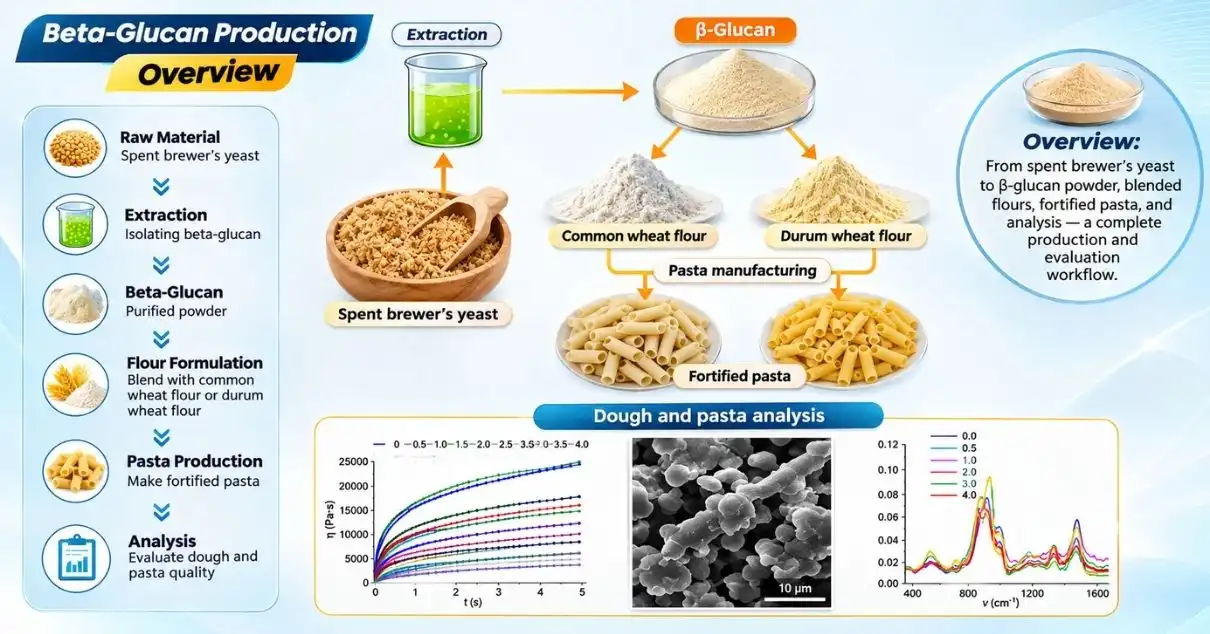
The sugar is derived from the cell wall of Saccharomyces cerevisiae, the same kind of yeast used to brew beer and bake bread. Only a structural carbohydrate remains after extraction and purification. It contains a β-1,3-glucan backbone and β-1,6-glucoside side chains . Good, at least 70% of the yeast ²-1,3/1,6-glucan in Yangge. During processing a few superfluous cells are removed to ensure the safety and consistency of the product.
Common Beta Glucan Sources and Their Primary Roles
| Source | Linkage Type | Primary Application |
|---|---|---|
| Baker's yeast (S. cerevisiae) | β-1,3/1,6 | Immune modulation, gut health |
| Oats (Avena sativa) | β-1,3/1,4 | Cholesterol reduction, heart health |
| Mushrooms (e.g., Lentinula edodes) | β-1,3/1,6 | Immune support, oncology research |
| Barley | β-1,3/1,4 | Glycemic management, fiber content |
Why Source Classification Matters for Buyers?
Baking yeast (S. cerevisiae) is a food that has yeast extract beta glucan with β-1,3/1,6 linkages. It is good for the gut and the immunity system. You can find β-1,3/1,4 in oats, which is good for your heart and cuts cholesterol. Some mushrooms, like Lentinula edodes, have β-1,3/1,6 that helps the immune system and is used to learn more about cancer. There is β-1,3/1,4 in barley.
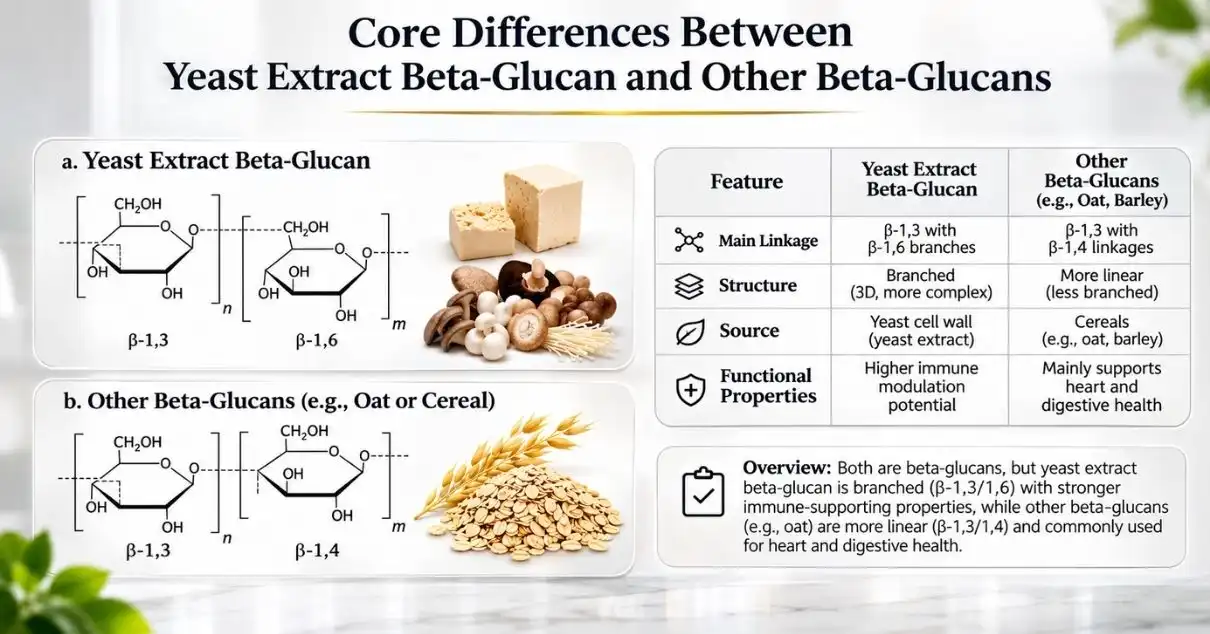
Core Differences Between Yeast Extract Beta Glucan and Other Beta Glucans
The structural difference between β-1,3/1,6 and β-1,3/1,4 linkages is not a minor technical detail. It determines how the molecule interacts with immune receptors, how quickly the body processes it, and which formulation formats it suits best.
Molecular Structure and Receptor Binding
Yeast β-1,3/1,6-glucan interacts precisely with Dectin-1 receptors on macrophages and dendritic cells to stimulate innate immunity without excessive stimulation. It is the branching triple-helix structure that directly accounts for its ability to bind. Oat β-1,3/1,4-glucan, however, does not bind Dectin-1 at substantial quantities; its major mechanism is viscosity-based cholesterol sequestration in the gut, not immunological signaling. β-1,3/1,6 from mushrooms is similar in structure to yeast glucan, but varies in molecular weight and branching according to the species and the technique of extraction.
Comparative Health Benefits
Here is a side-by-side view of functional differences that matter in product development:
| Property | Yeast β-1,3/1,6 | Oat β-1,3/1,4 | Mushroom β-1,3/1,6 |
|---|---|---|---|
| Immune activation (Dectin-1) | High | Low | Moderate–High |
| Cholesterol reduction | Moderate | High (FDA-approved claim) | Low |
| Gut microbiota support | Yes | Yes | Moderate |
| Heat stability (121°C) | Yes | Limited | Variable |
| Soluble form available | Yes | Yes | Rarely |
Bioavailability and Formulation Compatibility
Yeast extract beta glucan is stable from pH 2.0 to 12.0, meaning it survives gastric acid and remains active through the intestinal tract. It tolerates UHT and extrusion processing without losing potency. The insoluble form works well in capsules, tablets, and animal feed. The soluble form—modified for water dispersibility—suits functional beverages, dairy formulations, and liquid pet supplements, where insoluble particles would cause sedimentation or textural defects.
Yeast Extract Beta Glucan in Procurement: Sourcing and Supplier Considerations
You should not only look at the price per kilogram to find the right type of yeast beta glucan. A lot of different factors can change the total value of procurement, such as the ability to change the formulation, check the purity, and the scope of the certification.
Quality Criteria and Certification Benchmarks
Yangge's β-1,3/1,6-glucan is approved by ISO, HACCP, Kosher, and Halal. It doesn't have any GMOs, radiation, or allergens. A lot of the time, brands that sell in the EU have to make sure their goods meet the PAH4 standard. This standard says that the amount of benzopyrene in the product must be less than 10 parts per billion. A third party in a separate lab can use the beta-glucan enzyme method to test a product again and show that it is pure. This method counts β-1,3/1,6 content instead of total carbs.
Pricing, MOQ, and Inventory Flexibility
One kg is the least amount that Yangge will take as an order. It is sealed in metal foil bags to protect it from light and water and keep it fresh. There is 50 to 100 kg of ready stock on hand right now, which is enough for test production and first runs without having to wait for longer lead times. If a brand needs signs that are made just for them, they can get OEM packing. People who buy from us think that the short time between samples and full production is less risky because the minimum order quantity is low and the purity has been confirmed.
Supplier Evaluation Process
The following steps should be taken as part of a planned review of any beta-glucan provider:
- Request a Certificate of Analysis (COA) specifying beta-glucan content measured by enzymatic method—not total carbohydrate.
- Confirm structural linkage (β-1,3/1,6 vs. β-1,3/1,4) in documentation, since mislabeling is a documented industry issue.
- Verify third-party audit records for GMP compliance and relevant certifications (Kosher, Halal, Non-GMO).
- Assess batch consistency data across at least three production lots to evaluate manufacturing stability.
- Request a sample (1 kg) for in-house formulation testing before committing to larger volumes.
In this area, sellers often lie about how pure something is or make mistakes with differences between batches that mess up production plans. These steps keep sellers from making those two mistakes.
Comparative Analysis for B2B Decision-Makers
Which type of beta glucan to use will depend on the product and the health claim. Below is a list of ways that strategic sourcing can work in three main areas.
Nutraceuticals and Immune Supplements
At a daily amount of 250 to 500 mg, yeast extract beta glucan has been shown to boost the immune system in clinical tests. It can be used in goods for people who are stressed out or going through a hard time. Nutrition and the Journal of the American College of Nutrition both have papers on animal tests that show these amounts have a big effect on healthy people's immune systems. This is the main reason why yeast glucan is the best choice for immune-positioned SKUs.
Pet and Animal Nutrition
Instead of drugs, yeast cell wall beta-glucan changes the biological reaction and boosts the animals' natural immunity to help them grow in aquaculture. The feed conversion ratio goes up when there is a lot of stuff in a small space. It won't change the way the dry food or pelleted feed works, so you can add it to either one. Because of this, companies that make pet food and want to branch out into functional animal health can use this ingredient.
Functional Foods and Beverages
We can use clear drinks that don't settle because yeast glucan breaks down in water. It works with both UHT and pasteurization because it doesn't change when hit with heat. There is evidence that soluble yeast glucan in protein shakes, RTD drinks, and functional dairy products can help your immune system. This doesn't change the structure or quality of the product.
Practical Applications & Real-World Case Studies
Immune Supplement Capsules
They put 500 mg of yeast β-1,3/1,6-glucan, vitamin C, and zinc in a two-part tablet to help with seasonal immunity. When kept normally, it stayed in its insoluble form for 18 months, and studies of stability showed that there was no major loss of activity.
Functional Dairy and RTD Beverages
Yogurt drinks had 200 mg of yeast glucan added to them in a soluble form. Particles lose their rough taste when they are micronized. This is because particles lose their solid form. After following the rules set by law for immune marking, there were no issues with the product.
Pet Nutrition OEM Launch
Someone else made these chews for a private label dog food. Each one has 100 mg of yeast glucan that doesn't dissolve. The element worked well with high temperatures during extrusion and was still able to bind Dectin-1 when it was tested after the process. When it came to horse feed, this proved that the claim about being stable at high temperatures was correct.
Conclusion
Yeast extract beta glucan has a strong place in the beta glucan group. Formulators can use it in many ways for immune health, gut health, and cat diet since it can connect to Dectin-1, stay stable at different temperatures, and come in forms that dissolve and forms that don't dissolve. Beta glucans from oats and mushrooms are different and can't be used together. Before they can start making lines of pure products with low minimum order quantities (MOQs) and formulation-grade paperwork, people who buy in bulk need to know about these changes in structure.
FAQ
How is yeast beta glucan different from oat beta glucan?
Yeast beta glucan carries a β-1,3/1,6 linkage and activates Dectin-1 receptors on immune cells. Oat beta glucan has a β-1,3/1,4 linkage and primarily reduces LDL cholesterol through gut viscosity. They are structurally and functionally distinct—choosing between them depends entirely on your target health claim.
Does yeast beta glucan contain gluten or cause yeast infections?
High-purity yeast beta glucan is a purified cell wall fragment—not live yeast. It does not trigger yeast infections and is generally gluten-free when produced under controlled conditions. Yangge's product is also certified Non-Allergen and non-irradiated.
Why do lab results sometimes differ for the same batch?
Standard HPLC carbohydrate assays read both alpha- and beta-glucans, inflating results. Request testing by the glucan enzymatic method to confirm the actual β-1,3/1,6 content. Yangge cooperates with independent laboratories for third-party retesting on request.
What dosage is supported by clinical evidence for immune applications?
Published studies support 250–500 mg per day for adult immune priming. Animal nutrition applications use different weight-based calculations depending on species.
What certifications does Yangge's yeast beta glucan carry?
ISO, HACCP, Kosher, Halal, Non-GMO, and compliance with PAH4/benzopyrene EU standards.
Request a Sample from Yangge Your Trusted Yeast Beta Glucan Supplier
Yangge Biotech is where you can get yeast β-1,3/1,6-glucan. It's safe to use in food and medicine. They have between 50 and 100 kg of fresh stock, and their yeast is pure. Grades come in two different types: liquid and solid. Our staff can help you choose the best grade for your immune system supplements, functional pet food, or drinks that are already made. To get a sample and COA right away, email us at info@yanggebiotech.com.
References
1. Vetvicka, V., & Vetvickova, J. (2015). Immune-enhancing effects of Maitake (Grifola frondosa) and Shiitake (Lentinula edodes) extracts. Annals of Translational Medicine.
2. Talbott, S., & Talbott, J. (2009). Effect of BETA 1, 3/1, 6 GLUCAN on upper respiratory tract infection symptoms and mood state in marathon athletes. Journal of Sports Science & Medicine.
3. Brown, G. D., & Gordon, S. (2001). Immune recognition: A new receptor for beta-glucans. Nature.
4. Kohl, A., & Hofmann, T. (2018). Yeast beta-glucan and its biological effects on innate immunity. Nutrition Reviews.
5. Wood, P. J. (2007). Cereal beta-glucan: Structure, solubility, and health effects. Journal of Cereal Science.
6. Volman, J. J., Ramakers, J. D., & Plat, J. (2008). Dietary modulation of immune function by beta-glucans. Physiology & Behavior.

Based on your location and order quantity, you will have the opportunity to receive a limited time free shipping promotion!
Who we are
Popular Blogs