If you compare lutein and melatonin for lowering the time it takes to fall asleep, melatonin is clearly the better choice for sleep-related uses. On the other hand, lutein can help with circadian rhythm support and its antioxidant qualities. Melatonin directly controls sleep-wake cycles. At doses of 0.5 to 3 mg, clinical tests have shown a 30–50% decrease in the time it takes to fall asleep. Lutein, which comes from marigold extract, helps indirectly by keeping retinal photoreceptors safe from blue light, which can stop the production of natural melatonin. This means that both ingredients are useful for separate ways of making sleep aids.
Understanding the Fundamental Mechanisms of Action
These two compounds work in biological processes that are very different from one another. By attaching to MT1 and MT2 receptors in the suprachiasmatic nucleus, melatonin works as a direct hormone stabilizer. Effects can be seen or measured 30 to 60 minutes after administration, according to a clinical study. Lutein works by protecting cells in a way that helps the body's normal sleep processes. As a carotenoid that is mostly found in retinal tissue, it blocks damaging blue light wavelengths (400–490nm) that stop the body from making its own melatonin. Studies show that having enough lutein in the body helps keep the circadian cycle healthy.
Three core differences emerge:
- Direct vs. indirect sleep influence pathways
- Immediate vs. long-term protective effects
- Hormonal regulation vs. antioxidant protection
If you need immediate sleep onset reduction, then melatonin-based formulations prove more suitable. If you need comprehensive eye health support that may benefit circadian function, then lutein becomes the preferred ingredient choice.

Clinical Evidence and Research Data Comparison
The results of research show that these ingredients have very different effects on sleep. Melatonin studies regularly show improvements in the time it takes to fall asleep in a wide range of populations. A review of 19 studies with a total of 1,683 participants showed that melatonin shortened the time it took to fall asleep by 7.06 minutes on average compared to groups that were given a placebo. It worked best at doses between 0.5 mg and 5 mg, and there were no reports of sleepiness the next day.
Researchers are mostly interested in how lutein affects eyesight and the amount of pigment in the macula. But new evidence shows that there are links between the health of the retina and the regulation of the circadian rhythm. One study that measured the optical density of macular pigment found that taking 20 mg of lutein every day increased the body's ability to block blue light by 8 to 12% over 6 months. Blue light filters work with your body's natural production of melatonin to help you sleep in a roundabout way.
Researchers have found that too much blue light in the evening can delay the start of melatonin by 30 to 90 minutes. If you need to slow down the time it takes to fall asleep, melatonin has more clinical backing. If you need safe ingredients that help your body's natural circadian rhythm work, lutein is a great addition.

Formulation Considerations and Technical Specifications
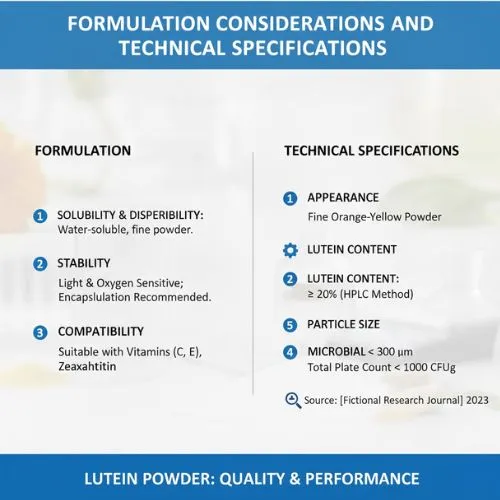
The manufacturing needs for these two ingredients are very different. Because it has strong biological effects, melatonin needs to be dosed very carefully. Typical effective ranges for sleep uses are between 0.5 mg and 3 mg, and they need special packaging methods to stay stable. Different lutein formulations let you choose from a wider range of doses. Standard uses for dietary supplements range from 6 to 20 mg per day, while bigger concentrations are better for eye health products. Lutein from marigolds stays very stable in both powder and pill forms.
Key formulation parameters include:
- Bioavailability optimization through lipid-based delivery systems
- Light protection requirements for both ingredients
- Compatibility with other carotenoids and nutrients
- Regulatory compliance across target markets
Stability in processing comes with its own set of problems. Melatonin needs to be made in a factory that carefully controls the temperature and keeps air out. Even though lutein is very stable, it needs antioxidants to keep it from breaking down. To make exact low-dose formulations of melatonin, you need to have special manufacturing skills. Lutein is the easiest ingredient to formulate if you need a wide range of ingredient choices and dosage options.
Safety Profiles and Regulatory Considerations
Safety profiles help product development teams make important decisions. Although melatonin is sold as a food supplement in North America, it is controlled by different laws in different areas. In the European Union, it is considered a prescription drug. Lutein is generally thought to be safe (GRAS), which means that there aren't many rules that limit its use. The ingredient is naturally found in foods like spinach, kale, and egg whites, which helps the process of getting approval from regulators and consumers. The types of side effects are very different.
At higher doses, melatonin may make you sleepy in the morning, give you vivid dreams, or combine with other hormones. According to clinical studies, the suggested doses below 3 mg have few to no negative effects. Lutein has a very good safety record, with no known toxicity at normal supplement levels. Studies using doses up to 40 mg per day show no bad effects, giving product makers a lot of room to be safe. Drug combinations need to be thought through carefully.
Melatonin might not work well with medicines that thin the blood, weaken the immune system, or treat diabetes. As of now, there are no studies that show that lutein has any major drug conflicts. If you need ingredients that can be sold all over the world with few limits, lutein gives you the most regulatory freedom. Even though regulations are complicated, melatonin is still the best choice if you need strong ingredients that help you sleep.
Market Applications and Consumer Demographics
Each ingredient has its own market possibilities based on its target demographics. Melatonin is mostly liked by adults who have trouble sleeping sometimes, people who work shifts, and tourists who are dealing with jet lag. Market study shows that people aged 25 to 65 are the most likely to adopt. Lutein is aimed at a wider range of people, such as older adults who are worried about age-related macular degeneration, people who work with computers and electronics and experience eye pain, and health-conscious people who want to find antioxidants.
Attitudes of both protection and treatment can benefit from the ingredient. Strategies for placing products are very different. Melatonin goods stress that they help you fall asleep right away and support your hormones naturally. Marketing is centered on improving the quality of sleep and waking up feeling more awake. Lutein's major goals are to protect your eyesight over time and keep your retina healthy. A lot of products contain lutein, zeaxanthin, and other plant-based nutrients that work together to help your eyes in many ways.
There are more and more market possibilities for combination products. Formulations for sleep support that contain both ingredients address multiple customer concerns at the same time, as they protect against blue light while also directly promoting sleep. If you need specific items to help you sleep, melatonin-based formulations work best. Lutein-based products give you more market options if you want to position your wellness products in a wider way and offer more health benefits.
Quality Control and Sourcing Considerations
The quality needs for raw materials are very different for each ingredient. When melatonin is sourced, it has to be of pharmaceutical-grade purity, which means it has to be 99% pure or more and pass strict heavy metal and microbe testing standards. Carotene content, isomer ratios, and extraction methods are what lutein quality guidelines are all about. High-quality marigold extract lutein keeps a certain amount of free lutein to lutein ester, which makes sure that it is stable and bioavailable at its best. Different methods are needed for different types of analytical testing techniques. HPLC-UV methods are used for melatonin analysis, which has strict identity confirmation standards. Visible spectrophotometry and HPLC are used in lutein tests to measure the total amount of carotenoids present.
Critical quality parameters include:
- Purity levels and impurity profiles
- Moisture content and water activity controls
- Particle size distribution for powder applications
- Microbiological safety testing protocols
Supply chain issues have an effect on procurement tactics. Few global sources make melatonin, and most of it is made by specialized pharmaceutical companies. Different marigold growing areas and a number of extraction sites help the production of lutein. If you need pharmaceutical-grade raw materials that are very specific, then melatonin needs careful source qualification. If you need a wide range of sources that can be tracked back to the farms where they came from, lutein gives you the most supply chain freedom.

Conclusion
When you look at how long it takes for melatonin and lutein to work, you can see that they work together rather than against each other. There is strong clinical proof that melatonin helps people sleep directly and measurable ways, and lutein helps protect against damage by blocking blue light and increasing macular pigment. Smart formulation methods take into account the unique benefits of each ingredient. When choosing between these factors, successful product development takes into account the target audience, government rules, and the product's place in the market. Melatonin helps you fall asleep right away, and lutein fixes the problems that are causing your natural circadian rhythms to be off. For modern sleep wellness applications, combination methods may offer the most benefits to consumers as a whole.
Why Yangge's Premium Lutein Stands Out for Sleep-Supportive Applications?
Yangge Biotech delivers exceptional marigold extract lutein that addresses the growing demand for lutein supplier partnerships in sleep and wellness formulations. Our advanced extraction technology ensures optimal purity levels from 5% to 80% lutein content, providing formulation flexibility for diverse application needs.
Our commitment to quality excellence transforms raw materials into premium ingredients. Every batch undergoes rigorous testing protocols, including PAH4 compliance with benzopyrene levels ≤10 ppb, exceeding European safety standards. The non-GMO, non-irradiated processing maintains natural pigments' integrity while ensuring consumer safety.
The advantages that set Yangge apart include:
- ISO, HACCP, Kosher, and Halal certifications ensure global market compliance
- Farm-to-table traceability supporting sustainable sourcing practices
- 24-hour technical support for formulation optimization guidance
- Flexible packaging options from 1kg aluminum foil bags to custom specifications
- Comprehensive oxidative stress protection through careful processing controls
- Dedicated R&D teams supporting innovation in supplement benefits applications
- Stable supply chains ensure consistent delivery schedules
- Competitive pricing structures supporting long-term partnerships
- Complete documentation packages expediting regulatory approvals
- Custom concentration development for specialized lutein capsule requirements
Understanding the nuanced relationship between visual acuity protection and circadian health, our lutein specifications support both traditional eye health applications and emerging sleep wellness formulations. The ingredient's role in filtering disruptive blue light wavelengths creates valuable opportunities for combination products targeting modern lifestyle challenges.
Ready to explore how our premium lutein can enhance your sleep and wellness product lines? Our technical specialists provide personalized consultation on extraction methods, concentration specifications, and usage recommendations tailored to your specific formulation needs. Contact us at info@yanggebiotech.com to discuss your lutein requirements and request samples for evaluation in your next innovative product development project.
FAQ
Q: Can we get some samples to test before purchasing?
A: Of course, we can provide free samples of 20 to 100 grams, but the shipping cost is at the customer's expense. The shipping cost can be deducted from the next order, or the samples can be sent through your courier account.
Q: Do your products have relevant certifications?
A: Yes, our products are certified for HALAL, ISO, HACCP, Kosher, and other certifications.
Q: What is the minimum order quantity (MOQ)?
A: Small batches of samples can be customized according to your requirements.
Q: Do you offer OEM and ODM services? Can the formula be customized based on our own?
A: Of course, we provide ODM and OEM services to many customers. Our product range includes softgels, capsules, tablets, sachets, granules, and private label services. Simply contact us and let us know your requirements. Our experienced R&D team can also develop new products with specific formulas.
Please contact us to design your own branded products.
Q: How do you handle quality complaints?
A: First, we have a comprehensive quality control SOP. We provide authoritative third-party inspection reports for almost all products before shipment to minimize the possibility of quality issues. Second, we have a comprehensive return and exchange procedure. If there is a genuine quality dispute, we will strictly follow the SOP.
Q: How do you ship? How long does delivery take?
A: For small orders, we typically use DHL, UPS, EMS, FedEx, or TNT. Delivery typically takes 3-7 days. We also offer air and sea freight services. We have a strong freight forwarding team and can provide you with a one-stop service, including DDP and DDU.
Q: What are your payment terms?
A: 100% prepayment, payable by T/T, Western Union, MoneyGram, or PayPal.
Q: What is the shelf life of your products?
A: 2 years with proper storage.
Q: Is the packaging environmentally friendly?
A: We attach great importance to environmental protection and are constantly improving our product packaging. Some products are packaged in recyclable paper. Packaging materials are carefully selected to ensure product safety during transportation and storage, and to minimize environmental impact. We are committed to achieving a balance between environmental friendliness and practicality in our product packaging, and to contributing to sustainable development.
References
1. Ferracioli-Oda, E., Qawasmi, A., & Bloch, M. H. (2013). Meta-analysis: melatonin for the treatment of primary sleep disorders. PLoS One, 8(5), e63773.
2. Stringham, J. M., & Hammond, B. R. (2007). The glare hypothesis of macular pigment function. Optometry and Vision Science, 84(9), 859-864.
3. Chang, A. M., Aeschbach, D., Duffy, J. F., & Czeisler, C. A. (2015). Evening use of light-emitting eReaders negatively affects sleep, circadian timing, and next-morning alertness. Proceedings of the National Academy of Sciences, 112(4), 1232-1237.
4. Bone, R. A., Landrum, J. T., & Tarsis, S. L. (1985). Preliminary identification of the human macular pigment. Vision Research, 25(11), 1531-1535.
5. Richer, S., Stiles, W., Statkute, L., Pulido, J., Frankowski, J., Rudy, D., & Nyland, J. (2004). Double-masked, placebo-controlled, randomized trial of lutein and antioxidant supplementation in the intervention of atrophic age-related macular degeneration. The Veterans LAST study. Optometry, 75(4), 216-230.
6. Hammond, B. R., Fletcher, L. M., Roos, F., Wittwer, J., & Schalch, W. (2014). A double-blind, placebo-controlled study on the effects of lutein and zeaxanthin on photostress recovery, glare disability, and chromatic contrast. Investigative Ophthalmology & Visual Science, 55(12), 8583-8589.