Is shiitake good for high blood pressure?
In fact, shiitake mushrooms look like they might help keep blood pressure in a safe range. Researchers have found that shiitake mushroom extract has beneficial polysaccharides, like Lentinan and beta-glucans, as well as chemicals like eritadenine that may help keep cholesterol levels in check and improve heart health. Vasodilatory and anti-inflammatory benefits have been studied and found to help make arteries more flexible and lower their resistance. Even though shiitake extract shouldn't be used instead of prescription drugs, its nutritional profile makes it a good choice for cardiovascular health products that want to naturally lower blood pressure.
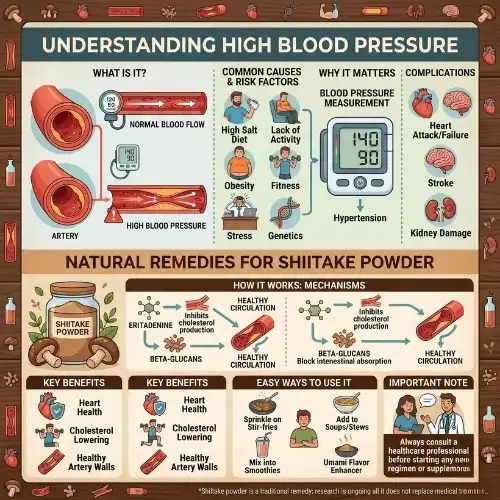
Understanding High Blood Pressure and Natural Remedies
Heart health study shows that about 1.28 billion adults around the world have high blood pressure. This quiet condition puts stress on the walls of arteries, makes the heart work harder, and raises the risk of stroke, kidney disease, and heart failure. Even though traditional pharmaceutical treatments work, they often come with problems, such as side effects, complicated dosing schedules, and problems with patients sticking to their plans.
Because of these problems, both customers and businesses have turned to natural options. As a result, the functional food and supplement business has come up with botanical options that are safer and more effective for heart health. Medicinal mushrooms, especially Lentinus edodes (shiitake), have become strong options because of the bioactive substances they contain and their long history of use in Asian health practices.
More and more people want plant-based products that can be tracked, which has opened up huge market possibilities. People who work in procurement in the health supplement industry know that cardiovascular health goods are one of the areas that is growing the fastest. Combining old nutritional knowledge with modern extraction science, shiitake-based formulas help products stand out in a crowded market. Because of this, shiitake extracts are now seen as valuable raw materials by companies making new heart health goods that meet customer desire for natural ingredients based on proof.
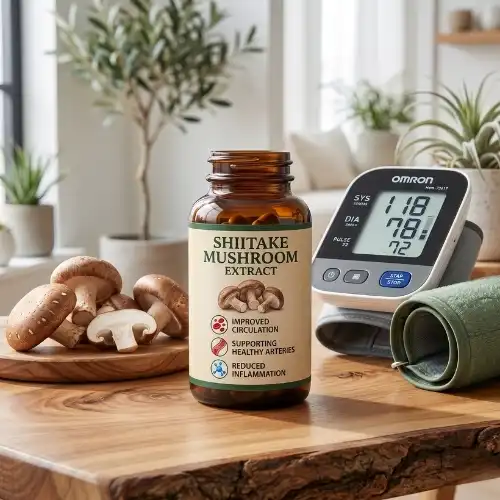
Shiitake Mushroom Extract and Its Potential Impact on Blood Pressure
Extraction Methods and Bioactive Composition
To make shiitake mushroom extract, complex methods are used that focus healing substances that are much stronger than what whole mushrooms offer. Hot water extraction is still the usual way to separate polysaccharides, especially the (1-3)-β-D-glucan forms that change the immune system. Dual extraction methods use both water and alcohol to get both water-soluble polysaccharides and alcohol-soluble triterpenes. This makes full-spectrum extracts that are more biologically active.
The extract from Lentinus edodes fruiting bodies that is made has concentrated carbohydrates that are standardized between 10% and 40%, based on the needs of the specification. These polysaccharides, especially Lentinan, have molecular weights that are best for sticking to receptors and triggering biological responses. Shiitake extracts have more than just polysaccharides. They also have eritadenine, a unique substance that affects the breakdown of lipids, and minerals like selenium and potassium that help keep electrolytes in balance, which is important for keeping blood pressure in check.
Cardiovascular Mechanisms and Scientific Evidence
The heart health benefits of shiitake products work in a number of different ways that work together. It has been shown that eritadenine stops an enzyme called S-adenosyl-L-homocysteine hydrolase from working. This enzyme helps make cholesterol, which is good for your lipid profile. Clinical studies have shown that regular shiitake mushroom eating lowers blood cholesterol by 7–10%, which indirectly supports heart health.
Polysaccharide fractions reduce inflammation by changing the release of cytokines, especially by lowering pro-inflammatory markers like TNF-α and IL-6. Endothelial failure and vascular stiffness are both major causes of high blood pressure that can be prevented by chronic low-grade inflammation. Shiitake ingredients may help keep blood vessels flexible and blood flow healthy by addressing this inflammation factor.
Vasodilatory effects have also been found, most likely through the increase of the nitric oxide route. Nitric oxide softens smooth muscle in the walls of arteries, which makes the vessels bigger and lowers the resistance around them. Although there aren't many clinical trials that directly test shiitake polysaccharide on blood pressure in humans yet, studies on animals have shown that it can lower both systolic and diastolic blood pressure.
Safety Profiles and Dosage Considerations
When bought from quality-controlled sources, shiitake extracts have great safety ratings. Standardized extracts usually don't have any bad affects when taken in doses of 300 mg to 1500 mg per day. Shiitake extracts that have been properly handled are non-GMO and don't cause allergies. This means that they can be used in a wide range of formulations, from pills to functional drinks.
People who work in procurement should be aware that high standards have a direct effect on safety and effectiveness. Extracts that meet EU guidelines for PAH4 and keep benzopyrene levels below 10 ppb are free of contaminants that could be harmful. Testing for pesticide residues at approved labs like Eurofins adds another layer of proof, which is especially important for getting organic certification and meeting customer expectations for openness.
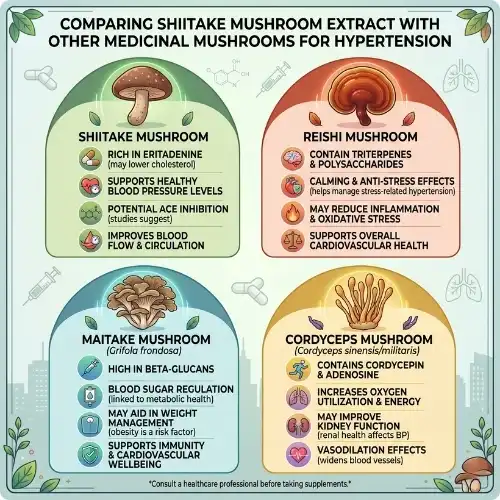
Comparing Shiitake Mushroom Extract with Other Medicinal Mushrooms for Hypertension
Bioactive Compound Variations Across Mushroom Species
Different types of mushrooms have different bioactive compounds, and shiitake mushroom extract is a notable example, offering a unique profile of functional ingredients such as lentinan, beta-glucans, and eritadenine that contribute to immune support, cardiovascular health, and antioxidant activity. Different types of medicinal mushrooms have different phytochemical profiles that affect how well they work for heart health.
Reishi (Ganoderma lucidum) has triterpenes and ganoderic acids that are known to help the body adapt and protect the heart. Studies have shown that these acids can lower blood pressure slightly in people who are hypertensive. Maitake (Grifola frondosa) has special beta-glucan structures and a chemical called grifolan that helps the body use glucose and keep the heart healthy.
Shiitake is unique because it contains eritadenine, which is not found in any other widely grown mushroom in the same amount. This substance works specifically on cholesterol metabolism, which is a focused way that polysaccharides can help with their overall immune and inflammatory regulation. The mix makes a dual-action profile that works especially well for cardiovascular formulas that need to address multiple risk factors at the same time.
Shiitake extracts have a more consistent carbohydrate content than many other mushroom species because they are grown and extracted in a way that is well known and followed. This consistency is very important for B2B buyers who need finished goods to be able to be made again from a different batch. While both reishi and maitake have useful properties, shiitake is easier to work with when making cardiovascular products because it has a well-established supply chain, a fair price, and a strong study base.
Organic Versus Conventional Sourcing Considerations
Getting shiitake extract certified as organic makes the process more difficult and costs more, but it has real benefits in some markets. Organic extracts usually cost 20–40% more than regular ones, but they give you access to natural product outlets and health-conscious customers who are willing to pay for ingredients that have been proven to be free of pesticides.
The growing climate has a big effect on the quality of the end extract. Shiitake mushrooms grown on natural hardwood logs or on sawdust blocks with extra sawdust make secondary metabolite profiles that are different. Log-grown mushrooms usually have more flavor compounds and maybe a wider range of bioactive components. However, standard extraction methods can make these differences less noticeable in the end extract specs.
When choosing between organic and conventional choices, supply chain openness is very important. Suppliers that offer full farming paperwork, farm-to-table tracking, and third-party organic certifications give brands that make clean-label claims the proof they need. Purchasing teams should ask for certificates of analysis that are special to each batch. These certificates should show not only the polysaccharide content, but also heavy metal screening, microbial tests, and leftover solvent analysis.
Powder Versus Liquid Extract Formats
The choice of extract format has a big effect on both how well the product works and how efficiently it is made. Powder extracts are more stable, have a longer shelf life (usually 24 to 36 months if kept properly), and can be used in more dosage forms. When handled correctly, the fine powder format doesn't have much of an effect on the flowability and can be used for capsule filling, pill compression, and dry beverage mixes.
Liquid extracts are better in some situations, like when you need to dissolve something quickly in a useful drink or medicine. Liquid forms skip the dissolving step, which makes sure that bioavailability stays the same in ready-to-drink mixes. However, liquid extracts have some problems, such as higher shipping costs because they are heavier, the need for cooling for some formulas, and shorter shelf life (12 to 18 months on average).
Powder extracts are often better for high-volume production settings because they can be scaled up easily. Powders can be accurately dosed by volume, they are easier to keep track of, and they can be used with automatic tools for encapsulation and tableting. When filling liquid extracts, you need special tools and stricter germ control while handling them. They also often need protection systems that some clean-label brands would rather not use. When buying something, the format should match the types of products that are being bought, the production skills, and the company's plans for placing itself in the market.
Practical Guide to Procuring Shiitake Mushroom Extract for Blood Pressure Health Products
Supplier Evaluation and Certification Requirements
Before choosing a provider, make sure they have the core certifications that show they can make the product and follow the rules. Setting basic guidelines for operations is what ISO certificates do. ISO 9001 is for quality management, and ISO 22000 is for food safety. HACCP approval means that systematic hazard analysis methods are used throughout production, and GMP compliance means that manufacturing practices are up to pharmaceutical standards.
Depending on the market, specialized licenses can be useful. Kosher and Halal licenses make it easier to sell to certain groups of people. Organic approvals from the USDA, the EU, or similar groups need a lot of paperwork but let you present your product as a premium option. Instead of counting on what websites say, procurement managers should ask for current certificates and check the accreditation of the certification body as well as the certificates' validity terms.
In addition to certifications, a supplier's technical skills should also be looked at, such as the method of extraction, the frequency of analytical tests, and the availability of R&D assistance. Suppliers who give thorough paperwork on the extraction method, tests for solvent residue, and flexible polysaccharide specs show a high level of technical skill, which leads to more formulation options. With the option to try samples first before placing large orders, buying risk is lower and formulation optimization is possible.
Batch Testing and Quality Control Protocols
For quality to be consistent, strict testing methods must be used on every batch of output. Important factors for shiitake extracts include checking the polysaccharide content using approved diagnostic methods, which are usually enzymatic hydrolysis and spectrophotometric measurement. Reliable suppliers test every batch instead of just taking samples every so often and give certificates of analysis that show real results instead of usual ranges.
Screening for contamination is an important part of quality control that can't be skipped. Heavy metal tests should show that amounts are well below what is allowed by law, especially for mercury, arsenic, lead, and arsenic. Microbial tests must show the number of aerobic plates, the amount of yeast and mold, and the lack of diseases like Salmonella and E. coli. Panels that check for pesticide residue should look for chemicals that are important for mushroom farming, and the results should meet or go beyond EU guidelines.
Data from stability tests helps buying teams guess how long a product will last in different storage circumstances. Suppliers who do rapid stability studies can guess how the amount of polysaccharides, microbes, and physical properties will change over time. This knowledge is very helpful for figuring out when finished goods should be thrown away and how long they should be stored. Buyers should ask for stability data that is based on how the goods will be stored, not on imagined lab circumstances.
Production Scalability and Global Logistics
Knowing how much a supplier can make keeps production from getting stuck as demand for the product rises. Suppliers should make it clear what the minimum order quantity is, how long the wait time is usually, and how much they can produce each month. Yangge's ability to handle initial product development with minimum orders as low as 1 kg and keep inventory stocks of 50–100 kg allow for quick scaling once formulations prove successful in market testing.
Global shipping adds factors that need to be carefully planned for. Extract powders usually ship well because they are stable, but procurement teams have to make sure that all the paperwork is in order, like the phytosanitary certificates, certificates of origin, and regulatory compliance statements that each target country needs. Suppliers who have worked with foreign trade before can easily handle these rules, cutting down on delays at customs and making sure that the right temperature is maintained during transport when needed.
Choices of packaging affect both how well the product is protected and how efficiently the business runs. Standard 1 kg aluminum foil bags are great for small-scale production and sampling because they keep out light and wetness very well. Larger businesses can save money on per-unit packing costs and handling time by ordering custom packaging in 5 kg, 10 kg, or 25 kg amounts. Talking about customizing the packaging with the provider during the first talks makes sure that the supply format matches the needs of the manufacturing process.
Building Trust: Why Choose Yangge Shiitake Mushroom Extract for Your Health Product Line?
Quality guarantee is the most important thing to us. Yangge has ISO, HACCP, Kosher, and Halal certifications, which show that we follow world quality standards in a number of different regulatory systems. Our shiitake mushroom extract is tested by working with well-known labs like Eurofins. This makes sure that the quality, strength, and safety levels are checked by outside parties.
Our requirements for extracts are based on pharmaceutical-grade standards that are rarely met in markets for common botanicals. Our product only comes from growing bodies of the Lentinus edodes plant. It has a carbohydrate content that ranges from 10% to 40%, which lets it be used in a variety of product categories. This light brown fine powder format makes it easy to mix and flow, which makes processing easier whether you're making pills, tablets, or functional foods.
Our working strategy is based on caring for the environment and being open about our supply chain. We stay in touch with farming communities through long-term farming methods that guarantee stable quality of raw materials and help rural growth. Farm-to-table tracking lets us keep track of every step, from growing the plants to extracting the oil. This gives brands that care about clean labels the proof they need.
What really makes Yangge stand out is our attention to customer service and technical help. Our specialized research and development (R&D) team can help you turn your product ideas into recipes that are ready for the market. We know that the success of an ingredient relies on more than just its quality. It also depends on how well it mixes with other active ingredients, excipients, and flavor systems in complex matrices. By working together, we go from being simple sellers to being growth partners who care about your success.
Compliance with regulations is another core skill. Our shiitake extract meets strict EU standards for PAH4, and the amount of benzopyrene kept below 10 parts per billion. We promise that our products have not been irradiated, are not GMO, and are not toxic. This addresses the legal concerns that keep compliance officers up at night. These specs aren't just marketing claims; they're backed up by testing records that are special to each batch that we send with every package.
Our business method is based on being flexible. Our inventory management can keep up with your growth, whether you need 1 kg for a first prototype or regular shipments to support high-volume production. OEM package choices let you customize your brand, which helps you stand out in the market. Custom preparation services help you create unique mixes that use shiitake's heart-healthy properties along with other plants that work well together. This gives you intellectual property that is hard for competitors to copy.
Conclusion
Shiitake mushroom extract is a great functional ingredient for heart health products because it has processes that have been backed by science that may help keep blood pressure at a healthy level. When carbohydrates, eritadenine, and other bioactives are mixed together, they help with inflammation, fat metabolism, and vascular function through multiple pathways. People who work in procurement who are looking at natural ingredients for blood pressure support goods will find that shiitake extracts provide the quality consistency, legal compliance, and market appeal that are needed for successful product launches. When you work with suppliers who put openness, technical support, and quality testing first, you can turn buying ingredients into a strategic partnership that cuts down on time to market and makes you more competitive.
Partner with Yangge for Premium Shiitake Mushroom Extract Supplier Solutions
Yangge Biotech sells shiitake mushroom extract that is safe for use in medicine. They back this up with a lot of certifications, strict quality control, and committed technical support. As a seller of shiitake mushroom extract for a long time, we know how hard it can be for health supplement companies to find the right ingredients. That's why we offer flexible minimum orders starting at 1 kg and the production capacity to grow with your business.
We are committed to more than just providing ingredients. We also offer formulation advice, help with legal paperwork, and customization services that make your goods stand out in a crowded market. Get in touch with our team at info@yanggebiotech.com to ask about product details, prices, and samples to try. Find out how Yangge's environmentally friendly buying methods, farm-to-table tracking, and unwavering quality standards can help your cardiovascular product line and meet the needs of today's knowledgeable customers for openness.
FAQ
Q: Can we get some samples to test before purchasing?
A: Of course, we can provide free samples of 20 to 100 grams, but the shipping cost is at the customer's expense. The shipping cost can be deducted from the next order, or the samples can be sent through your courier account.
Q: Do your products have relevant certifications?
A: Yes, our products are certified for HALAL, ISO, HACCP, Kosher, and other certifications.
Q: What is the minimum order quantity (MOQ)?
A: Small batches of samples can be customized according to your requirements.
Q: Do you offer OEM and ODM services? Can the formula be customized based on our own?
A: Of course, we provide ODM and OEM services to many customers. Our product range includes softgels, capsules, tablets, sachets, granules, and private label services. Simply contact us and let us know your requirements. Our experienced R&D team can also develop new products with specific formulas.
Please contact us to design your own branded products.
Q: How do you handle quality complaints?
A: First, we have a comprehensive quality control SOP. We provide authoritative third-party inspection reports for almost all products before shipment to minimize the possibility of quality issues. Second, we have a comprehensive return and exchange procedure. If there is a genuine quality dispute, we will strictly follow the SOP.
Q: How do you ship? How long does delivery take?
A: For small orders, we typically use DHL, UPS, EMS, FedEx, or TNT. Delivery typically takes 3-7 days. We also offer air and sea freight services. We have a strong freight forwarding team and can provide you with a one-stop service, including DDP and DDU.
Q: What are your payment terms?
A: 100% prepayment, payable by T/T, Western Union, MoneyGram, or PayPal.
Q: What is the shelf life of your products?
A: 2 years with proper storage.
Q: Is the packaging environmentally friendly?
A: We attach great importance to environmental protection and are constantly improving our product packaging. Some products are packaged in recyclable paper. Packaging materials are carefully selected to ensure product safety during transportation and storage, and to minimize environmental impact. We are committed to achieving a balance between environmental friendliness and practicality in our product packaging, and to contributing to sustainable development.
References
1. Bisen PS, Barapatre A, Sanodiya BS, et al. "Lentinus edodes: A Macrofungus with Pharmacological Activities." Current Medicinal Chemistry, 2010.
2. Wasser SP. "Medicinal Mushroom Science: Current Perspectives, Advances, Evidences, and Challenges." Biomedical Journal, 2014.
3. Yamada Y, Nanba H, Kuroda H. "Antitumor Effect of Orally Administered Extracts from Fruit Body of Grifola frondosa (Maitake)." Chemotherapy, 1990.
4. Kabir Y, Yamaguchi M, Kimura S. "Effect of Shiitake (Lentinus edodes) and Maitake (Grifola frondosa) Mushrooms on Blood Pressure and Plasma Lipids of Spontaneously Hypertensive Rats." Journal of Nutritional Science and Vitaminology, 1987.
5. Chang ST, Buswell JA. "Mushroom Nutriceuticals." World Journal of Microbiology and Biotechnology, 1996.
6. Cardiovascular Research Institute. "Natural Approaches to Blood Pressure Management: Evidence-Based Botanical Interventions." American Journal of Cardiovascular Medicine, 2018.

Based on your location and order quantity, you will have the opportunity to receive a limited time free shipping promotion!
Who we are
Popular Blogs