E153 Food Coloring vs Other Reds: Which Grade Fits Your Product?
If you're sourcing a black colorant for beverages, confectionery, or baked goods, the choice between e153 food coloring and other color additives matters more than most buyers expect. Vegetable Carbon Black E153, derived from carbonized coconut shells, delivers a stable, deep black tone across a wide range of food matrices. Unlike synthetic alternatives such as E151 (Brilliant Black), E153 meets clean-label requirements in the EU and many international markets. This guide breaks down the key differences so you can match the right grade to your specific product application before committing to a bulk order.For more details and informations you may send us email at info@yanggebiotech.com.
Understanding E153 Food Coloring Composition and Applications
What Is E153 and Where Does It Come From?
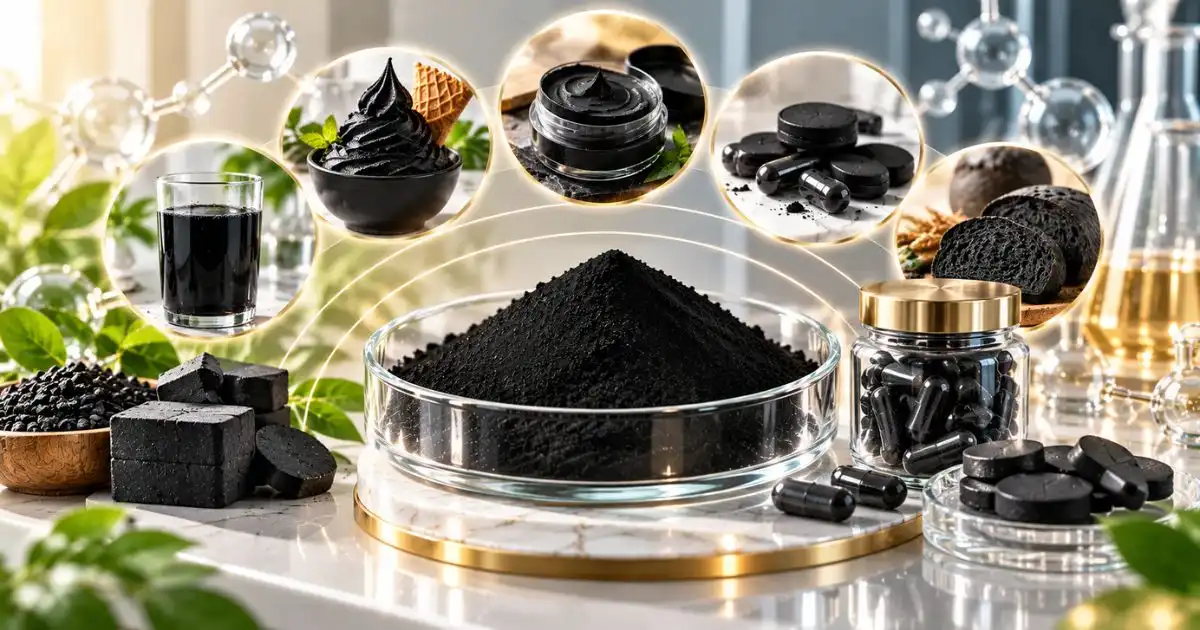
Controlled carbonization of plant-based materials, mostly coconut shells, is what makes vegetable carbon black E153 food coloring. The end product is a black powder that has no smell or taste and more than 95% carbon by weight when it is dry. It doesn't react with chemicals and doesn't dissolve in water or organic solvents. Instead of a soluble dye, it works as a dispersed pigment. Yangge's E153 food coloring is KOSHER/USP grade, and they have 5 tons in stock right now for use as a food colorant and in cosmetics.
Key Application Areas
E153 food coloring works with a lot of different types of food. It gives licorice and jello products their signature deep black finish without letting the color run between layers. It keeps its color at core temperatures above 180°C, which is something that organic dyes can't usually do. If you use it at doses of 0.1% to 0.5% by weight in beverage coating and dragée systems, it makes thin film layers very opaque.
Regulatory Acceptance and Storage
In the EU, E153 food coloring is allowed at a level that is good for most Group II foods. It has also been given approval in Canada. The FDA does not currently list E153 food coloring as an allowed food color additive for direct use in the US. This means that product teams that are heading for the US should check application-specific routes. To keep the pigment load and batch consistency, store E153 food coloring in a cool, dry place away from direct light in a container that can't be opened.
Comparing E153 with Other Food Colorings Key Differentiators
E153 vs. E150 (Caramel Coloring)
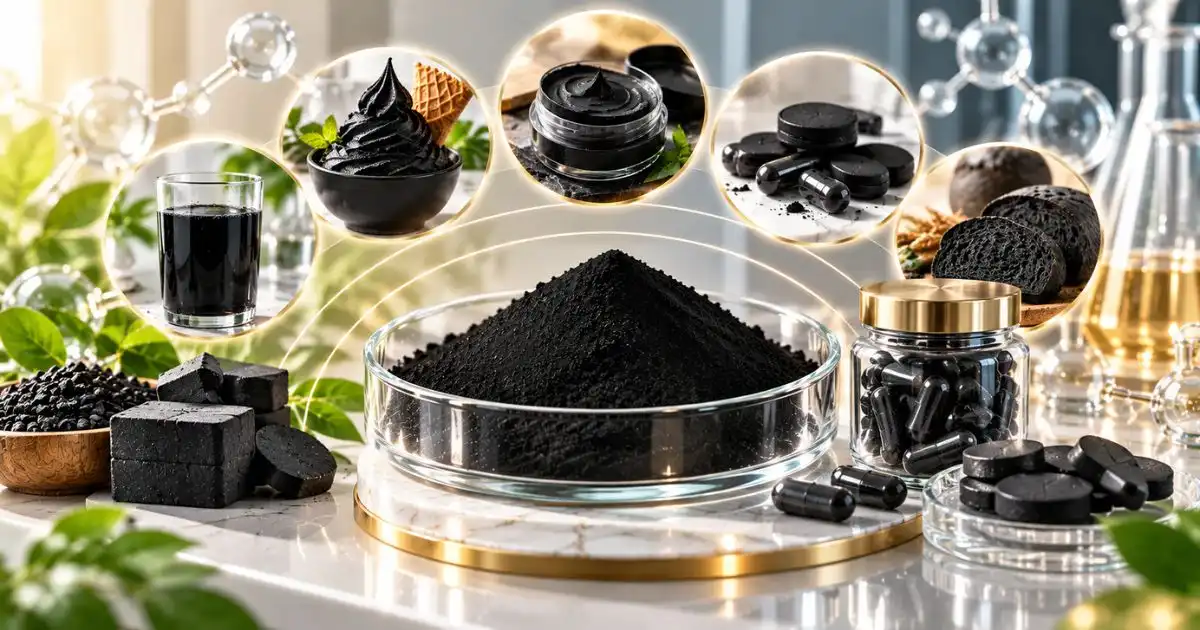
By heating sugar, E150 makes a variety of brown shades, making it good for cola-style drinks and sauces. It mixes well with water and is easy to spread. E153 food coloring, on the other hand, gives you true black and is chemically insoluble, so you have to spread it out first.
| Property | E153 food coloring (Vegetable Carbon Black) | E150 (Caramel Coloring) |
|---|---|---|
| Color Outcome | Deep black | Brown to dark brown |
| Solubility | Insoluble (pigment) | Water-soluble (dye) |
| Heat Stability | Above 200°C | Moderate |
| Clean-Label Status | Yes (plant-derived) | Varies by class |
| Typical Use Level | 0.1%–0.5% | 0.1%–3% |
E153 vs. Beetroot Red and Cochineal
Natural reds, such as cochineal (carmine) and beet extract, give colors that range from bright red to pink, but they fade a lot in heat and UV light. For example, beet red loses some of its color when it is pasteurized. In some places, cochineal has to have an allergen statement. E153 food coloring doesn't break down in the same handling conditions and doesn't pose an allergen risk, which makes it easier for multi-market goods to follow the rules.
E153 vs. Synthetic Black Dyes (E151)
Chemical E151, also known as Brilliant Black PN, is an azo dye that is still used in some markets. However, it is not allowed in the EU because of the "Southampton warning" system for certain azo colors. Many stores have taken E151 off of product labels because customers asked them to. By switching to E153 food coloring, producers can keep the black color character while still meeting clean-label requirements. This is a big business benefit in supply chains that are driven by retail.
How to Choose the Right Grade for Your Product?
Match Color Target to Matrix Type
The first step is to decide what color you want within the food grid. For a drink system that uses water, a pre-dispersed E153 food coloring slurry in glycerin or syrup lowers the risk of sedimentation. A uniform, shiny finish is achieved by adding the powder form during the panning stage for coatings on hard candies or sweets. When you match the physical form of E153 food coloring to the matrix, you avoid the most common technical problem, which is uneven color distribution. Here are some examples of how to use E153 food coloring:
• Beverages: Dispersion in glycerin/syrup (0.05%–0.2% | Sedimentation)
• Candy coatings: Fine powder (0.1%–0.5% | Gloss uniformity)
• Bakery (buns, crusts): Powder blended dry (0.2%–0.5% | Heat retention)
• Film coatings (supplements): Aqueous dispersion (0.1%–0.3% | Layer opacity)
Evaluate Regulatory Compliance Before Sampling
Before asking for samples, make a list of all the ways your chosen colorant can be used that are legal in the countries you want to sell to. E153 food coloring can be sold in the EU and some markets in the Middle East and Southeast Asia. Buyers who want to send their goods to the US should look at FDA CFR 21 to see what other options they have or to see if the cosmetic or supplement pathway applies. Yangge offers a full COA (found as COA-Vegetable carbon blackE153-YANGGEBIOTECH.pdf), a Halal certificate, and a Kosher certificate to meet the documentation needs of different markets.
Factor in Total Cost Per Ton of Finished Product
People often make the mistake of comparing colorant prices per kilogram without first figuring out how much each colorant actually costs per ton of final product. Because E153 food coloring gets deep dark at 0.1% to 0.5% use levels, the cost per ton of finished goods is often less than what buyers who are moving first think it will be. Before you decide where to get your colorant, make sure you get application data from your seller instead of just a picture of the powder. You should also compare the dosage-efficiency of the new colorant to your present one.
Advantages of Using E153 in Industrial Applications
Buyers who have tried other black colorants always come back to E153 food coloring for three practical reasons: it is stable, it doesn't react with anything else, and there is a lot of information available about it. These are the main technical and business benefits this grade provides:
- Thermal stability above 200°C: E153 food coloring keeps its black color after being heated through HTST, baked, and extruded. Because most organic dyes can't perform at this level, it's the first choice for high-heat processing lines.
- Chemical inertness across pH ranges: It doesn't combine with acids, bases, preservatives, or sugars because E153 food coloring is just carbon. This gets rid of the risk of color change that comes with using anthocyanin-based or pH-sensitive dyes in systems that hold acidic drinks.
- Consistency from batch to batch: Yangge's E153 food coloring is checked by international labs before every shipment. The carbon content is more than 95% when it is dry, and the amount of benzo(a)pyrene is kept below 50 µg/kg in line with EU Commission Regulation (EU) No 231/2012 and JECFA safety standards.
There are three main benefits that make black colorants work better: they don't fade in hot conditions, they don't change color in acidic environments, and they don't vary from lot to lot. For procurement teams that are in charge of many SKUs, switching to a single, well-defined black colorant like E153 food coloring cuts down on the number of times they have to re-validate suppliers and the work they have to do to manage suppliers.
Conclusion
If you want to choose between E153 food coloring and other colorants, you need to make sure that the technical performance matches your grid, processing conditions, and target markets. E153 food coloring gives stable, deep black color in baking, candy, and coated systems where resistance to heat and pH is important. Natural reds like cochineal and beet are used for different things and can't be used in place of black in the same kinds of products. If a team wants to switch from synthetic dyes like E151 to E153 food coloring, it can do so without losing color depth or processing stability. Make sure you know your regulatory pathway, define your matrix, and ask for application data, not just a specification sheet.
FAQ
Is E153 food coloring approved for use in the United States?
As of right now, the FDA does not list E153 food coloring as a food color additive that can be used in regular foods in the US. It's okay to sell in the EU and a few other places. Before they source, buyers in the US should check to see if the regulations for their individual use case, like cosmetics or food supplements, are different.
How do I prevent sedimentation when using E153 in beverages?
Because E153 food coloring is a pigment that doesn't dissolve in water, it needs to be mixed with a dispersing agent in a carrier like glycerin, syrup, or water first. In liquid production settings, the risk of sedimentation and cross-contamination is greatly reduced when a paste or liquid dispersion form is used instead of raw powder.
What certifications does Yangge's E153 carry?
The vegetable carbon black E153 food coloring from Yangge is certified as Halal, Kosher, ISO, and HACCP. International labs test each batch before it is sent out. If you ask for it, you can get a full Certificate of Analysis.
What is the typical dosage rate for achieving deep black?
When used in food, 0.1% to 0.5% by weight makes the color very dark. In the EU, E153 food coloring is allowed at quantum satis for most types of food. This means that the amount allowed is based on what is technically needed to get the desired effect.
Request Samples or a Quote from Yangge Your E153 Food Coloring Supplier
As of right now, Yangge Biotech has 5 tons of KOSHER/USP grade Vegetable Carbon Black E153 food coloring in stock, and they can send as little as 1 ton FOB/CIF. For research and development, we provide free samples ranging from 10 to 30 grams, full compliance documentation, and direct technical support from our formulation team. You can email us at info@yanggebiotech.com to get your application data pack, which will include stability reference data and suggested dosages by matrix.
References
1. European Food Safety Authority (EFSA). Re-evaluation of vegetable carbon (E 153) as a food additive. EFSA Journal, 2012.
2. Food and Agriculture Organization / World Health Organization. JECFA Monographs: Vegetable Carbon. FAO/WHO, 2001.
3. European Commission. Commission Regulation (EU) No 231/2012 laying down specifications for food additives listed in Annexes II and III to Regulation (EC) No 1333/2008. Official Journal of the European Union, 2012.
4. Downham, A., & Collins, P. Colouring our foods in the last and next millennium. International Journal of Food Science & Technology, 2000.
5. Hendry, G. A. F., & Houghton, J. D. Natural Food Colorants (2nd ed.). Springer, 1996.
6. Socaciu, C. Food Colorants: Chemical and Functional Properties. CRC Press, 2008.

Based on your location and order quantity, you will have the opportunity to receive a limited time free shipping promotion!
Who we are
Popular Blogs