Can you freeze kale extract
When you freeze kale extract, the good chemicals stay in the product longer, making it a good way to store it. Microbes and enzymes that break down food move more slowly when it's frozen. Vitamins, enzymes, and phytonutrients that are important for product recipes are kept safe. But this method only works if the food is made and packed correctly and the temperature stays the same. For liquid extracts, freezing is very helpful, but for powders, you need to be very careful so they don't stick together when they thaw. If procurement experts know about these little details, they can make choices that meet their quality standards and work with how their business works.
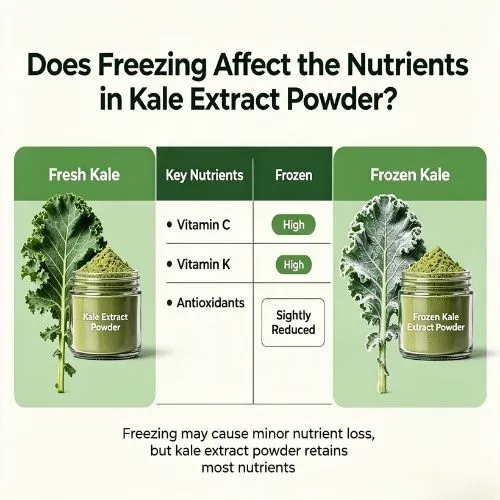
Does Freezing Affect the Nutrients?
When properly stored, freezing has minimal impact on many nutrients. Important compounds found in kale extract may remain stable, including:
Natural antioxidants
Chlorophyll
Carotenoids
Polyphenols
Certain vitamins and minerals
However, prolonged exposure to moisture, light, or repeated temperature changes can gradually reduce product quality.
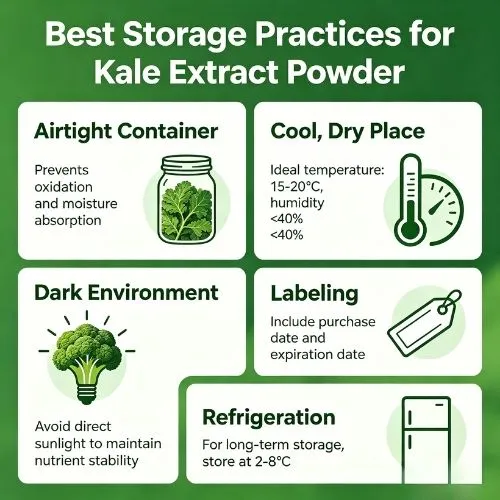
Best Storage Practices for Kale Extract Powder
For commercial and personal use, these storage conditions are recommended:
|
Storage Factor |
Recommendation |
|
Temperature |
Cool, dry place below 25°C |
|
Humidity |
Low humidity environment |
|
Light |
Keep away from direct sunlight |
|
Container |
Airtight and moisture-proof |
|
Freezing |
Optional for long-term storage |
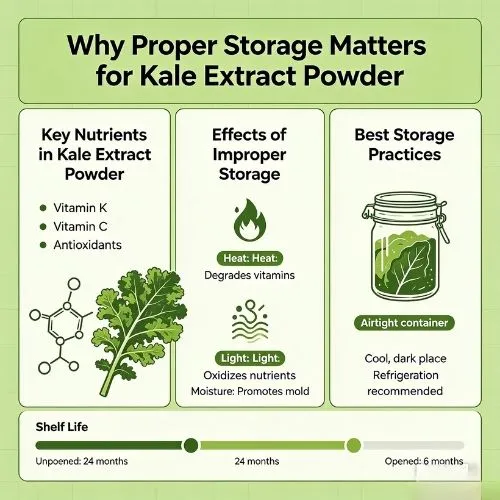
Why Proper Storage Matters
Proper storage helps maintain:
Nutritional value
Color and appearance
Antioxidant activity
Product stability
Shelf life and freshness
This is especially important for manufacturers using kale extract in:
Dietary supplements
Capsules and tablets
Functional beverages
Smoothie powders
Nutritional formulations
Sports nutrition products
Conclusion
Freezing kale extract is a scientifically proven way to keep it fresh, as long as the right steps are taken to prepare it, package it, and keep the temperature stable. Business people who buy things have to compare freezing to other ways like cooling and freeze-drying based on business needs, cost structures, and application needs. To be successful, you need to work with service providers who have the right credentials, know what they're doing, and have strict quality controls. Spending money on the right way to store things will pay off in the form of stable product performance, following the rules, and less waste from ingredients breaking down.
Partner with Yangge: Your Trusted Kale Extract Supplier
Yangge Biotech Co., Ltd. sells high-quality organic kale extract that makes it easier to store and makes sure that the quality of your products is consistent. We have 5 tons of KOSHER/USP grade product in stock right now. Companies that make food, drinks, and health aids use it because they need a steady supply and the best technical performance. With low-temperature solvent extraction, we can keep the vitamin's work while making it completely water-soluble, which makes it easy for the body to swallow. These are important perks for using healthy drinks and supplements.
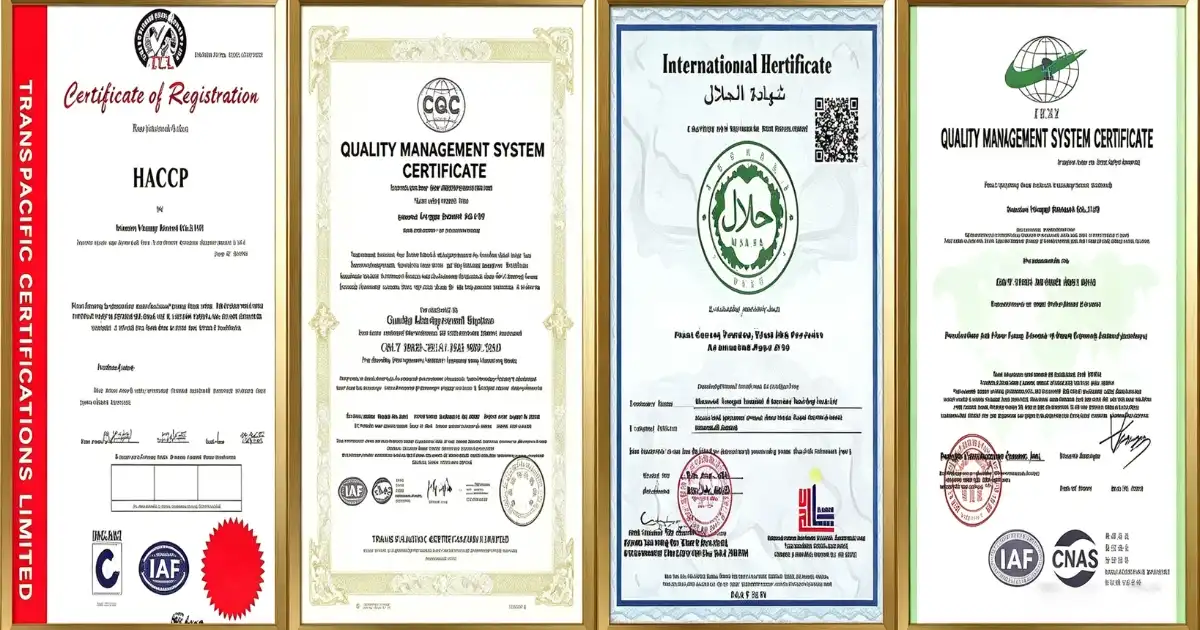
Our non-irradiated, GMO-free extract doesn't have any extra chemicals, pesticides, or allergens added to it, so it follows all international laws. Our commitment to quality is backed by ISO, HACCP, Kosher, and Halal standards. Tracking from farm to table makes sure that the whole supply chain is clear. Your OEM needs for superfood mix powders, pills, tablets, and gummies can be met, and we're here to help you 24 hours a day, seven days a week. Contact Us to info@yanggebiotech.com right now to find out how working with a business that specializes in the extract can help you make your product better and make you more competitive in the market.
FAQ
Q: Can we get some samples to test before purchasing?
A: Of course, we can provide free samples of 20 to 100 grams, but the shipping cost is at the customer's expense. The shipping cost can be deducted from the next order, or the samples can be sent through your courier account.
Q: Do your products have relevant certifications?
A: Yes, our products are certified for HALAL, ISO, HACCP, Kosher, and other certifications.
Q: What is the minimum order quantity (MOQ)?
A: Small batches of samples can be customized according to your requirements.
Q: Do you offer OEM and ODM services? Can the formula be customized based on our own?
A: Of course, we provide ODM and OEM services to many customers. Our product range includes softgels, capsules, tablets, sachets, granules, and private label services. Simply contact us and let us know your requirements. Our experienced R&D team can also develop new products with specific formulas.
Please contact us to design your own branded products.
Q: How do you handle quality complaints?
A: First, we have a comprehensive quality control SOP. We provide authoritative third-party inspection reports for almost all products before shipment to minimize the possibility of quality issues. Second, we have a comprehensive return and exchange procedure. If there is a genuine quality dispute, we will strictly follow the SOP.
Q: How do you ship? How long does delivery take?
A: For small orders, we typically use DHL, UPS, EMS, FedEx, or TNT. Delivery typically takes 3-7 days. We also offer air and sea freight services. We have a strong freight forwarding team and can provide you with a one-stop service, including DDP and DDU.
Q: What are your payment terms?
A: 100% prepayment, payable by T/T, Western Union, MoneyGram, or PayPal.
Q: What is the shelf life of your products?
A: 2 years with proper storage.
References
1. Sikora, E., & Bodziarczyk, I. (2012). Composition and antioxidant activity of kale (Brassica oleracea L. var. acephala) raw and cooked. Acta Scientiarum Polonorum Technologia Alimentaria, 11(3), 239-248.
2. Martínez-Hernández, G. B., Artés-Hernández, F., Colares-Souza, F., Gómez, P. A., García-Gómez, P., & Artés, F. (2013). Innovative cooking techniques for improving the overall quality of a kailan-hybrid broccoli. Food and Bioprocess Technology, 6(8), 2135-2149.
3. Olsen, H., Aaby, K., & Borge, G. I. A. (2010). Characterization and quantification of flavonoids and hydroxycinnamic acids in curly kale (Brassica oleracea L. convar. acephala var. sabellica) by HPLC-DAD-ESI-MSn. Journal of Agricultural and Food Chemistry, 58(7), 4026-4035.
4. Turkmen, N., Sari, F., & Velioglu, Y. S. (2005). The effect of cooking methods on total phenolics and antioxidant activity of selected green vegetables. Food Chemistry, 93(4), 713-718.
5. Koh, E., Surh, J., & Kim, Y. S. (2014). Effect of freezing temperature on antioxidant activities of vegetables. Preventive Nutrition and Food Science, 19(4), 306-312.
6. Favell, D. J. (1998). A comparison of the vitamin C content of fresh and frozen vegetables. Food Chemistry, 62(1), 59-64.

Based on your location and order quantity, you will have the opportunity to receive a limited time free shipping promotion!
Who we are
Popular Blogs